
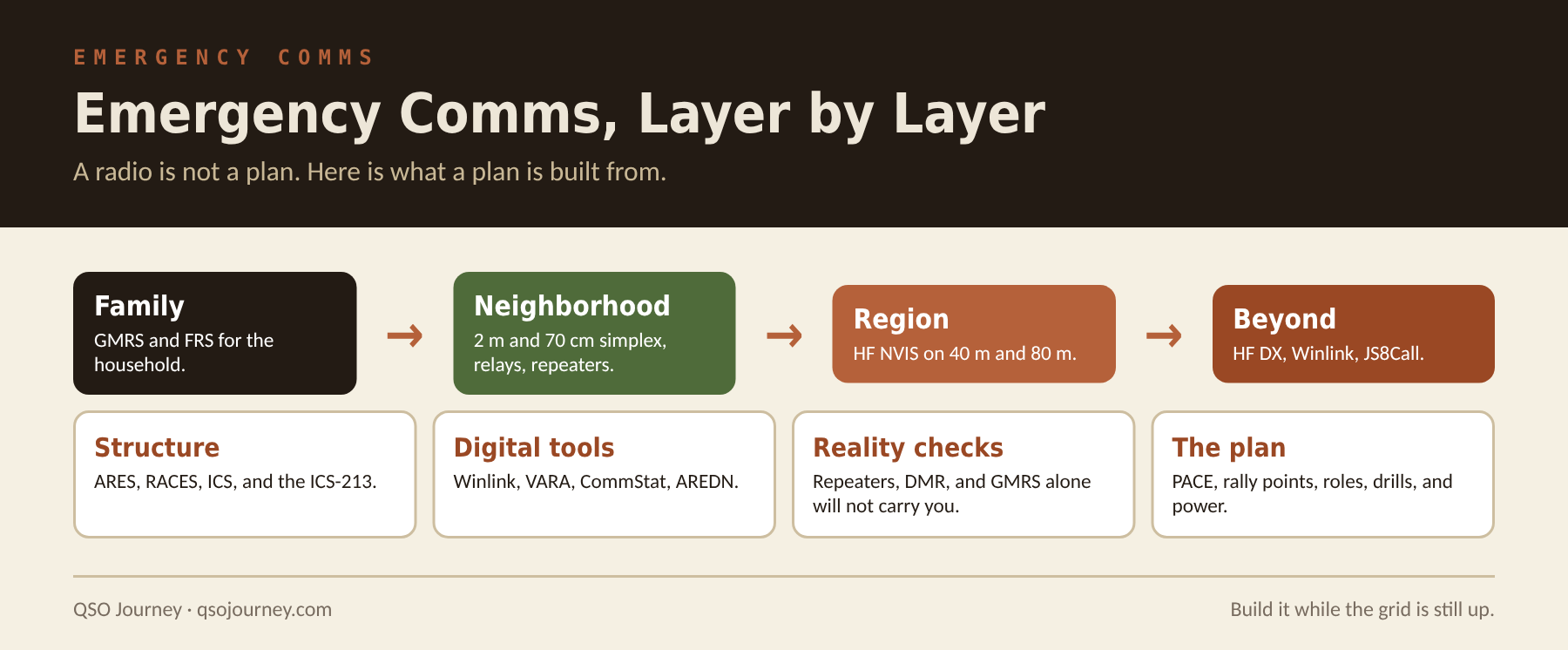
Owning a radio is not an emergency communications plan. Real EmComm capability takes structure, training, and an honest understanding of what each system can and can’t do when it actually matters. Here’s what that looks like in practice.
The Building Blocks
- Why Ham Radio Matters: A Hobby, a Lifeline, and a Century of Proof, what ham radio does for you, your family, and your community, plus a century of times it kept people connected when everything else failed.
- What EmComm Actually Is, and Why It Needs Both VHF/UHF and HF
- Emergency Alert System and Wireless Emergency Alerts: How They Work, and Ham Radio’s Role
- ARES vs RACES: How Emergency Communications Are Actually Organized
- ICS-213 and Message Formats: How EmComm Traffic Actually Gets Passed
- FEMA ICS Courses for Hams: IS-100, 200, 700, and 800 Explained, what each free FEMA course covers, which ones ARES requires, and direct links to every course and exam.
Digital EmComm Tools
- What Is Winlink, and Why EmComm Operators Rely On It
- Setting Up Winlink: RMS Express, VARA, and Sending Your First Message, the hands-on setup guide that follows the overview.
- VARA vs. PACTOR: Choosing a Winlink Modem
- What Is CommStat? The Complete Guide to JS8Call’s Group Status Board, how StatReps turn JS8Call traffic into a live status board, how AmRRON, MAGNET, and GhostNet use it, and how the versions differ.
- AREDN Mesh Networking: Building a Ham Radio Internet
Volunteer Roles
- SkyWarn and Weather Spotting: How Ham Radio Ties Into Storm Reporting
- What Is AMRRON? The American Redoubt Radio Operators Network Explained
Reality Checks: What Won’t Save You
- DMR Talkgroups Are Great Fun, But Don’t Mistake Them for a SHTF Plan
- Why a Single-Band Radio Isn’t Enough for SHTF
- GMRS Is Great for Family Comms, But It Won’t Save You When SHTF
- Repeaters: How They Work, Why They’re Great, and Why They’re Not a SHTF Plan
Choosing the Right Tool
- GMRS vs. Amateur Radio VHF/UHF vs. HF: Picking the Right Tool
- MURS vs GMRS vs FRS: Which One (or Combination) Actually Fits Your Family
- GMRS Repeaters, and How They’re Different From Ham Repeaters
- The Reality of Off-Grid Mesh Comms: Meshtastic, LoRa
- What Is ATAK (CivTAK)? Tactical Mapping and Team Awareness Explained for Hams
- Tactical Team Comms vs. SHTF Comms
- Private, Secure, or Obscure? What Part 97 Actually Lets You Do With Your Comms
- What Is a MARS/CAP Mod? How It Works and the Legal Reality
- Setting Up a Peltor ComTac Headset with Your Radio for a Tactical Kit
- The BTECH UV-PRO + UV-50PRO: A great pairing
- Ailunce HD2 Review: A Great EmComm Handout Radio, With a Warning
Where to Go Next
New to the hobby? Start with Start Here: A New Ham’s Guide to Getting on the Air. For the operating skills EmComm builds on, see Getting On The Air: Modes, Operations, and Making Contacts.
Related Reading: GMRS and Mesh in a Preparedness Plan
- Running GMRS and Ham Radio Together: Legal Lines and Practical Setups
- Mesh Networking: Meshtastic, MeshCore, and AREDN, the complete guide to getting mesh gear running and where it realistically fits in a preparedness plan.
Related Reading: Building a Real Communications Plan
- Start This Week: 10 SHTF Prep Steps You Can Knock Out in Seven Days, a printable infographic and checklist for getting your radios, water, food, cash, and family plan squared away in one week.
- Building a PACE Communications Plan for Grid-Down Scenarios, the complete framework with a linked series covering specific scenarios, family roles and drills, and go-bag gear.
- The Pentagon Wants Bases to Last 90 Days Off-Grid. What’s Your Plan?, what the Pentagon’s FORTRESS initiative means for civilians, and how GMRS, VHF/UHF, and HF fit into a community comms plan.
- Your Comms Plan for Every Disaster Scenario, a single reference covering wildfire, flood, winter storm, hurricane, earthquake, tornado, house fire, grid cyberattack, pandemic, hazmat, and civil disturbances.
- What a Real SHTF Communications Plan Actually Looks Like
- The Key Parts of a SHTF Communications Plan: PACE, Rally Points, and Roles
- Training Your Family or Group on the Communications Plan
- Documenting Your SHTF Communications Plan: The One-Page Reference Everyone Needs
- The 3-3-3 Radio Plan: A Simple Plan for SHTF Communications
- The Frequencies Every Ham Radio Should Have Programmed for SHTF, the specific NOAA, ham, GMRS, MURS, CB, and HF frequencies worth having on hand.
- When the Repeater Goes Silent: Your Backup Plan for Grid-Down Comms, simplex relays, cross-band repeat, and NVIS options for when the repeater isn’t there.
- Human Relay Networks: Moving Traffic Across Town on Simplex, mapping who hears whom, picking relay stations, and passing messages cleanly when the repeater is down, with a printable relay log.
- What Is an HF NVIS Regional Net?, why an NVIS net is a better regional test than a repeater net, with modes, antennas, radios, and four station builds.
- Your Repeater Is Not a Plan: Why HF NVIS Matters Just as Much, how I layer VHF/UHF and HF NVIS when the repeaters go dark, with one bridge station tying the two together.
- Why HF Radio Matters Most When the Grid Goes Down, using NVIS for your region and HF DX to poll other states and continents for news while you bug in, with a printable poll sheet and CommStat for group status.
- Fox Hunting in Ham Radio: How It Works, and How to Be Harder to Find, a newcomer’s look at radio direction finding, why HF NVIS is so hard to direction find, and the EMCON habits that shrink your footprint, with a printable field card.
- How a Nuclear Blast Impacts HF, VHF, and UHF: Lessons from Operation Starfish Prime, what Operation Starfish Prime showed about EMP, and how each band’s equipment and propagation actually fares afterward.
- What to Actually Store in a Faraday Cage: A Realistic Radio Gear List, a budget-honest breakdown of handhelds, an HF radio, antennas, batteries, and documentation worth shielding.
- Backup Power for the Shack: Generators, Solar, and Batteries for Extended Outages, keeping the radios in this plan actually running past the first day.
- Packing an FTX-1 Go-Bag: What I Actually Carry, a real-world example of the go-bag gear this plan calls for.
- My Yaesu FTX-1 Go-Box, a watertight hard case holding the FTX-1 Optima, the SPA-1 amp, and antennas for HF through UHF.
- My Updated Yaesu FTX-1 Optima Go-Box, the same box with MOLLE pouches so antennas, coax, power, and a speaker ride on the case.
- SHTF Scenario: The Road Ends Before the Journey Does, a 140-mile bug-out scenario where the road gives out before the trip does, plus my answer: a Ténéré 700, a staged loadout, and the FTX-1 go-box riding on the back.
- Grab and Go Box: 2m/70cm Family and Emergency Comms Kit, a self-contained Pelican case pairing a BTECH UV-50PRO base station with four APRS handhelds for family comms.
- Building an EmComm Go-Kit Inventory You’ll Actually Update
- Setting Up a Neighborhood Radio Watch Program
- What Is GhostNet? S2 Underground’s Off-Grid HF Comms Plan Explained
- MAGNET: A Nationwide HF Network for Mutual Assistance Groups, a well-run digital HF net connecting local MAGs across the US and Canada.