

If you’ve ever seen a Midland or BaoFeng-adjacent radio at a big box store and wondered “wait, do I need a license for this?” The answer is usually yes, and the service you’re looking at is GMRS. This guide covers what GMRS actually is, what it costs, how far it really reaches, and what to buy first.
What Is GMRS, Really?
GMRS (General Mobile Radio Service) is a licensed UHF radio service built for short-to-medium range voice communication: family outings, off-roading convoys, farm and ranch use, and increasingly, emergency preparedness. It shares frequencies with FRS (Family Radio Service, the license-free walkie-talkies sold everywhere), but GMRS unlocks meaningfully more: higher power output (up to 50 watts on some channels, versus 2 watts max on FRS), removable/external antennas, mobile and base station radios, and, critically, access to repeaters.
MURS, if you’ve heard the term, is a different license-free VHF service with its own five channels. It’s worth knowing about, but it doesn’t offer repeater access and isn’t as widely adopted in the prepper/off-road space, so this guide focuses on GMRS. If you’re weighing MURS against GMRS and FRS for your specific situation, I break that comparison down in MURS vs GMRS vs FRS: Which One (or Combination) Actually Fits Your Family.
The reason GMRS is such a good entry point is that it requires no test. You pay a fee, you get a call sign, and your entire immediate family is covered under one license. That’s a dramatically lower barrier than amateur radio, which makes GMRS the natural first step for households that want reliable radio comms without committing to a study guide first.
That easy entry has a tradeoff, and I get into it in Where Are the Young Hams? Not at Your Club Meeting.
The License: What It Actually Costs
As of 2026, a GMRS license costs $35 for a 10-year term, paid directly to the FCC. There is no exam. The license covers you and your immediate family (spouse, kids, grandkids, parents, siblings, in-laws) regardless of their age, all operating under your call sign with individual unit numbers (Unit 1, Unit 2, etc.).
To apply:
- Register for an FRN (FCC Registration Number) at the FCC’s CORES system; this is free.
- Apply for the GMRS license itself through the FCC’s ULS (Universal Licensing System), using FCC Form 605.
- Pay the $35 fee online.
- Your license and call sign typically arrive within a few business days, though it can occasionally take longer.
- Identify with your FCC call sign at the end of a transmission (or a series of transmissions), and at least every 15 minutes during a long one.
- No encryption or scrambling of GMRS transmissions, ever. This trips up a lot of preppers who assume they can run private, encoded traffic on GMRS. You can’t, by rule.
- No business use. GMRS is licensed for personal/family use, not commercial dispatch.
- Stay within the power limits for each channel (interstitial channels are capped lower than the main GMRS channels).
- Find local repeaters through public GMRS repeater directories (searchable by location).
- Program your radio with the repeater’s output/input frequency pair and the correct CTCSS/DCS tone the repeater requires to open up (this is often the detail people miss: without the right tone, the repeater won’t repeat you).
- Listen first. GMRS repeater communities have informal norms, and monitoring for a while before transmitting will save you some awkwardness.
- GMRS Channel Guide: What Each of the 30 Channels Is Actually For
- GMRS Licensing 101: Cost, Application, and What It Actually Covers
- FRS vs. GMRS vs. Ham Radio: Which License (If Any) Do You Need
- GMRS Repeaters, and How They’re Different From Ham Repeaters
- GMRS Repeater Etiquette: Courtesy Tones, Timeouts, and Not Being That Guy
- FCC Cracks Down on Linked GMRS Repeaters: What the Notice of Violation Means for You
- GMRS Base Stations: Building a Fixed GMRS Setup at Home
- Midland MXT275 Review: A Popular GMRS Mobile Radio
- BTECH GMRS-V2 Review: A Budget GMRS Handheld Worth a Look
- Running GMRS and Ham Radio Together: Legal Lines and Practical Setups
- Wouxun UV-9G Review: Our Family’s GMRS Handheld
- GMRS Scanning and Monitoring: What You Can (and Can’t) Legally Do
- Installing a GMRS Mobile Radio in Your Vehicle: A Step-by-Step Guide
- GMRS for RVers and Overlanders: A Practical Setup Guide
- GMRS Is Great for Family Comms, But It Won’t Save You When SHTF
- The Frequencies Every Ham Radio Should Have Programmed for SHTF, including the GMRS channels and repeater pairs worth having on hand.
- Can You Encrypt or Scramble a GMRS Radio? The Legal Reality
- Setting Up a Family GMRS Base Station Net Schedule
- GMRS Range Expectations: Marketing Claims vs Reality
- Combining GMRS and Ham Radio on a Road Trip
- Business Band Radio vs GMRS: Why They’re Not Interchangeable
One tip that saves people real frustration: CORES and ULS are two separate logins on two separate FCC systems. Set aside 30 minutes and expect a small amount of bureaucratic friction; it’s not complicated, just clunky.
Legal requirements once you’re licensed:
Realistic Range Expectations
This is where most GMRS marketing oversells reality, so let’s be blunt about it.
Handheld-to-handheld, simplex (no repeater): In flat, open terrain, expect 1–3 miles. In suburban terrain with houses and trees, 0.5–1 mile is more typical. In hilly or heavily wooded terrain, or between floors of a building, it can drop to a few hundred yards. Radio waves at UHF frequencies are line-of-sight: hills, ridgelines, and dense buildings block them.
Handheld-to-mobile or mobile-to-mobile: A mobile radio with a proper roof-mounted antenna and more height above ground will noticeably outperform handhelds, often 5–15 miles depending on terrain, because antenna height matters more than wattage.
Repeater-assisted: This is where GMRS gets genuinely useful for a family plan. A well-sited repeater on a hill or tower can extend your effective range to 20–40+ miles for handhelds that would otherwise only reach a mile or two.
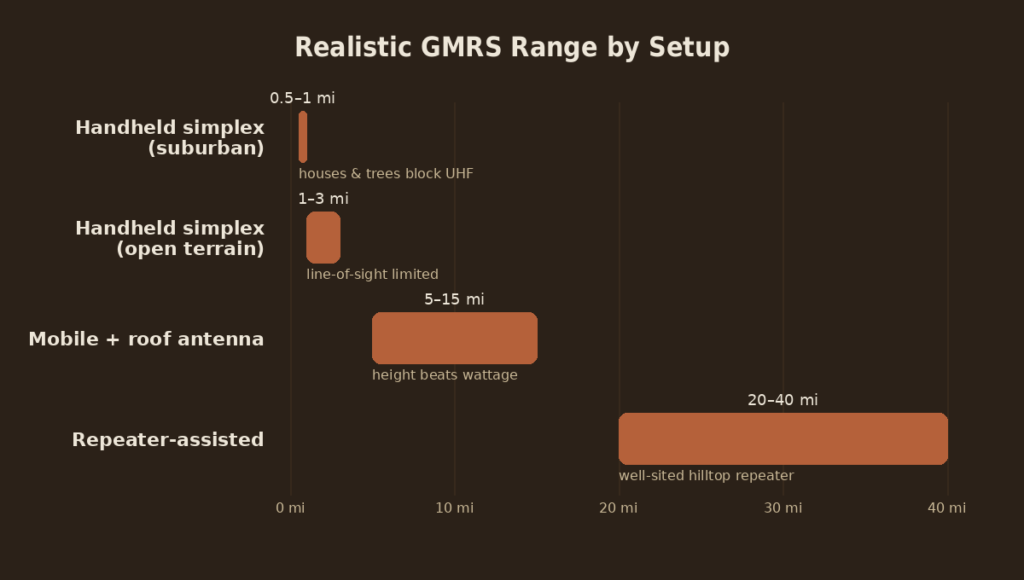
The single biggest lever for range isn’t wattage: it’s antenna height and terrain. A 5-watt handheld talking to a repeater on a hilltop will out-perform a 50-watt mobile radio trying to punch through a ridge in simplex mode.
Repeaters 101
A repeater is a station, usually on high ground, that receives a signal on one frequency and instantly retransmits it on another, extending everyone’s effective range within earshot of that repeater. GMRS repeaters are increasingly common, and a growing number are linked into networks (like MyGMRS-listed repeaters) that you can find by ZIP code.
To use one:
Some repeater owners require registration or membership; many are open. Either way, treat repeater access as a shared resource, not a guarantee. And repeater access is not unconditional: the FCC’s first Notice of Violation over internet-linked GMRS repeaters is a good reminder that a single, unlinked repeater on a hilltop is fine, but tying multiple repeaters together over the internet is not.
Gear: What to Actually Buy
Budget handheld (start here): A basic 5-watt GMRS handheld from Midland, BTECH, or similar. This is enough for most family/short-range use and lets you learn the service before spending more. Skip anything advertising “36-mile range”: that number assumes ideal conditions you will basically never have.
Mobile radio: If you drive off-road, overland, or want a fixed base station for the house, a mobile GMRS radio (typically 15–50 watts) paired with an external antenna is the biggest single upgrade in real-world range. This is usually the second purchase, after you’ve confirmed GMRS is useful for your situation.
Base station / repeater: For a homestead, retreat property, or neighborhood comms group, a dedicated base station, or even your own low-power repeater, is the top tier. This is a bigger investment in both money and setup knowledge, and it’s usually where GMRS starts to overlap with the amateur radio skill set.
Where GMRS Fits Into a Bigger Plan
GMRS is an excellent Alternate or Contingency layer in a family communications plan: it’s fast to get licensed, the gear is inexpensive, and non-hams in your household can use it immediately. Its limits (no encryption, shorter range without repeaters, reliance on commercial infrastructure for repeater internet linking in some setups) are exactly why it usually isn’t the only layer worth having.
If you want to see how GMRS slots in alongside amateur radio and non-radio options inside a full family emergency comms plan, that’s covered in the PACE planning guide on this site. For the radio itself, see Best GMRS Radios for Families, GMRS Antennas, and Finding and Programming GMRS Repeaters.
Read More on GMRS
Running a Wouxun KG-1000G or another GMRS mobile? See the GMRS mobile field card for a quick reference on repeater channels, VFO mode, power, and scan.