

If GMRS is the on-ramp, amateur radio is the highway. This guide walks through why it’s worth the extra step, exactly what’s tested on the entry-level Technician exam, how to study for it, and what to do once you pass.
Why Go Ham If GMRS Already Works?
GMRS covers a lot of ground for family and short-range use, but it has hard ceilings: no HF (high-frequency, long-distance) privileges, no encryption, and a fixed set of channels shared with everyone else on GMRS. Amateur radio removes those ceilings:
- Distance. With a General or Extra class license and an HF radio, you can talk hundreds or thousands of miles without relying on the internet, cell towers, or a repeater someone else owns.
- Flexibility. Hams can build, modify, and experiment with equipment in ways GMRS licensees can’t: different modes (digital, Morse, satellite, packet), different bands, different antenna designs.
- Community and skill-building. The ham radio world has an enormous, active community of clubs, nets, and mentors (“elmers”) that GMRS doesn’t have in the same density.
None of this makes GMRS obsolete; a lot of experienced preppers run both. But if you want range and flexibility that don’t depend on someone else’s repeater, ham radio is the path.
The Technician License: What’s Actually Tested
Technician (often called “Element 2” or “Tech”) is the entry-level U.S. amateur radio license, and it’s the one nearly everyone starts with. Here’s what to know for 2026:
- A new question pool took effect July 1, 2026 and runs through June 30, 2030. It contains 409 questions (down slightly from 412 in the prior pool), with roughly two dozen new questions and about 155 modified from the previous cycle, including expanded coverage of digital modes.
- Your actual exam pulls 35 questions, one weighted-random question from each of 35 question groups spanning ten subject areas (FCC rules, operating procedures, radio wave propagation, station equipment, safety, and more).
- Passing score is 26 out of 35 (about 74%).
- No Morse code requirement; hasn’t been for years.
- The exam is multiple choice, administered by volunteer examiners (VEs), often at a local club or a scheduled test session, and increasingly available online through remote-proctored sessions too.
If you already own an older study guide, double-check its edition: anything based on the 2022–2026 pool is now out of date for exams taken on or after July 1, 2026.
How to Study (and How Long It Takes)
Most people with no prior electronics background can prepare for the Technician exam in 2–6 weeks of casual study, faster if you’re already comfortable with basic electrical concepts.
Study paths that work:
- Practice-question apps and sites (HamStudy and similar) that use the actual current question pool and track which subelements you’re weak on. This is the fastest path for most people: you’re literally studying from the same pool your exam draws from.
- A study guide/manual for readers who prefer to understand the “why” behind each answer rather than pattern-matching questions. Make sure it’s the current 2026–2030 edition.
- A one-day cram class, often run by local clubs, that walks a room through the material and administers the test at the end of the same session.
Whichever path you choose, confirm it’s built on the 2026–2030 pool before you start; this is the single most common mistake beginners make right now, since a lot of older content and used study guides are still floating around.
Your First Radio
Resist the urge to buy anything expensive before you’re licensed and have a sense of what you’ll actually use.
For most new Technicians: A basic dual-band (2m/70cm) handheld transceiver is the standard first radio. It’s inexpensive, gets you onto local repeaters immediately, and is enough to participate in nets, simplex chats, and most Technician-class privileges.
If you know you want a fixed base setup from day one: A dual-band mobile radio at home with a simple external antenna will outperform a handheld significantly and is a reasonable second step once you’ve confirmed you’ll stick with the hobby.
Don’t buy an HF radio yet: Technician-class HF privileges are limited, and HF gear is a General-class purchase for most people.
The Path to General and Extra
Technician gets you VHF/UHF privileges and a small sliver of HF access. If long-distance HF communication is the goal:
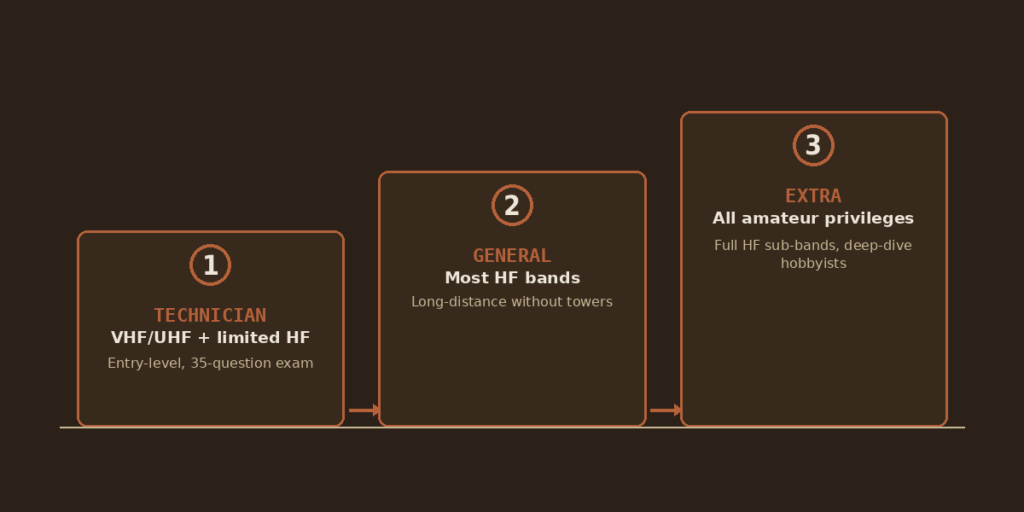
- General class opens the majority of HF bands and is genuinely the license most preppers and emcomm-focused hams eventually want, since HF is what keeps working when local infrastructure doesn’t.
- Amateur Extra unlocks the remaining HF sub-bands and is mostly pursued by people who want the full privilege set or plan to get deeply technical (contesting, experimentation, VE credentialing).
Many people take Technician and General back-to-back at the same test session once they’ve decided ham radio is for them, since the incremental study jump from Tech to General is smaller than starting from zero.
Find a Club (This Is the Part People Skip)
The single biggest predictor of whether someone sticks with ham radio isn’t the gear: it’s whether they connect with a local club or an experienced ham willing to mentor them (an “elmer,” in ham slang). Clubs typically offer:
- Free or low-cost testing sessions
- Help programming your first radio (this trips up more beginners than the exam does)
- Local nets you can check into to practice actually talking on the radio
- A built-in emcomm/ARES connection if that’s a direction you want to go
Search for a club near you before you even sit the exam; many will let you sit in on a meeting as a guest, and some run their own Technician classes.
What’s Next
Once you’re licensed, the natural next step for a preparedness-minded ham is figuring out where amateur radio fits alongside GMRS and non-radio options in an actual family communications plan, and that’s covered in our PACE planning guide.
Read More on Getting Licensed
- Getting Your Ham Radio License: Technician, General, and Extra Explained
- General Class Deep Dive: What Changes When You Upgrade
- Extra Class Deep Dive: Is the Upgrade Worth It?
- Technician’s Expanded HF Phone Privileges: What’s Actually Been Proposed
- Finding a VE Test Session Near You (and What to Bring)
- VE Session Day-Of: What Actually Happens During Your Exam
- How ExamTools and Other Online VE Platforms Work Behind the Scenes
- How to Become a Volunteer Examiner: The Process, Start to Finish
- Remote vs In-Person VE Testing: What’s Actually Different
- Choosing a Vanity Call Sign: Rules, Costs, and How I Picked Mine
- Renewing Your Ham Radio License: What to Know Before It Expires
- Clubs and Nets: Finding, Joining, and Running Them, the complete guide to finding a club, running a good net, and getting involved.
- Getting Kids and Teens Licensed: Programs, Camps, and What Actually Works
- Getting Your Family Involved in Ham Radio
- What to Expect at Your First Hamfest
- The Petition That Could Finally Give Technicians a Reason to Explore HF
- Understanding FCC Enforcement: What Actually Happens If You Violate Part 97
- What Happened to Novice and Advanced Class Licenses?
- Understanding Reciprocal Callsigns: /W, /VE, and Portable Designators