

Part of our Emergency Communications and Preparedness guide.
I recently built a presentation to explain what an HF NVIS regional net is and why I think every group that cares about regional comms should run one. This is the written version. The short pitch: a repeater net proves everyone can reach one machine on a hill. An NVIS net proves every station can reach the region on its own, with no tower, no linking, and no shared point of failure.
What NVIS Is
NVIS stands for Near Vertical Incidence Skywave. You send an HF signal almost straight up (roughly 60 to 90 degrees) and the ionosphere returns it across the area around you, like a sprinkler. The coverage is about 300 miles in every direction with no skip zone, and because the signal arrives from overhead, mountains and canyons do not get in the way.
It only works below the critical frequency, the highest frequency the ionosphere will reflect straight back down. In practice that means roughly 2 to 10 MHz, which for us is 80, 60, and 40 meters. I go deeper on the antenna side of this in NVIS vs. Vertical DX Antennas.
The Gap NVIS Fills
A normal HF station often hears the next state better than the next county. Ground wave fades out after a few tens of miles. A low-angle antenna sends its signal toward the horizon, so the first place it comes back down is hundreds of miles away. Everything in between is the skip zone. NVIS drops your signal right into that gap, which is exactly where your regional net lives.
A side effect I didn’t expect: that same overhead geometry makes an NVIS station much harder to direction find than a VHF station. I dig into why in Fox Hunting in Ham Radio: How It Works, and How to Be Harder to Find.
Picking a Band by Time of Day
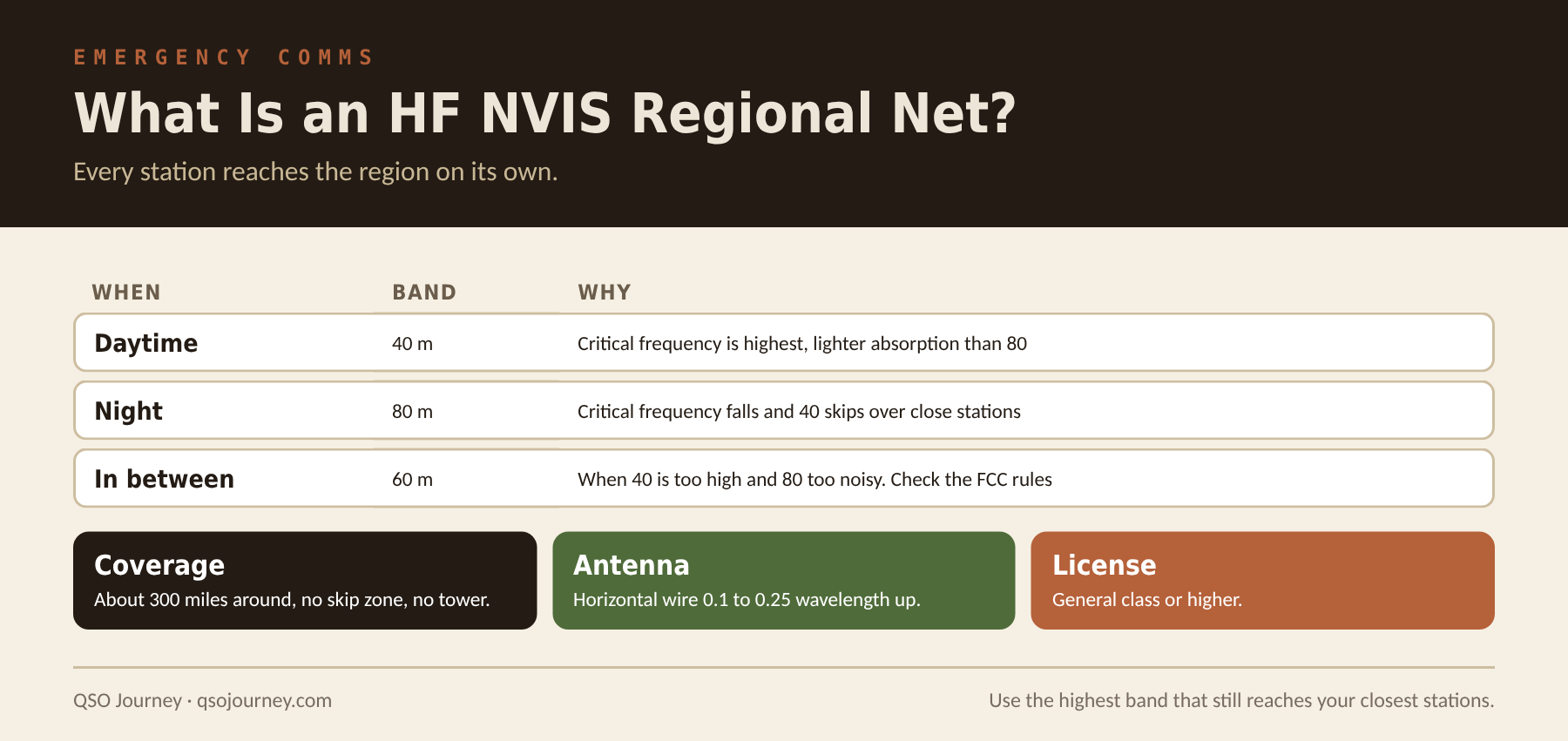
- Day, 40 meters: the critical frequency is at its highest and daytime absorption is lighter than on 80.
- Night, 80 meters: the critical frequency falls after dark and 40 starts skipping over nearby stations.
- In between, 60 meters: useful when 40 is too high and 80 is too noisy. Check the current FCC power and frequency rules first.
My rule of thumb is to use the highest band that still reaches your closest stations. If the close-in stations vanish while the distant ones get louder, the band has gone long and it is time to drop down. Every net plan needs a primary and an alternate.
Why an NVIS Net Is a Better Regional Test Than a Repeater Net
I like repeaters. They are easy, consistent, and open to every licensee. But they share a single point of failure, which I covered in When the Repeater Goes Silent. Here is how the two kinds of net compare.
| VHF/UHF repeater net | HF NVIS net | |
|---|---|---|
| Infrastructure | Tower, site power, often internet linking | Nothing between the stations |
| Coverage | Line of sight to the repeater | About 300 miles around, no skip zone |
| Terrain | Mountains and canyons shadow stations | Signal arrives from overhead |
| When it fails | Repeater down, net down | One station down, net carries on |
| What it tests | Access to one machine | Each station’s antenna, power, and operator |
| Conditions | Consistent day to day | Change with time of day and solar activity |
| Cost of entry | Technician license, handheld | General license, HF radio, wire antenna |
The last two rows are the honest costs of NVIS. It asks more of the operator, and you need a General class license or higher. If you are not there yet, start with Getting Licensed.
What 300 Miles Looks Like From My Station
I am in Maricopa, Arizona (grid DM33xb). Draw a 300 mile circle around my station and it takes in nearly all of Arizona: Phoenix (27 miles), Tucson (85), Flagstaff (150), Yuma (152), and Kingman (187), plus Las Vegas (278) and San Diego (297). El Paso, Albuquerque, and Los Angeles sit just outside. Those are straight-line distances, and real coverage shifts with band, time of day, and solar conditions, but compare that circle to the few tens of miles a single mountaintop repeater covers and the case makes itself.

What Fails First in a Wide-Area Event
- Grid power drops. Homes and repeater sites go dark at the same time.
- Backup runs down. Site batteries and generators last only as long as their charge and fuel.
- Links go quiet. Internet and RF links fail, and wide-area repeater systems split apart.
- The site is lost. Wildfire, wind, or ice can take the tower or close the road to it.
A repeater net depends on that whole chain. An NVIS net needs a radio, a battery, and a wire at each station, and nothing else.
Where NVIS Sits in a PACE Plan
NVIS is not a replacement for repeaters. It is the layer underneath them. Here is one example of how it fits a PACE communications plan:
- Primary: local and linked repeaters. Everyday nets, fast and clear.
- Alternate: VHF/UHF simplex. Works without the repeater, but only across town.
- Contingency: an HF NVIS net. Regional reach with no infrastructure, SSB first and then a digital mode.
- Emergency: low-power HF digital on battery at set times, relayed by any station you can hear.
A plan only counts if every layer has been tested, which is the whole reason to run an NVIS net before you need it. For how the layers hand off to each other when the repeaters go dark, including a bridge station that ties HF to local handhelds, see Your Repeater Is Not a Plan.
Not everyone in a group will have HF. The NVIS stations still need a way to reach members on 2 meters once the repeater is down, and that’s where a simplex relay network comes in. I cover how to set one up in Human Relay Networks: Moving Traffic Across Town on Simplex.
Modes That Work on an NVIS Net
Start with voice, then move to a digital mode that still gets through when voice is marginal.
| Mode | Best for | Notes |
|---|---|---|
| SSB voice | Roll call and fast traffic that everyone can join | 80 and 40 meters. Needs the strongest signal of any mode here, so 100 watts helps. |
| JS8Call | Keyboard chat, relays, and messages left for later | Decodes well below the noise at low power. Heartbeats show who hears whom. 7.078 and 3.578 MHz. |
| Winlink | Email and forms such as the ICS-213 | VARA HF or ARDOP, peer to peer or through a gateway. Error-corrected delivery. |
| fldigi (NBEMS) | Bulletins and forms sent to many stations at once | MFSK, Olivia, or PSK with flmsg. One station sends and everyone copies. |
| FT8 | Propagation check before the net | Shows in minutes whether the band is open close in. It does not carry messages. |
If JS8Call is new to you, read What Is JS8Call? and then Getting Started with JS8Call. For the bigger picture on choosing between voice and digital, see FT8 vs SSB vs CW.
The Net Software: CommStat, VarAC, and FLDIGI
Three tools turn a digital net into tracked status, distributed files, and structured reports.
- CommStat is a JS8Call companion app for tracking operator status and check-ins. It connects directly to JS8Call and monitors group activity in real time. One screen shows a color-coded status report grid, the live JS8Call traffic, a map of reporting stations, and the group messages.
- VarAC handles file distribution. Leadership passes files and tasking to targeted operators through the VarAC BBS system over the VARA HF modem.
- FLDIGI and FLMSG carry SitRep forms and structured traffic over modes like PSK31, RTTY, and Olivia. Install the HTML forms into your FLMSG CUSTOM folder. The SitRep form is only used to send reports to the net.
For a deeper look at CommStat itself, including how StatReps work, the internet backbone, and how the versions differ, see What Is CommStat? The Complete Guide to JS8Call’s Group Status Board. I keep a running list of the other programs I rely on in Ham Radio Apps and Software Worth Having.
Antennas: Horizontal and Low
This is the opposite of what you build for DX. You want a horizontal wire about 0.1 to 0.25 wavelength above the ground, so the ground acts as your reflector and most of the energy goes straight up.
| Band | Height | Dipole length |
|---|---|---|
| 40 meters | 13 to 34 ft | About 65 ft |
| 80 meters | 26 to 65 ft | About 125 ft |
In the field, 10 to 15 feet still works on both bands. You give up some efficiency and keep the high-angle pattern. An inverted V with the apex at 20 to 30 feet needs only one support. For more on why higher is not always better, see Antenna Height: How Much Does It Actually Matter.
Good choices: a low dipole or inverted V, an 80/40 fan dipole on one feedline, an end-fed half-wave strung low and level, or crossed dipoles on one mast (the classic military NVIS layout).
Poor choices: quarter-wave verticals and upright mobile whips (both have a null pointing straight up, right where you need signal), dipoles a half wavelength off the ground or higher, and anything built for low-angle DX.
The military solves the same problem with purpose-built gear. I look at a spooled field dipole, a 16-foot vehicle whip, and a tunerless inverted vee built for NVIS in 3 HF Antennas the Military Uses (and What Hams Can Learn From Them).
Radio Considerations
The radio matters less than the antenna, but a few things make net night easier.
- Bands: you need 80 and 40 meters. 60 is a bonus. Nearly any HF transceiver qualifies.
- Power: 100 watts makes SSB comfortable. 10 to 30 watts is plenty for JS8Call and Winlink.
- Duty cycle: digital modes transmit for long stretches. Back the power down and watch the heat.
- Digital interface: built-in USB audio and CAT is simplest. Older rigs need an external interface.
- Receiver: 80 meters is noisy. Noise reduction and narrow filters earn their keep here.
- Power and clock: run the net on battery. JS8Call and FT8 need a clock accurate to about a second.
A Modest Station Is Enough: Four Builds
You do not need a tower or an amplifier to check in. Here are four complete HF stations, from about $275 to about $1,125. Prices are approximate and do not include a battery or power supply.
| Option | Radio | Digital interface | Antenna | Coax | Total |
|---|---|---|---|---|---|
| 1: 5 watt HF | TruSDX, ~$125 | Digirig Lite, ~$60 | Homemade wire dipole, ~$40 | ~$50 | ~$275 |
| 2: 20 watt HF | Xiegu G90, ~$450 | Digirig Lite, ~$60 | “Better” homemade wire dipole, ~$75 | ~$50 | ~$635 |
| 3: 100 watt HF | Yaesu FT-891, ~$600 | Digirig Mobile, ~$75 | MyAntennas 40m EFHW, ~$150 | ~$50 | ~$875 |
| 4: 100 watt HF SDR | Icom IC-7300, ~$900 | Built in | MyAntennas 40m EFHW, ~$150 | ~$75 | ~$1,125 |
Option 1 at 5 watts is a digital-mode station first, because voice at that power is hard work. Option 2 adds enough power for comfortable digital and usable SSB. Options 3 and 4 are full 100 watt stations. I make the longer case for the fourth build in The One HF Setup I’d Recommend, and the IC-7300 Mark II Complete Guide covers that radio in depth. If you are weighing the G90 against the FT-891, this comparison shows where each one wins.
The one requirement that does not shrink: a General class license or higher.
Running a First NVIS Net Test
Keep it short: an SSB roll call, then one digital mode.
- Plan. Pick a primary and alternate frequency on 40 and 80 meters. Publish the time, mode, and net control.
- Call. Take check-ins by area. Each station gives call sign, location, power, and antenna.
- Record. Log a signal report for every path. Relay for stations net control cannot hear.
- Review. Map who heard whom. Gaps point to antenna work or a different band.
Then repeat at a different time of day and on the other band. The coverage map you build afterward is the real product. It tells you which stations you can count on when the repeaters are down. If you want to hear how established nets run before you start your own, I list several in Cool HF Nets Worth Checking Into, and the Clubs and Nets guide covers running one.
Bonus: The Same Station Also Works DX
Here is the part I love about the end-fed half-wave. Strung low and level, it is an NVIS antenna. Raise one end to about 30 feet or higher and more of the signal leaves at a lower angle, which is what long-distance contacts need. Same radio, same coax, same wire, and little to no added cost beyond a taller support, a tree branch, and some rope.
The improvement is biggest on the higher bands. A 40 meter EFHW also works 20, 15, and 10 meters, and that is where the lower angle pays off most. On 40 itself, 30 feet is still fairly low, so the pattern stays more regional. Lower the far end again for the next NVIS net.
That DX capability matters most when your whole region is dark. I walk through how to use it to poll other states and continents for news while you are bugging in, plus a printable sheet of what to ask, in Why HF Radio Matters Most When the Grid Goes Down.
So, Do We Start One?
That is the question I closed the presentation with, and I will close with it here too. If your group already runs a weekly repeater net, you have the people and the habit. Add one HF NVIS session, map the results, and you will know something a repeater net can never tell you: who can still reach whom when the infrastructure is gone.