

Part of our Emergency Communications and Preparedness
Why I Built This Box
I wanted one box I could grab on the way out the door that would let my whole family stay in contact no matter what’s going on. Not a bug out bag, not a full station buildout. Just a self contained kit that covers base station range and handheld coverage for 2m and 70cm, all in one Pelican case.
The idea is simple. One box, one battery, one antenna connection, and enough radios inside that everyone in the family has one in hand within a minute of opening the lid. It’s also just a great box to grab for family range days, since everyone gets a radio, the base station gives us real coverage across the property, and there’s no fumbling with programming once we’re out there.

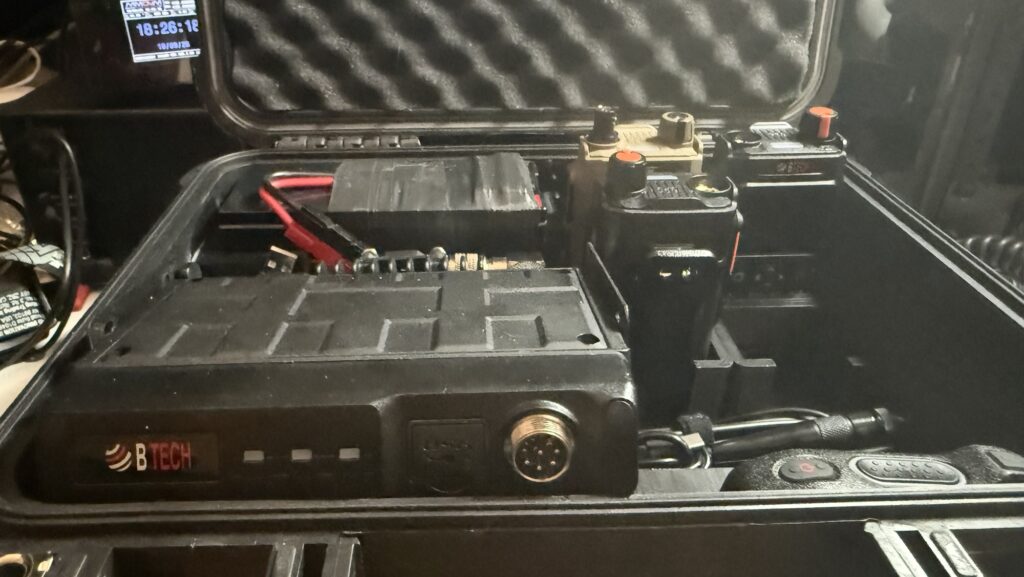

The Base Station
Inside the case sits a BTECH UV-50PRO, a 50 watt dual band mobile radio. That’s the muscle of the kit. It’s wired straight to a 10Ah battery mounted inside the case, and I added a bulkhead connector on the case wall so I can run coax straight out to an external antenna without ever opening the lid. Set the antenna up, plug in, and you’ve got a real base station running at real power, not just a handheld with rubber duck range.
This is what turns the box from a pile of handhelds into an actual comms hub. If conditions call for reach, the UV-50PRO is what gets you there.
Antennas and Power
For the antenna side, I keep two options in the box instead of relying only on the bulkhead connector for a full antenna setup. There’s a ZBM2 antenna that mounts right on the case for grab and go simplicity when I don’t want to deal with running a full antenna, and a roll up j-pole for when I want a little more height and range than the ZBM2 can give me. Between the two, I’ve got a quick deploy option and a step up option without adding much bulk to the kit.
On the power side, there’s an Anderson Powerpole connector on the side of the case. That lets me charge the internal battery without opening the box, and it also lets me run the whole box off a larger external battery if the 10Ah pack inside isn’t enough for a longer situation. The battery box itself can also charge all four handhelds, so the case isn’t just storage for the HTs, it’s the charging station for them too.
The Handhelds
Alongside the base radio, I keep four handhelds in the case:
- 2x VGC VR-N76
- 2x BTech UV Pro
These two models are basically the same radio under the hood. Both are made by VGC, just sold under different labels. I like having a mix like this because it means shared programming, shared accessories, and shared quirks across all four units. No guessing which radio behaves differently in the field.
Each of these gives you GPS, KISS TNC, and APRS support on top of standard analog VHF/UHF. That’s a lot of function packed into a small handheld. Yes, they’re analog only, no DMR or other digital voice modes, but that’s fine for this box’s job. Analog is what keeps a family group net simple. Everyone can hear everyone, no code plugs, no digital handshaking, no compatibility headaches mid emergency.
Programming all four is easy too. I only have to build out the memory channels on one radio, then wirelessly share those programmed memories with the other three. No cables, no cloning software, no sitting there manually entering the same frequencies four times over.
These Are Ham Radios
Worth being clear about this. All four handhelds and the UV-50PRO are ham radios operating on amateur bands, and that means a valid amateur radio license is required to use them under normal circumstances. This box isn’t a way around getting licensed. The one exception is a genuine emergency, where FCC rules allow use of amateur equipment by anyone when there’s an immediate threat to life or property and no other means of communication is available. Outside of that, everyone using this box day to day should be licensed.
A Word on GMRS
All four of these handhelds can be unlocked to transmit outside the ham bands, including on GMRS frequencies. None of them are part 95 certified for that, so this isn’t something to do casually, and it isn’t legal for normal day to day GMRS use. But in a genuine emergency, if I need to reach a family member who only has a GMRS radio and not a ham license, having that option in the box matters more than the certification technicality. When the situation is bad enough that you’re grabbing this box on your way out the door, worrying about type acceptance is going to be the last thing on your mind. It’s a last resort capability, not a normal operating mode, and it’s worth knowing it’s there before you need it. If GMRS is your main family comms plan day to day, GMRS Is Great for Family Comms, But It Won’t Save You When SHTF covers where that plan runs into trouble.
Why This Combo Works
The pairing of the UV-50PRO as a base station with four APRS capable handhelds covers both ends of the problem. If someone in the family needs to reach out further than a handheld can manage, the mobile radio and external antenna handle that. If everyone just needs to stay in touch while moving around a campsite, a neighborhood, a shelter area, or out on a range day, the handhelds do the job, and APRS means you can also track where everyone is.
This box lives by the door. It doesn’t need programming decisions made under stress, because that’s already done. It doesn’t need a truck battery, because the 10Ah pack inside runs the base radio just fine, and it can charge the handhelds too, so the whole kit keeps itself topped off. Grab it, connect an antenna if you have the time, and you’ve got a working family comms network in minutes.