
Part of our Emergency Communications and Preparedness guide.
I came across this scenario in another group chat and liked it enough to build a post around it. To be clear, I didn’t create it. I modified it and then wrote my own answer to it. It’s a good argument starter. Most bug-out discussions stop at “what’s in your bag.” This one forces a harder question: how do you actually get to where you’re going when the road gives out before the trip does? Read it, pick your answer, and then see mine at the bottom.
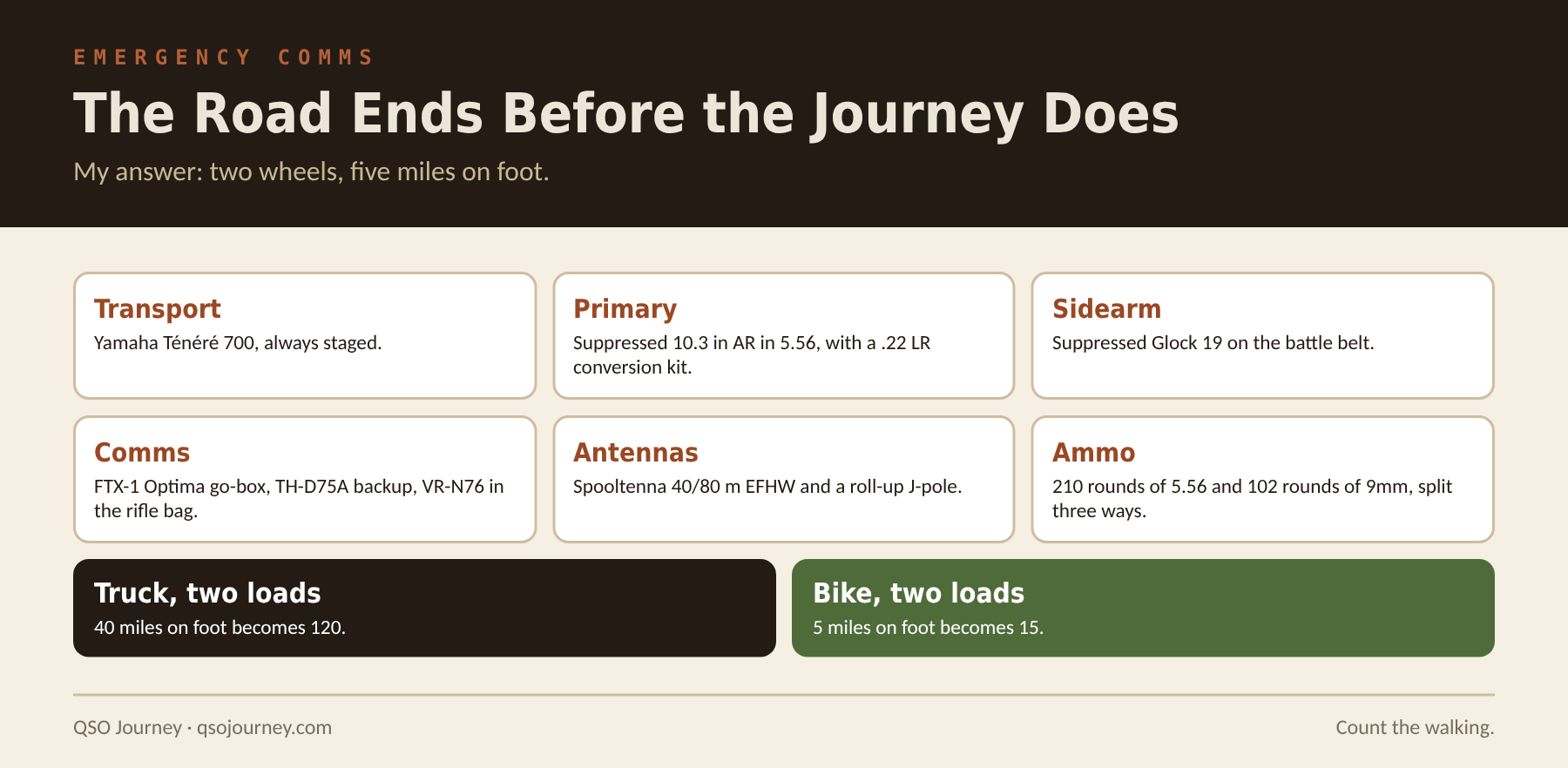
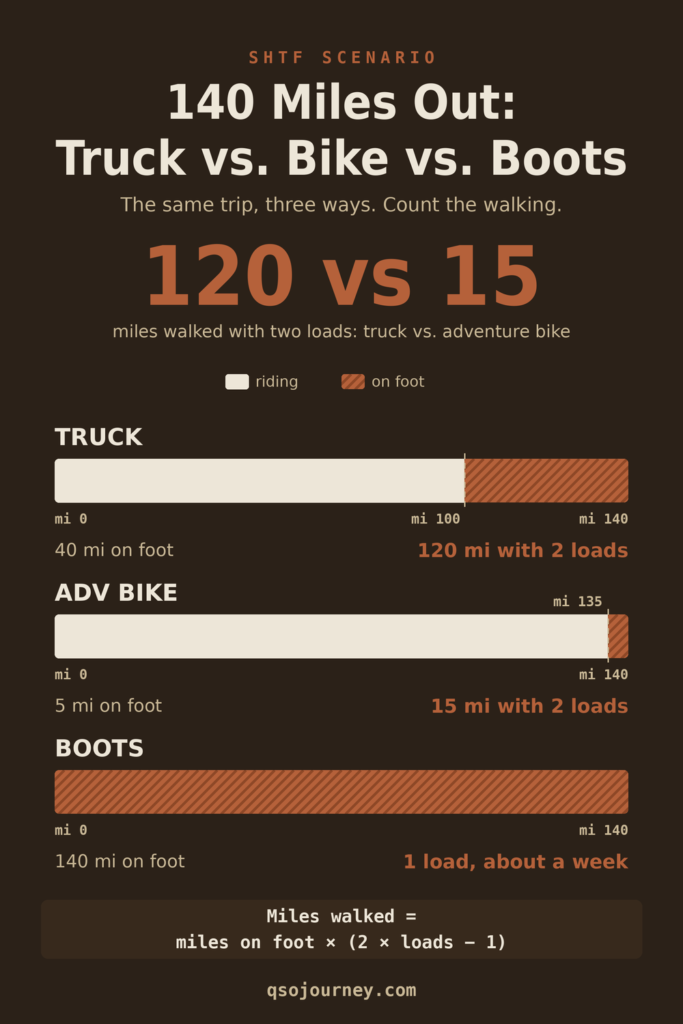
TL;DR: Drive a truck and the road ends at mile 100, so if your gear takes two loads, that 40-mile walk becomes a 120-mile foot march through ground you’ve already exposed yourself on. Ride an adventure bike and you’re only 5 miles out, so the worst case is a 15-mile shuttle, and that math is why my answer is the Ténéré.
The Scenario
EMERGENCY BROADCAST SYSTEM / ADVISORY ALERT
CRITICAL ANNOUNCEMENT: COUNTYWIDE EVACUATION & TERRAIN ROUTE PROTOCOL
It begins without warning. One morning, cellular towers go silent. The internet is down, and the national grid is fully offline. No commercial news, no official updates, no digital trace. Even air traffic has ceased.
By Day 10, the collapse is total. Municipal infrastructure has ceased functioning, retail shelves are depleted, and fuel pumps are dead. Suburban neighborhoods are quiet by day and targeted by night.
Today is Day 30. Unidentified, organized armed elements are conducting systematic, block-by-block sweeps through your sector. Fixed locations are compromised. Staying put is no longer viable.
Your target destination is a remote off-grid site 140 miles out. However, access is strictly bottlenecked by terrain degradation and route blockades:
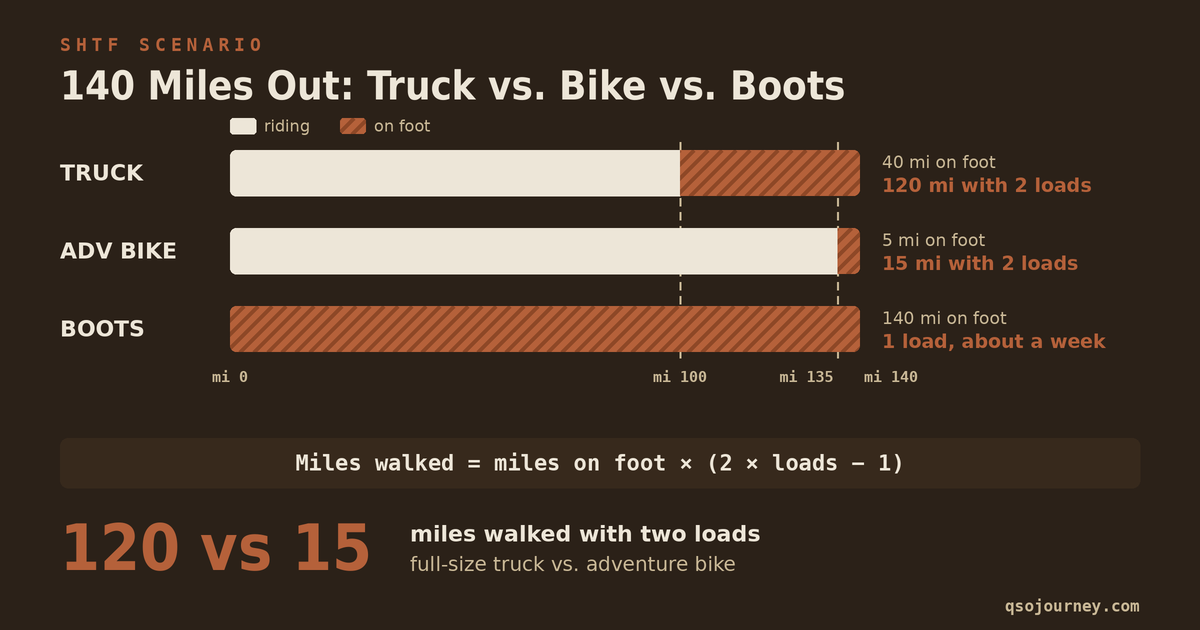
- Four-Wheel / Full-Size Vehicles: Navigable for approximately 100 miles. Beyond that point, severe road destruction, impassable washouts, or vehicle gridlock permanently block all full-sized auto traffic. The remaining 40 miles must be completed strictly on foot.
- Two-Wheel Vehicles (Bicycles / Motorcycles / Dirt Bikes): Navigable past auto blockades up to approximately 135 miles. Beyond that point, total terrain breakdown forces you to abandon two-wheel transport. The final 5 miles must be completed on foot.
LOGISTICAL IMPACT WARNING: If you choose to drive a vehicle for the first 100 miles, you face a severe transport trade-off. Once the road ends, any gear stored in your vehicle that exceeds what fits on your back will require multiple high-risk shuttle trips on foot between your vehicle’s drop point and your final staging area. Every extra trip increases exposure, doubles fuel/calorie burn, and risks ambush along an un-cleared corridor.
Equipment Regulating Directive & Debate Parameters
1. Primary Rifle (1 Only)
Must be an existing, owned rifle platform. Weight, durability, and multi-role versatility are paramount. It must handle close-quarters defense, reach targets out to 300 yards, assist in game harvesting, and ideally operates quietly (suppressed) when signature reduction is mandatory. It must remain functional for months beyond the trek without access to replacement parts or gunsmithing. (Note: Sidearm is permitted per standard loadout, but exempt from primary selection analysis.)
2. Communications & Power Array
Communications are limited strictly to gear carried in your primary loadout or staged inside your bug-out vehicle. All comms gear must handle local tactical coordination, field intelligence gathering, and wideband monitoring without access to grid power or commercial supply chains. Gear must account for both vehicle-mounted operation and quick transition to a man-portable pack. Weight, power efficiency, and field durability will determine survival.
3. Ammunition & Battery Logistics
Every round of ammunition, every watt-hour of battery capacity, and every foot of wire carried adds physical weight. Resupply does not exist. RF signatures can be tracked just as gunshots can be heard. Every transmission and every shot carries a distinct cost.
The road ends before the journey does. Terrain conditions are unpredictable, signal discipline is active, and the last leg will test your loadout limits.
Given the vehicle cutoffs at 100 and 135 miles, what is your movement strategy? Do you take a vehicle and risk making multiple shuttle trips on foot for heavier gear, rely on a two-wheeler for 135 miles, or pack strictly what fits on your back from mile zero?
The Math Most People Skip
Shuttling gear sounds reasonable until you count the miles. Every extra load means walking out, walking back, and walking out again. If you drive and end up with two loads at the 100-mile cutoff, that 40-mile hike becomes 120 miles on foot. Three loads makes it 200. And every one of those legs runs through ground you’ve already shown yourself on.
Now run the same math on a two-wheeler. Two loads over the final 5 miles is 15 miles of walking. That’s a long afternoon, not a death march.
My Answer
I’m taking the two-wheeler, and I’m not overthinking it.
- Transport: My Yamaha Ténéré 700.
- Primary: A suppressed 10.3″ AR in 5.56, staged in its own bag, with one of my plate carriers and a belt that’s already loaded and ready.
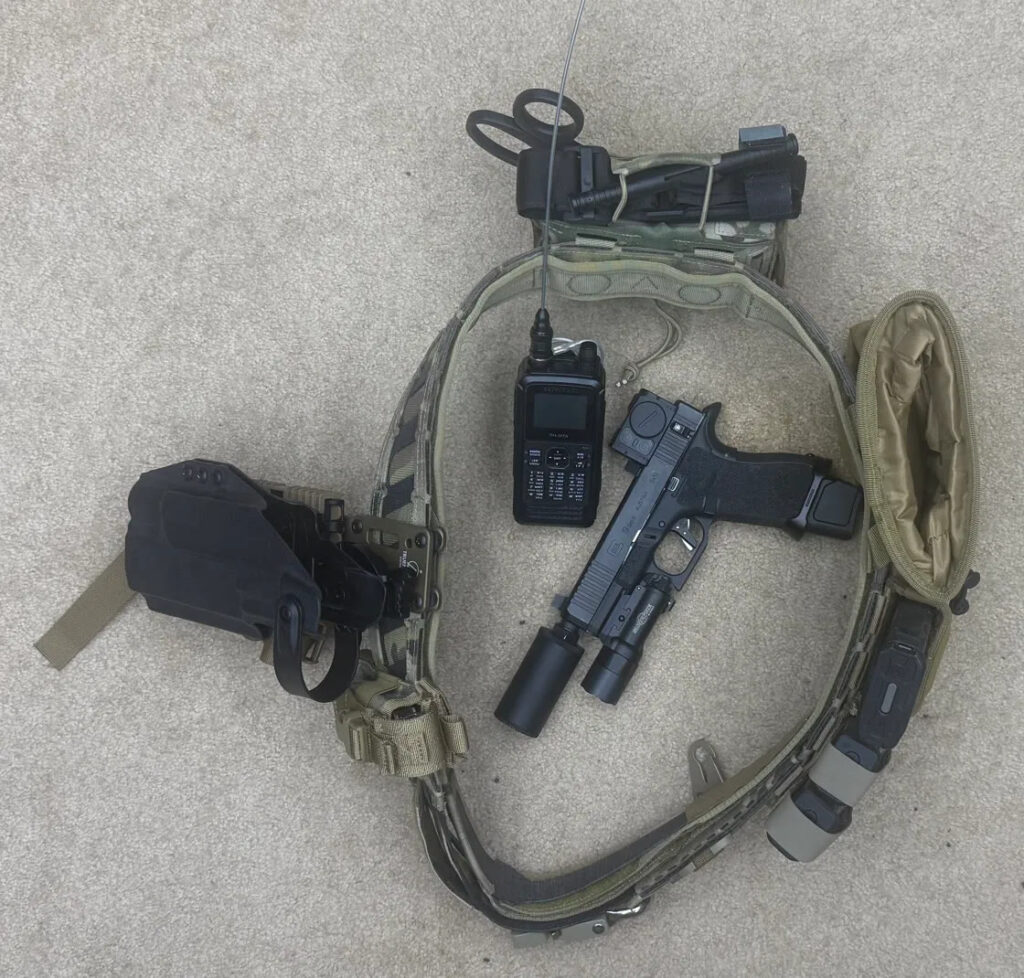
- Sidearm: A suppressed Glock 19 “Hush Puppy” on my battle belt. The belt also carries my med kit, so if everything else gets left behind, I still have a gun, ammo, and a way to stop bleeding.
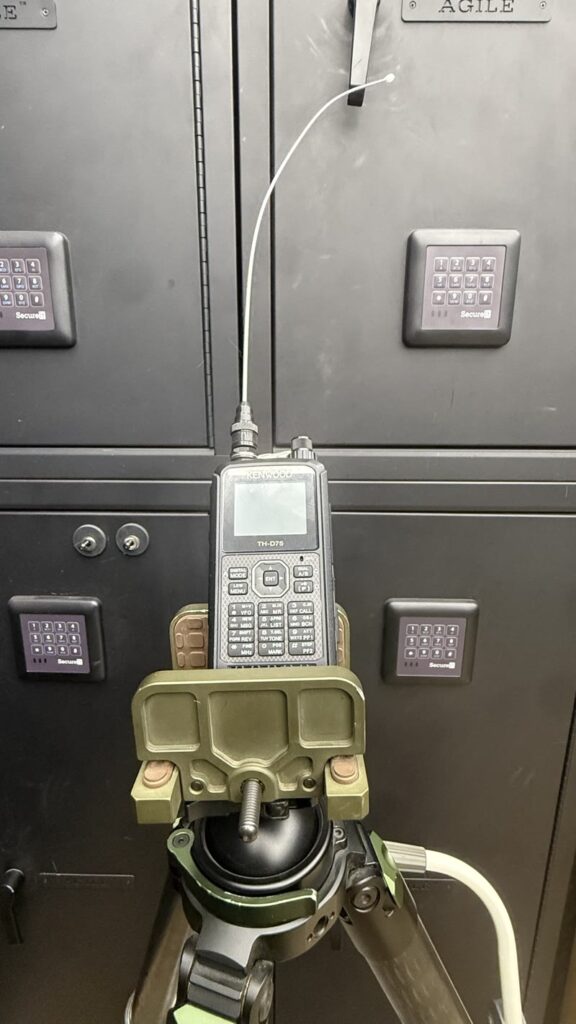
- Comms: My Yaesu FTX-1 Optima go-box, mounted on the back of the bike and easy to carry off it. That’s 100 watts on HF and 50 watts on VHF/UHF in one box. Backing it up is my Kenwood TH-D75A with extra batteries, which gives me solid VHF/UHF transmit (GMRS included) and HF receive. A third radio, a VGC VR-N76 VHF/UHF handheld, rides in the AR bag.
- Antennas: A Spooltenna 40/80m EFHW and an N9TAX Labs roll-up J-pole.
Where Everything Rides
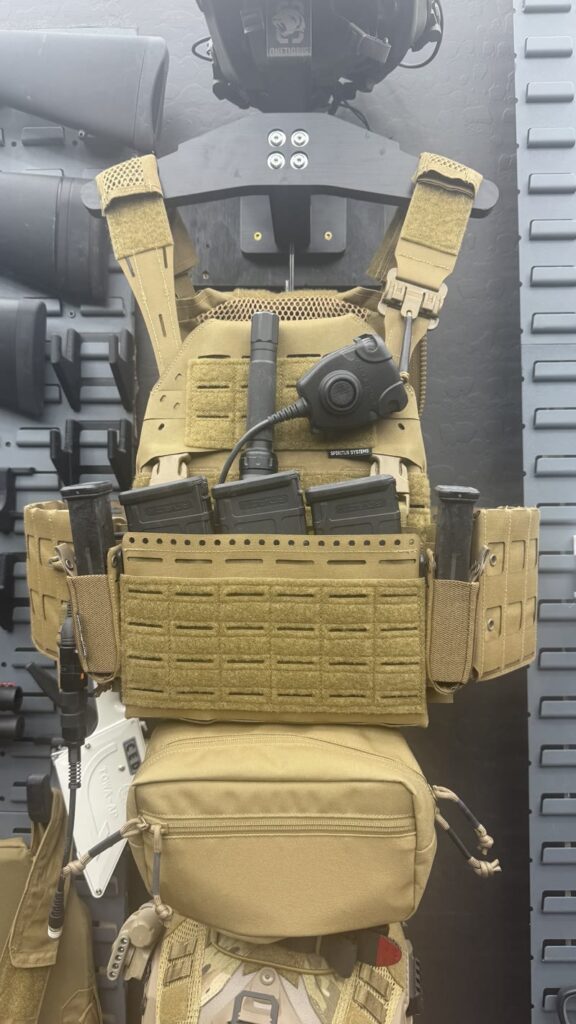
Plate carrier: A Spiritus Systems LV-120 with three 30-round AR mags and two 17-round Glock 9mm mags. It’s wired for PTT and holds my handheld radio, so comms ride on my chest, not buried in a pack.
Battle belt: An Agilite Magnetix with one more 30-round AR mag, two more 17-round Glock mags, a med kit, a Leatherman, and the holster for my Glock.
Rifle bag: My 10.3″ always lives in a Savior Equipment 30″ Specialist Covert soft case, which works as both a shoulder bag and a backpack. It holds the AR, the suppressor, a .22 LR conversion kit with two .22 LR magazines and .22 LR ammo, three more 30-round 5.56 mags, and two more Glock 9mm mags. It also carries a VHF/UHF handheld, my VGC VR-N76 (the BTECH UV-PRO is basically the same radio under a different brand), plus a small socket and tool kit, a lock pick set, a fixed blade knife, a folding knife, a magnesium fire starter, and water purification tablets.
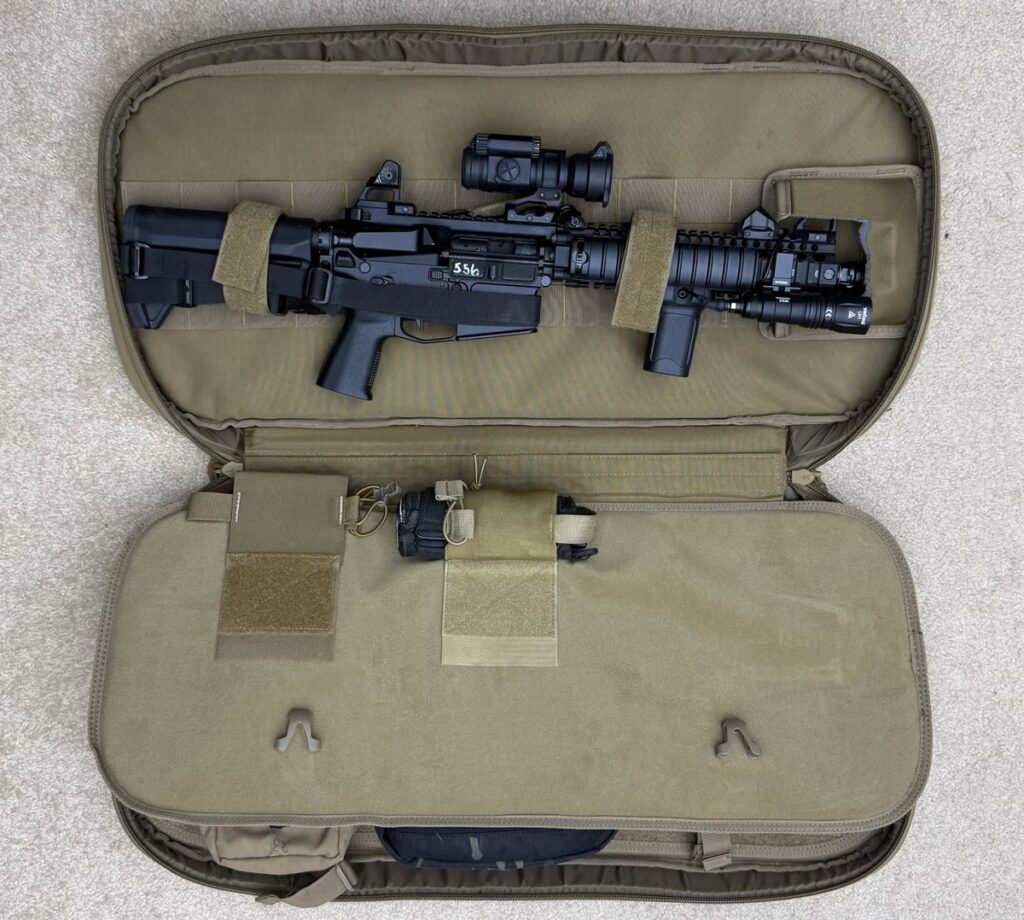
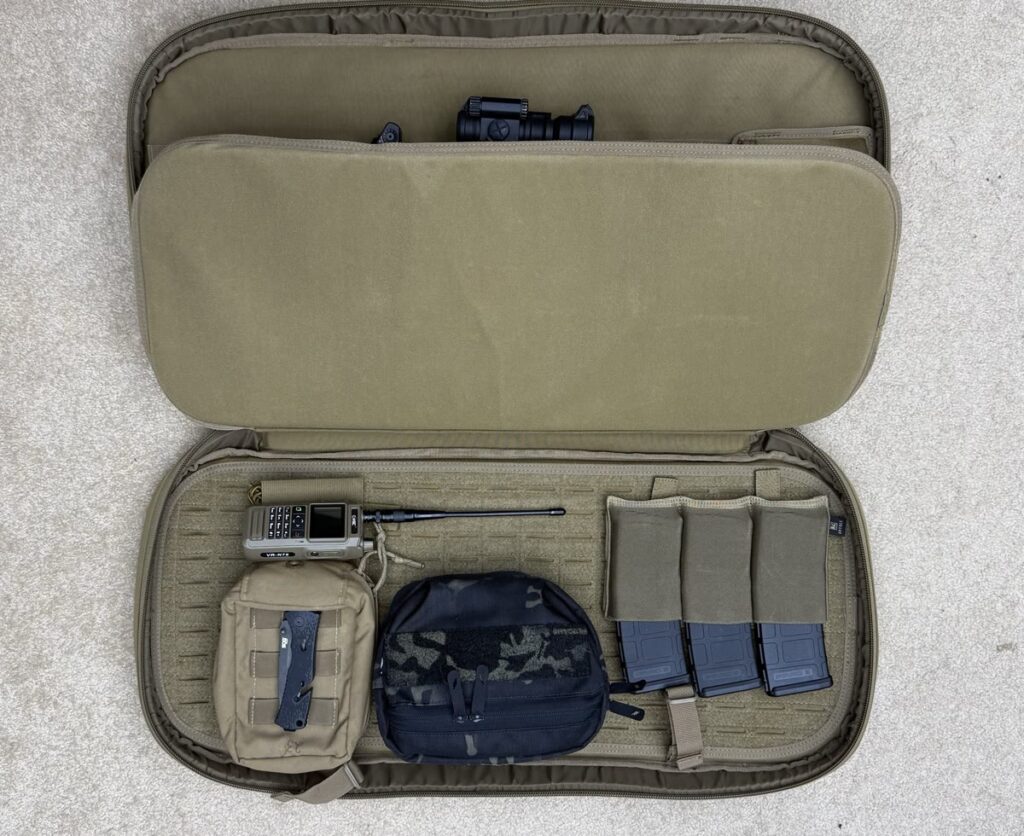
Add it up and that’s seven 30-round mags of 5.56 (210 rounds) and six 17-round Glock mags (102 rounds of 9mm), split across three things I can grab off the bike in seconds. The .22 LR conversion means small game doesn’t cost me 5.56, and the ammo is light enough to carry a lot of it.
Both guns are suppressed for the same reason the scenario calls out: every shot carries a cost. If I ever have to use them, a suppressor cuts the sound signature, so a shot is harder to hear from a distance and harder to pin to a location. On top of the mags above, the kit includes two boxes of subsonic 9mm (100 rounds), and one of my Glock mags is loaded with subsonic. A subsonic load through the Hush Puppy Glock and its suppressor is quite quiet. It isn’t movie silent, but it’s a big step down from a standard round.
Why Not a Long Bolt Gun?
A full-size bolt gun or a big semi-auto in a heavier caliber sounds like the obvious pick for a 300-yard requirement. For this scenario, I don’t think it is:
- Limited up close. A long rifle is clumsy in close quarters: around vehicles, inside buildings, or in thick brush.
- Harder ammo to scavenge. Bigger cartridges are more powerful, but they’re harder to find in the field than 5.56 or 9mm.
- Hard to conceal and carry. It’s far less concealable, and it doesn’t fit in a bag that rides on a motorcycle. Add a suppressor and it gets even longer.
- Slower follow-up shots. With a bolt gun, every shot means working the action.
- Heavier. A semi-auto in a bigger caliber gets heavy fast, and so does every round you carry for it. For the same weight, I can carry a lot more 5.56.
- More than the job needs. The scenario calls for 300 yards, and a 10.3″ 5.56 with a good optic covers that. The extra reach isn’t buying much.
- No shared ammo. My spouse runs a 5.56 AR and a Glock 19, so we share mags for both. A different rifle caliber breaks that.
Why Not a Dedicated .22 LR?
A dedicated .22 LR like a Ruger 10/22 comes up in every one of these discussions. The ammo is light and cheap, and you can carry a lot of it. It still isn’t the better option here:
- Far less effective for defense. The ammo is lighter, but it has far less stopping power. Against an armed group doing sweeps, that’s the wrong trade.
- Short effective range. .22 LR drops off fast past about 100 to 150 yards. The scenario asks for 300.
- Less reliable. Rimfire ammo has more duds than centerfire, and it runs dirty, which matters when you can’t clean and swap parts whenever you want.
- It breaks the one-gun rule. The scenario allows one primary. A 10/22 would have to be the primary, and it can’t do the defensive job.
- I already have .22 covered. The .22 LR conversion kit in my rifle bag turns the AR into a .22 for small game. I get the light ammo without carrying a second gun.
Why Not a 300 Blackout?
This one was a closer call, because I hold many 300 BO builds, both as ARs and as bolt guns. 300 Blackout has real advantages: it’s quieter, and the guns are often smaller. One of my 300 BO ARs runs a 7.5″ barrel instead of 10.3″, and its suppressor is smaller too. Even so, the 5.56 wins for this scenario:
- No .22 LR conversion. A 300 BO barrel is a .30 caliber bore, so a .22 LR conversion kit won’t work in it. On the 5.56, the same kit gives me a .22 for small game.
- Harder ammo to scavenge. 300 BO is a lot less common than 5.56, so it’s less likely to turn up if I need more.
- Range. 300 BO drops off faster than 5.56 at longer distances, and subsonic loads drop off much faster. The scenario asks for 300 yards.
- No shared ammo, and a real mix-up risk. My spouse runs a 5.56 AR, so 300 BO breaks our shared ammo. Worse, 300 BO uses the same mags as 5.56, and a 300 BO round fired in a 5.56 rifle can destroy the gun and hurt the shooter. Mixing the two between two people under stress is asking for trouble.
Why the Ténéré
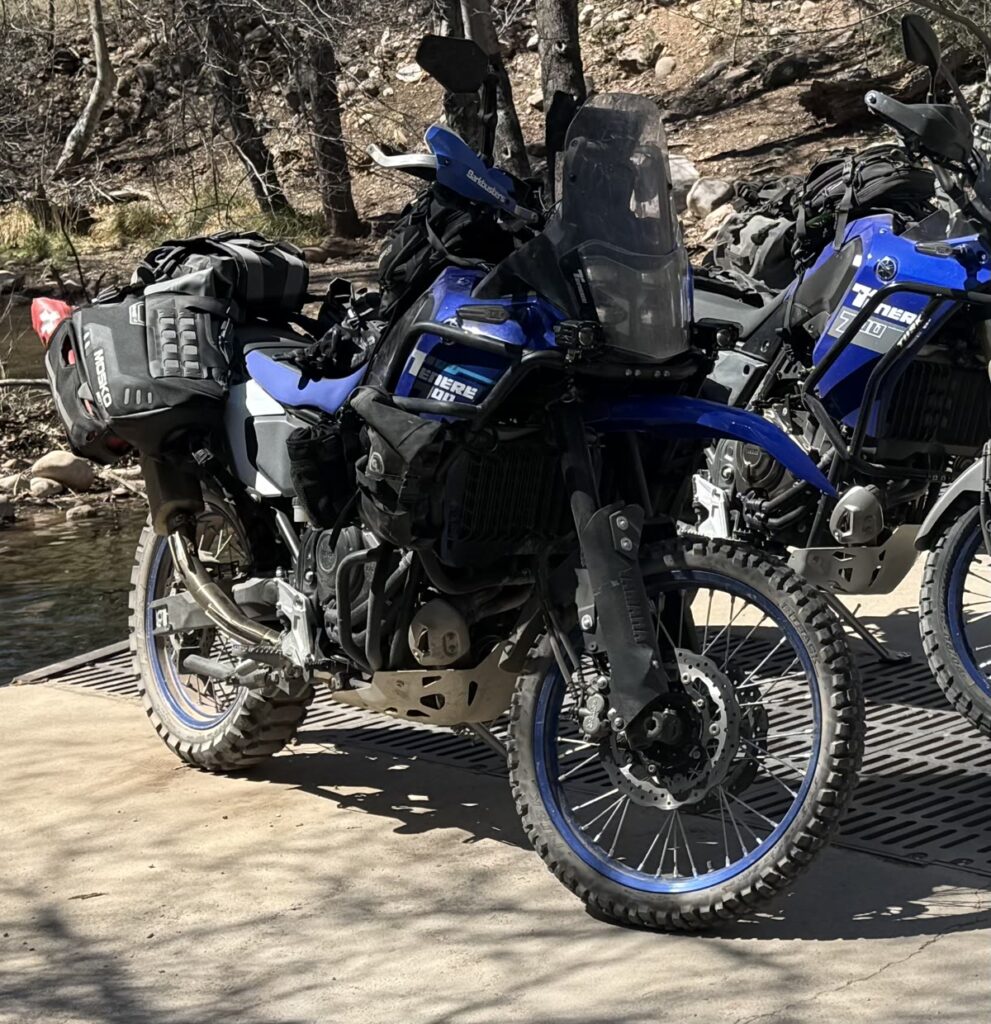
My T7 is always staged. The luggage is a Mosko Moto Reckless 40L kit with the aux pods, and one of those pods is a dedicated med kit. The back of the bike also carries a Mosko Moto Stinger 22L storage bag. On the crash bars, a pair of Giant Loop 3.5L Possibles Pouches (one on each side) are both set up as tool kits. Basic tools, a med kit, water, GPS, and the rest of my ride kit live on the bike full time, so leaving means grabbing the rifle, the carrier, and the comms box and going. Nothing gets packed on Day 30.
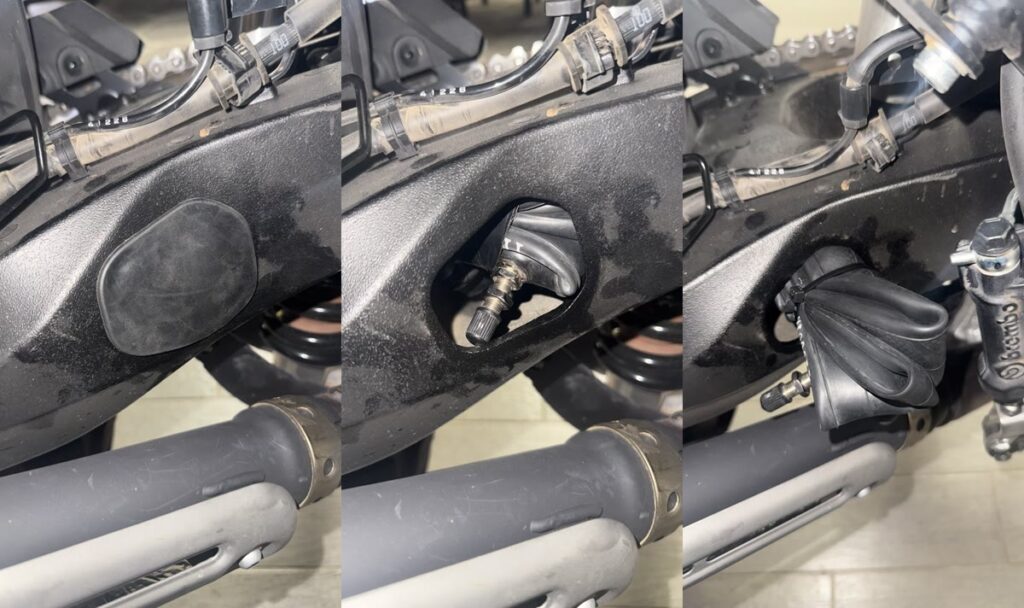
Flats are covered too. I keep spare motorcycle tubes stuffed inside the swingarm, behind a rubber plug, and they work for both the front and rear tires. My Ténéré tool kit also carries a tire patch kit and a Fanttik X9 Pro portable tire inflator, which has a 2.5Ah battery and charges over USB-C. A flat on mile 80 is an inconvenience, not the end of the ride.
A full tank covers the whole 135 miles with room to spare, so I’m not hunting for gas at dead pumps. Under normal conditions the Ténéré gets 50 to 55 mpg, and even fully loaded it still gets better than 40. My bike also has a Camel ADV Camel Tank auxiliary fuel tank, which holds another 1.3 gallons and feeds into the main tank automatically. On top of that, the bike carries a Giant Loop 2-gallon roll-up fuel bag for extra range. (Giant Loop sells it as a utility bladder, not a certified fuel container, so check your local rules before you carry gas in one.) The bike is built for exactly the kind of broken ground that stops a truck at mile 100. And it puts me 5 miles from the site instead of 40. Everything on the bike comes with me for those last 5 miles. If I’m riding two-up, the two of us can carry it all in one trip. If I’m solo, the radio box, battery box, water, medical, guns and tools mean it takes two trips, but two trips over 5 miles is a reasonable call. Over 40, it’s a gamble.
Just as important, an adventure bike opens up far more route options than a car, a Jeep, a side-by-side, or even a street motorcycle. Dirt roads, washes, trails, gaps between stalled traffic, and paths a bigger vehicle can’t fit through are all on the table. So when you plan your evac from your house to your destination, you have way more ways to get there, and way more ways around whatever is blocking the obvious one.
The scenario mandates that I hike the last 5 miles, and I played it that way. In reality, there are very few places the Ténéré can’t go. In a real-world evac, it might get me all the way to the site with no walking at all.
Why Not the Jeep?
I also have a Jeep on 40″ tires, fully equipped with HF and VHF/UHF radios, Starlink, a Garmin GPS, extra batteries, air compressors, and tools, all set up and ready to go. Even so, there are a few reasons it doesn’t work for this situation:
- Fuel. The Jeep gets 9 to 13 mpg. The Ténéré gets 40 to 55.
- Speed. It holds four people, but it isn’t fast. If I have to get away from something, that’s harder to do in the Jeep.
- Size. The Jeep is huge, and it doesn’t fit through tight trails easily.
- Tracks. The tire footprint is enormous. Every time it leaves the pavement it leaves marks, and that makes it easy to track down.
- Gridlock. In gridlock, the Jeep has a lot more limitations than a motorcycle does.
- Simplicity. The Ténéré’s engine and electrical system are far simpler than the Jeep’s, which matters when nobody is coming to fix it.
- Weight. The Ténéré is about 500 pounds loaded (without a passenger). The Jeep is about 5,500 pounds loaded. For sketchy bridges and crossings, the bike is far better.
- Recovery. The Jeep has winches, but it’s still far harder to recover than the bike. I can lift the bike over things I can’t ride over. With the Jeep, if I can’t drive over it, I’m not lifting it over anything.
Ideally I’d have both in a SHTF situation, because they each have solid use cases. The Jeep is great as a mobile base camp and for bugging out with three to five people. The Ténéré is an evasion, scouting, and solo operator tool: very agile, and able to go hundreds of miles on limited fuel. If it’s just me, or me and one passenger, the bike will probably be the go-to.
Why This Comms Package
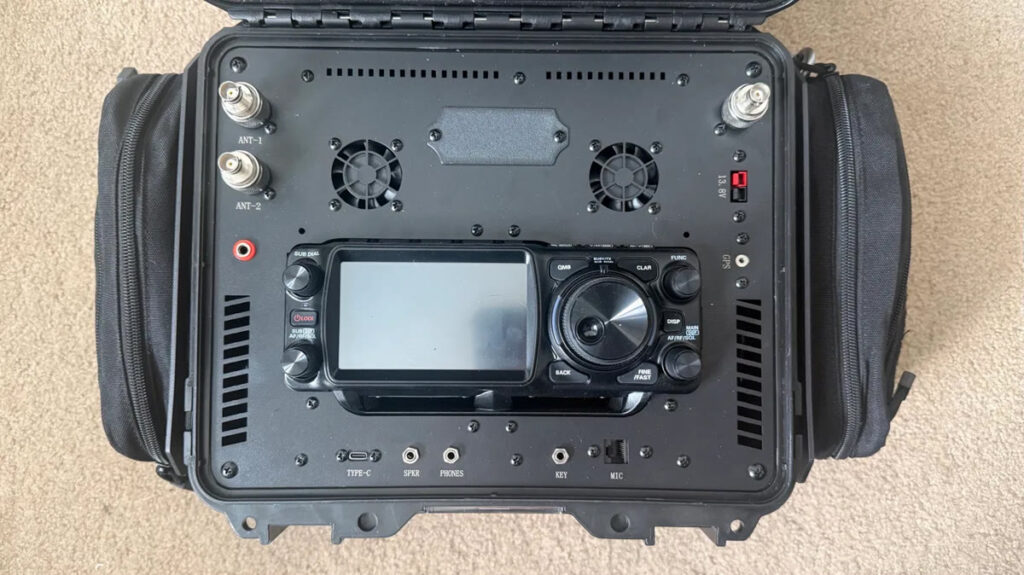
One box covers HF and VHF/UHF, so I’m not juggling separate rigs on the bike. The D75A is the backup for VHF/UHF, and because it can listen on HF (including SSB), I can still hear regional traffic if the FTX-1 goes down. On antennas, the 80m side of the Spooltenna is my night NVIS option and 40m handles daytime regional work. Strung up as a sloper in a tree (or off any other structure I can find), the same EFHW also gives me DX access, so I can gather intel from well outside the region, not just what’s happening nearby. I go deeper on that in Why HF Radio Matters Most When the Grid Goes Down. The roll-up J-pole goes up a tree to stretch simplex range on either radio, and it weighs almost nothing.
The Catch: This Plan Is Built for Two
Everything above works for me and at most one passenger. If it were more than me and my spouse, this plan would have to change quite a bit. I have multiple motorcycles that could make the trip, but that only works if everyone else can actually ride them well enough over broken ground. If they couldn’t, we’d be taking the Jeep instead, and that puts us right back in the math above: the road ends at mile 100, and it’s a lot of walking to close out the last 40 miles on foot.
On the Ténéré, she rides two-up with me, and the bike handles that weight along with the gear. It’s not a comfortable ride, but it’s very doable.
The good news is that my spouse and I have similar kits set up. She has her own plate carrier and loadout, a dedicated AR, and a sidearm. Hers runs a little lighter and doesn’t include a battle belt, but overall it’s a good match. Her sidearm is a Glock 19 and her AR is an 11.5″ in 5.56, so we can share mags for both the ARs and the Glocks. If one of us runs low, the other one can resupply.
What I’d Still Tighten Up
- Power. A 10Ah and a 100Ah battery both ride on the bike, and both have solar and DC-to-DC charging. The Ténéré’s stator puts out around 350 watts total. The bike’s own electrics use part of that, but as long as I have fuel, what’s left over can charge a battery (or a lightweight LiFePO4 pack) through the DC-to-DC charger while I ride, or power the FTX-1 go-box on receive. It won’t run 100 watts on transmit, but it keeps the batteries topped off. What I don’t carry is a solar panel, so I’d have to find one. Luckily I’m in Arizona, where panels are everywhere, and I carry multiple adapters so I can hook up to almost any panel I come across.
- Noise. I suppressed the rifle, but the bike is the loudest thing I own. Slow speeds near the cutoff and shutting the engine down early matter.
- Transmit discipline. 100 watts is the biggest RF signature I’m carrying, so it’s a listening station first. Low power for most check-ins, full power only when it counts. More on that in my EMCON and direction finding post.
- The 80m wire. A half-wave on 80 meters is roughly 130 feet. That’s slow to deploy at night, though NVIS works fine with it run low to the ground.
- Water. Five miles in Arizona with a plate carrier on is real work. The bike doesn’t hold a lot of water. It carries 1 gallon in the back, plus another 2.0L in my Mosko Moto Nomax tank bag, which doubles as a backpack and a CamelBak-style hydration pack when I’m moving on foot. Even so, that’s not enough. That’s why I carry water purification tablets and a 2-gallon roll-up bag that’s just for water, so I can refill and treat whatever I find along the way.
Your Turn
Truck, two wheels, or boots from mile zero? Drop your movement plan, your primary, and your comms package in the comments. And here’s the follow-up: how does your answer change with a family of four? I want to see how other people would solve this one.