

Part of our Yaesu FTX-1 Complete Guide.
The Yaesu FTX-1 Optima is my favorite radio to take out of the shack. With the SPA-1 amplifier it gives me 100 watts on HF, plus 6 meters, 2 meters, and 70 centimeters in one package. The problem was never the radio. It was carrying it. A radio, an amp, a head, cables, and antennas tossed in a bag and bouncing around the back of a vehicle is a good way to break something you paid a lot of money for.
So I built a go-box around it.
The Case
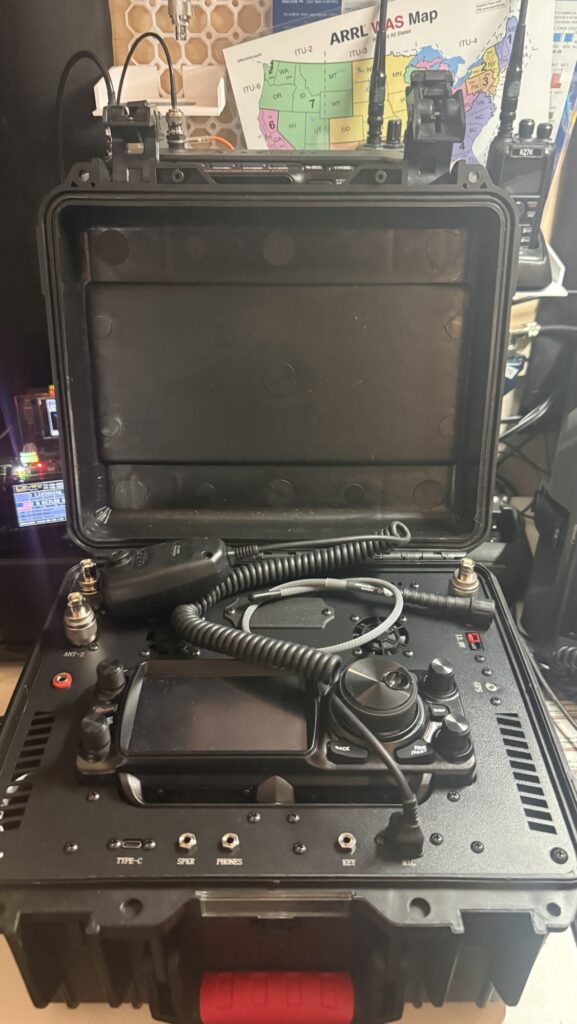
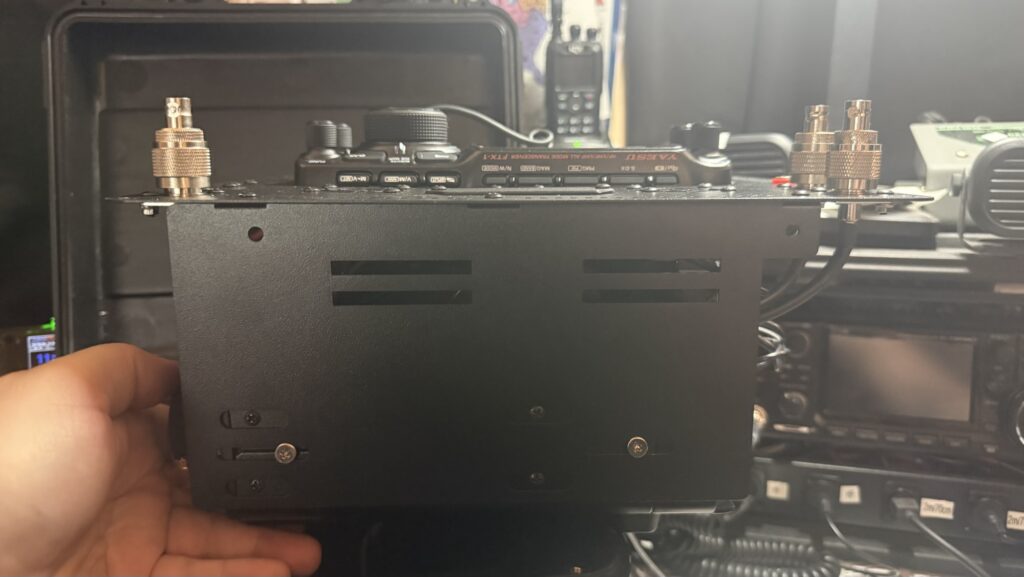
I bought the case on eBay. It’s a waterproof hard case made specifically for the 100 watt FTX-1, molded from impact-resistant plastic. The FTX-1 and the SPA-1 Optima amp both mount inside, and when the lid closes it seals watertight. It comes with all the adapters, wires, and extensions you need to connect both the SPA-1 and the FTX-1 Field unit to the connectors on the panel, so there’s nothing extra to source.
Here’s how mine came together.




By the Numbers
- Size: 12 inches wide, 12 inches deep, and 7 inches tall.
- Weight: 16.5 pounds for the complete setup. That’s the box, the mounting gear, the FTX-1, and the SPA-1 amp, ready to go.
- Bands: HF at 100 watts through the SPA-1, plus 6 meters, 2 meters, and 70 centimeters from the same radio.
Sixteen and a half pounds is easy to grab with one hand and carry from the vehicle to a picnic table, a tailgate, or a spot where I can hang a wire.
Room for the Antennas Too
This is the part that sold me. With the radio and amp mounted, there’s still enough room inside for the antennas and coax:
- An EFHW for HF. My Spooltenna fits, along with its coax. I covered how it pairs with this radio in Pairing the FTX-1 with the Spooltenna Ultra.
- Something for VHF/UHF. A dual-band roll-up J-pole, or a ZBM2 or similar whip.
That means one box is a complete station. I don’t have to remember a second bag of antennas, and I don’t get to the site and find out the coax is still in the garage.
Why a Box Instead of a Bag
Bags are great when you’re hiking into a park and every ounce counts. But most of the time my radio rides in the back of a vehicle, and a soft bag doesn’t do much when it’s sliding around with recovery gear and water jugs. A hard case takes the hits so the radio doesn’t. The watertight seal handles rain and the occasional spilled drink, and here in Arizona it keeps the dust out too.
If your radio only leaves the house in a backpack, a bag is fine, and I still use one (here’s what goes in my FTX-1 go-bag). If it spends time bouncing around in a vehicle, a hard case is worth a serious look.
Yes, It’s Expensive
As I write this the case is listed at about $228 plus shipping. That’s far more than a bag. It’s also quite a bit more than grabbing a Pelican or Harbor Freight hard case and dropping the FTX-1 into it.
But the quality of the panel and the connections is excellent, and it fully protects the radio. The FTX-1 Optima is a nearly $1,800 radio. If you plan on taking it out of the shack for POTA, Field Day, or SHTF operations, it’s worth spending a little more to fully protect it.
Don’t Have the Optima?
They also make a version of this box for just the FTX-1 Field unit. It’s smaller and lighter, with the same style of layout and the same protection. I actually started with that one and got rid of it when I upgraded to the Optima with the SPA-1.
Go-Bag vs. Go-Box
I still keep a soft FTX-1 go-bag built around the Field unit. Here’s how the two compare.
| Go-Box (FTX-1 Optima) | Go-Bag (FTX-1 Field) | |
|---|---|---|
| Weight | 16.5 lbs | 10 lbs (without the Maverick) |
| Size | 12″ x 12″ x 7″ | 10″ x 10″ x 4″ |
| Power output | 100 W HF, 50 W VHF/UHF | 10 W |
| Power source | No battery included. Runs off my 100Ah battery box | Two batteries for the FTX-1 Field included |
| Protection | Watertight hard case | Soft bag, no drop protection, minimal water resistance |
The bag is lighter, smaller, and carries its own power, so it’s still what I grab for a hike-in activation or a quick callout. The box trades weight and an external battery for ten times the HF power and protection that survives the back of a vehicle.
Where It Fits in My Emergency Plan
Because this box covers both HF and VHF/UHF, it’s my bridge station, the one I describe in Your Repeater Is Not a Plan. It can check into a regional HF NVIS net on 40 or 80 meters with the EFHW strung low, then pass that traffic to local handhelds on 2 meters or 70 centimeters simplex. And because the FTX-1 has a built-in digital interface, JS8Call and FT8 only need a USB cable to a laptop.
It complements my 2m/70cm grab-and-go box for the family. That one handles the local layer. This one reaches past it.
Would I Buy It Again?
Yes. The FTX-1 Optima is a lot of radio, and it deserves better than a bag. Twelve inches square, 16.5 pounds, sealed against the weather, and everything I need for HF through UHF in one handle. That’s what a go-box should be.