
Part of our Building Your First Ham Radio Station guide.
Every new ham asks it, and every prepper who just bought a six-pack of handhelds asks it louder: how far will this thing talk? The box says 8 watts. The honest answer is almost always “less than you think.” So I built a range map to show it.
Why VHF and UHF Run Out of Room
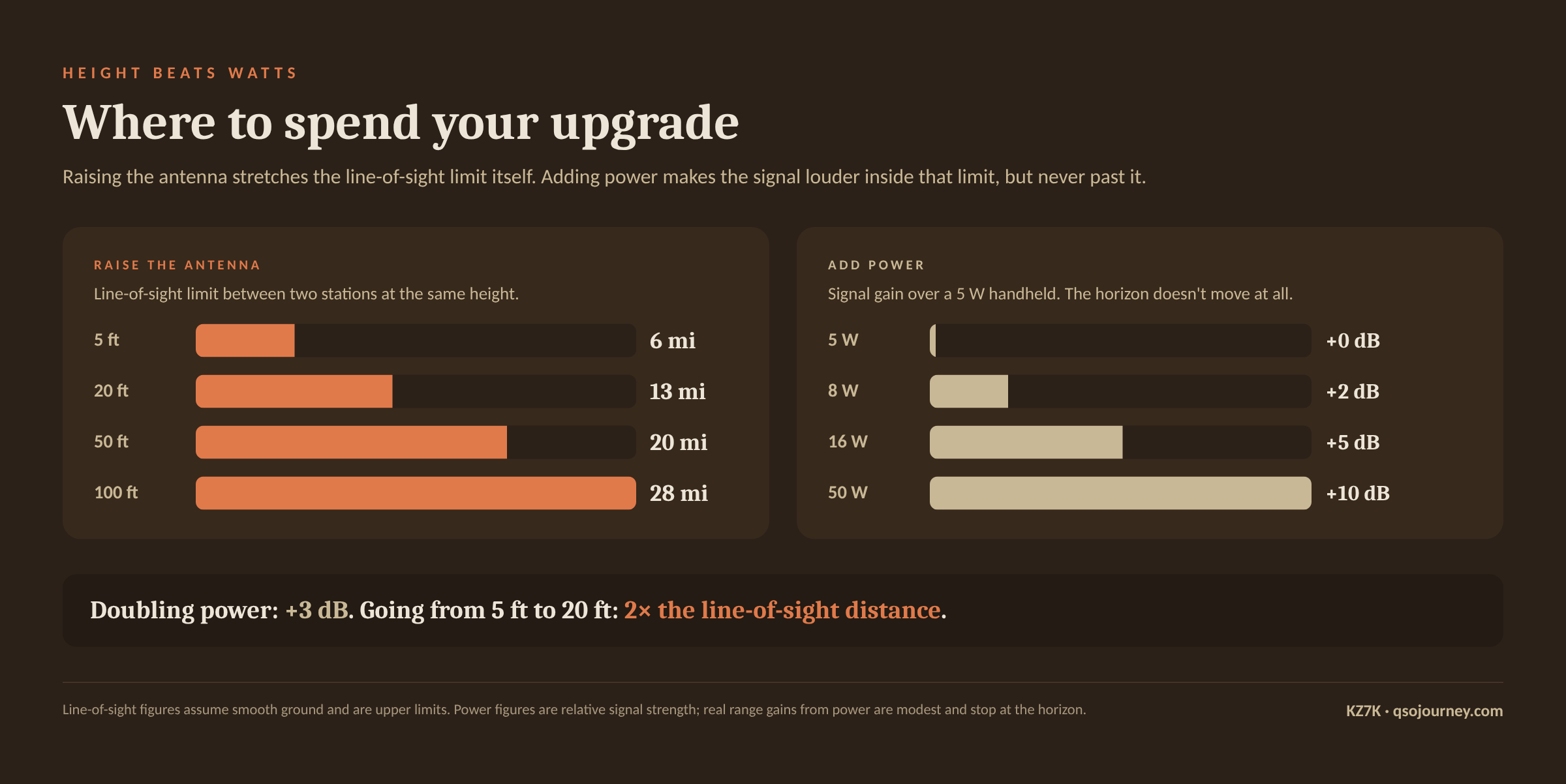
VHF and UHF travel in straight lines. They don’t bend over the horizon the way HF does, so your range is set by line of sight. That means antenna height first, antenna quality second, and watts a distant third. Doubling your power only buys you 3 dB. Getting your antenna 20 feet in the air changes everything.
Four Setups, Same Four Stations
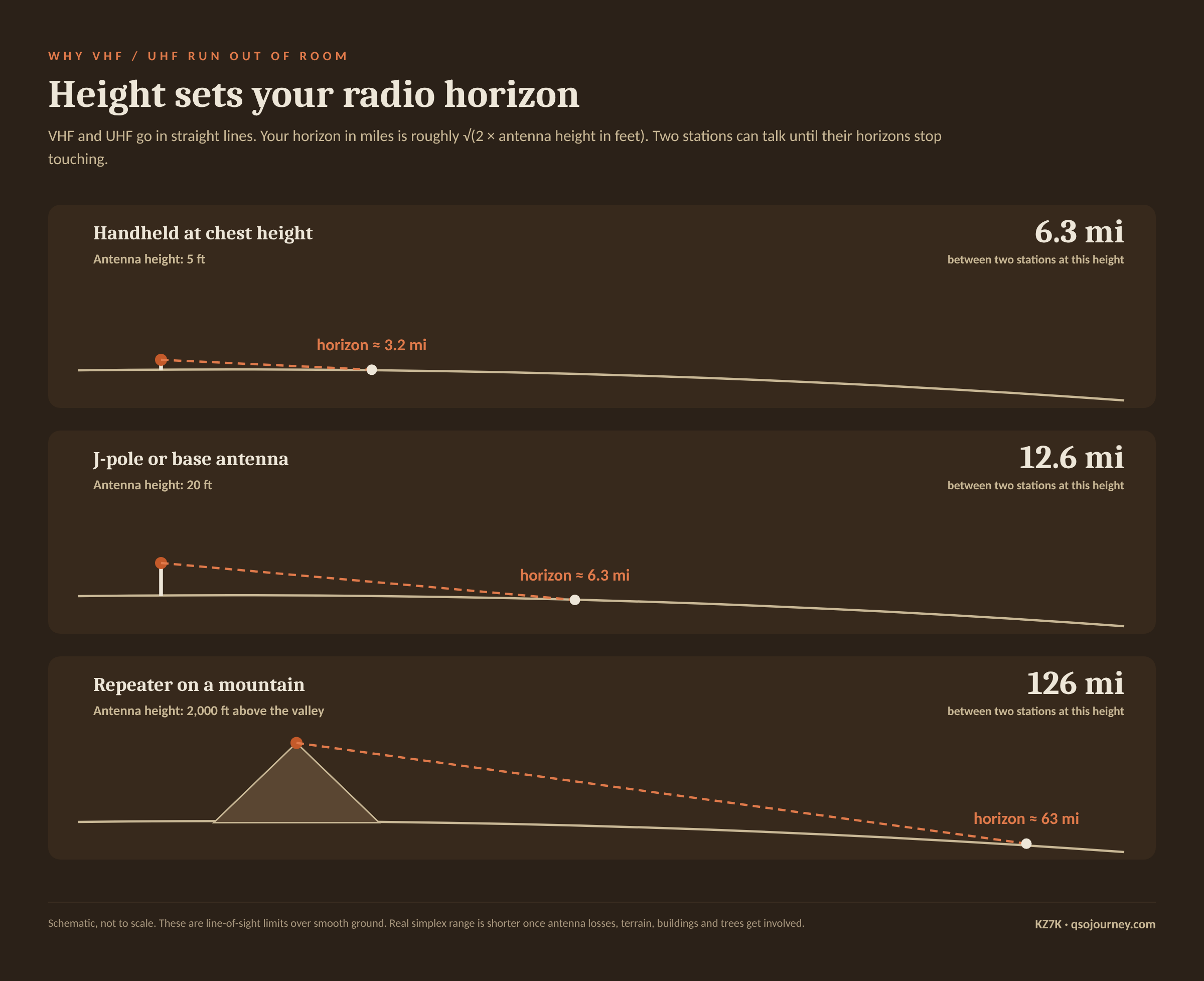
Every map uses the same four stations. Station A sits in the middle. B is 0.8 miles away, C is 2.5 miles out and D is 14 miles out. Each map gives all four stations the same setup.
| Setup | Typical simplex reach | Links that work |
|---|---|---|
| 8 W handheld, stock antenna | 1–2 mi | 1 of 6 |
| 8 W handheld, ZBM2 Foul Weather Whip | 2–4 mi | 2 of 6 |
| 8 W, roll-up J-pole at 20 ft | 8–12 mi | 3 of 6 |
| 50 W, base antenna at 20 ft | 15–25 mi | 6 of 6 |
The stock rubber duck is the weakest link in almost every kit. A good full-size whip roughly doubles your reach for the price of a pizza dinner. Same radio with a roll-up J-pole hung in a tree turns three isolated handhelds into a neighborhood net. And the 50 watt base talks to everyone on the map, but it still gets nowhere near 50 miles.
The Weaker Station Sets the Range
Real groups don’t all run the same gear. When two different setups talk, the weaker one decides how far the conversation goes.
| HT stock | HT ZBM2 | J-pole 20 ft | 50 W base 20 ft | |
|---|---|---|---|---|
| HT stock | ~1.5 mi | ~2 mi | ~4 mi | ~5 mi |
| HT ZBM2 | ~2 mi | ~3 mi | ~5 mi | ~7 mi |
| J-pole 20 ft | ~4 mi | ~5 mi | ~10 mi | ~13 mi |
| 50 W base 20 ft | ~5 mi | ~7 mi | ~13 mi | ~20 mi |
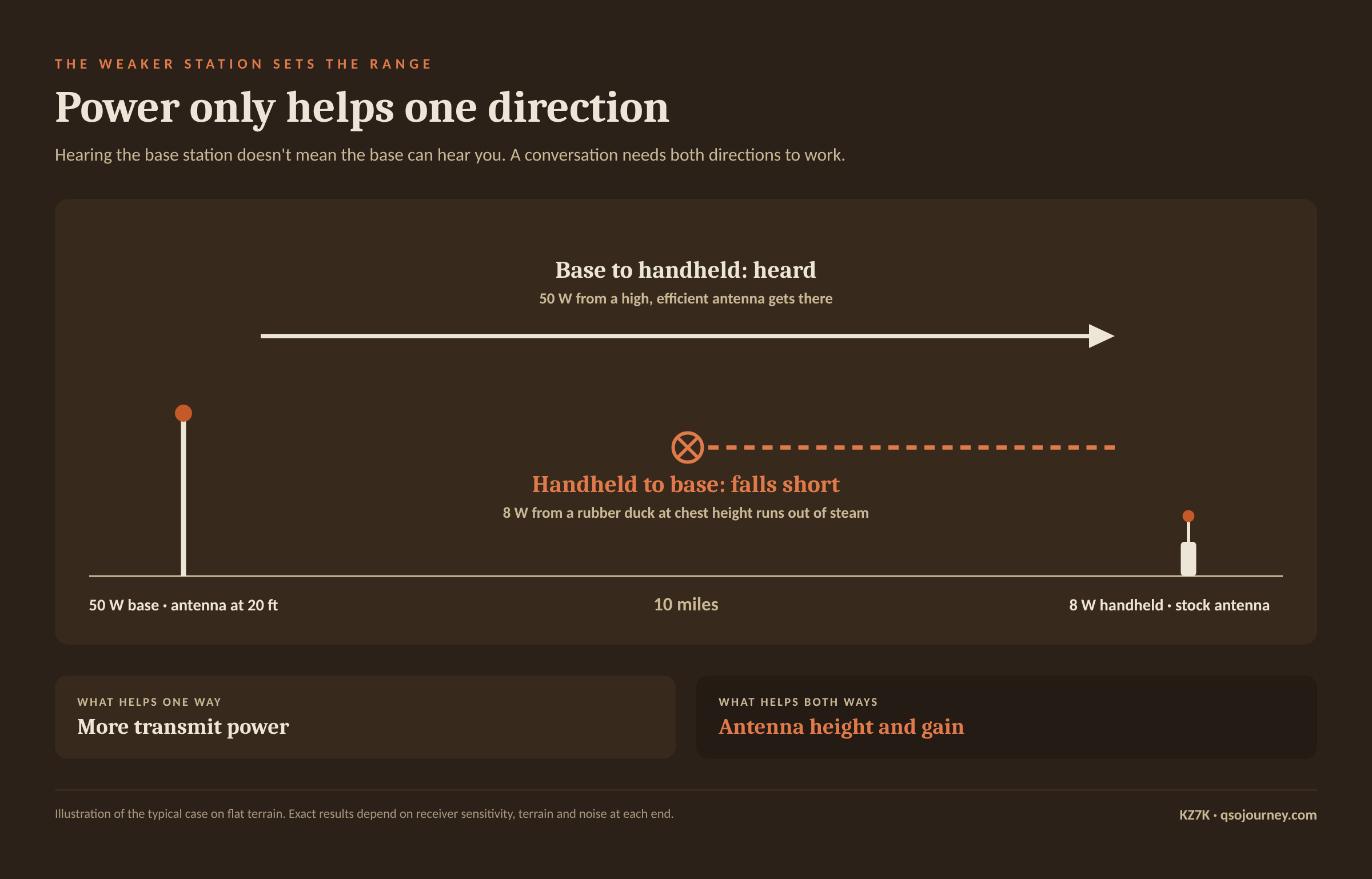
This is the part that surprises people. A 50 watt base can often be heard by a handheld 10 miles out, but the handheld’s 8 watt reply won’t make it back. Power only helps in one direction. Antenna height and gain help both.
Simplex vs. a Repeater at 2,000 Feet
The last two maps scatter eight stations (two of each setup) across 45 miles. On simplex, only 4 of the 28 possible pairs can talk. The 50 watt base near town becomes net control by default, relaying for stations that can’t hear each other, and three stations are on their own.
That base station turning into the relay isn’t a quirk of the map. It’s how a group stays connected on simplex, and it works a lot better when it’s planned ahead. I walk through building one in Human Relay Networks: Moving Traffic Across Town on Simplex.
Now drop a repeater on a hill 2,000 feet above the valley. Its radio horizon is about 65 miles. Seven of the eight stations get in, which means 21 of the 28 pairs can talk. The one that misses is a stock handheld 30 miles out. Even a great repeater can’t fully rescue a bad antenna.
But don’t build your plan around that repeater. In a true SHTF or grid-down situation, it may not be there. Plenty of repeaters run on commercial power with little or no battery backup, and the ones that do have backup only last as long as their batteries, fuel or solar. Hilltop sites also depend on links, controllers and people to keep them running, and a repeater that does stay up can get swamped the moment everyone in the valley keys up at once. Treat the repeater as your primary when things are normal, and make sure your group can still reach each other on simplex when it goes quiet. That’s what map 05 is really showing you. (I go deeper on this in Your Repeater Is Not a Plan.)
The Big Exception: Mountaintop to Mountaintop
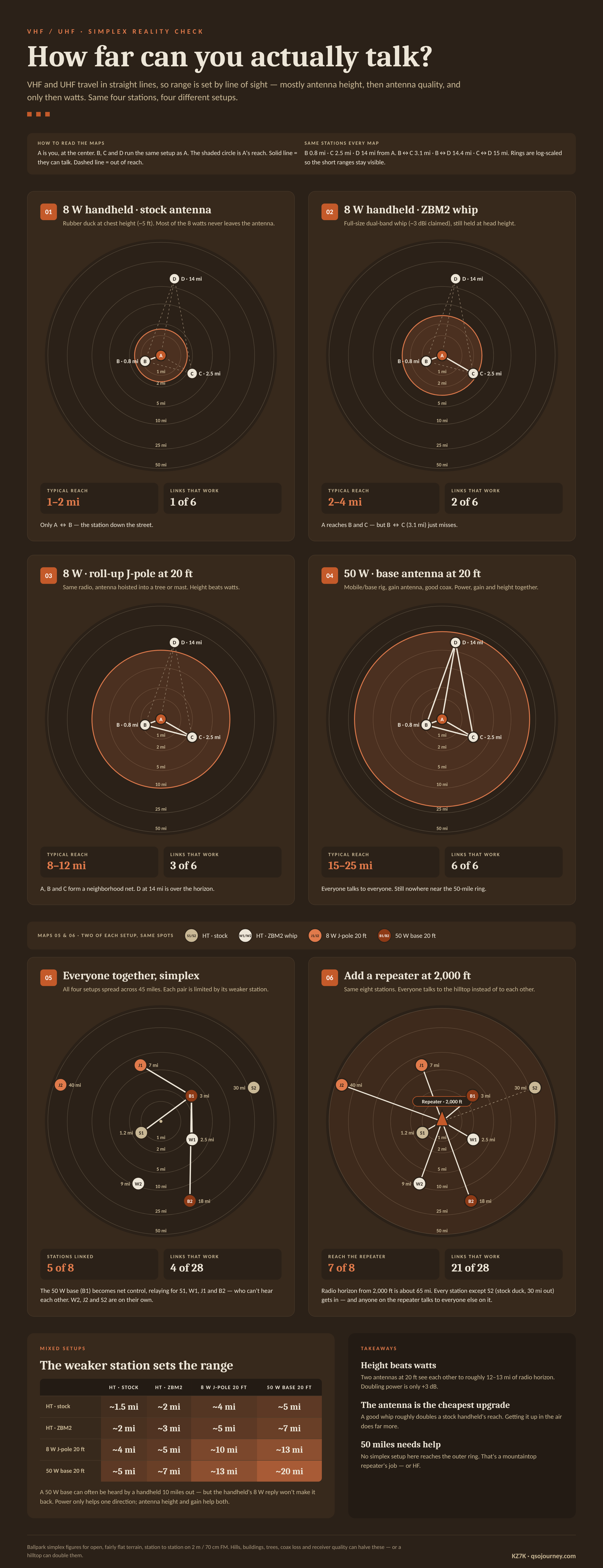
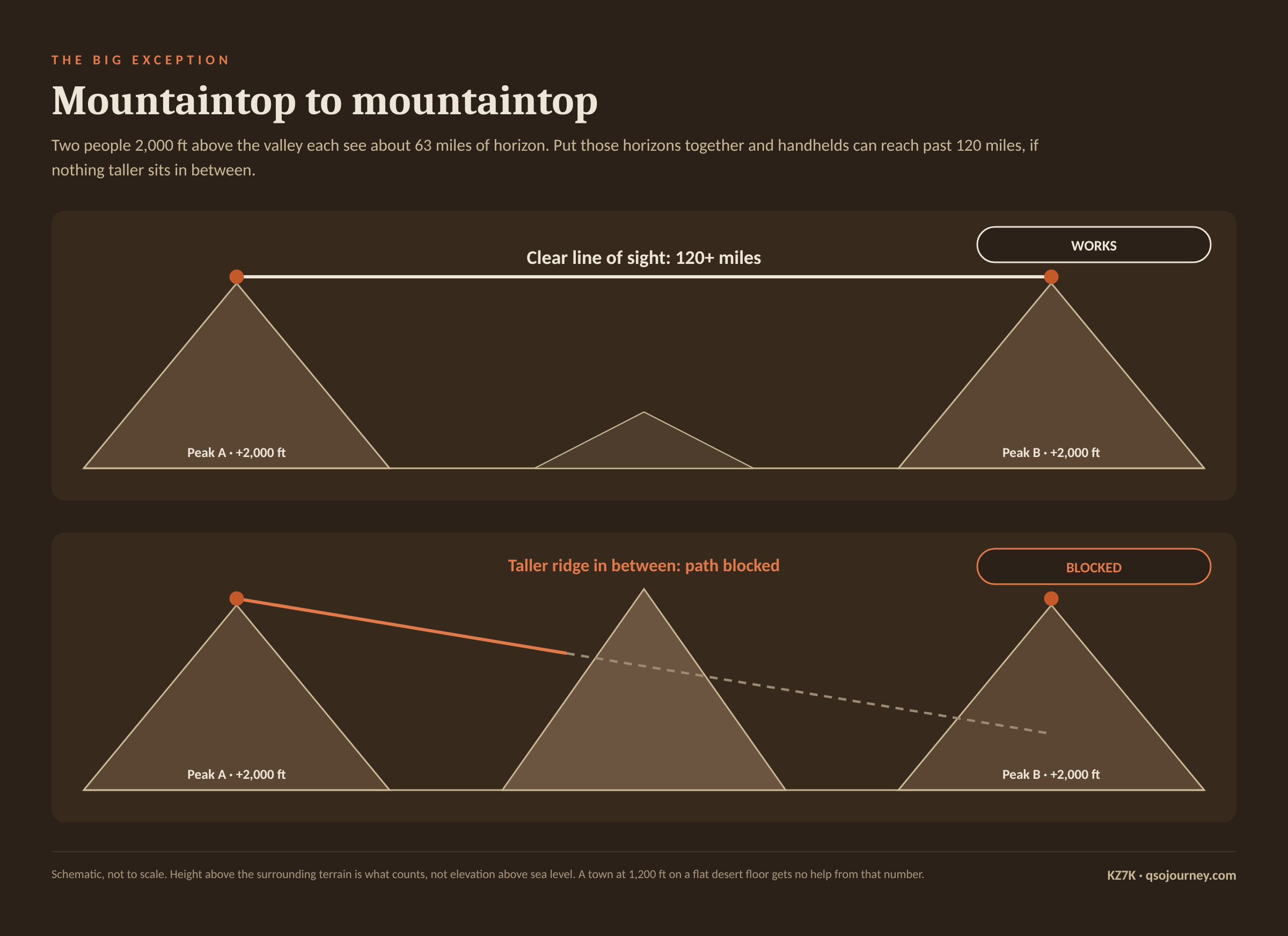
Everything above assumes you’re standing on fairly flat ground. Put both people on top of mountains and the math changes completely. Your radio horizon grows with height: take the square root of twice your height in feet and you get roughly your horizon in miles. At 5 feet that’s about 3 miles. At 2,000 feet above the surrounding terrain it’s about 63 miles. Put two people on peaks 2,000 feet above the valley floor, with nothing taller in between, and the line-of-sight path between them stretches past 120 miles. That’s why SOTA activators regularly make 100+ mile simplex contacts on 2 meters with nothing more than a handheld and a decent whip.
Two catches. First, it’s height above the surrounding terrain that counts, not elevation above sea level. A town sitting at 1,200 feet on a flat desert floor gets no help from that number. Second, the path still has to be clear, and another ridge between the two peaks blocks it just like a building would. But for a grid-down plan, this is a big deal. A pair of handhelds on two hilltops can bridge distances no setup on this map can touch, no repeater required.
What I’d Do With This
- Swap the stock antenna first. It’s the cheapest range upgrade you can buy.
- Carry a roll-up J-pole. Height beats watts, and a J-pole in a tree turns a handheld into a base station. If you’d rather make one, here’s how I go about building a 2m/70cm J-pole.
- Plan for a relay. In a mixed group, the best-equipped station should expect to be net control.
- Know your local repeaters, and know what happens when they’re down. That’s what simplex practice and a PACE communications plan are for.
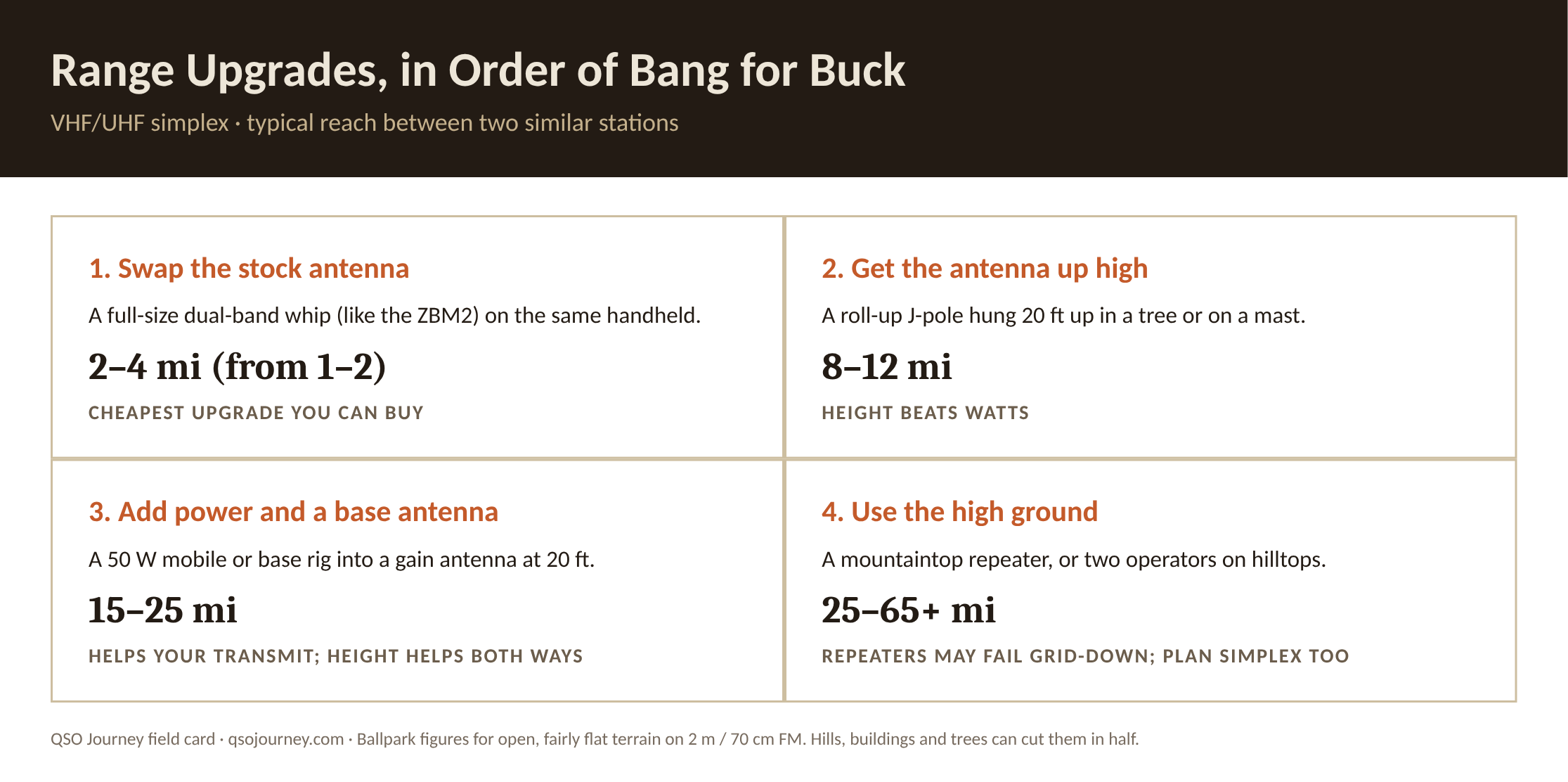
These are ballpark simplex numbers for open, fairly flat terrain on 2 m and 70 cm FM. Hills, buildings, trees, coax loss and receiver quality can cut them in half, and a good hilltop can double them. The same physics applies to GMRS (see GMRS Range Expectations: Marketing Claims vs Reality). Go test with your own group and see where your map lands.