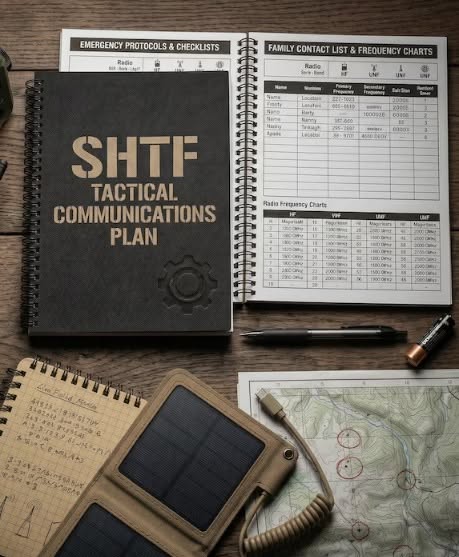
Part of our Emergency Communications and Preparedness guide.
I see a lot of guys building out kit or talking about builds and picking radios based entirely on what military, police, or tactical teams are doing. Here’s the reality check: a tactical team’s comms plan and an absolute worst-case SHTF plan are two completely different animals.
If you copy-paste tactical team logic into a grid-down scenario, you’re going to blind yourself. Here’s how the planning, device selection, and considerations actually break down, and why it matters.
The Tactical Team Model: Structured & Locked Down
When a dedicated tactical team spins up, they operate under a highly structured, top-down PACE plan (Primary, Alternate, Contingency, Emergency).
- The Setup: Predetermined frequencies, strict channelized memory blocks, and everyone running the exact same hardware.
- The Gear: Rugged, high-end, dedicated band transceivers, often locked down to specific UHF/VHF or P25 digital/encrypted channels.
- The Goal: Absolute internal team coordination. They don’t want or need to surf the bands during an op. The mission is self-contained, and extraneous RF traffic is just noise. If you’re on the team, you turn to Channel 2 and stick to the plan.
The SHTF Model: Team Comms + Signal Intelligence
When the grid goes dark and the shit hits the fan, your internal team comms plan is still vital, but it’s only half the battle. You cannot afford to lock yourself into a bubble.
- The Reality: You aren’t just coordinating a movement, you are hunting for information. What are local emergency services doing? What are other groups doing? Where is the traffic migrating?
- The Expansion: While your immediate circle might have an agreed-upon UHF/VHF simplex frequency or a DMR talkgroup for primary contact, your hardware needs to pull double duty. You need VFO mode unlocked and ready to manually punch in frequencies on the fly, rather than being restricted to a few locked channels.
- The Bandwidth: You need to monitor local repeaters, airbands, marine bands, GMRS/FRS, and potentially HF traffic to get the big picture.
For a structured way to build this out, see Building a PACE Communications Plan and The 3-3-3 Radio Plan. Tactical teams running the actual professional gear behind this model increasingly lean on ATAK for shared situational awareness, worth a look if your group is coordinating more than a couple of people in the field.
Bottom Line
A tactical team can afford to go quiet and narrow because someone else is watching the wider picture for them. In a grid-down world, nobody’s doing that for you. Your radio isn’t just a phone to your team, it’s your only window into what’s happening outside your bubble. Plan, and buy gear, accordingly.