
Part of our Getting On The Air: Bands, Operating, and Making Contacts guide.
Your logger is the hub that ties rig control, digital modes, awards and confirmations together (I explain why in Logging Software: Why It Ties Your Whole Station Together). Picking one comes down to three questions: do you want one paid suite or free tools, how serious are you about awards, and do you log away from the shack? I run Ham Radio Deluxe at home and HAMRS in the field, with everything confirming through LoTW, QRZ and HRDLog. Here’s how the main options compare.
Jump to: Ham Radio Deluxe · Log4OM and DXKeeper · Cloud logging
What Is Ham Radio Deluxe?
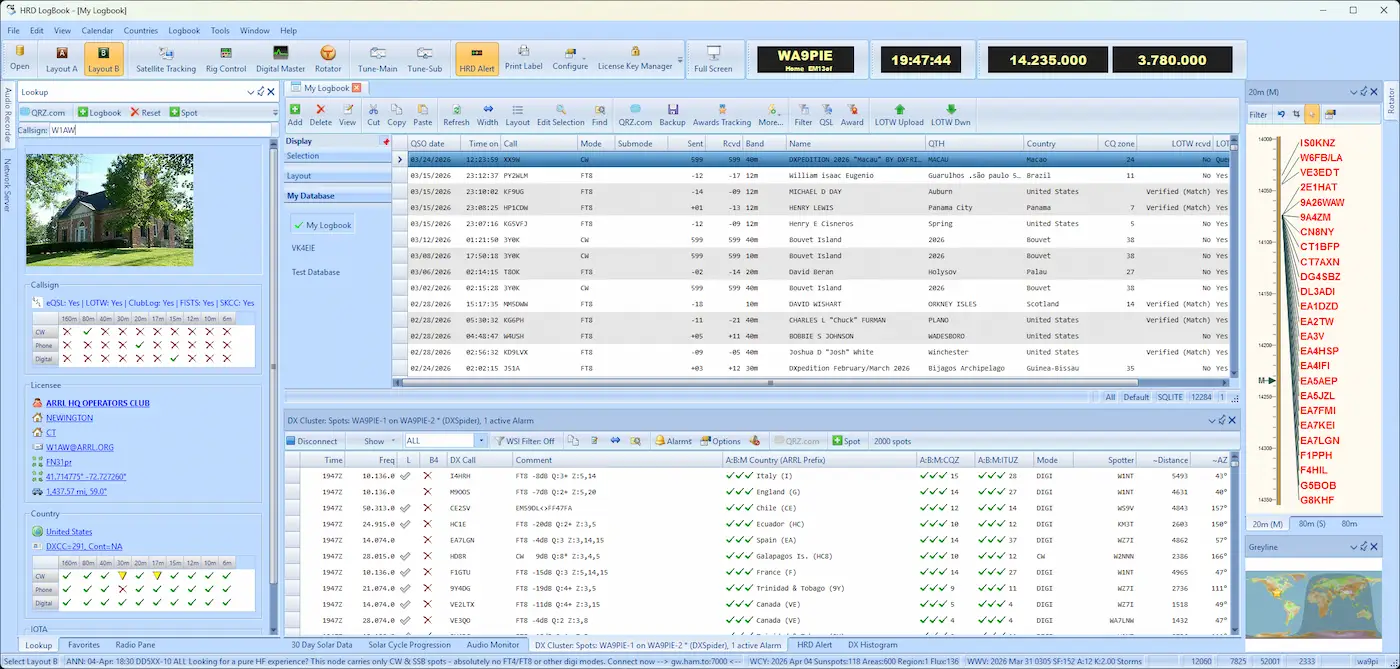
Ham Radio Deluxe, usually HRD, is a commercial Windows suite (paid, with a support and update subscription) that bundles rig control, logging, digital modes and more into one integrated package. You use as much or as little of it as you like.
- Rig Control: CAT control for a very wide range of radios, with an on-screen interface for frequency, mode and settings.
- Logbook: full-featured logging with online services and award tracking.
- Digital Master (DM780): PSK31, RTTY and similar modes, much like Fldigi.
- Rotator Control for pointing a beam, and Satellite Tracking with Doppler correction.
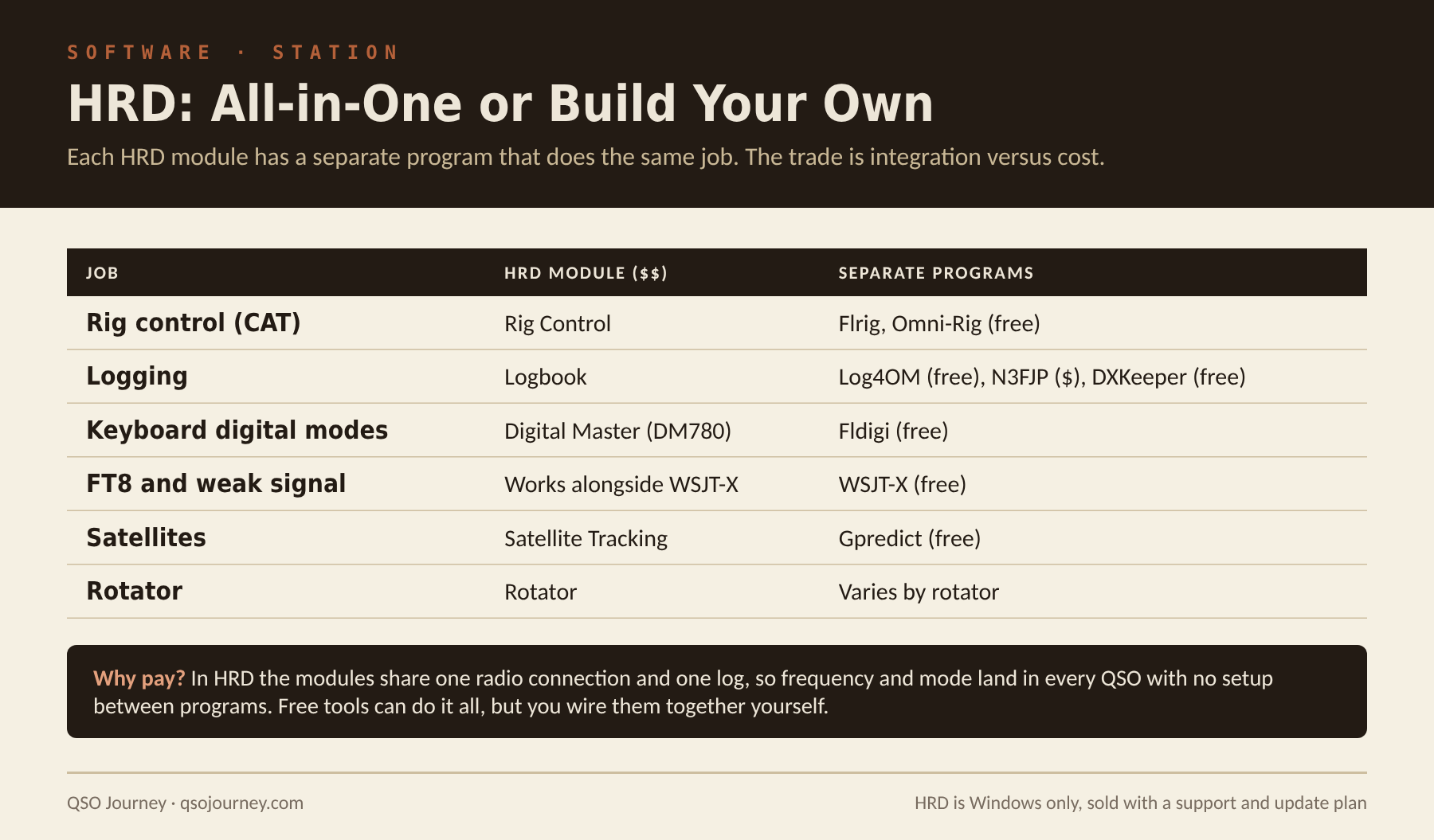
The big draw is that everything talks to itself. Rig control feeds the logbook, so contacts get the right frequency and mode automatically, the logbook connects to the online services, and digital-mode contacts land in the same log. It has a long history, a big user base and a huge radio list. The catch is cost: free tools can cover most of the same ground if you’re willing to connect them yourself. For me the all-in-one convenience won out, and I show how HRD shares CAT control with WSJT-X in Setting Up WSJT-X, GridTracker, HRD and TQSL. For a free all-in-one built from the other direction, see my Nexus review.
Log4OM and DXKeeper: Free Alternatives to HRD

Log4OM (now on its second major version) is completely free, developed by an Italian team of hams and actively maintained. It handles CAT control directly, integrates with WSJT-X and JTAlert the same way HRD does, has a built-in DX cluster, and covers digital-mode integration, DXCC and award tracking, and cloud sync, essentially the same checklist as the paid options. The interface is rougher and the learning curve steeper, with a smaller (but active) support community. It’s one of the best free loggers available.
DXKeeper is part of the DXLab Suite, a set of interconnected free programs for logging, spots, propagation and more, built to work together. It’s well regarded by serious DXers and contesters for its award tracking depth, though the suite’s dated interface and multi-program setup ask more of a new user than a single app.
- Want a modern, single-application free logger: Log4OM is the easier recommendation.
- Chasing DXCC and awards seriously and don’t mind a piecemeal suite: DXKeeper’s award tracking is hard to beat.
- Whatever you choose, make sure it exports clean ADIF, since that’s what lets you move your log later.
If HRD or another paid logger is already working for you, I wouldn’t rip it out to save the subscription. Migrating loggers mid-stream is a real hassle and a real risk to your contact history. But for a new ham keeping costs down, either free option is worth the download, and neither is a stripped-down demo. Contest logging is its own animal, covered in Contest Logging: N1MM+ vs N3FJP.
Cloud Logging Compared: QRZ Logbook, Club Log and HAMRS
Desktop software is great at one computer in one shack. Cloud logging solves a different problem: keeping your log reachable from your phone, laptop and the field, all synced to one place.
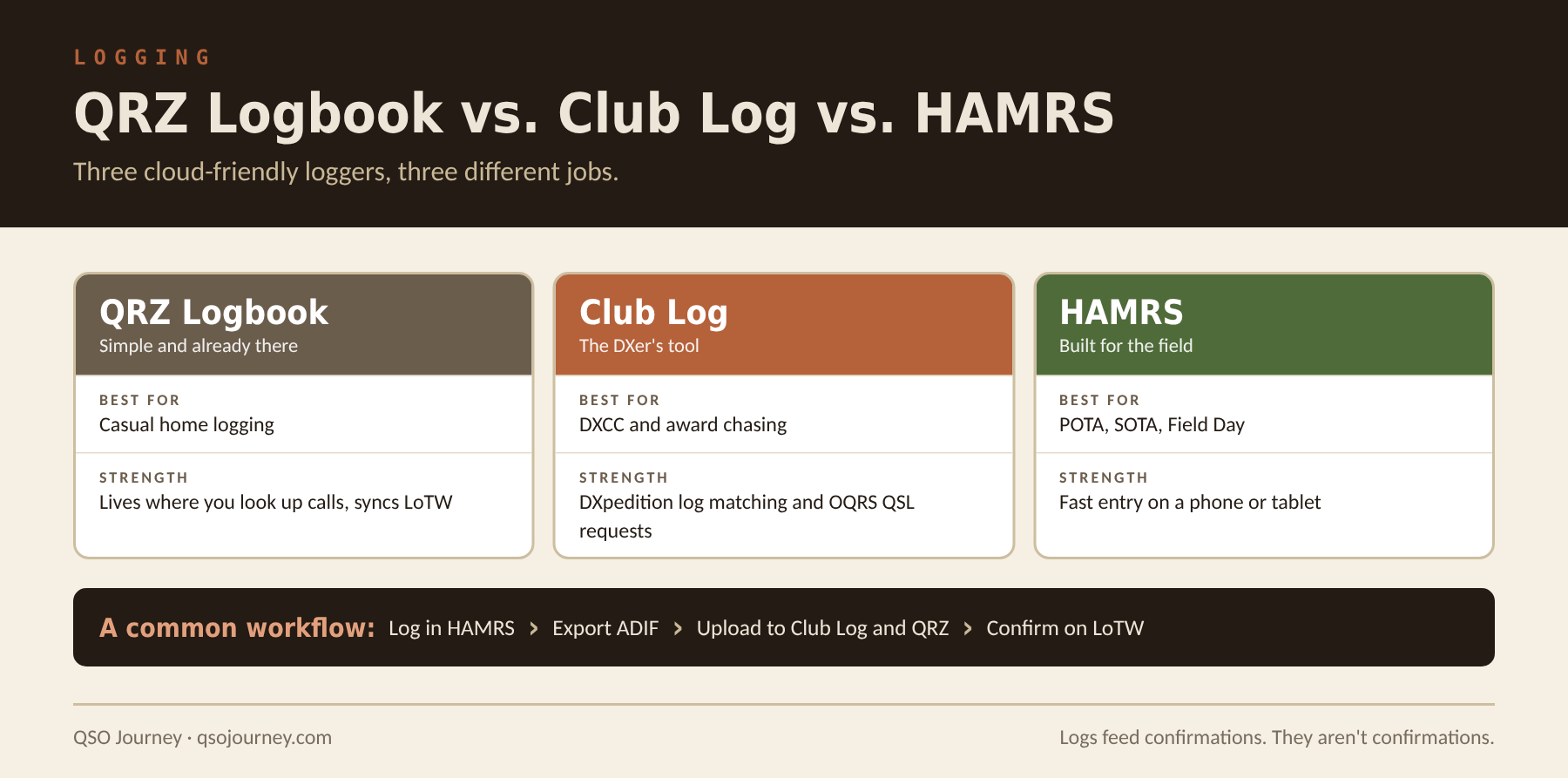
- QRZ Logbook lives in the QRZ.com ecosystem most hams already use, so it’s a low-friction start. It syncs with LoTW and eQSL reasonably well and is an upload target for a lot of logging software. Best for casual home logging.
- Club Log is the standard for serious DXers and DXpeditions. It excels at DXCC tracking, checks your contacts against uploaded DXpedition logs to catch busted calls, handles QSL requests through OQRS, and gives detailed award statistics.
- HAMRS is built for portable operating: POTA, SOTA and Field Day logging on a tablet or phone with a fast, simple interface. It’s about capturing accurate logs outdoors, then exporting them elsewhere. It’s what I use in the field (see The POTA Go-Bag Guide).
Most active operators use more than one: log in the field with HAMRS, then upload to Club Log and QRZ for award tracking and visibility. None of these replace LoTW confirmations. They’re logging tools that feed the confirmation systems, which I cover in QSLing for DXCC. Don’t forget backups either: my logbook backup routine is in the shack setup guide.
Related reading: Ham Radio Apps and Software Worth Having · RT Systems Programming Software · FT8 Helper Apps