

Part of our Getting On The Air: Bands, Operating, and Making Contacts guide.
A POTA go-bag isn’t the same thing as a manpack, even though they overlap. A manpack is built around the radio. A go-bag is built around getting in and out of a park efficiently, with everything in one place and organized so you aren’t digging through a jumble of cables trying to remember which one is CAT and which one is audio. This guide covers what goes in it, what to carry it in, and how to scale it down for a family trip. If you haven’t activated yet, read My First POTA Activation: What I Wish I Knew Beforehand first.
Jump to: The go-bag checklist · Choosing a backpack · POTA on a family vacation
Building the Ultimate POTA Go-Bag
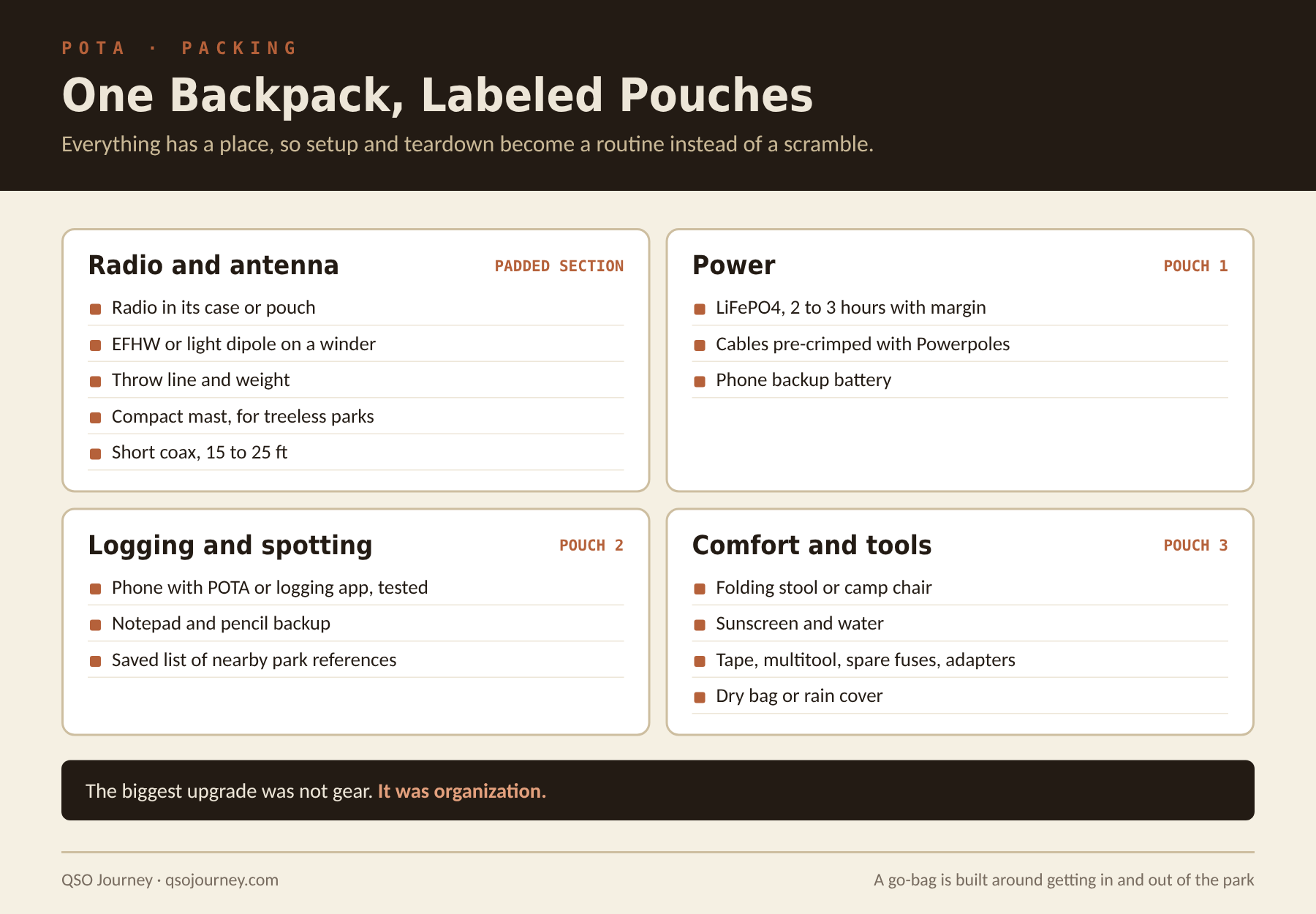
The radio and antenna core
- The radio, already in whatever case or pouch protects it in transport and during setup.
- An EFHW or lightweight dipole, pre-wound on a winder so it deploys without untangling a mess every time. (Not sure which? See Which Portable HF Antenna Should You Actually Bring?)
- A throw line and weight for getting wire into a tree with no mast at all, one of the fastest deployment methods there is.
- A compact mast or collapsible pole as backup for parks with no usable trees.
- Short coax. A 15 to 25 foot run is usually plenty and keeps loss minimal.
Power
- A LiFePO4 battery sized for at least two to three hours of operating with margin left over. I do the math in HF go-kit power budgeting.
- Power cables with Anderson Powerpoles already crimped on (here’s how I wire them), so you aren’t fumbling at the park.
- A small backup battery for your phone, since spotting and logging drain it faster than you expect in the sun.
Logging and spotting
- A phone with the POTA app or your logging app already installed and tested, not downloaded for the first time in the parking lot. HAMRS is what I use for portable logging.
- A notepad and pencil as backup, because phones die, apps crash, and paper does neither.
- A saved list of nearby park reference numbers if you plan a rover run through several parks.
Comfort and practicality
- A folding stool or camp chair, since not every park has seating.
- Sunscreen and water, which sound obvious until you’re twenty minutes in and realize you forgot both. Here in Arizona, water is not optional.
- A tool pouch with electrical tape, a multitool, spare fuses and a couple of connector adapters. The one time you skip the spare fuse is the time you need it.
- A dry bag or rain cover for the kit if you activate anywhere with unpredictable weather.
The biggest upgrade to my own go-bag wasn’t any piece of gear. It was organizing everything into labeled pouches inside one backpack so setup became a repeatable routine instead of an improvisation. Cables in one pouch, antenna and throw line in another, radio and accessories in a padded section. When everything has a place, setup time drops dramatically and teardown is just as fast, which matters when you’re trying to beat fading daylight or an incoming storm. For the weather and working-alone side of that, see Field Safety for POTA and SOTA.
Choosing a Backpack for a Portable HF Setup
Most of the planning goes to the radio, antenna and battery, but the wrong pack turns a good kit into an awkward carry, and the right one disappears into the background.
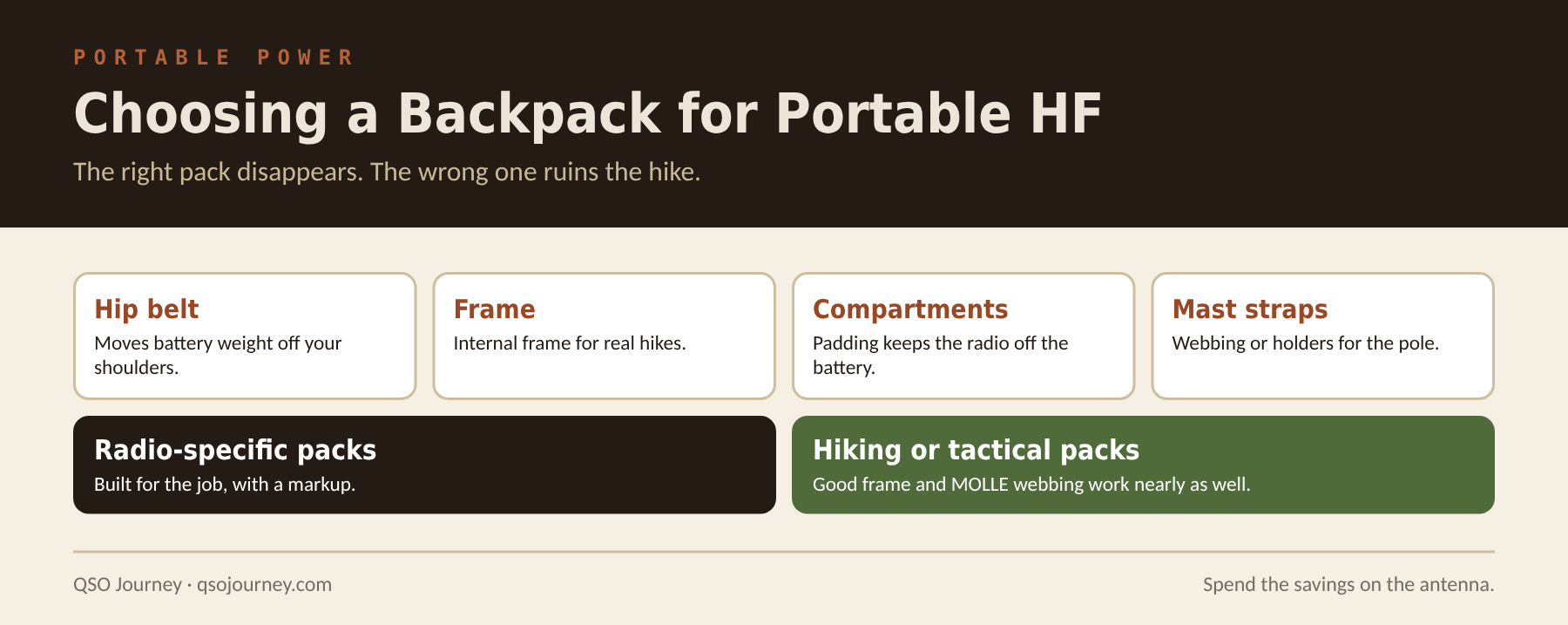
- Weight distribution beats capacity. A battery, radio and antenna add up fast. A proper hip belt moves the load off your shoulders, and an internal frame matters if you hike any real distance to a POTA or SOTA site.
- Dedicated compartments prevent damage. Radios and antenna parts don’t do well bouncing against a battery box or tools. Padded, separated compartments, or padded cubes inside one main compartment, protect them far better than one open cavern.
- External attachment points for a mast. A telescoping mast or Porta Mast-style pole is usually too long to fit inside. Daisy chain webbing, side compression straps or a mast holder let you strap it outside. It’s one of the most overlooked features and one of the most useful.
Radio-specific manpack backpacks exist, but a quality tactical or hiking pack with a good frame, solid compartments and external MOLLE webbing works nearly as well for a fraction of the markup. I’d rather see the money go into the radio and antenna than into a radio-branded bag with mediocre construction.
A packing checklist
- Radio and any tuner, in a padded pouch.
- Battery, in its own compartment or at the bottom of the pack near your back.
- Antenna wire, feedline and connectors, in a labeled bag.
- Mast strapped to the outside.
- Log, pencil, earbuds and a small tool kit.
- Water, a layer, and anything else the hike calls for.
Pack heavy items close to your spine and low in the pack. A battery sitting high or far from your back pulls you off balance on uneven trail.
Operating POTA on a Family Vacation Without Making It a Whole Thing
I’ve activated parks on family trips more than once, and the difference between a trip that stays fun for everyone and one that causes friction usually comes down to how much time and gear I let myself bring.
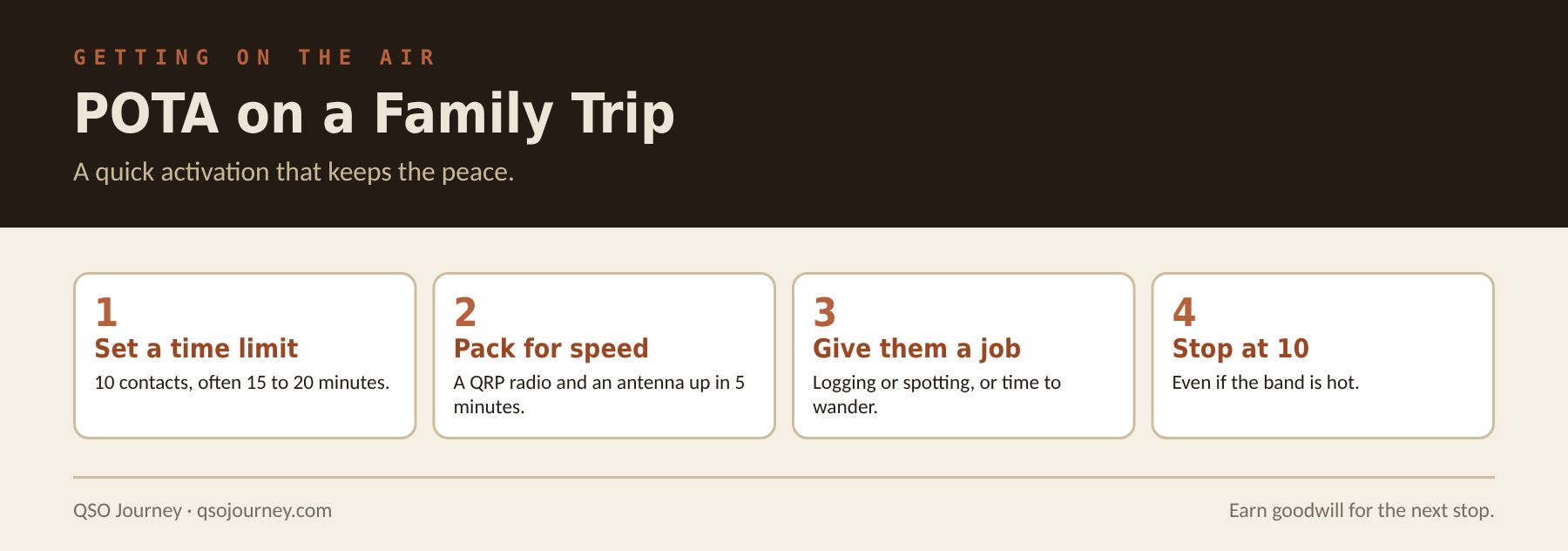
- Set a real time limit. Ten valid contacts qualifies an activation, and on FT8 or a decent SSB opening that’s often 15 to 20 minutes. Decide the limit before you set up, tell your family the plan out loud, and stick to it even if the band is hot. A quick, successful activation earns goodwill for the next one.
- Pack for speed, not capability. This isn’t the trip for the full manpack. A compact vertical or random wire that deploys in under five minutes, a small radio and a lightweight support (even a hiking pole with a clip) gets you on the air fast. Save the full dipole and tuner for a trip where activating is the point. I learned the carry-less lesson the long way, which I wrote about in My POTA Radio History.
- Spot yourself right away. Self-spotting is what brings hunters to your frequency fast, and fast is the whole point on a family stop.
- Give your family a job or an out. Some families enjoy logging or spotting the park on a phone, which turns it into a shared activity. If that’s not your family, let them wander while you activate and rejoin them the moment you hit ten contacts.
Related reading: POTA and SOTA: Taking Ham Radio Into the Field · Ham Radio Apps and Software Worth Having · Reading Solar Weather