
Part of our Building Your First Ham Radio Station guide.
Running a station away from the wall comes down to three questions: which battery chemistry, how much battery, and how to put the energy back. This guide answers all three, in that order. My own portable and backup power is a DIY 100Ah LiFePO4 battery box, and I compare that approach to the commercial stations in DIY Battery Box vs EcoFlow, Jackery and Predator. For wiring it all safely, see 12V DC Power for Ham Radio.
Jump to: LiFePO4 vs SLA · Power budgeting · Solar charging
LiFePO4 vs SLA: Choosing a Battery for Portable Power
Sealed lead acid was the default portable ham battery for decades, and lithium iron phosphate has largely taken over for good technical reasons. Both still have a place, and the right choice depends more on your use than on which chemistry is better on paper.
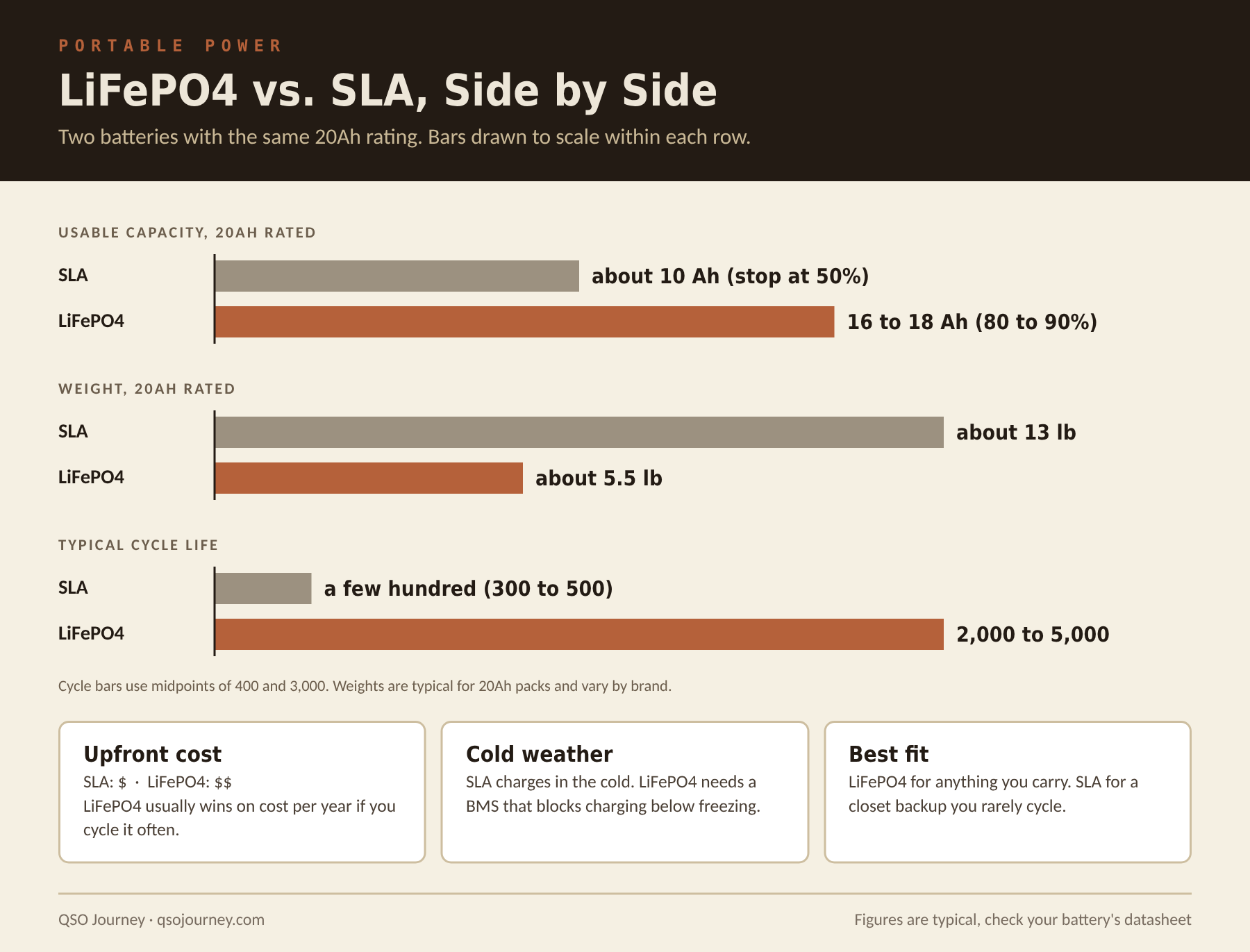
- Weight and size: LiFePO4 wins decisively, typically under half the weight for the same usable capacity. In the shack it barely matters. For a manpack or POTA kit it’s often the deciding factor.
- Usable capacity: an SLA shouldn’t go below about 50 percent of its rating without shortening its life, so a 20Ah SLA really gives you about 10Ah. LiFePO4 handles 80 to 90 percent depth of discharge, so a 20Ah pack gives you close to 20Ah. A LiFePO4 battery rated at half an SLA’s capacity often runs about as long.
- Lifespan and cost: SLA is cheaper up front but tolerates a few hundred cycles. LiFePO4 handles several thousand, which usually makes it cheaper per year of use. If you cycle a battery often (Field Day, regular POTA, nets away from home), LiFePO4 pays for itself. If it mostly sits as backup, the SLA price advantage matters more.
- Cold and safety: SLA tolerates cold charging better. LiFePO4 shouldn’t be charged below freezing without a battery management system that blocks it, though most quality packs include that now. LiFePO4 is also far more thermally stable than other lithium chemistries, without the fire risk of lithium ion or lithium polymer.
Voltage under load and charging
A 12 volt LiFePO4 pack rests around 13.2 to 13.4 volts and stays near 13 volts for most of its discharge, which suits radios built around a 13.8 volt supply. An SLA starts near 12.7 volts at rest and sags steadily, and under transmit current it can drop low enough that some radios cut power or shut down well before the battery is empty. That flat curve is a big part of why LiFePO4 feels stronger in the field at the same rating. Charge each chemistry with the matching profile: LiFePO4 wants roughly 14.2 to 14.6 volts and no long float or desulfation stage.
My recommendation: for anything portable, a manpack, a POTA kit, an HT charging station you actually carry, LiFePO4 is worth the extra cost almost every time. For a stationary backup that sits in a closet and gets tested occasionally, a well-maintained SLA still does the job for less, as long as you respect its shallower discharge limit.
HF Go-Kit Power Budgeting: How Much Battery You Really Need
Nothing ends an activation or a field deployment faster than running out of power halfway through. Guessing at capacity is how that happens. Running the numbers is how you avoid it.
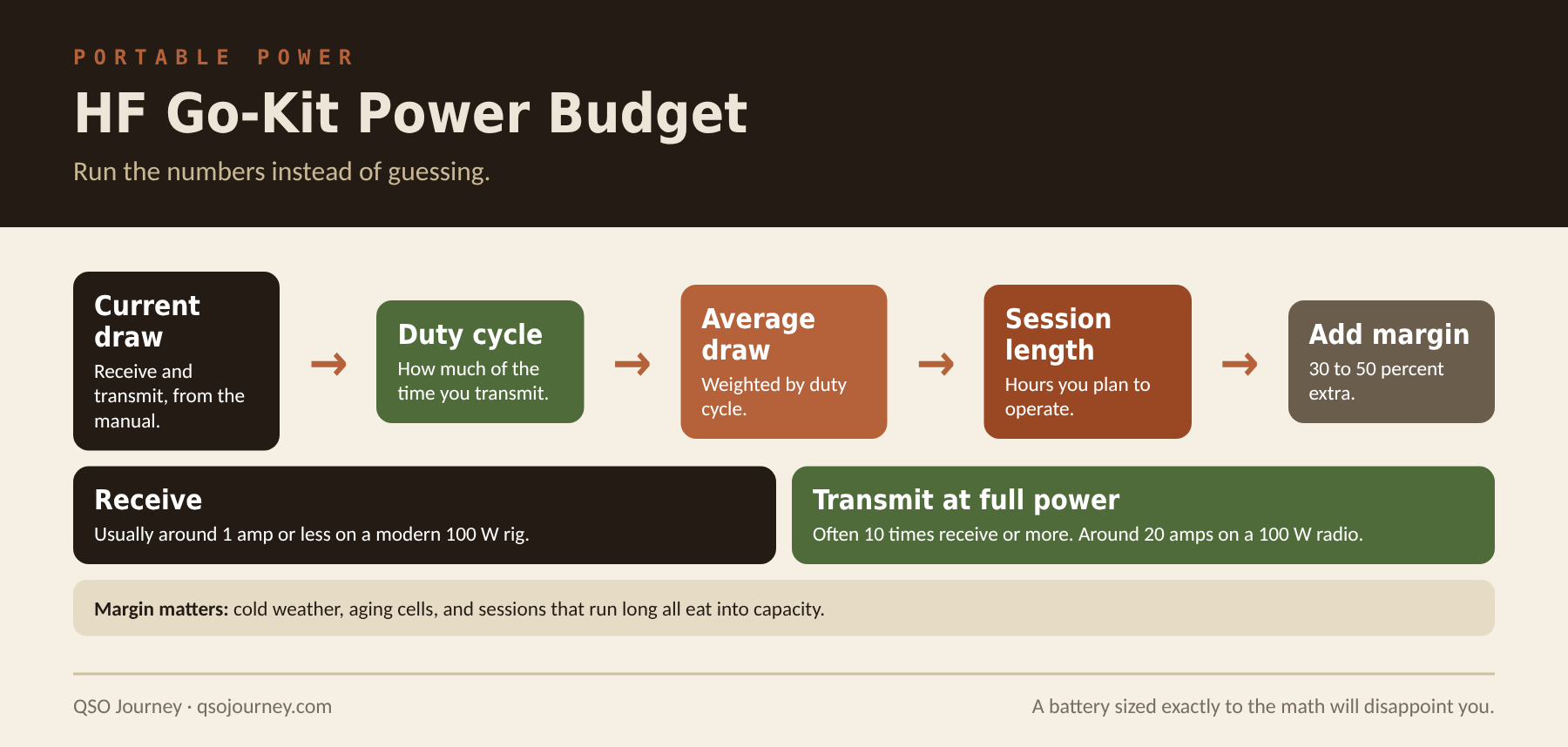
Start with your radio’s actual current draw for receive and for transmit at various power levels, from the manual. Transmit at full power is often ten times receive or more on a 100 watt radio, but your real pattern is mostly receive with intermittent transmit. Then estimate duty cycle. An SSB ragchew runs maybe 40 to 50 percent transmit during active conversation, and less when you’re running a pileup with short exchanges. FT8 is predictable: close to 50 percent. Multiply out the average draw over your session length.
| Item | Value |
|---|---|
| Receive draw | About 1.5 A |
| Transmit draw at 100 W | About 20 A |
| SSB duty cycle (transmit share) | About 25 percent while running a pileup |
| Average draw | (0.75 x 1.5) + (0.25 x 20) = about 6.1 A |
| Three-hour session | About 18 Ah |
| With 50 percent margin | About 27 Ah |
That’s a typical 100 watt HF rig on a three-hour POTA activation, so swap in your radio’s real figures. Drop to 50 watts and transmit draw roughly halves, bringing the same session to around 15 Ah with margin. On FT8 the duty cycle is close to 50 percent, so even at reduced power the average draw is higher than SSB. My Power Calculator runs this math for you.
- Build in margin: at least 30 to 50 percent beyond the calculation. Cold reduces usable capacity, and sessions run long far more often than they run short.
- Budget against usable capacity, not rated: a 50 Ah AGM battery is closer to a 25 Ah LiFePO4 pack in practice, for the reasons above.
Solar Charging: Panels, Charge Controllers and Realistic Expectations
Solar-powered stations sound great and disappoint a lot of people, usually because the system was sized for a best-case sunny day. Done right, solar can keep a station running indefinitely off-grid.
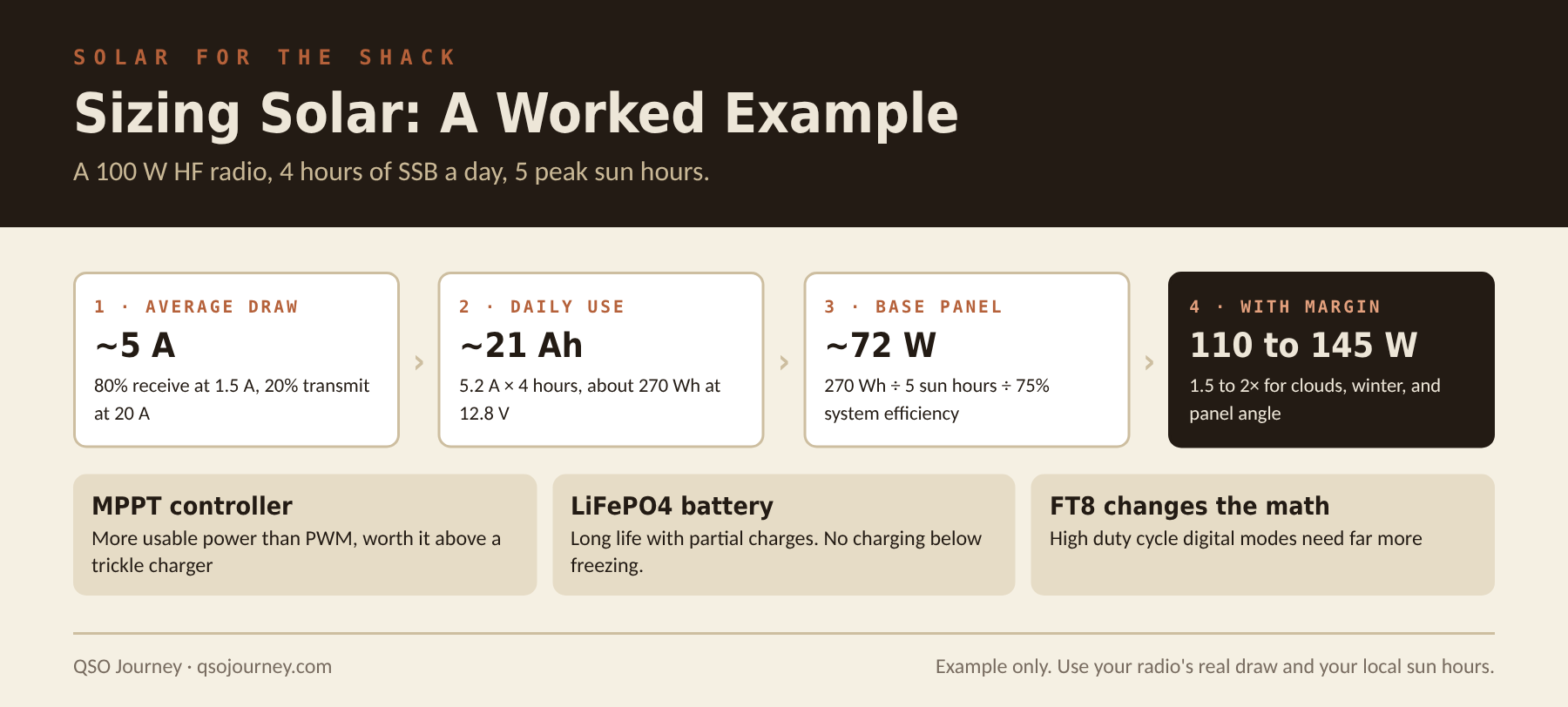
- Start with the daily budget: your realistic average draw (from the section above) times the hours you’ll operate per day.
- Size the panel to replace that within your region’s realistic average sun hours, not a clear June afternoon. Clouds, short winter days and panel angle all cut output well below rating. Size for about 1.5 to 2 times your calculated need so two cloudy days don’t leave you with a dead battery.
- Use an MPPT controller. MPPT extracts meaningfully more power than PWM, especially in cooler weather or with higher-voltage panels. For anything beyond a trickle charger, it pays for itself.
- Pair it with LiFePO4. It handles the repeated partial charges of solar far better than SLA. If your panels and battery live somewhere that freezes, use a battery with low-temperature charge cutoff or a controller with a temperature sensor.
Set expectations honestly. Casual QRP or receive-heavy operating is easy to sustain on a modest setup. Regular high-power transmitting, especially high duty cycle digital modes, needs much more panel and battery than people expect. And a few cloudy days in a row will test any system, so plan margin for that instead of sizing for average conditions alone.
Related reading: The POTA Go-Bag Guide · Backup Power for the Shack · Choosing a Desktop Power Supply