
Part of our GMRS Radio: The Complete Guide.
People chase GMRS range by buying a radio with more watts. That helps a little. What actually moves the needle is the antenna and where it sits, and then giving the radio a proper install with clean power. This guide starts with antennas, then builds out the two stations most families end up with, a home base and a mobile, and finishes with setting up a group on the road. My own home GMRS station is a Wouxun KG-1000+, my favorite dedicated GMRS radio.
Jump to: Antennas and coax · Home base station · Mobile install · RV and overland groups
GMRS Antennas: What Actually Improves Your Range
GMRS at 462 and 467 MHz is line of sight. Getting your antenna higher, whether that’s a roof mount on a truck instead of a hood mount, or a mast antenna instead of a handheld on the kitchen counter, does more for your range than doubling your transmit power. It’s the same physics as ham VHF and UHF range, and it doesn’t care what service you’re licensed under.
- Handhelds: the stubby stock antenna is built for compactness. A longer whip tuned for 462 to 467 MHz, not a generic multiband antenna, noticeably improves transmit and receive, and it’s the cheapest upgrade there is.
- Vehicles: an NMO mount on the roof is the gold standard, with a full ground plane and the highest practical mounting point. A mag mount is a reasonable compromise if you can’t drill, but loses some to the ground plane and cable routing.
- Home: a dedicated UHF base antenna on a mast, gable mount or in the attic beats a handheld on a desk by a wide margin. If you’re getting scratchy audio into a repeater, the antenna and its height are almost always the fix, not a new radio.
What doesn’t help much, and why coax matters at UHF
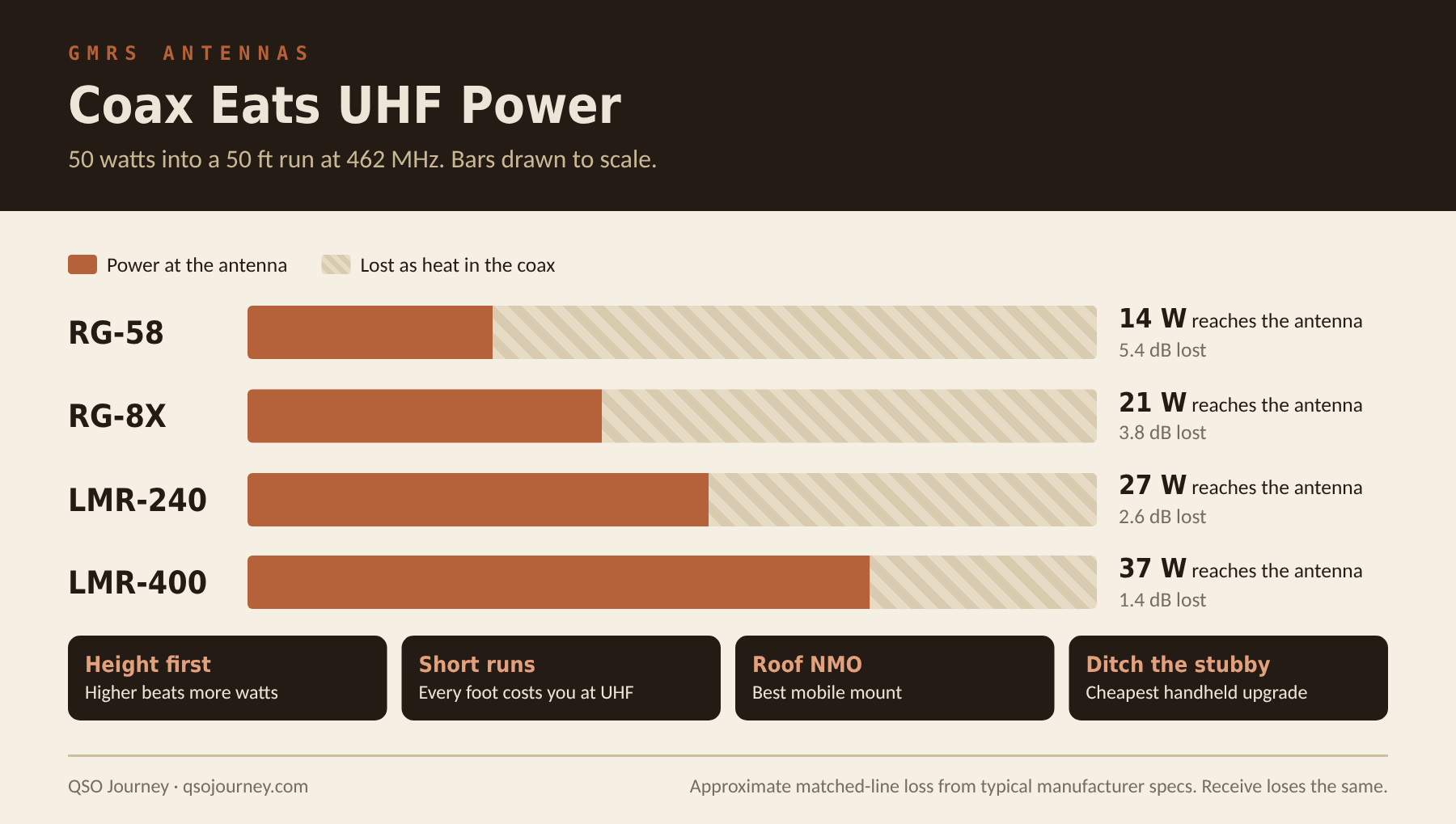
A “50 watt” radio on the stock rubber duck still bottlenecks at the antenna, and an antenna mounted low, indoors or surrounded by metal won’t give mobile-radio range. Coax is the sneaky one. At 462 MHz, 50 feet of thin RG-58 loses roughly 5 dB, so a 50 watt mobile puts only about 14 watts into the antenna, and every weak signal takes the same hit coming back in. RG-8X is a little better. LMR-400 over the same run loses well under 2 dB and delivers more than twice the power of the RG-58. For a home base with a long run up a mast, the coax upgrade can be worth more than the radio upgrade.
GMRS Base Stations: Building a Fixed Setup at Home
A handheld on the kitchen counter isn’t a base station. It’s a handheld indoors, and it performs like one. A real base station is a small, worthwhile project that dramatically improves your ability to reach family members running errands, kids at practice, or a repeater across town.
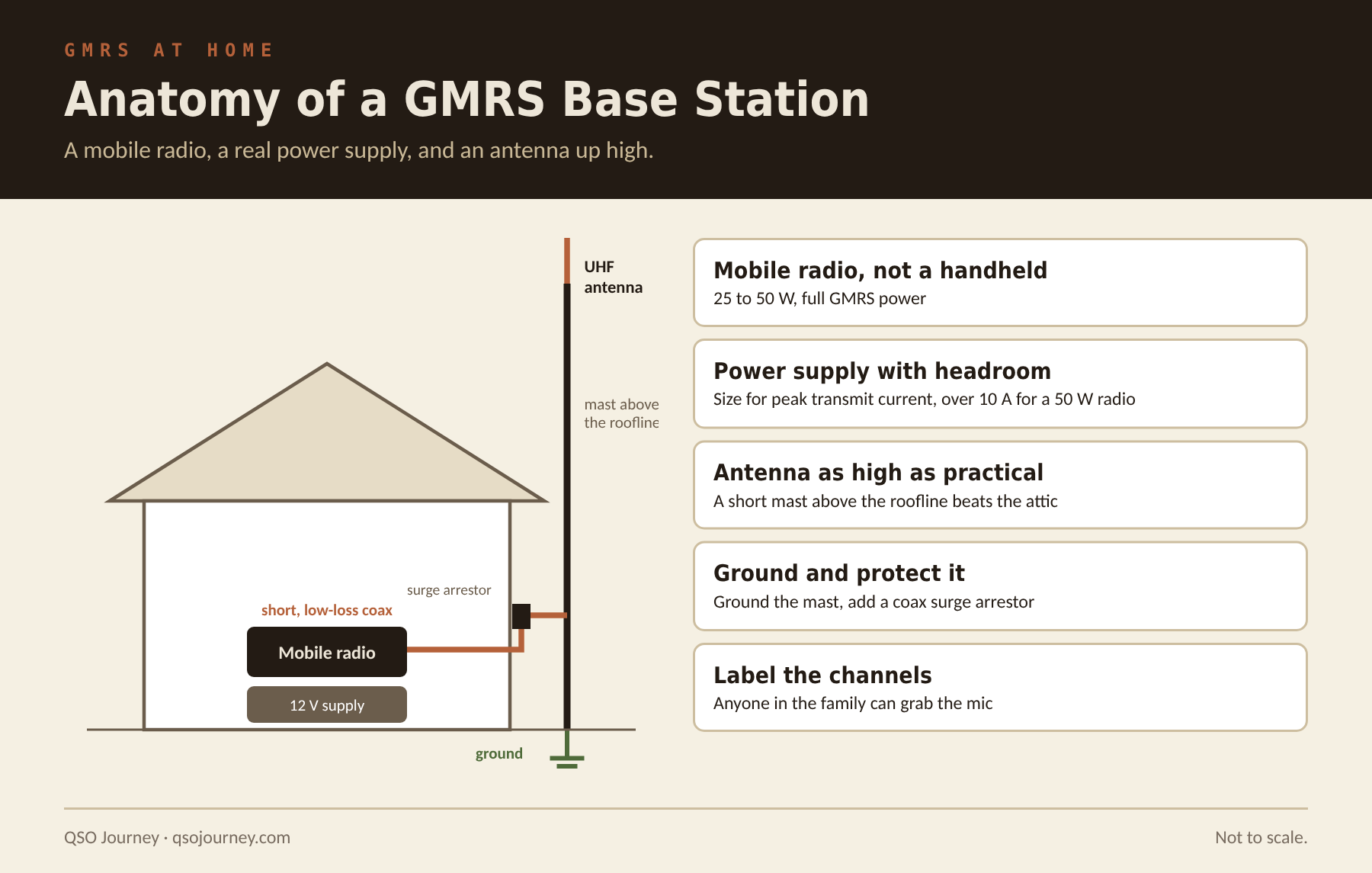
- A mobile GMRS radio (not a handheld) capable of full legal power, typically 25 to 50 watts.
- A 12V power supply sized for the radio’s peak draw. A 50 watt GMRS mobile can pull well over 10 amps on transmit, and an undersized supply sags, which shows up as distorted audio or resets. An Astron-style linear or quality switching supply both work.
- A dedicated UHF base antenna, ideally on a short mast above the roofline. An attic mount is a reasonable compromise, though metal roofing and HVAC ductwork can attenuate more than people expect.
- Quality low-loss coax, as short as practical.
Once the antenna is outside and up high, ground the mast and put a coax surge arrestor where the cable enters the house, bonded to the same ground as your electrical service. The National Electrical Code (Article 810) covers how antenna masts and lead-ins are grounded, and a local electrician can confirm it’s done right. It won’t make a direct strike harmless, but it gives nearby surges and static a path to ground that isn’t through your radio.
Program your family’s agreed simplex channel plus any local repeaters worth having (see GMRS Repeaters), and label channels clearly so anyone in the family can grab the mic and use it correctly without a tutorial.
Installing a GMRS Mobile Radio in Your Vehicle
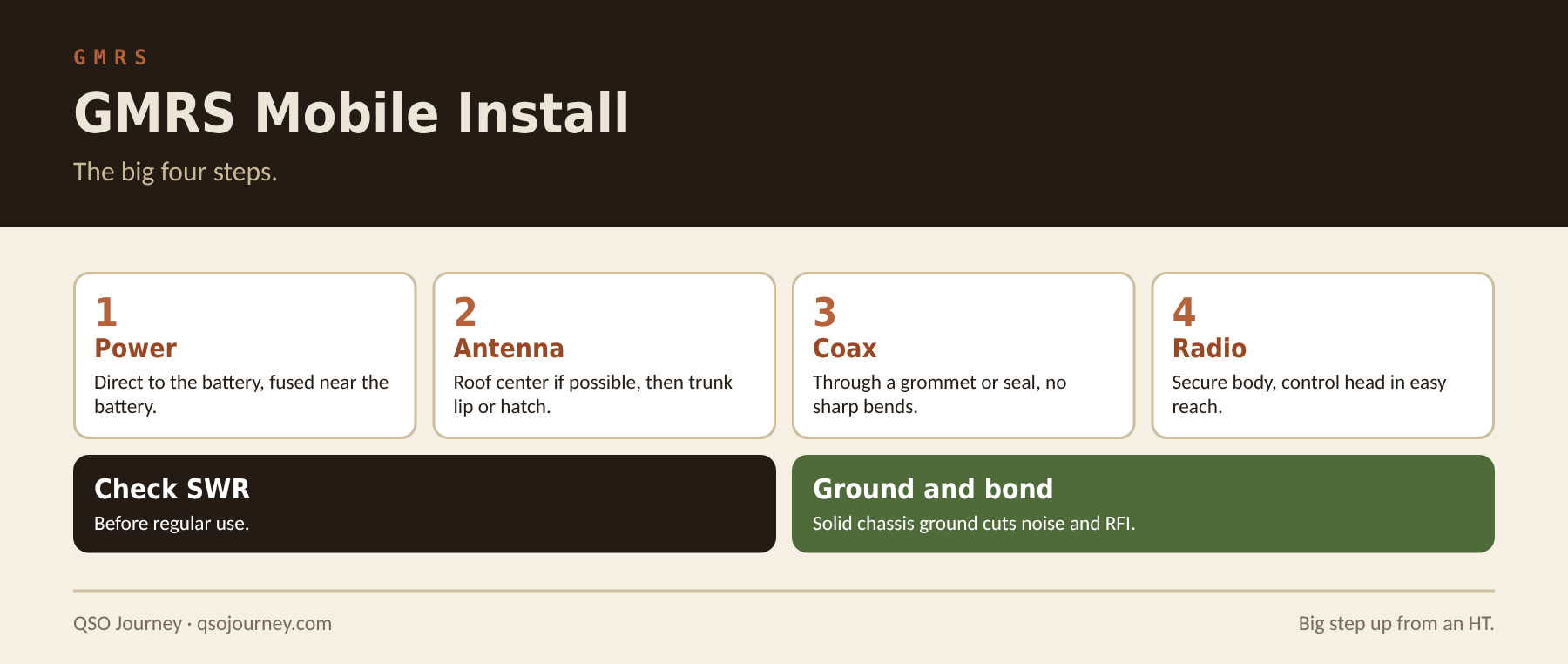
- Power straight to the battery. Don’t tap an accessory outlet or the fuse box. Run the leads to the battery with an inline fuse close to it on the positive lead, and keep the fuse on the negative lead too if the radio came with one. Accessory circuits often can’t deliver clean voltage under transmit load, which shows up as low power or resets. (More on that in fusing a 12V station.)
- Mount the antenna high. A roof mount, permanent or magnetic, gives the best ground plane and clearest line of sight. If that isn’t practical, a trunk lip or hatch mount is next best. Use a GMRS-rated antenna tuned for 462 to 467 MHz, not a 2 meter or dual-band ham antenna.
- Route the coax and power cleanly. Plan the full route before drilling anything. Bring coax in through an existing grommet or door seal, avoid sharp bends, use a factory firewall grommet for power, and keep both runs away from factory wiring where you can to reduce noise.
- Mount the radio and check it. Put the body somewhere secure, under a seat or in a console, with the control head where you can see and reach it. Ground the chassis to the vehicle frame, since a poor ground is a common source of noise. Check SWR with a meter or dummy load inline the first time you transmit.
If you can, have a licensed friend check in on simplex from a few miles away before you rely on it. A range test is the best way to know what to expect. For the ham side of the same job, see Mobile Radio Install Guide.
GMRS for RVers and Overlanders

If you travel with other vehicles, in an RV caravan or an overland group, GMRS is the easiest way to keep everyone in touch without the complexity of ham radio or the range limits of FRS. One license covers your immediate family with no exam, and GMRS power limits and repeater access give real range between vehicles.
- Put a properly installed mobile with an external antenna in as many vehicles as practical. The gap between a mobile and a handheld is significant at highway speed with terrain between you. Keep a handheld in each vehicle for camp and hikes.
- Give the lead and trail vehicles the strongest radios and best antennas, since they cover the longest spacing.
- Assign a main and a backup channel before leaving, and write them on a card in each vehicle.
- Use a CTCSS or DCS tone on your group channel to cut down on hearing other users, but remember it doesn’t make the channel private.
- Set check-in times, such as each fuel stop, so everyone confirms the group is together.
- Check repeater directories for your destination the way you’d check cell coverage, and get the owner’s permission where required.
Everyone who transmits needs to be covered by a GMRS license. Yours covers your immediate family, but friends traveling with you need their own. For mixing GMRS and ham on the same trip, see GMRS and ham on a road trip.
Related reading: Best GMRS Radios for Families and Overlanding · Midland MXT275 Review · What GMRS Allows