

Part of our New Ham? This Is Where You Should Spend Your Money guide.
If you’ve spent any time around a ham shack built in the last few decades, odds are you’ve seen an Astron linear supply sitting under the desk, usually still running, usually still original. The RS-50M is one of the most common sizes in that lineup, and it’s worth understanding both what it does well and where a modern switching supply might actually make more sense.
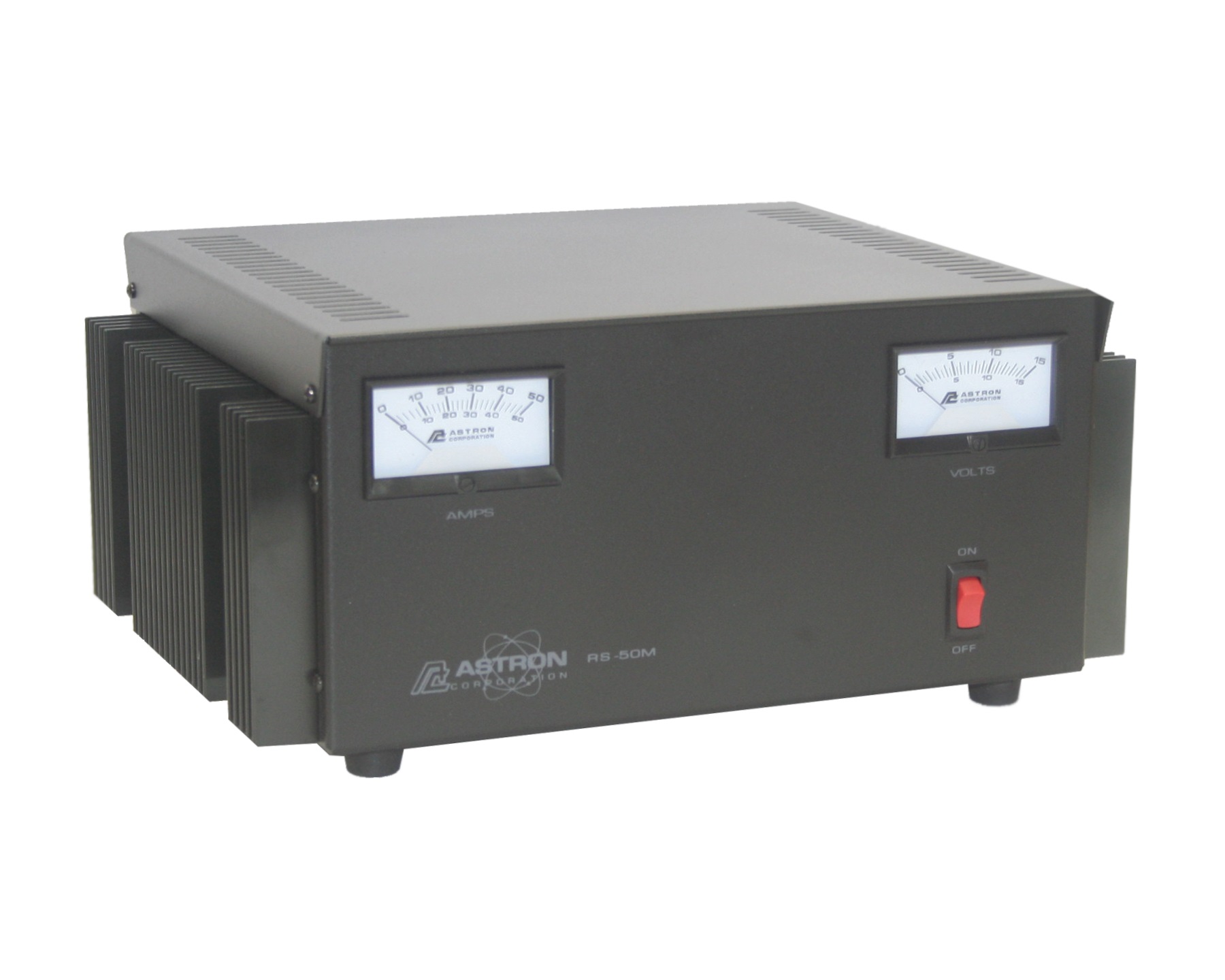
What the RS-50M actually is
- Linear, transformer-based, solid-state regulated power supply
- Output: 13.8 VDC ±0.05V (internally adjustable from roughly 11-15 VDC)
- Current: 37A continuous duty, 50A ICS (Intermittent Communication Service, rated at a 50% duty cycle, 5 minutes on / 5 minutes off)
- Ripple: less than 5mV peak-to-peak at full load, low line, genuinely clean DC
- Regulation: 0.5% across load and line voltage ranges
- Protection: fold-back current limiting (kicks in around 55A) plus crowbar over-voltage protection that trips at 16.5V to protect your radio from a runaway supply
- No cooling fan on this size, it’s convection-cooled off a heavy internal heat sink
- Backlit volt/amp meters on the -M variant
- Dimensions roughly 6 x 13.75 x 11 in., shipping weight around 46 lbs, this is a genuinely heavy, dense unit
- Street price typically $300-350
The “37A continuous / 50A ICS” split is worth understanding before you buy: the 50 in the model name is the intermittent rating, useful for the current spikes of SSB or CW keying, not something you should run continuously. For sizing purposes, treat 37A as the number that matters for steady-state load, plenty for a 100W HF radio, which typically draws in the 20-23A range on transmit, with headroom for accessories.
How it compares to other options
Within Astron’s own linear lineup, the RS-50M sits in the middle, bigger than the RS-35M (25A continuous/35A ICS) for someone running a single 100W rig with some accessories, smaller than the RS-70M for anyone running an amplifier or multiple stations off one supply. Compared to other linear competitors like Samlex’s linear line, the story is similar across brands: heavy, simple, quiet, and built to last decades with no real upgrade path other than more amps.
The more interesting comparison is against switching supplies: Astron’s own SS-30M, Samlex’s SEC series, and similar switch-mode units aimed at the ham market. These trade the RS-50M’s size and weight for a fraction of the bulk at a similar current rating, and that tradeoff deserves its own section.
Linear vs. switching for HF: the real tradeoffs
How they work: A linear supply like the RS-50M takes 120V AC, steps it down through a large 60Hz transformer, then rectifies and filters it into DC. A switching supply first converts the AC to DC, then chops it at a much higher frequency (often tens or hundreds of kHz) before stepping it down through a much smaller, lighter transformer and filtering again. That’s the whole reason switchers can be so much smaller: a high-frequency transformer core does the same job as a 60Hz one at a fraction of the size and weight.
- Size and weight: switching wins by a wide margin. A switching supply rated for similar current can weigh a third as much as a linear unit and take up a fraction of the desk space.
- Efficiency and heat: switching supplies typically run 85-90%+ efficient, versus roughly 50-60% for a linear design. That efficiency gap is exactly why linear supplies need such large heat sinks; the RS-50M is literally dumping the difference as heat.
- Price per amp: switching generally wins here too, especially at higher current ratings, since the smaller transformer and components cost less to build.
- Electrical noise: this is where linear still has a real edge. The RS-50M’s rated ripple is under 5mV peak-to-peak. Budget or general-purpose switching supplies commonly spec closer to 100mV of ripple, and, more relevant for a radio, the high-frequency switching action itself can radiate or conduct RF hash directly into the HF bands, showing up as noise or “birdies” on receive, particularly below 30 MHz.
That last point is the one that keeps linear supplies alive in ham shacks despite the size and efficiency disadvantages. It’s also more nuanced than “switching is noisy”: cheap, general-purpose switching bricks are the usual offenders, while switching supplies designed specifically for the ham market with proper output filtering (Astron’s own SS-series among them) have a solid track record of running clean on HF. Plenty of operators run switchers with zero noise complaints. The honest answer is that switcher quality varies unit to unit and design to design in a way that linear supplies mostly don’t; a linear supply’s cleanliness is close to guaranteed by the physics, while a switcher’s cleanliness depends on how well it was engineered and filtered.
So which should you buy?
If your station is a permanent base setup, you don’t mind the weight, and you want to never think about power-supply-induced noise again, a linear supply like the RS-50M remains the safest bet. It’s the reason these things are still in shacks that were built in the 1990s. If you’re weight- or space-constrained, want better efficiency, or are setting up something portable or semi-permanent, a quality ham-market switching supply is a completely legitimate modern choice. Just buy from a brand with a track record on HF rather than an unbranded high-current “universal” switcher, and keep an ear out for hash on the lower bands when you first hook it up.
For my own desk, the RS-50M earns its shelf space the boring way: it’s been on 24/7 since I got it and it’s never introduced a single bit of noise into a receiver, and the only maintenance it’s ever needed is dusting.