

Part of our GMRS Radio: The Complete Guide.
The single biggest range upgrade you can make on GMRS costs nothing extra: using a repeater. A handheld that reaches a mile or two on simplex can suddenly reach 20 or 30 miles through a well-placed repeater on a hill or tower. This guide covers how GMRS repeaters work, how to find and program one, and how to use it without being that guy.
Jump to: How GMRS repeaters work · Finding and programming one · Repeater etiquette
GMRS Repeaters, and How They’re Different From Ham Repeaters
GMRS started as a short-range simplex service, but the FCC has allowed repeaters for years, and a useful network has grown up around them, especially for families, off-roaders and preppers who want real range without an amateur exam.
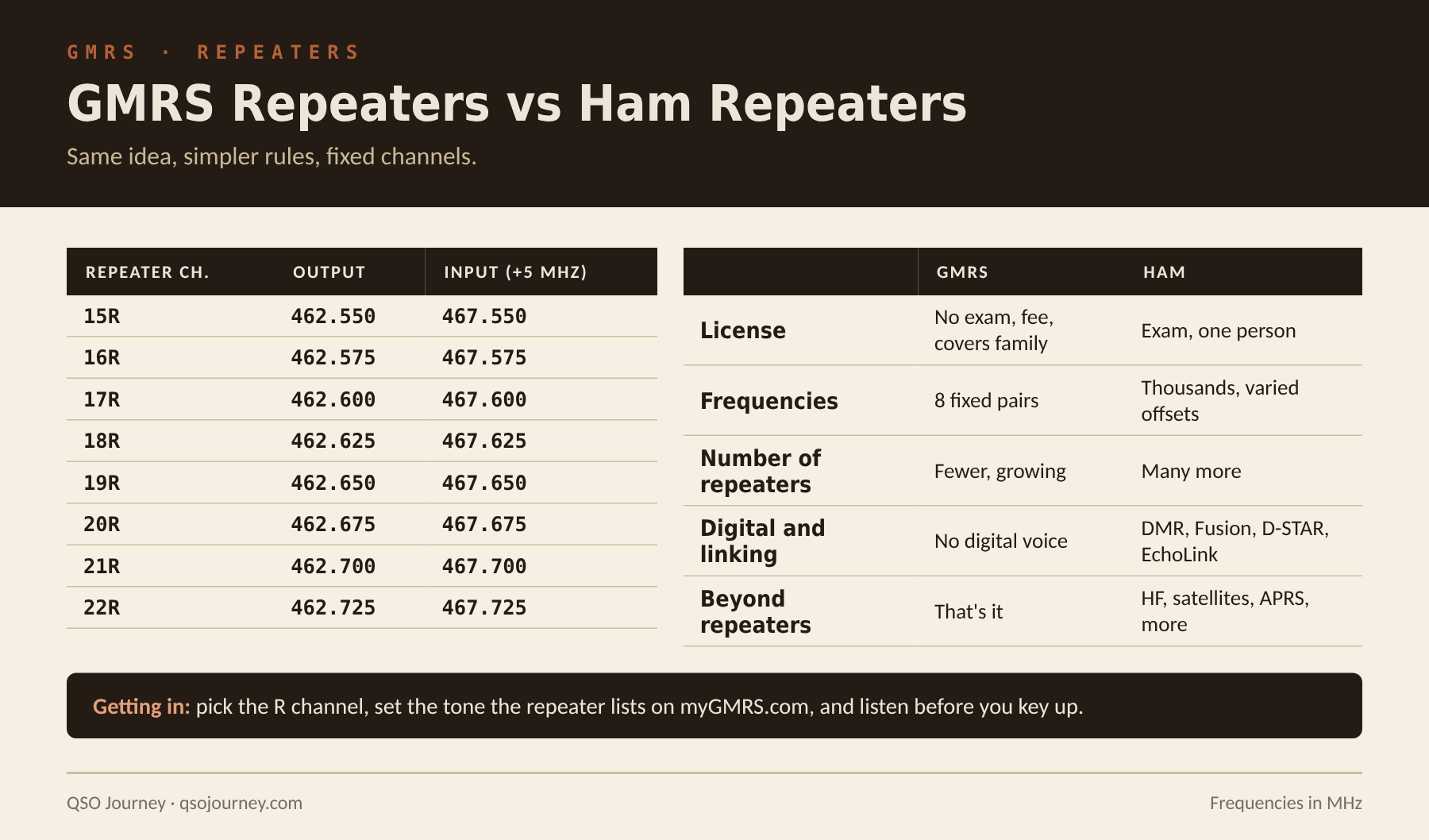
The mechanics are the same idea as a ham repeater: a station on a hill or tower receives on one frequency and retransmits on another. GMRS uses eight repeater channel pairs, with outputs around 462 MHz and inputs around 467 MHz and a fixed 5 MHz offset, so nearly every GMRS radio already knows the standard pairs. No custom offsets like on ham repeaters.
The biggest difference is licensing. There’s no exam. You apply to the FCC, pay the fee, and one license covers your immediate family under one call sign. That’s why GMRS has exploded among people who want longer-range radio without studying for a Technician exam. What you give up compared to ham repeaters:
- GMRS power limits are much lower than what ham repeaters are allowed, and fewer GMRS repeaters sit on prime high sites, so range per repeater is generally shorter.
- There are far fewer GMRS repeaters than ham repeaters in most areas, though the gap keeps closing.
- Digital voice, internet linking and the rest of the ham playground (HF, APRS and more) aren’t part of GMRS, which is intentionally a narrower service. Linking repeaters over the internet is the line the FCC has now enforced, covered in the first Notice of Violation over linked GMRS repeaters.
GMRS repeaters are a good middle ground for anyone who wants more range than FRS or simplex GMRS but isn’t ready to become a ham. They’re worth having even if you hold a ham license, since a family member without a Technician ticket can ride along under your family GMRS license and reach the same repeaters you do. For the same topic on the ham side, see Repeater Basics.
Finding and Programming GMRS Repeaters in Your Area
Finding repeaters near you
MyGMRS.com is the standard database: a crowdsourced, searchable map of GMRS repeaters with frequency, offset, tone, location, and whether each one is open or restricted to a group. Search your location, note the repeaters within realistic range, and read the usage notes. Some want you to check in before regular use, and others are wide open.
GMRS repeaters are privately owned, so the owner sets the rules. Many myGMRS listings let you request access with a free account, and the owner approves it and may send you the tone directly instead of publishing it. Before you transmit, listen on the output for a while. A repeater that’s busy every evening is a good sign the listing is current, and dead silence for days can mean it’s down or has moved.
What you’re programming
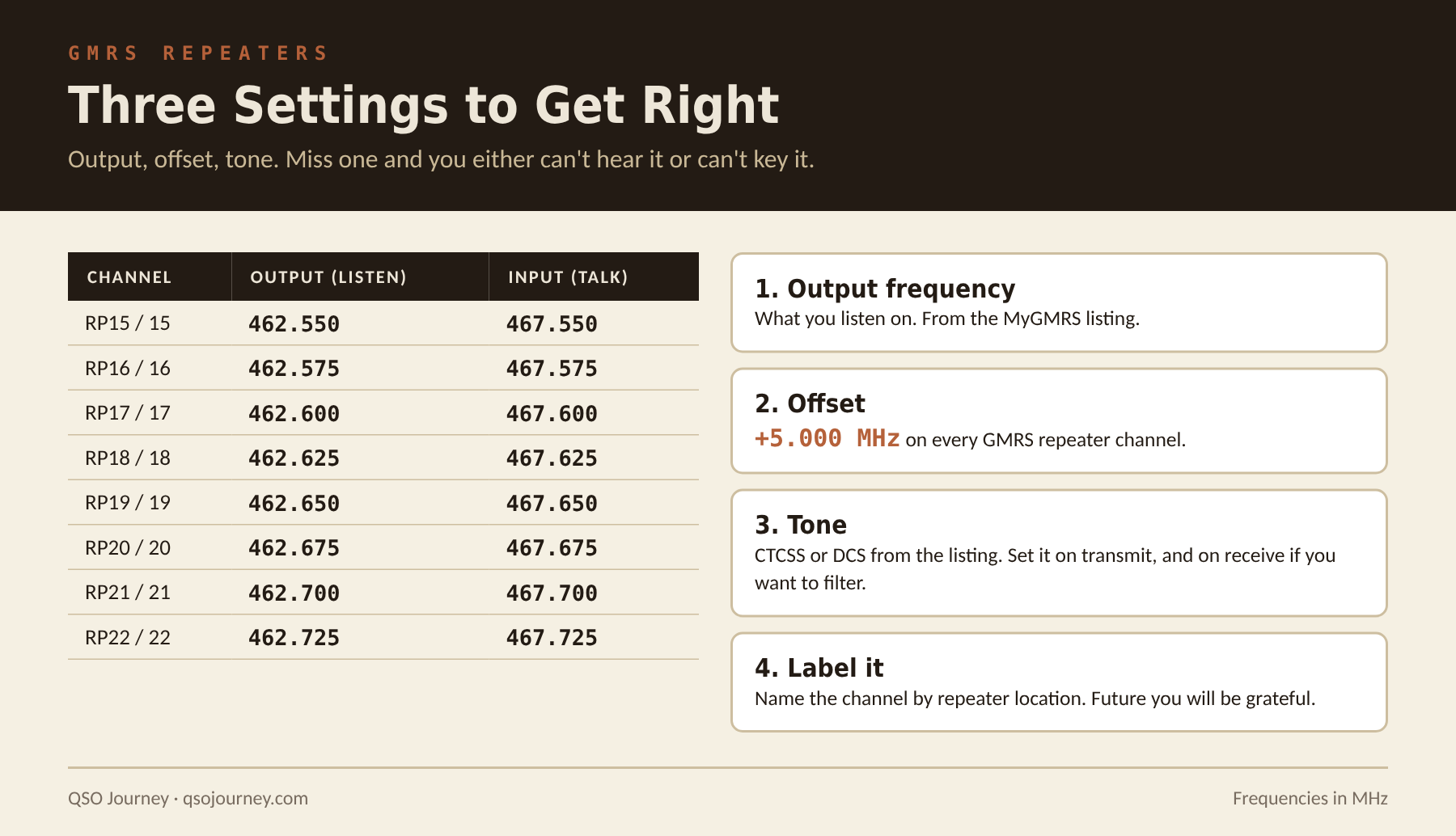
- Set the receive frequency to the repeater’s output.
- Set the transmit offset, +5 MHz on the GMRS repeater channels.
- Enter the correct CTCSS or DCS tone for transmit, and for receive if you want to hear only that repeater.
- Label the channel clearly. You’ll thank yourself when you have a dozen repeaters programmed.
Get any one of those wrong and you’ll either not hear the repeater or not get into it. Many GMRS radios support cable programming with free software, which is far less error-prone than typing on a tiny keypad. If you’ve programmed a ham HT with CHIRP, it’s nearly identical, just with GMRS frequencies and offsets.
GMRS Repeater Etiquette: Courtesy Tones, Timeouts, and Not Being That Guy
Because there’s no GMRS test, there’s no built-in moment where someone explains repeater etiquette. Hams pick it up from study guides and mentors. GMRS users mostly figure it out by trial and error, or by being that guy on the repeater until someone politely corrects them. Here’s the short version.
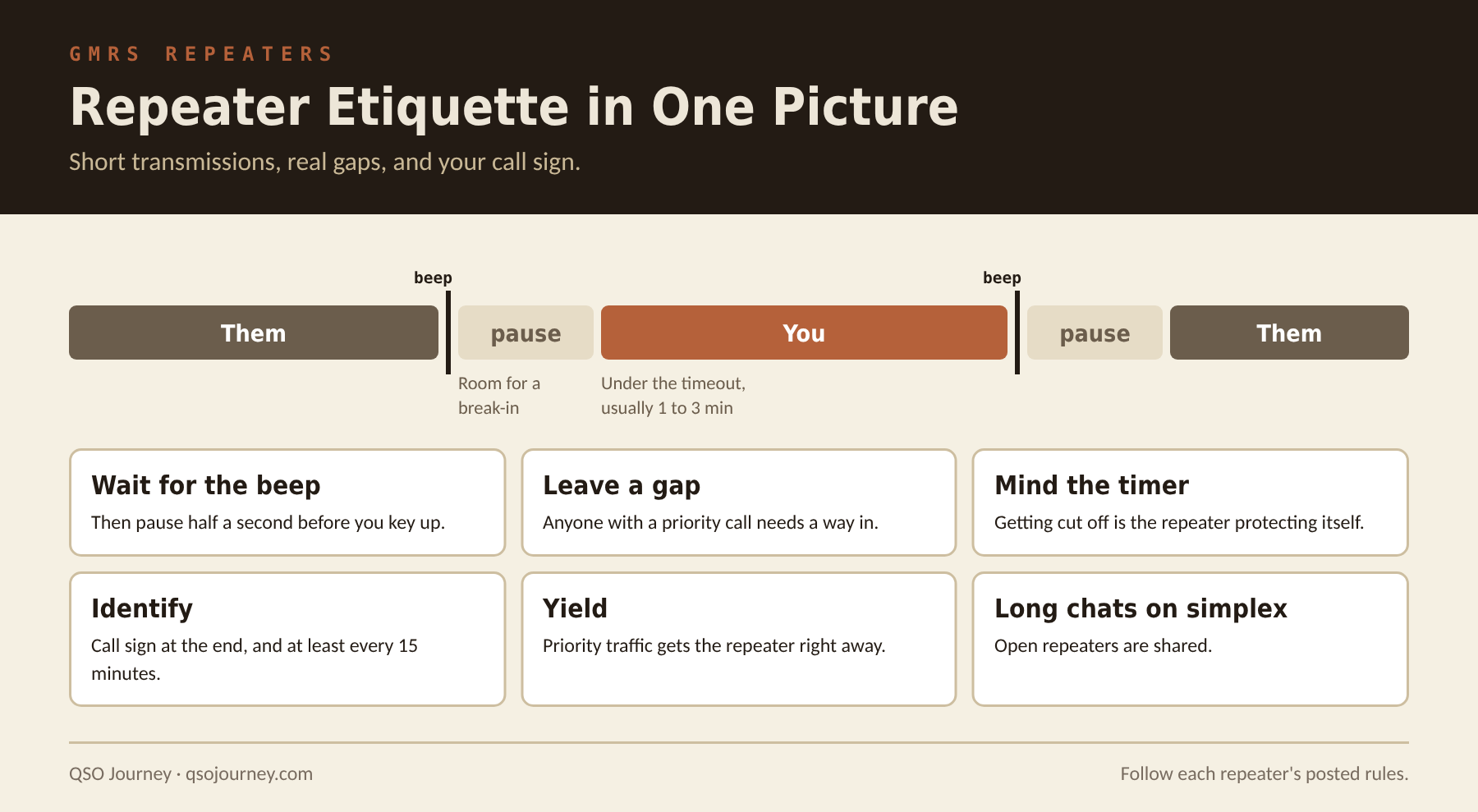
- Wait for the courtesy tone. Most repeaters beep or chirp after each transmission before they’re ready for the next one. Keying up before it can step on someone trying to get in, so pause half a second and listen for it.
- Leave a gap. A short pause between transmissions gives anyone with an emergency or a quick call a chance to break in. Ragchewing is fine, but rapid-fire back and forth shuts everyone else out.
- Know the timeout timer. Repeaters cut your transmission after a set time, usually one to three minutes. Getting cut off mid-sentence isn’t a malfunction. It’s the repeater protecting itself from a stuck mic, so release the key regularly.
- Identify properly. The FCC rule (47 CFR 95.1751) says to give your GMRS call sign at the end of a transmission or series of transmissions, and at least every 15 minutes during a longer exchange. Skipping it is the fastest way to get flagged or reported.
- Don’t monopolize an open repeater. Long family conversations belong on a simplex channel. Yield immediately to a priority call, and follow any posted usage guidelines, since they exist for a reason even if you don’t know the backstory.
Good etiquette isn’t complicated. It’s situational awareness and basic courtesy applied to a shared resource.
Related reading: GMRS Channel Guide · GMRS Station Setup: Antennas, Base, Mobile and RV · What GMRS Allows: Encryption, Scanning and Business Band