
Part of our Handheld Radios (HTs): The Complete Guide.
“Which handheld should I get?” is the question I hear most, and the honest answer depends on what you’re doing with it. This guide walks through it in the order I’d think about it: your first HT and whether to go budget or mid-tier, what to get if emergency communications is the goal (and why “a handheld that can talk far” is mostly a myth), the checklist I run every new radio through, a 34-radio comparison, and what I actually carry.
Jump to: Your first HT · For emergency comms · My HT checklist · 34 radios compared · What I carry
Your first HT: beyond “just get a Baofeng”
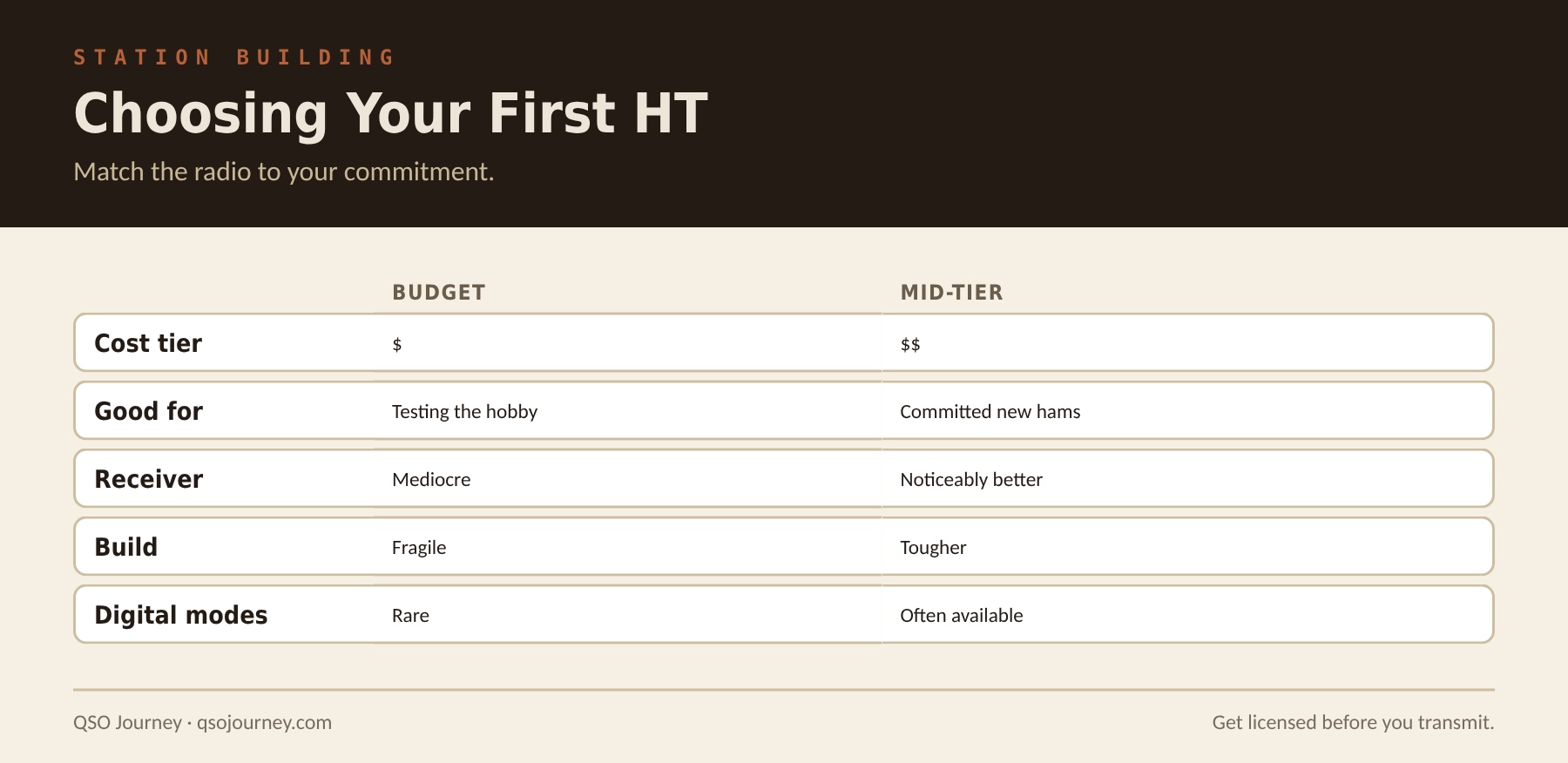
“Just get a Baofeng” isn’t wrong exactly, but it skips a decision that deserves more thought. A Baofeng UV-5R is genuinely fine for learning programming, repeater offsets and simplex, and it’s cheap enough that losing or breaking one isn’t a setback. The trade is a mediocre receiver, spurious emissions that can occasionally cause interference complaints, and build quality that won’t survive much abuse. If you already know you’re staying in the hobby, a mid-tier radio from AnyTone, Wouxun or another established brand gets you a meaningfully better receiver and build without flagship pricing.
Ask yourself:
- Am I testing the hobby or already committed? Testing favors cheap. Committed favors mid-tier.
- Do I want DMR or Fusion, or just analog FM? That changes which radios are even in the running.
- Will it live in a truck, a backpack or a drawer? Durability matters more for radios that travel rough.
- Do I want wideband receive to listen beyond the ham bands? Not every budget radio has it.
If you’re brand new and unsure ham radio will stick, a cheap analog radio is a fine low-risk start. If you already know you’re in, or you have specific goals like digital voice or serious durability, skip straight to mid-tier and save yourself outgrowing your first radio in a few months. And if that cheap radio is your first, get licensed before you transmit on it.
What handheld should I get for emergency comms?
Someone wants “a handheld that can talk far,” and that’s the whole spec: no terrain, no budget, no license, no idea what “far” means. Before I hand anyone a model number, these are the questions that matter:
- What counts as far: a mile to a neighbor’s ranch, 20 miles across a valley, or across the state?
- What’s your terrain? Flat desert, mountains, dense trees or concrete canyons. Terrain matters more than the radio.
- Are you licensed for ham, GMRS, or neither yet?
- Is it for off-roading, hiking, a family bug-out kit, or general preparedness?
- Do you need two-way voice, or would a “help, I’m here” message be enough? That last one changes the whole category of device.
The physics reality check
Handhelds are line of sight. A 5 watt handheld with a rubber duck on flat, open ground might get 2 to 5 miles, and a hill, building or forest cuts that fast. I’ve had a handheld fail to punch through a ridge less than a mile away. What actually extends range is elevation, a better antenna and repeaters, not a bigger number on the spec sheet. A “long distance handheld” is always the handheld plus something else.
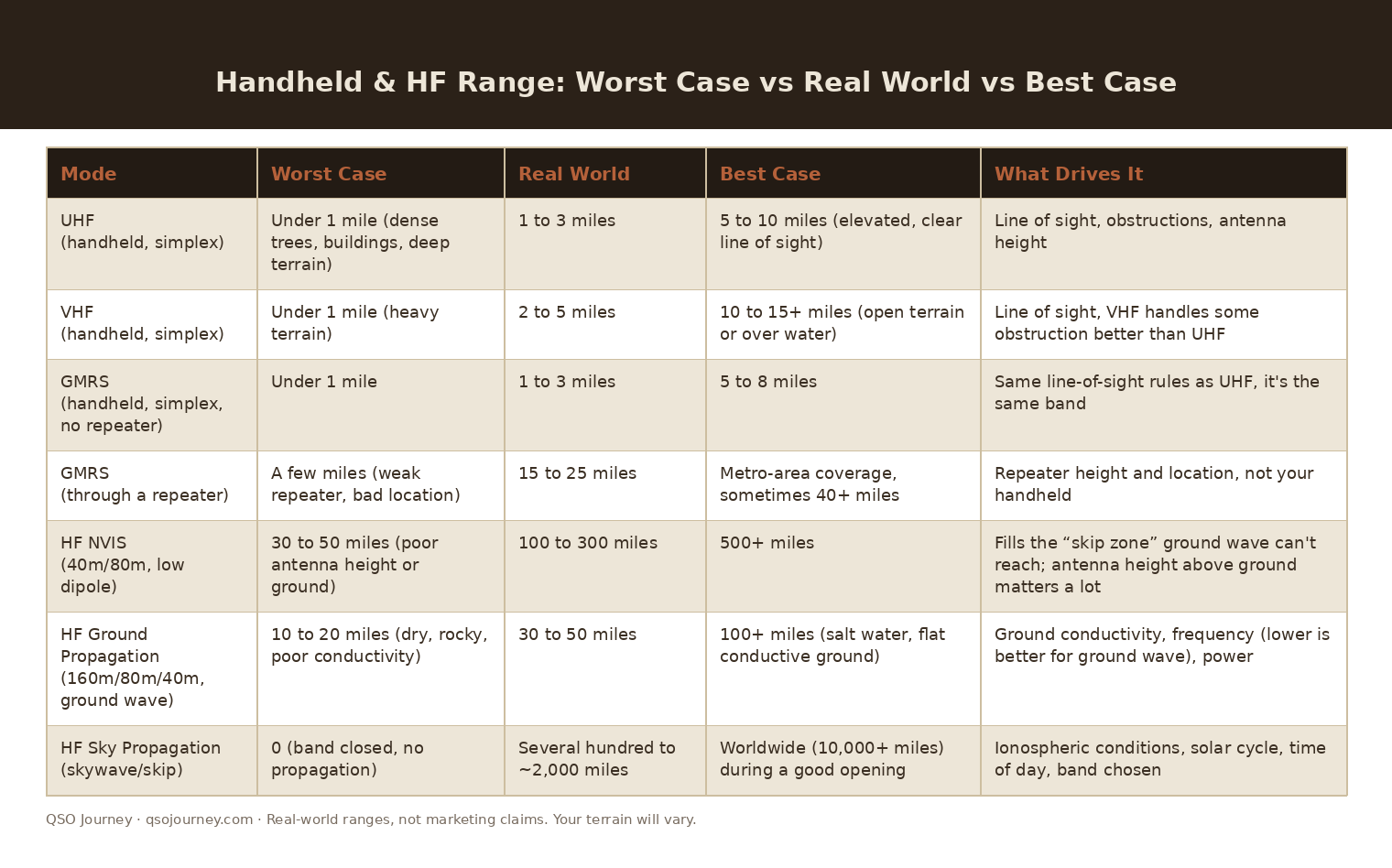
Two things jump out. GMRS through a repeater beats a bare ham handheld on simplex, which surprises people who assume ham radio always wins. And HF skywave is the only mode that can realistically go worldwide, but it’s also the only one that can drop to zero on a bad day, which is why most emcomm plans lean on NVIS or ground wave for reliable regional coverage. True handheld HF radios barely exist. Real 40 or 80 meter performance means a portable radio in a bag and a wire antenna you deploy on arrival, which is a different category of gear and skill.
Your options, matched to the job
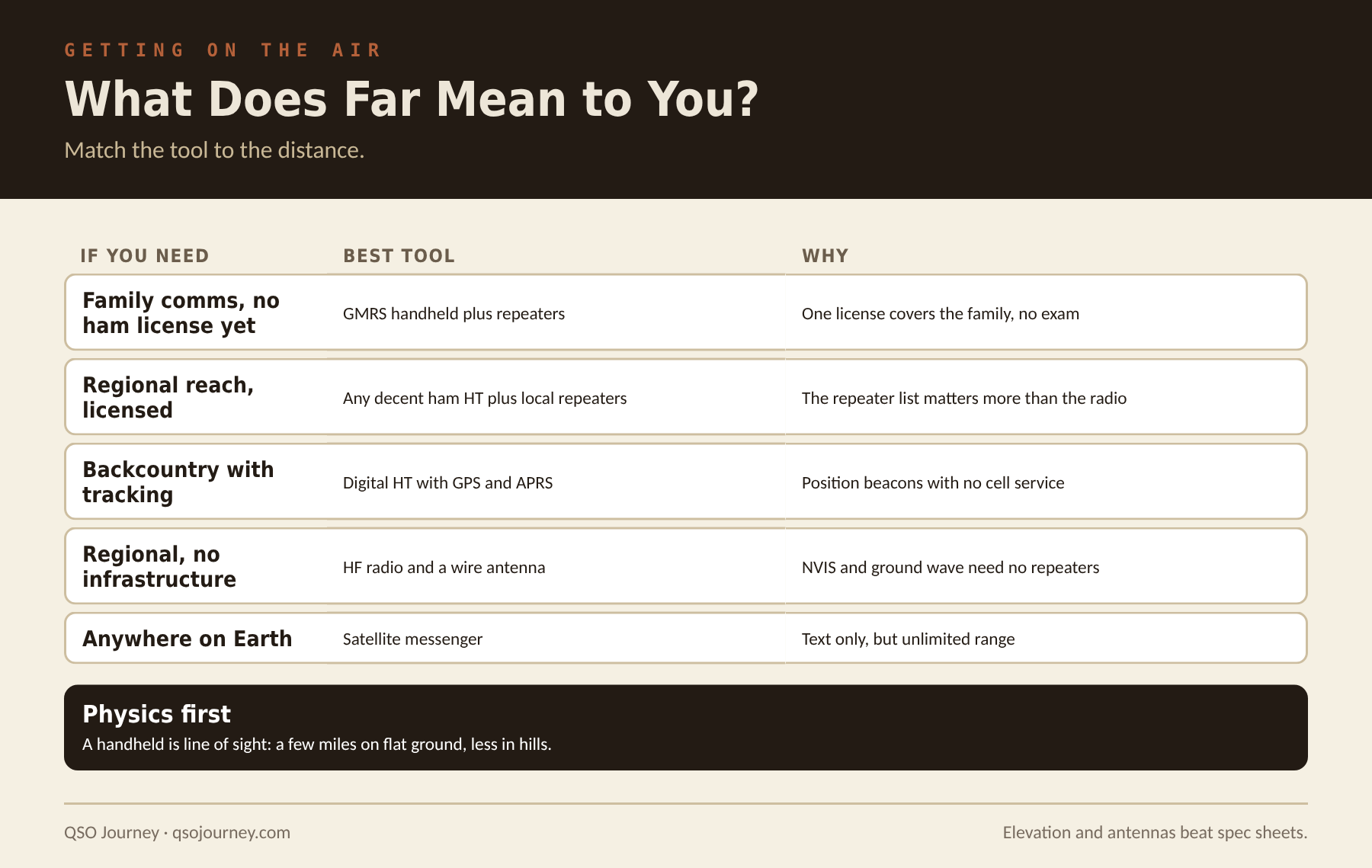
- GMRS handheld (no ham license needed). One license, no test, covers the whole family. Through a repeater network it can realistically cover a metro area; without one, figure a few miles. This is what I hand my family for the prep kit. See the GMRS Complete Guide and GMRS real range.
- Ham handheld, analog or digital. A Technician license opens a much bigger repeater network and better build quality at every price. Digital handhelds add APRS, better audio on repeaters, and often better GPS lock and weather alerts, which matter for off-road and backcountry use. Some offer AES-256 encryption, but that’s illegal on amateur frequencies under Part 97, and GMRS prohibits coded messages too. If encryption matters to your plan, it belongs on licensed business-band radios.
- Repeaters are the real answer. A $30 radio hitting a mountaintop repeater will outperform a $600 radio on simplex every time. Find your local repeaters and program them in. It’s the upgrade nobody sells you, because it’s homework, not a product.
- Satellite messenger. If far means “anywhere on the planet with zero infrastructure,” you want a Garmin inReach or Zoleo, not a radio. It’s text, not voice, and it needs a monthly plan, but it’s the only option with genuinely unlimited range. Slot it into your PACE plan.
My short version: a family kit with nobody licensed gets GMRS handhelds. Licensed and want range? Any decent ham handheld plus your local repeaters; the repeater list matters more than the radio. Off-road or backcountry? A digital handheld with APRS and GPS earns its price. Need a guaranteed way out? HF with a multiband antenna, or a satellite messenger.
The checklist I run every HT through
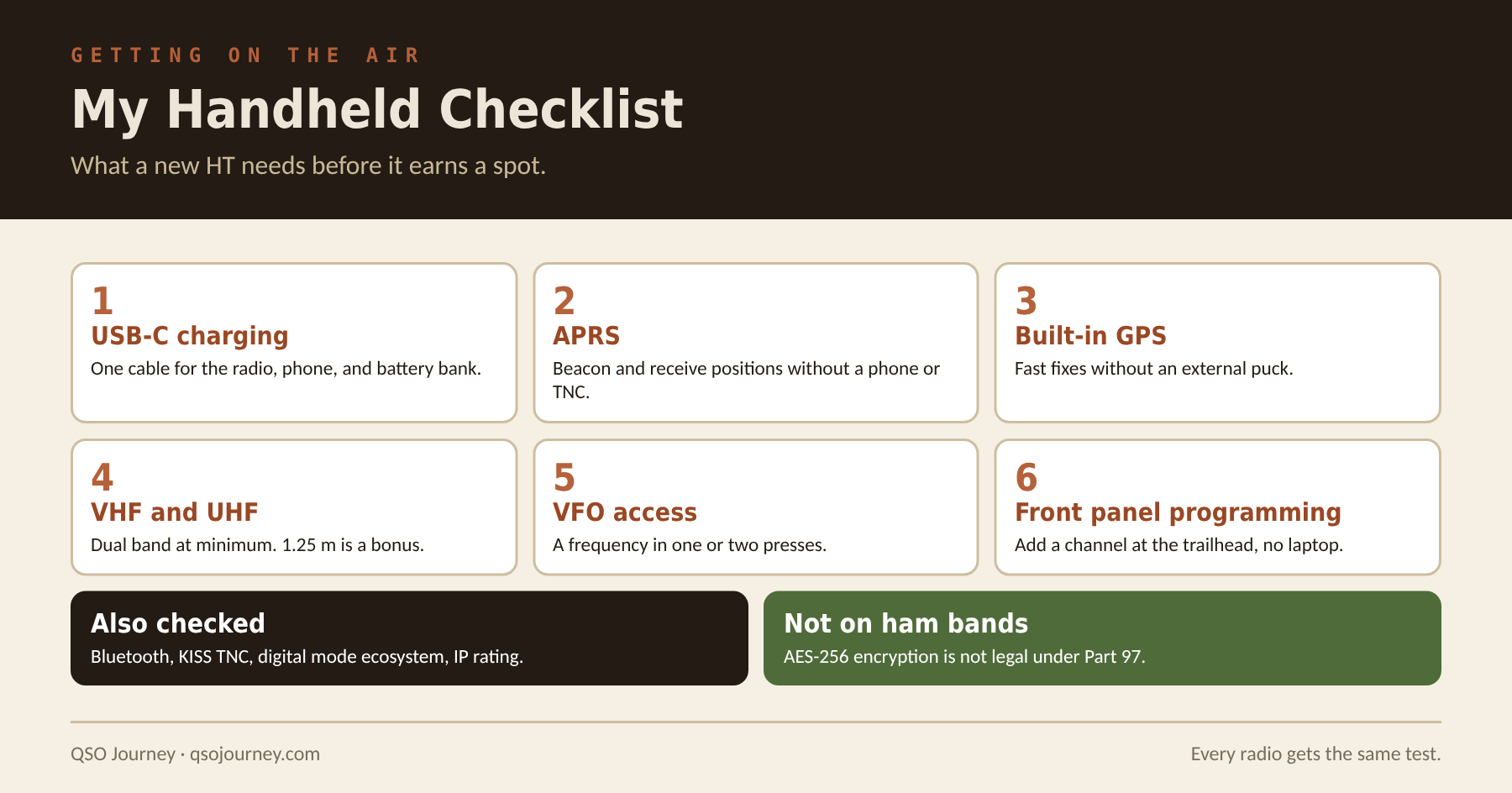
After years running HTs in the shack, the Jeep and the go-bags, every new radio has to pass this before it earns a spot:
- USB-C charging. It charges off the same battery bank, car charger or laptop cable I already carry. One less proprietary cradle to pack.
- APRS. Beacon my position and pull it off the network without a phone or a separate TNC. Huge for SAR support, POTA, or letting family see where the Jeep is on a trail with no cell service.
- Integrated GPS. APRS is only as good as the GPS feeding it, and a built-in chip beats an external puck.
- VHF and UHF, with 1.25 meters as a bonus. A few radios, mostly older Yaesu tri-banders and the TH-D75A, also cover 220 MHz.
- VFO access one or two button presses away, not six submenus. This is where commercial radios fall flat: most are channel-only.
- Front panel programming. CPS is fine at home, but at a trailhead with no laptop I want to add a channel or change a tone from the keypad.
Once those are covered I look at Bluetooth for a wireless mic or app control, KISS TNC support for feeding APRS or Winlink apps like APRSdroid or RadioMail, the digital mode (DMR, D-STAR and C4FM aren’t interchangeable and lock you into an ecosystem), and an IP rating, because a radio that rides in the Jeep or a go-bag has to survive dust, rain and the occasional dunk.
34 handhelds compared
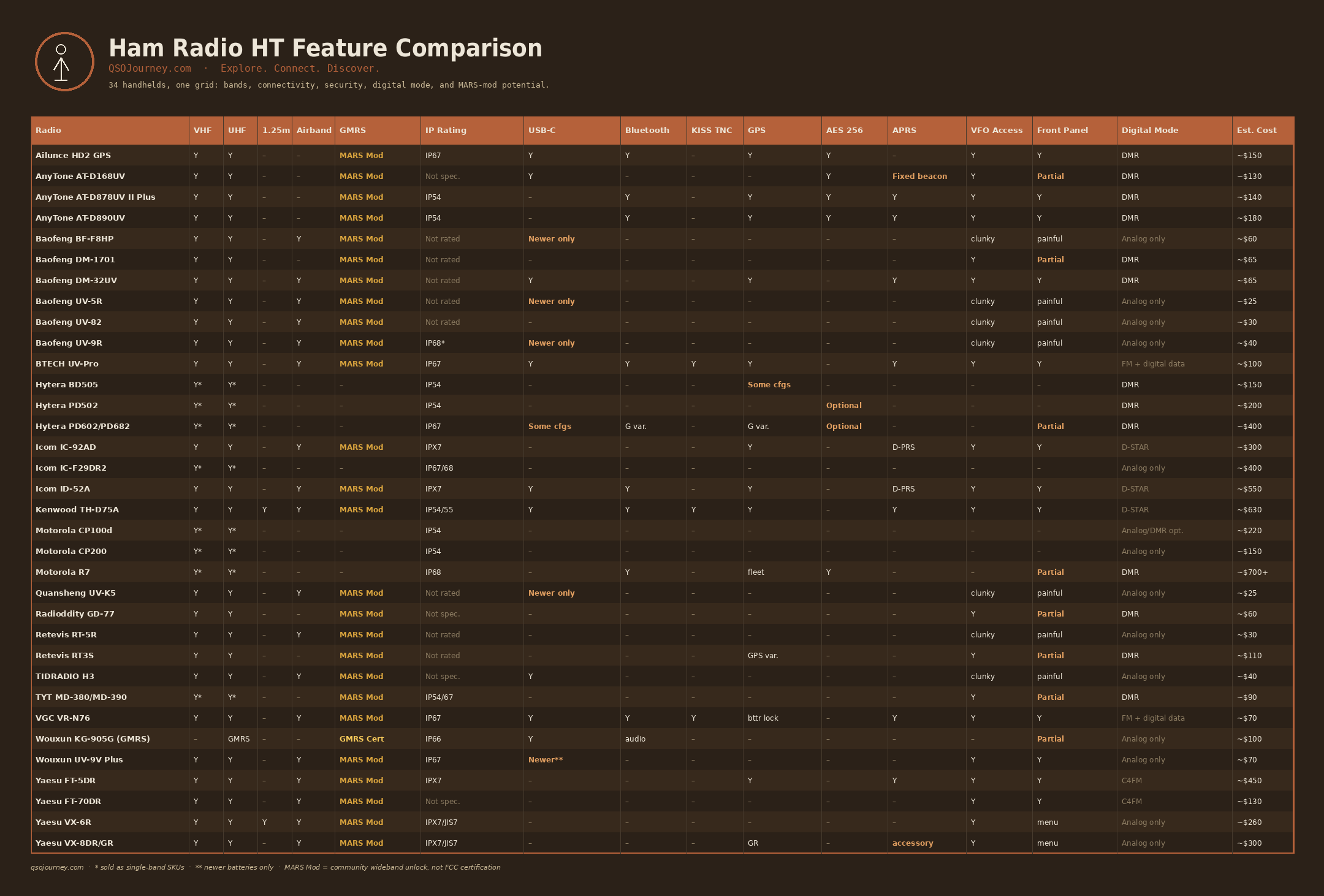
The chart covers everything from the $25 Quansheng UV-K5 and Baofeng UV-5R up to the Kenwood TH-D75A (about $630) and the Motorola R7. To put two or three radios side by side with my take on the ones I’ve owned, use the Compare Radios tool, or see Six Handheld Radios Compared for a hands-on head to head. A few notes on the chart:
- Motorola and Hytera radios are commercial land-mobile units: channel-only, programmed through the manufacturer’s CPS, and usually sold as separate single-band models. That’s a fundamentally different design philosophy from ham gear.
- The Wouxun KG-905G is a GMRS radio, included as a reference point, and it’s the only radio on the list with real Part 95 GMRS certification.
- AES-256 only shows up on the commercial DMR side (the Ailunce HD2 and AnyTone D168UV borrow it), because it isn’t legal on amateur bands.
- A MARS mod opens TX range, but transmitting outside the service you’re licensed for can put you outside FCC rules. Treat it as something to know about, not lean on. Prices are rough street prices, and specs shift between firmware revisions and regional variants, so check the current listing before you buy.
What I actually carry
- EDC: the Kenwood TH-D75A and the AnyTone AT-D890UV. The D75A comes on long road trips, where I run APRS a ton and want the GPS and D-STAR. The D890UV rides everywhere else: the motorcycles, the Jeep, the range. It shares the same DMR programming as my Ailunce HD2s, so I can talk to those analog or digital.
- SHTF hand-out radios: pre-programmed Ailunce HD2 GPS units, loaded from my SHTF frequency list, so a friend or family member is ready to go without touching a CPS.
- The family disaster radio kit: a BTECH UV-50PRO as the mobile base with BTECH UV-Pro and VGC VR-N76 handhelds for me, my wife and the kids, all pre-programmed. To change a frequency I update my own radio and push it to the rest over the air. I picked the UV-Pro and VR-N76 for my family because the phone app makes them easy for someone who doesn’t tinker with radios every week.
Related reading: Handheld Radios (HTs): The Complete Guide · HT Upgrades: Antennas, Accessories, Batteries and Cables · FRS vs GMRS vs MURS vs Ham Radio · Your First DMR Codeplug on the AnyTone