

Part of our Start Here: A New Ham’s Guide to Getting On The Air guide.
Someone walks into a big box store looking for “walkie talkies” and walks out more confused than when they arrived. FRS, GMRS, MURS and ham radio all use handheld radios that look nearly identical, but the rules, range and licensing behind them are completely different. This guide puts all four side by side, then looks at where ham VHF/UHF and HF fit, because “which radio should I get” depends entirely on the job you need it to do.
Jump to: Quick answer · FRS · GMRS · MURS · Ham radio · Ham VHF/UHF vs GMRS · HF · Range · Which one you need
The quick answer
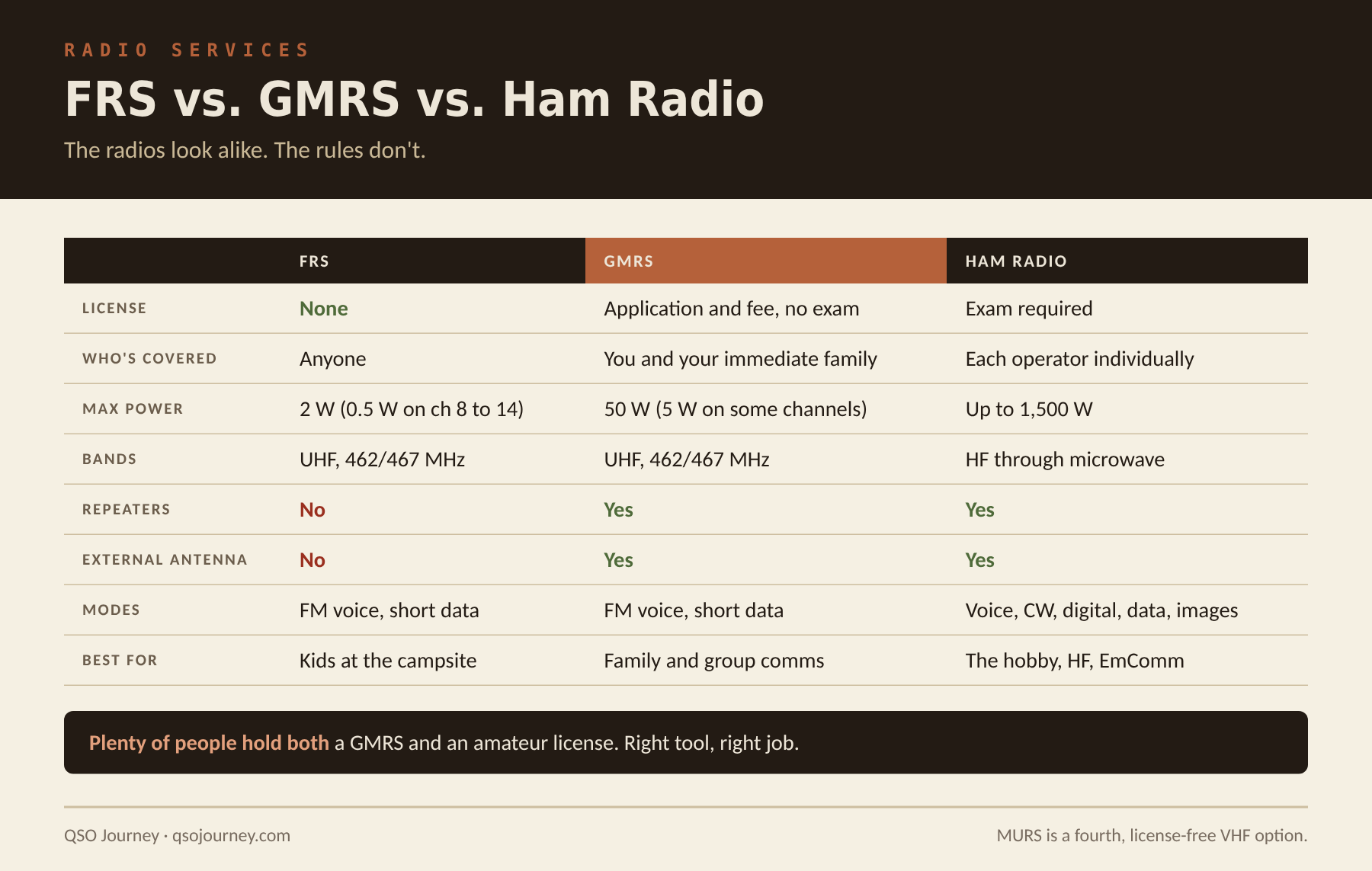
| Service | License | Max power | Repeaters | Best for |
|---|---|---|---|---|
| FRS | None | 2 W (0.5 W on some channels) | No | Short range: the campsite, the parking lot |
| GMRS | $35, no test, covers your immediate family for 10 years | 50 W on the main channels | Yes | Family and group comms with real range |
| MURS | None | 2 W | No | A license-free VHF base station with a real antenna |
| Ham radio | Exam (Technician to start), one call sign per person | Up to 1,500 W PEP | Yes, plus linked and digital networks | Everything above, plus HF, digital modes and emcomm |
Not sure yet? The Which Radio Do I Need? tool asks a few questions about your family and your plans and points you at the right service.
FRS: no license, no test, limited power
Family Radio Service is the license-free option. Anyone can buy and use FRS radios out of the box. In exchange you are capped at low power (2 watts on some channels, half a watt on others), the antenna is fixed, and there are no repeaters. It is fine for keeping track of kids at a campsite or coordinating across a parking lot, and that is about the ceiling. FRS shares its UHF channels with GMRS, which is why the two get confused so often.
GMRS: a license, but an easy one
- License: $35 for a 10-year term, no test, and one call sign covers your immediate family. You apply online with the FCC. GMRS Radio: The Complete Guide walks through it.
- Frequencies: UHF, 462 to 467 MHz, 30 channels: 8 main 462 MHz channels, 8 paired 467 MHz repeater inputs, and 14 interstitial channels shared with FRS.
- Power: up to 50 W on the main channels for mobile, base and repeater stations. The interstitial channels are capped at 5 W ERP (462 MHz) or 0.5 W ERP (467 MHz, handhelds only).
- Hardware: radios must be FCC certified for GMRS and cannot be modified. You buy one and use it as is.
- Repeaters: allowed, and a growing number of community and personal GMRS repeaters extend range a lot.
External antennas and repeater access are what make GMRS so much more useful than FRS in the real world.
MURS: the license-free VHF option nobody talks about

I write a lot about GMRS and FRS, but MURS almost never comes up, and that is a gap. The Multi-Use Radio Service is license free like FRS, but it runs on VHF with its own five channels and its own short rulebook under Part 95:
- Five channels: 151.820, 151.880 and 151.940 MHz are narrowband only, while 154.570 and 154.600 MHz also allow wider 20 kHz FM.
- Transmitter power is capped at 2 watts on every channel.
- External antennas are allowed, as long as the top of the antenna is no more than 60 feet above the ground or 20 feet above the structure it is mounted on, whichever is higher.
- No repeaters and no connection to the telephone network.
- No station identification or call sign is required.
Where MURS wins: VHF generally does a bit better over open terrain than UHF, and you can put up a real outdoor antenna without any license. Two watts on VHF into a good antenna is a real step up from a fixed-antenna FRS handheld. Where it falls short: only five channels, no repeaters, and far fewer radios on the market. It is still well short of a 50 watt GMRS mobile into the same antenna, so MURS works best as a fill-in layer, or as the VHF option in your kit for redundancy.
Ham radio: a test, but no ceiling
Amateur radio requires passing a written exam (no Morse code test anymore) for your Technician license, and every operator gets their own call sign. The Technician exam is 35 questions and you need 26 correct. There is no minimum age and no fee for the license itself beyond the exam session. What you get back is enormous: 17 bands from 50 MHz up, plus HF once you upgrade, power limits up to 1,500 W PEP, fully programmable radios, and every mode from FM to DMR, D-STAR, Fusion, packet and APRS. Getting Licensed covers the path.
Ham VHF/UHF vs GMRS: same physics, different ecosystem
Here is the part worth being honest about: for simplex, radio-to-radio range, GMRS and ham VHF/UHF follow the same physics. Both are line-of-sight services, and a similarly powered handheld with a similar antenna covers similar ground either way. Ham radio’s real advantage is not raw range. It is the depth of the ecosystem: more repeaters, internet-linked systems like EchoLink and AllStarLink, digital voice networks with worldwide talkgroups, more bands, more modes, and the freedom to build your own infrastructure. Ham VHF/UHF does everything GMRS does, plus repeater nets, ARES and RACES, and a much bigger community to tap into.
HF: a completely different propagation story
VHF and UHF travel more or less in a straight line and get blocked by hills, buildings and the curve of the earth. HF signals can refract off the ionosphere and come back down hundreds or thousands of miles away. That means HF can connect two points with nothing in between: no repeater, no tower, no internet. Just two radios and the right band at the right time of day.
The catch is the license and the hardware. A Technician only gets a slice of 10 meter phone plus some CW segments on 80, 40 and 15 meters, so real HF use means a General license or higher. And HF radios run roughly $400 to $2,000 before the antenna. A half-wave dipole on 40 meters needs about 65 feet of wire, while a quarter-wave on 2 meters is about 19 inches. HF demands real estate that VHF and UHF simply do not.
Range: what to actually expect
| Setup | Typical range |
|---|---|
| FRS, GMRS or ham handheld to handheld, simplex | 1 to 5 miles depending on terrain, more with elevation or a vehicle antenna |
| Through a well-sited VHF/UHF repeater | 20 to 50+ miles, sometimes much farther |
| HF NVIS on 80 or 40 meters | Tens to a few hundred miles, with no repeater |
| HF skywave | Hundreds to thousands of miles, depending on band, time of day and the sun |
My VHF/UHF range map shows how far a stock handheld, an upgraded antenna, a J-pole and a 50 W base station really reach.
So which one do you actually need?
- Just talking to the kids at the trailhead? FRS is fine and free.
- Reliable family and group comms with real range, without a test? GMRS is the sweet spot, and for most families it is the backbone: licensed per household, repeaters allowed, and the widest radio selection.
- A base station with a real antenna and no license at all, or a VHF backup? Add MURS.
- Interested in radio as a hobby, want HF, or want to be useful in emergency communications? Get your ham license.
Plenty of people end up holding both a GMRS and an amateur license, and that is not overkill. It is using the right tool for the job. For SHTF planning, remember that GMRS and ham VHF/UHF are both limited to line of sight unless a repeater you do not control is still up. HF is the one option that reaches far beyond your area with nothing but your own equipment and power. More on that in GMRS Is Great for Family Comms, But It Won’t Save You When SHTF.
Related reading: GMRS Radio: The Complete Guide · GMRS Licensing 101 · Getting Licensed · Emergency Communications and Preparedness