
Part of our Emergency Communications and Preparedness guide.
Most comms planning advice quietly assumes two capable adults, a house with a yard, and everyone in the same town. Real households don’t look like that. This guide takes the parts of a family plan that change with who you live with and where, and covers each one: the family member who will never get a license, young kids and newborns, a multi-generational home, an elderly parent living alone, school pickup, renters, RV families, and family spread across different cities. The core structure stays the same as in the key parts of a SHTF communications plan. What changes is how you fit it to your people.
Jump to: Non-ham family · Multi-generational roles · Young kids · A newborn · Elderly parent alone · School pickup and lockdowns · Apartments and renters · RV and travel trailer families · Family in different cities
A Plan Your Non-Ham Family Members Can Actually Use
This is the plan simplified for the family member who is never getting a license, never wants a radio lesson, and just needs to know what to do.
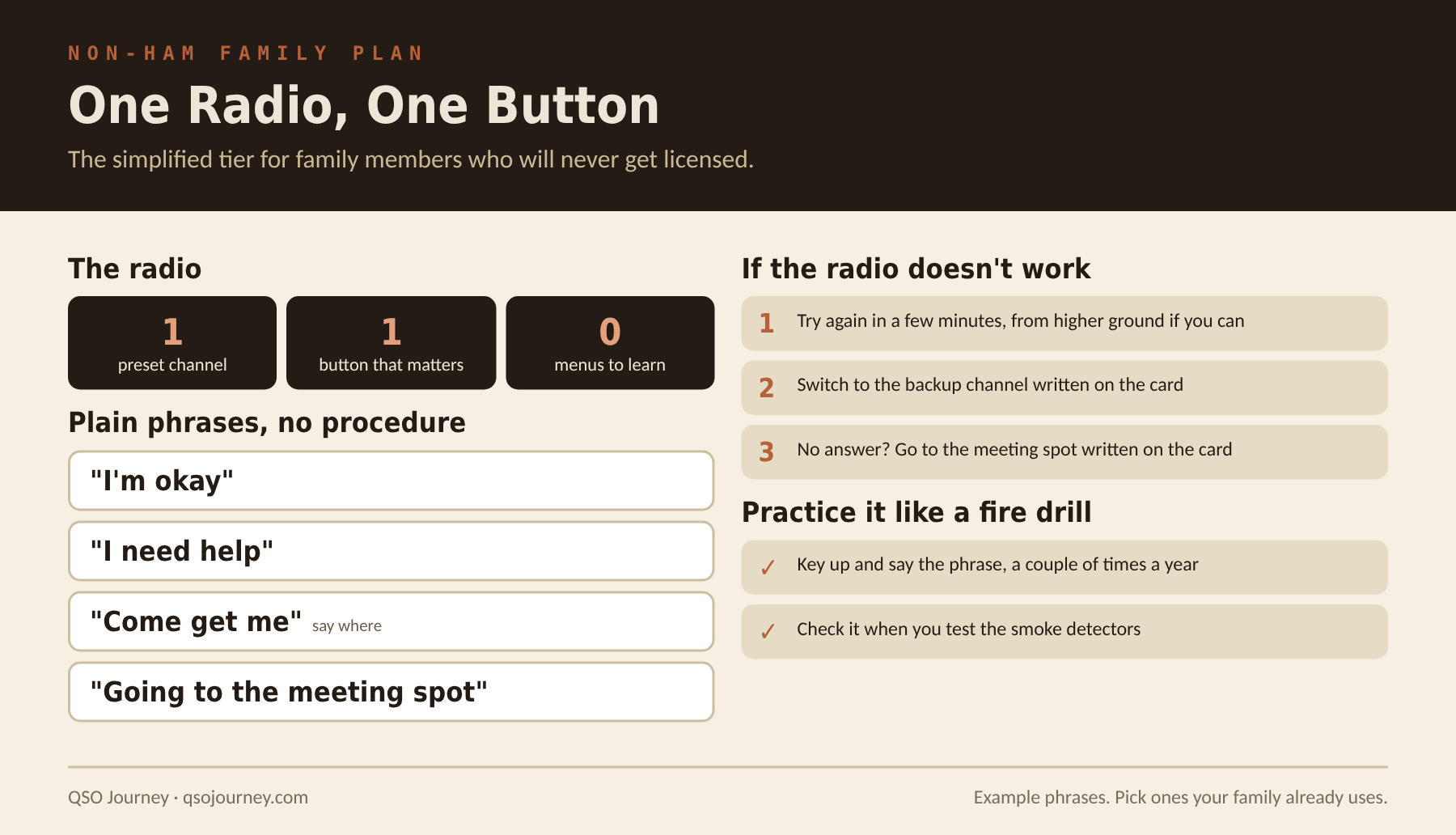
- One radio, one button. A GMRS handheld programmed to one channel, with the scan and menu buttons taped over if you have to, removes every decision except push to talk and let go. Don’t hand a non-technical person a multi-channel, multi-mode radio and expect them to navigate it under stress.
- Code words beat procedure. Proper procedure matters for licensed operators. It doesn’t matter for a spouse or teenager who just needs to say “I’m okay,” “I’m not okay,” or “come get me.” Pick three or four plain phrases everyone already understands and skip the phonetic alphabet for this tier.
- Write down what to do if the radio doesn’t work. Which backup channels to try, in what order, and where to physically go if nobody answers. This is the most important part of a simplified plan, and the part people skip because it feels obvious. It is not obvious in a stressful moment.
- Practice it like a fire drill. Run it a couple of times a year, actually keying up and saying the phrase, the way you test a smoke detector. A plan that exists only on paper is one nobody remembers how to run.
To put it on paper, the Family PACE Plan Builder is written for non-hams. It asks plain questions, keeps your code words and meeting places, and prints a one-page plan, wallet cards for everyone, and a label for each radio. The Family Communications Plan in EmComm Hub does the same offline, and its Family view hides the radio club tools.
Assigning Radio Roles in a Multi-Generational Household
Grandparents, parents and kids under one roof have more comms capacity than a single family, but only if you divide the work instead of defaulting to whoever holds the ham license doing everything.
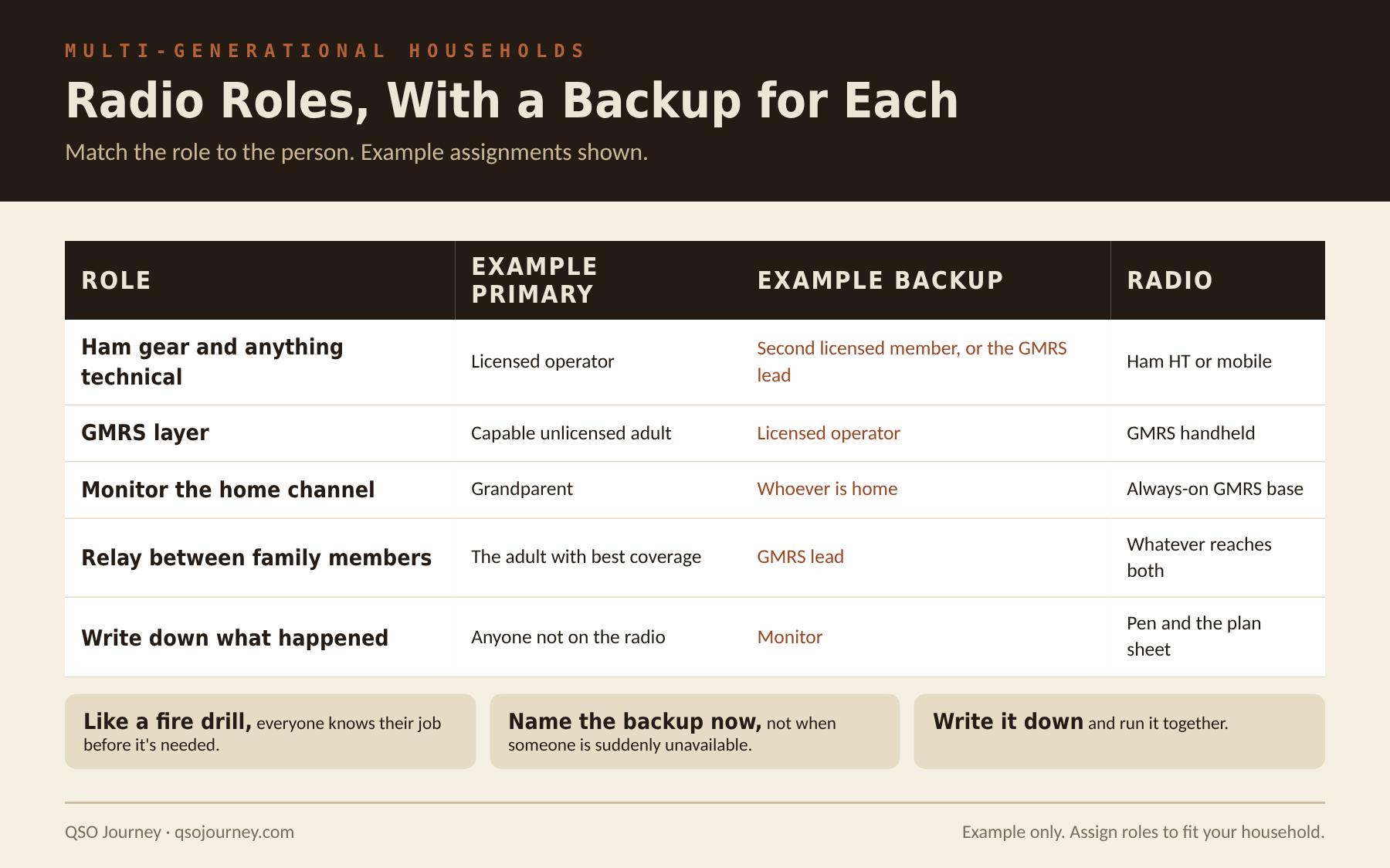
- Match the role to the person. The licensed operator runs the ham gear. A capable unlicensed adult can run the GMRS layer. Grandparents may be best on a simple, always-on base station rather than a handheld they have to remember to carry.
- Be as specific as a fire drill. Who monitors which channel, who relays messages between family members, and who writes down what actually happened.
- Name a backup for every role. It’s the PACE principle applied to people instead of frequencies. The mistake is not deciding who the backup is until someone is suddenly unavailable.
- Write it down. More people means more moving parts, which makes the written plan more important. Use the format in documenting your SHTF communications plan.
Teaching Young Kids Radio Basics Without Overwhelming Them
A young kid doesn’t need to understand PACE planning or licensing to be a useful part of the plan. They need three skills, taught in a way that feels like a game, because a bored kid learns nothing and a scared kid learns even less.
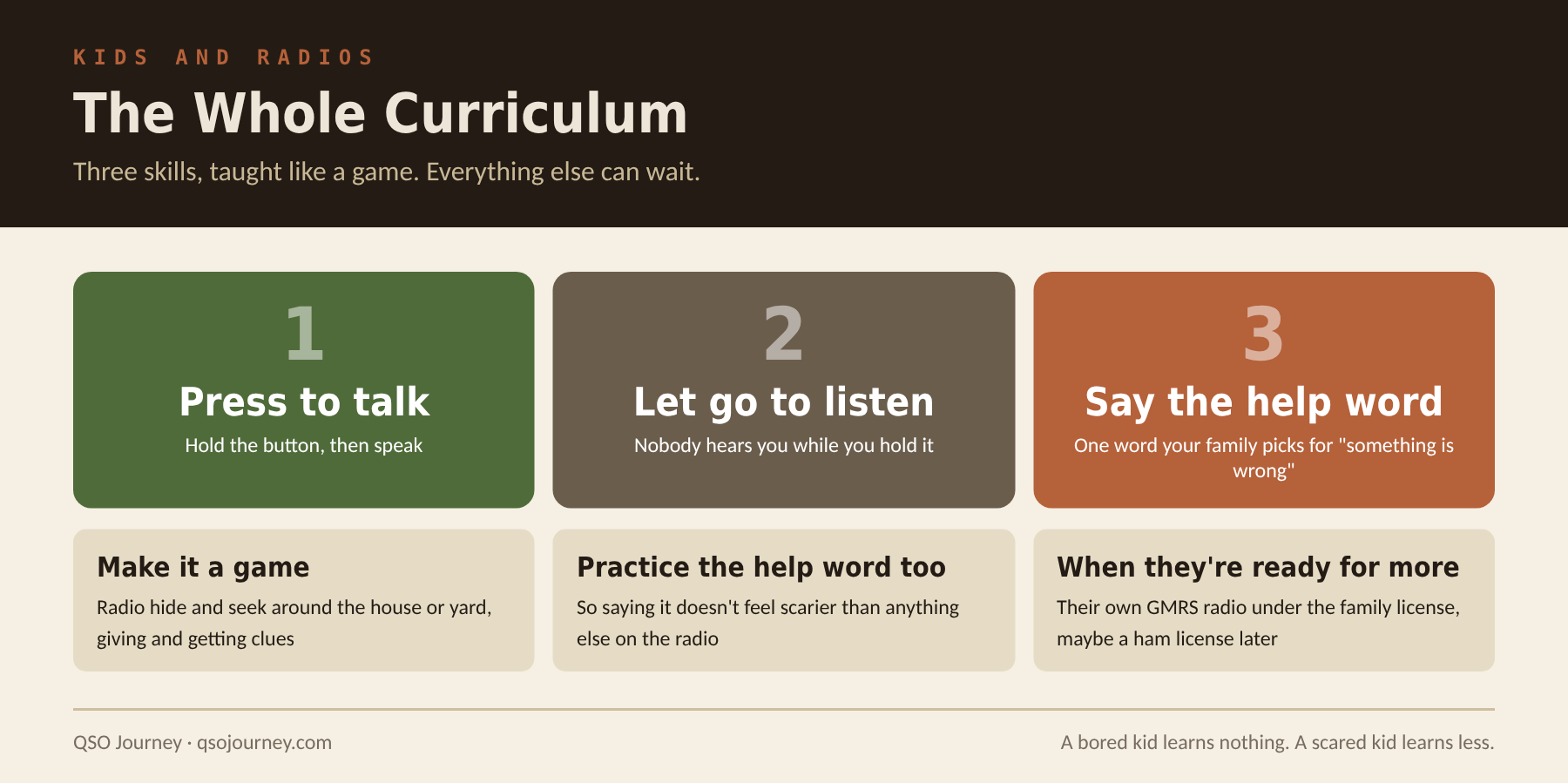
- The whole curriculum: press this button to talk, let go to listen, and say this specific word if something is wrong. Channels and procedure can wait until they’re older and curious.
- Make it a game. A hide and seek game around the house or yard, using the radio to give and get clues, teaches push to talk faster than any explanation, and kids ask to do it again.
- Practice the help word too. Rehearse the moment something is actually wrong, so the help word doesn’t feel scarier to say than anything else. Kids who only practice the fun version sometimes freeze when the real version matters.
- When they’re ready for more: a GMRS radio under your family license is the natural next step, and a kid who gets curious about the hobby might be ready for a ham license of their own down the road.
What Changes When You Add a Newborn or Young Child
A plan built for two capable adults doesn’t automatically scale to a household with a baby. Timelines get slower, the gear list gets longer, and the plan needs an honest update.
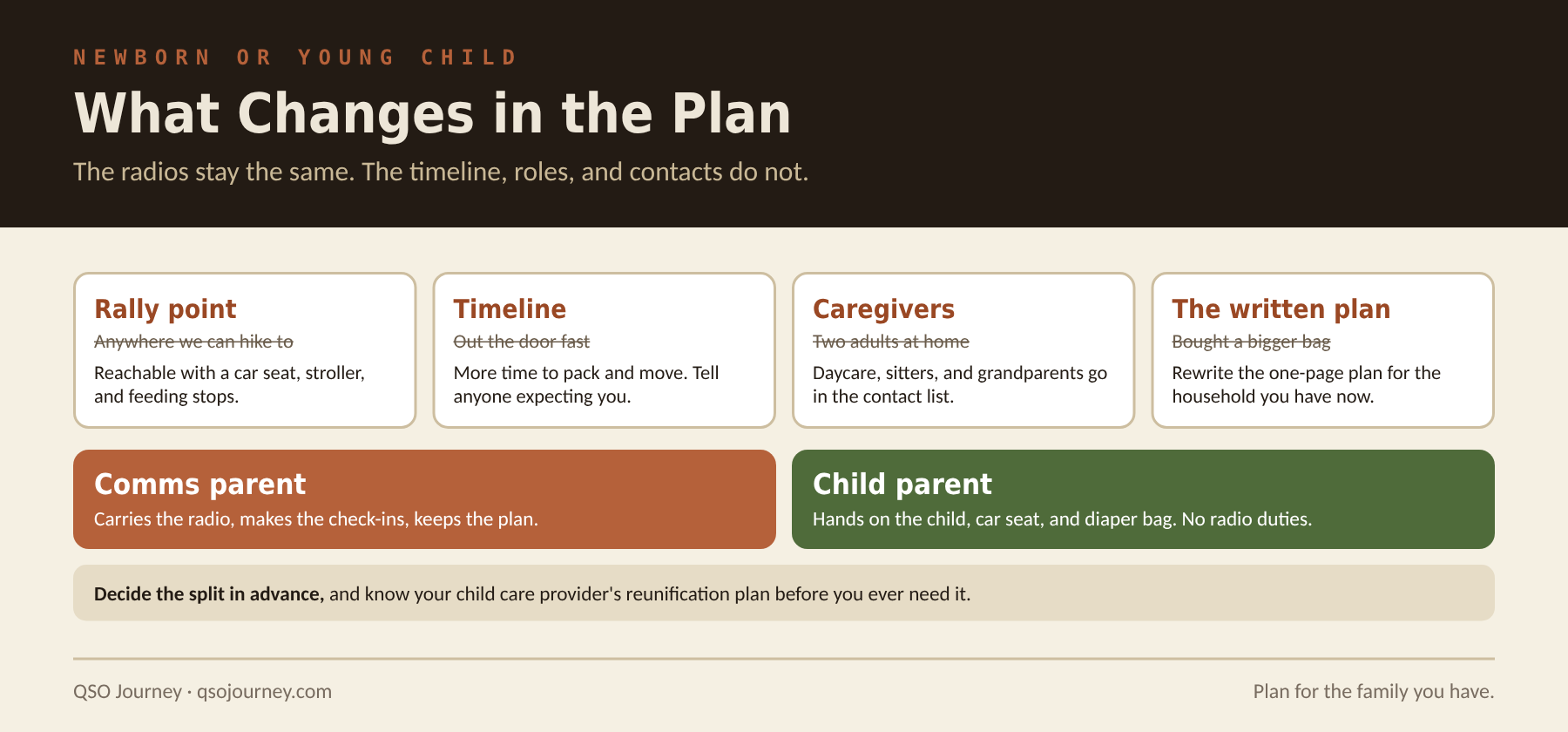
- Your rally point got less flexible. A rally point everyone could hike or drive to quickly may not be realistic with a car seat, a stroller and a feeding schedule. Revisit it with that constraint in mind.
- Everything takes longer. Packing, feeding and moving as a group all slow down. Build in more time than you think, and tell anyone expecting you at a rally point about the new timeline.
- Someone always has hands free for the radio. Whoever is carrying the child can’t also run a radio. Decide in advance which parent handles comms and which handles the child.
- Add the people who have your child when you don’t. Ask the daycare about its emergency and reunification plan, where it would move the children and how it contacts parents, and put that on your one-page plan. Make sure sitters and grandparents know your rally point and who may pick the child up.
- Update the plan, not just the gear. A bigger go-bag isn’t the same as revisiting the written plan. Update the document so it reflects your household as it is now.
A Check-In System for an Elderly Parent Living Alone
A phone call is the default way to check on an aging parent, and it works until cell service is the thing that fails, which tends to be exactly when you most need to know they’re okay. A radio check-in closes that gap without asking them to become a radio hobbyist. It doesn’t replace the phone call. It gives you a second way in when the first one is down.
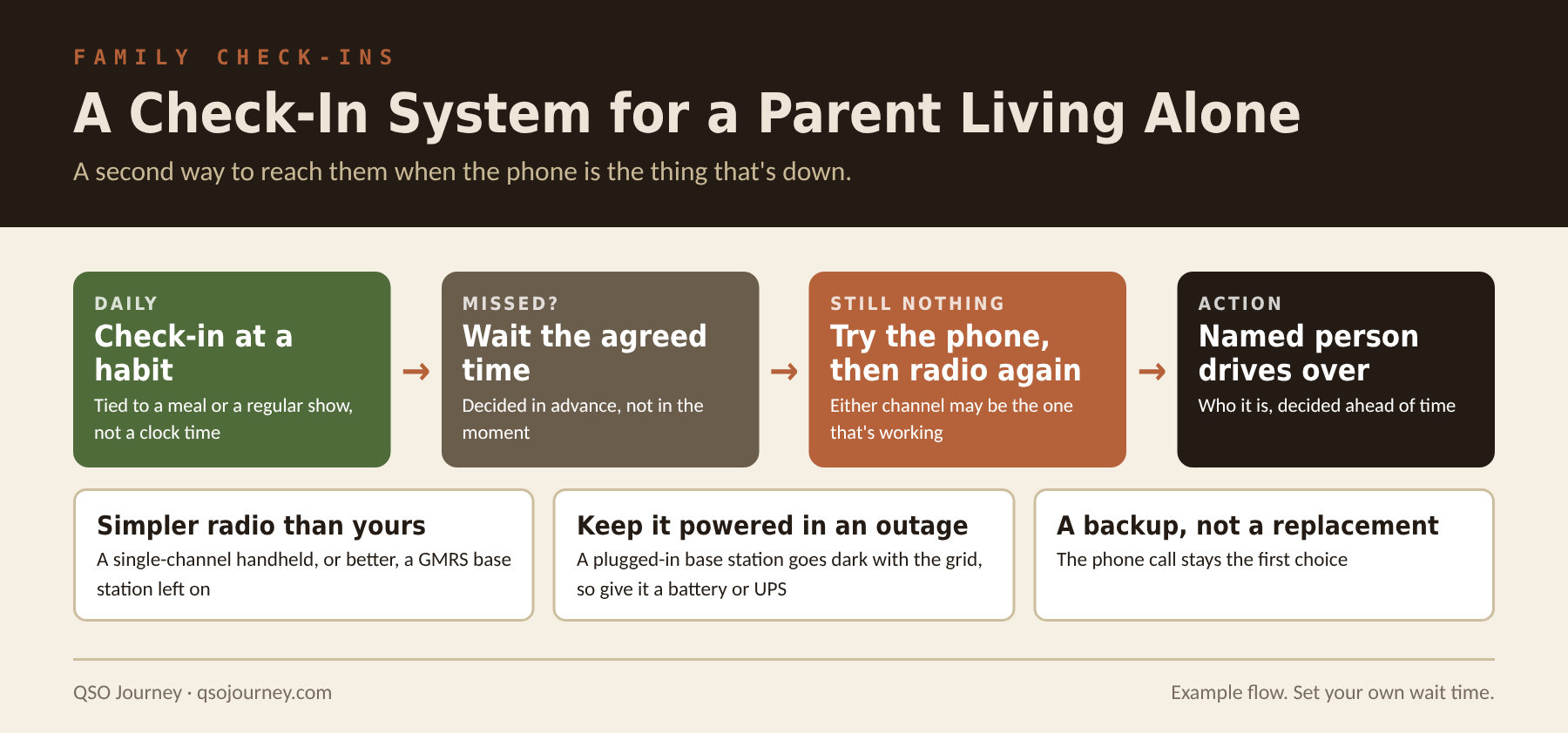
- Keep their radio simpler than yours. A single-channel GMRS handheld works, but a small GMRS base station left plugged in and always on is better: no battery to remember and no menu to navigate. A base station on wall power goes dark when the power does, so run it from a small battery with a charger, or a UPS.
- Tie the check-in to a habit. Anchor it to a meal or a regular show, not a clock time. The 3-3-3 radio plan works for an active emergency, but daily life needs something anchored to routine.
- Decide now what a missed check-in means. How long a miss goes before someone drives over, and who that someone is. A decision made calmly ahead of time beats one made anxiously after the fact.
School Pickup and Lockdown Planning
Every school has its own emergency plan, and it isn’t yours to run or override. Don’t plan to coordinate with the school by radio, and don’t expect staff to interact with your plan. Their job during a lockdown is following their procedure. Your plan works entirely on the parent side of that line.
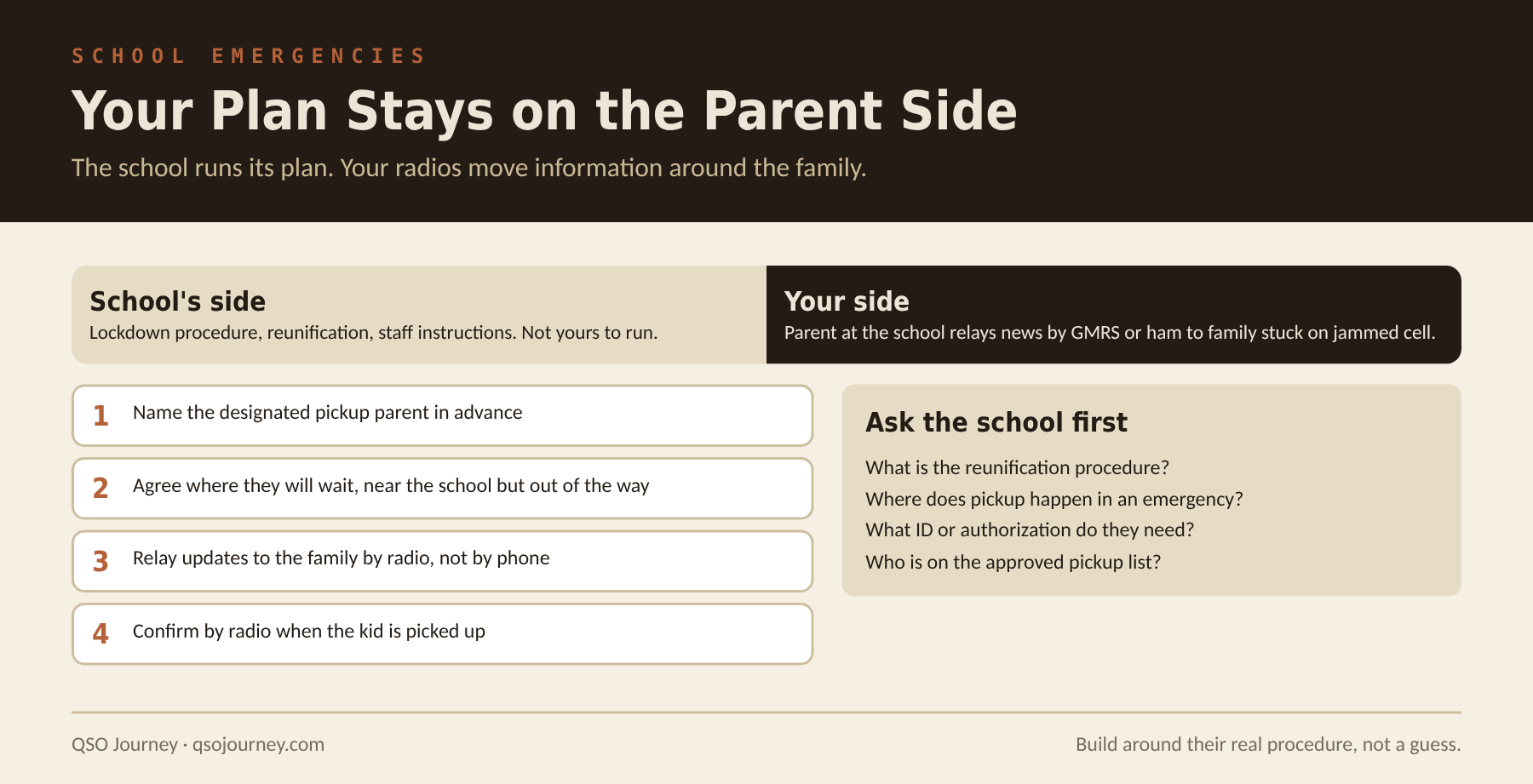
The real value shows up when one parent is at the school gathering information and needs to reach a spouse stuck at work, while every other parent in the parking lot is jamming the same cell tower. GMRS or ham moves that information around the family without competing for it. Decide in advance who the pickup parent is, where they’ll wait, and how they’ll confirm the kid has been picked up.
Then talk to the school, because some districts have pickup rules during an emergency that override whatever you assumed. Ask what the reunification procedure is, where pickup happens, what ID or authorization they require, and who is on your child’s approved pickup list. Make sure your designated pickup parent is on that list, or the rest of the plan doesn’t matter.
A Plan for Apartments and Multi-Family Housing
Renting changes almost every assumption in a typical plan. Some units have a balcony and some don’t, and leases often restrict what you can mount. Build around the handheld and indoor layer first, and treat any outdoor antenna as a bonus.
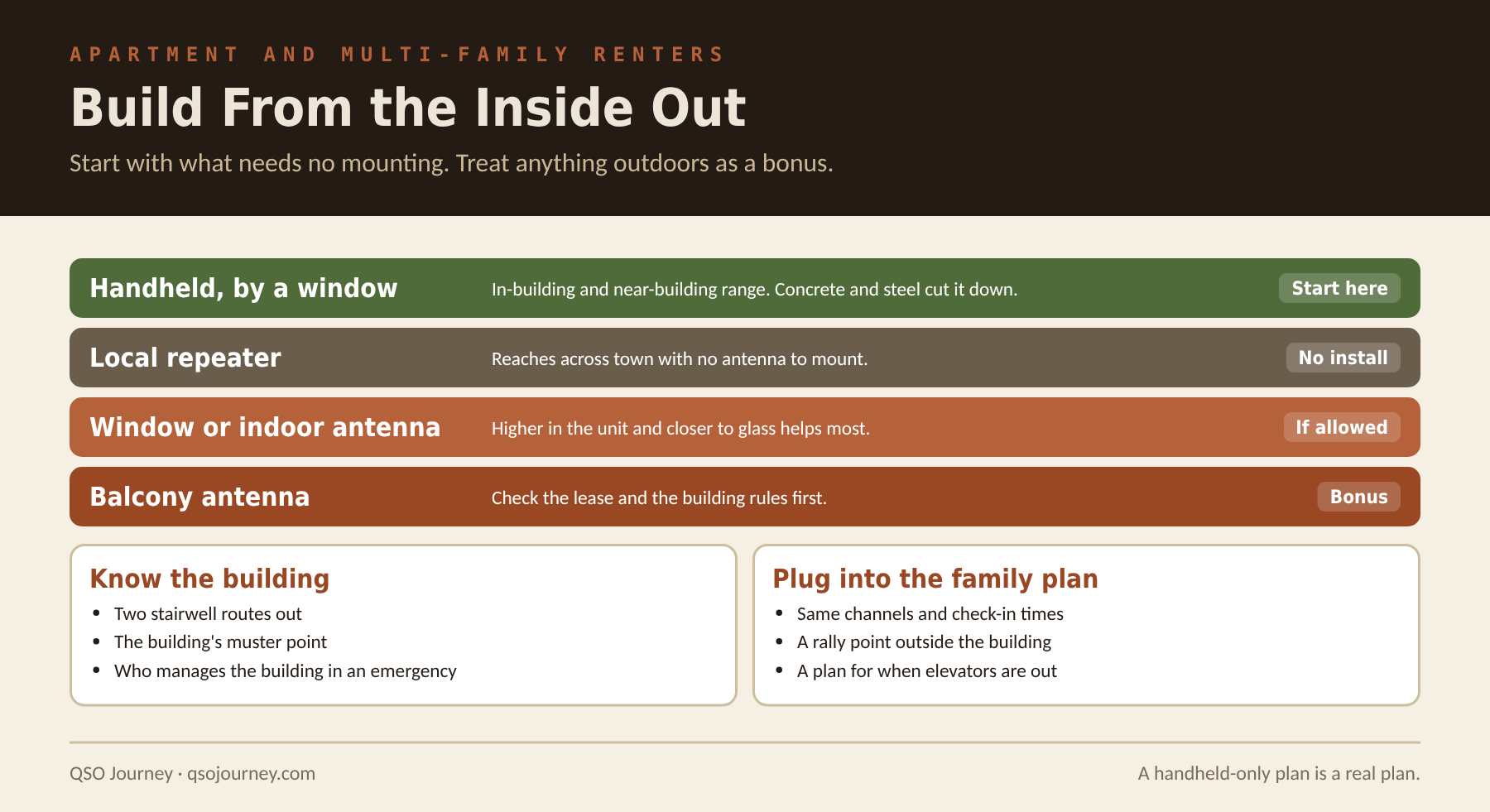
- GMRS works without an outside antenna. A handheld covers in-building and near-building range, and a local GMRS repeater extends that a lot further without mounting anything.
- Construction matters. Concrete and steel soak up far more signal than wood framing, so test from your unit. A window facing the person or repeater you’re trying to reach often makes the difference, and higher floors usually do better.
- Know the building, not just your unit. Stairwells, exits and any building muster point. Pick a family rally point outside the building too, and plan for elevators being out.
- A handheld-only plan is a real plan. If your lease allows a small antenna improvement, great. If not, a practiced handheld plan with a written card and rally points is completely legitimate.
A Plan for RV and Travel Trailer Families
A family living seasonally out of an RV can’t rely on a fixed rally point, a known repeater, or a neighborhood that stays the same. The whole plan has to be portable, so build it around a process you repeat at every stop instead of a location.
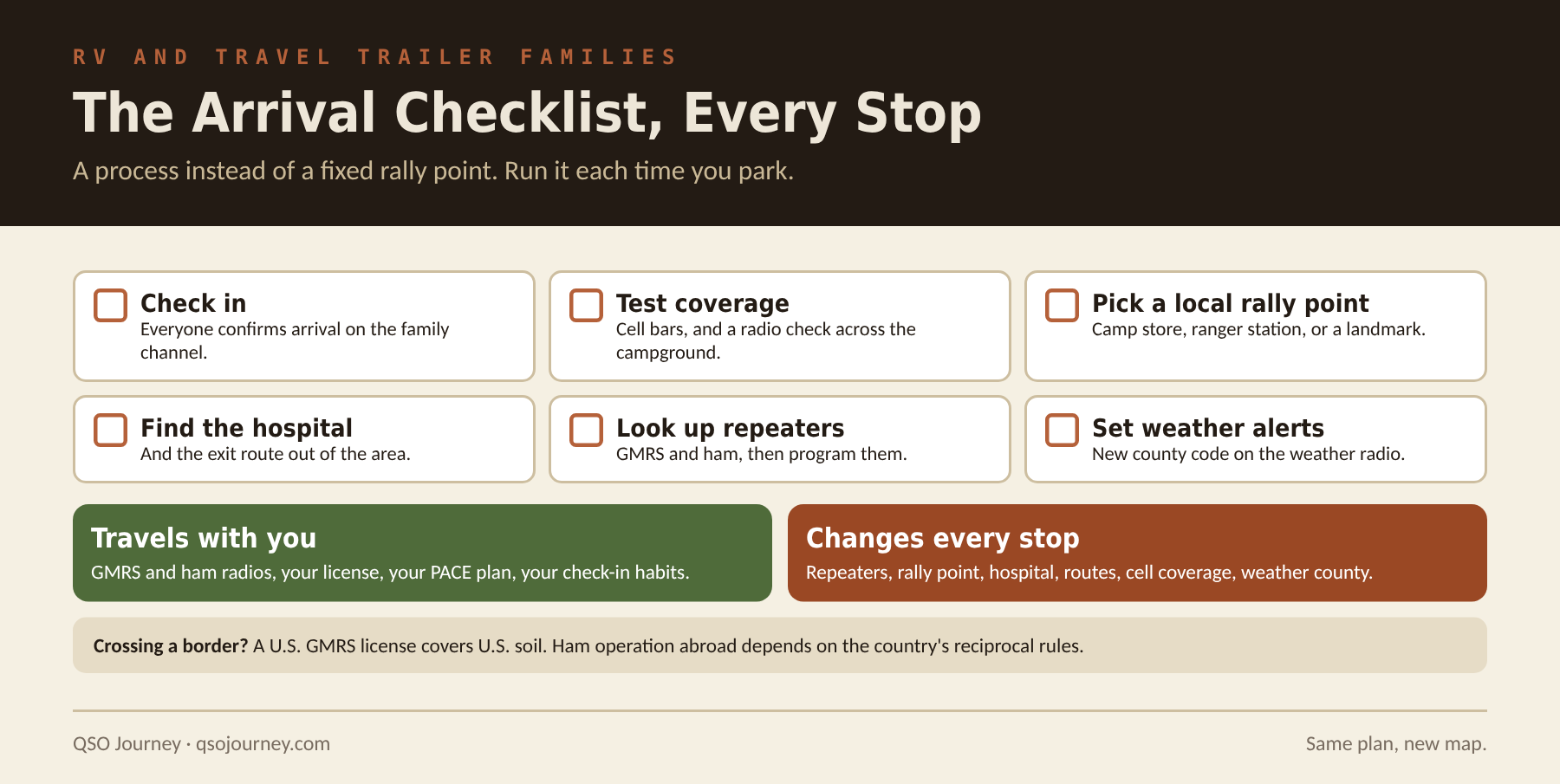
- Run the arrival checklist every time. Check in with each other, confirm cell coverage, find the nearest hospital and exit route, and pick a rally point everyone can find on foot, like the camp store, ranger station or entrance gate.
- Update the weather radio. Change its county code at each stop so alerts follow you.
- Radio travels better than cell coverage. Rural campgrounds often have weak cell service, which makes GMRS and ham more valuable for a traveling family. Both work the same anywhere in the US. If you cross into Canada or Mexico, check first: a US GMRS license doesn’t cover operation abroad, and ham operation depends on that country’s reciprocal agreement.
- A portable base station. A compact GMRS base setup scaled to mount easily in the RV, with antenna and power connections simple enough to set up in minutes.
- Look up local repeaters on arrival. Five minutes of research beats scrambling during an emergency. The process is in Finding and Programming GMRS Repeaters in Your Area.
A Plan for Family Spread Across Different Cities
Adult kids, parents and siblings in different cities or states break most radio-based plans, because simplex GMRS and VHF/UHF ham are local tools measured in miles. If your plan assumes a handheld will bridge hundreds of miles, it won’t. You need a different layer for real distance.

- Winlink for licensed family members. Winlink moves real email over HF no matter the distance, without the affected city’s cell towers or internet. Normal traffic still passes through the internet at the gateway end, so it works because a gateway outside the disaster area picks up your message. If the internet is down more widely, Winlink’s Hybrid network forwards between gateways by radio, and two stations can connect peer to peer. It needs a licensed operator in each location who knows how to run it.
- An out-of-area contact. A relative or friend in an unaffected region that everyone checks in with, even by normal phone, since a regional disaster rarely takes down phones everywhere at once.
- Text before you call. A text needs far less network capacity than a voice call and often gets through on a congested network when calls won’t.
- Practice a joint check-in. A few times a year, everyone uses their local layer and reports to the same out-of-area contact or Winlink address.
Keep Going
- Building and Maintaining the Family Radio Kit: the frequency card, redundancy, batteries, power and storage
- Practicing the Plan: drills, cross-training, after-action reviews and non-radio backups
- Your SHTF Communications Plan: PACE, 3-3-3 and Training
- PACE Communications Plan for Grid-Down