

Part of our Emergency Communications and Preparedness guide.
A plan nobody has practiced is a plan nobody remembers how to run. This guide is the practice side of a family comms plan: a script for your first drill, cross-training so the plan doesn’t depend on one person, an after-action review that actually fixes things, and the whistle, light and ground signals to fall back on when every radio is dead or lost. The broader training approach is in training your family or group on the communications plan.
Jump to: Your first drill · Cross-training · After-action reviews · Whistle and light codes · Panels and ground signals
Running Your First Family Comms Drill: A Script
The gap between knowing you should run a drill and actually running one is usually just not having a script. Here’s one you can use this weekend.
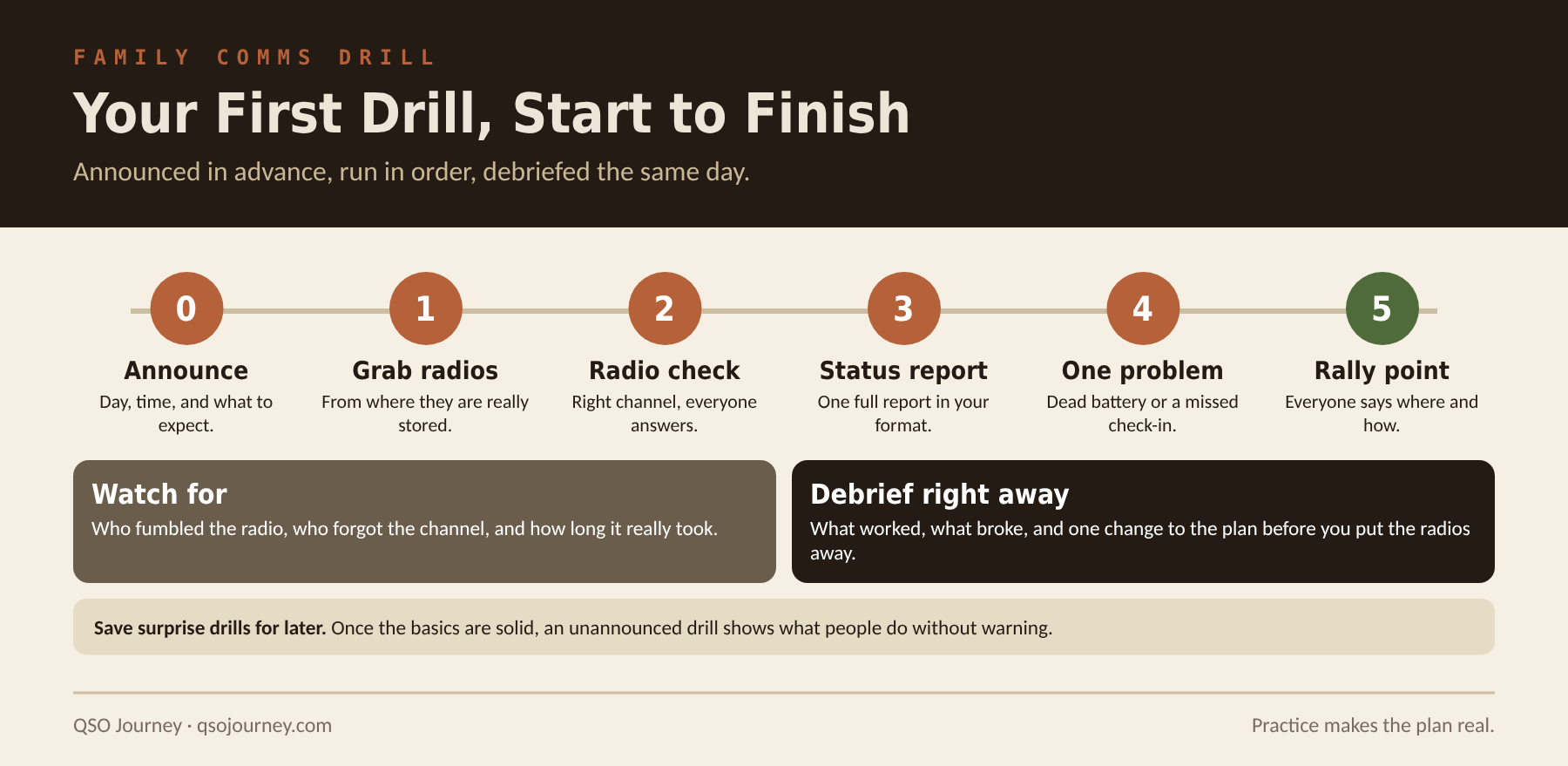
Announce it like a fire drill, not a pop quiz. Tell everyone the day, time and roughly what to expect. A surprise drill sounds appealing but on the first attempt it mostly creates confusion and resentment. Save the unannounced version for once the basics are solid.
- Everyone grabs their assigned radio, already charged, from wherever it’s actually stored.
- Turn on, confirm the channel, and do a radio check. One person calls each family member by name, and each answers with their name and “loud and clear” or “weak.” Keep the wording the same every time.
- Practice one full status report in your agreed format.
- Simulate one problem: a dead battery, a missed check-in, someone unreachable. Anyone who didn’t answer the radio check within a minute becomes the problem, which is often more realistic than anything you planned.
- Confirm everyone knows the rally point and how to get there.
While it runs, note who fumbled the radio, who forgot the channel, and how long it took compared to what you assumed. Those observations are the real point of the drill. Then debrief right away, using the review below.
Cross-Training So More Than One Person Can Run the Radio
In most households, one person, usually the licensed ham, knows everything. That person being hurt, unavailable or simply not home is the biggest hole in an otherwise solid plan. A plan that only works if one specific person is present isn’t a plan. It’s a dependency.
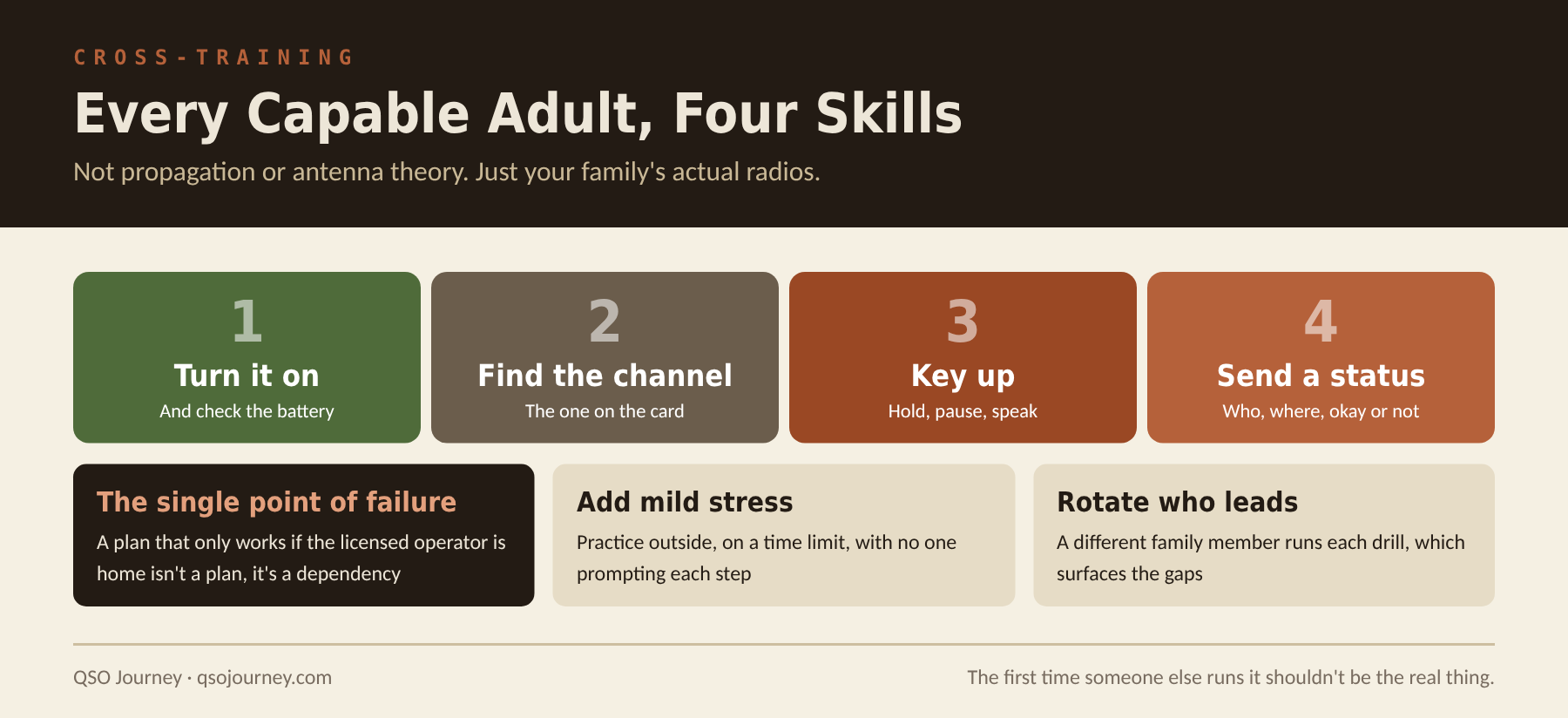
- The four skills every capable adult needs: turn the radio on, find the right channel, key up, and send a basic status, on the specific radios your family owns. No propagation or antenna theory required.
- Tape a card to each radio with the channel, how to key up, and your status format. It doesn’t replace practice, but it keeps a nervous first-timer from freezing on the one detail they forgot.
- Practice under mild stress. A kitchen table walkthrough teaches mechanics but not confidence. Do it outside, with a time limit, without the licensed operator prompting each step.
- Rotate who runs the drill. A different family member leading each time surfaces gaps you’d otherwise miss and builds real confidence.
After-Action Reviews: Fix the Plan, Not the Person
Running the plan surfaces problems. Only a deliberate debrief captures them before everyone forgets the dead battery, the confusing instruction, or the step that took three times longer than expected. It’s the half almost everyone skips.
- Do it right away, not next week, while details are fresh.
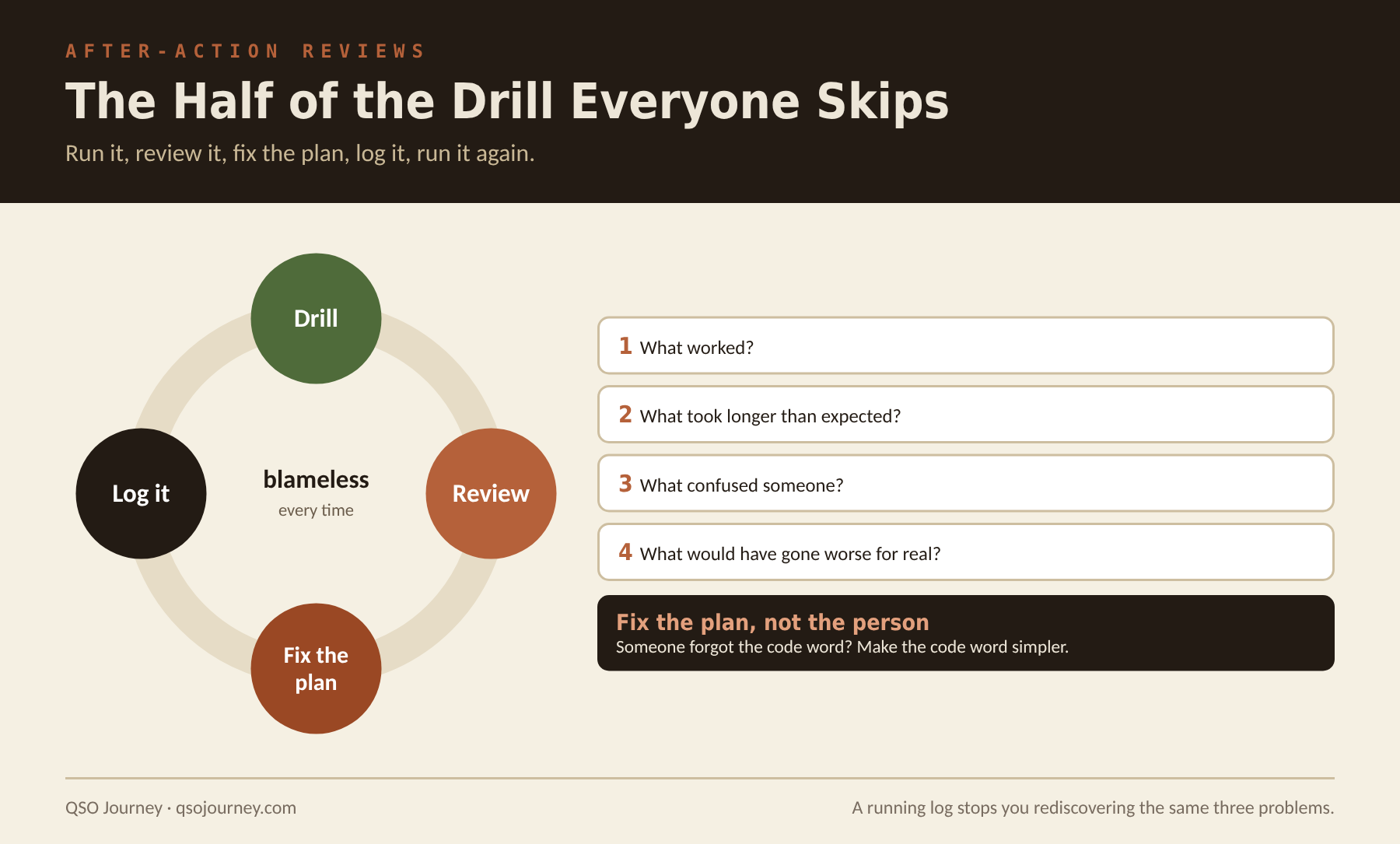
- Ask specific questions: what worked, what took longer than expected, what confused someone, and what would have gone worse in a real emergency. A quick version is three questions: what worked, what broke, and what one change you’ll make before next time.
- Keep it blameless. A defensive family member tells you less than one who feels safe admitting they froze.
- Fix the plan first. If someone forgot the code word, the fix is usually a simpler code word, not a lecture. Write the change into the plan before the radios go back on the shelf, so the next drill tests the fix.
- Keep a running log of what each review found and what changed, so you stop rediscovering the same three problems every drill. Keep it in the comms binder.
For club drills and real activations, the After-Action Report in EmComm Hub drafts it for you from the net logger’s timeline, check-ins, traffic and volunteer hours.
When Radios Fail: Whistle and Light Codes
Every layer of the plan, GMRS, ham or mesh, still depends on a working radio and a charged battery. A dropped radio, a dead battery, or getting separated from your gear during an evacuation are all realistic ways the plan stops working right when you need it. A non-verbal fallback costs nothing and never runs out of charge.
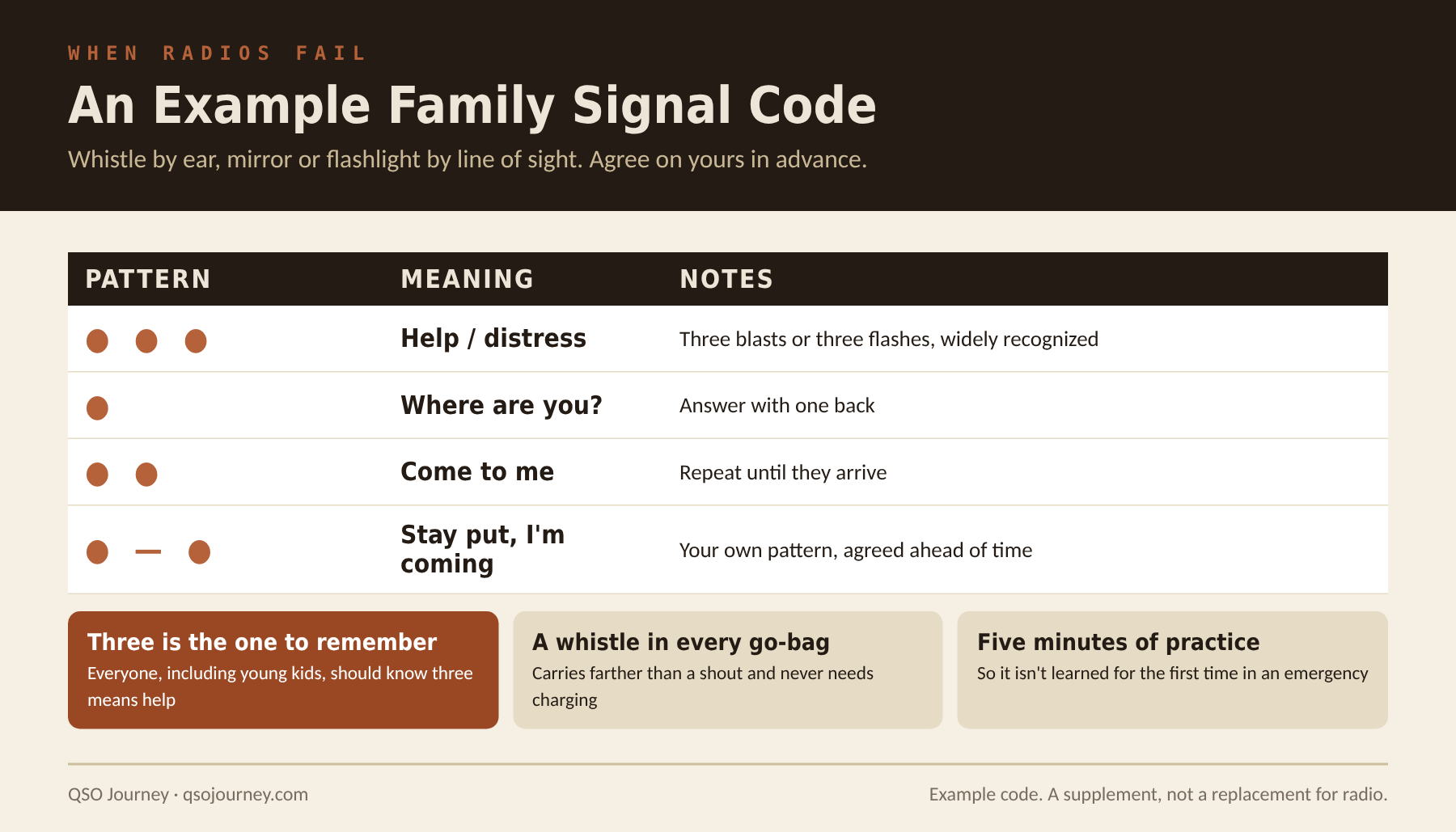
Three short blasts is a widely recognized distress signal. A good starting set borrows the pattern many scouting and hiking groups use: one blast means “where are you,” two means “come to me,” and three means “help.” Add one pattern of your own for “stay put, I’m coming,” and write them all on the family card. A whistle in every go-bag carries much further than a shout. The same counts work with a flashlight after dark, and a signal mirror can be seen for miles in the right conditions. Three flashes repeated is simple enough for young kids.
Visual Panels and Ground-to-Air Signals
Search and rescue teams have used panel signals for decades, and the idea scales down to a family plan: fabric or objects arranged in a pattern that means something to anyone looking for you, visible long before they’re close enough to hear you.
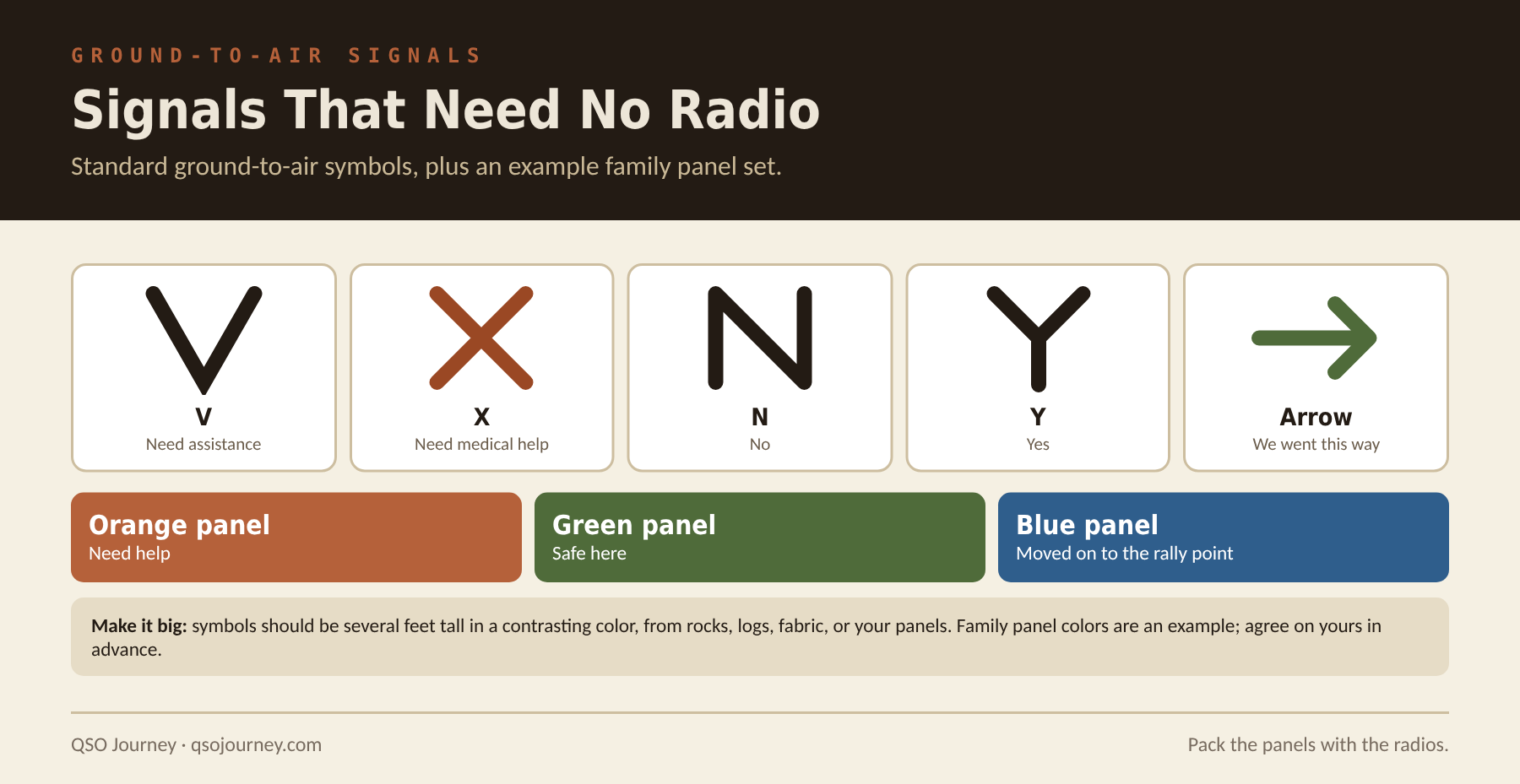
- A family panel set: two or three high-contrast panels, bright fabric or a tarp, each with a meaning agreed in advance, like need help, safe here, or moving on to the rally point. Keep it small enough that a young child remembers it without a cheat sheet.
- Standard ground-to-air signals worth knowing: a large V for need assistance, X for need medical help, N for no, Y for yes, and an arrow pointing the way you went. Make them several feet tall in a color that contrasts with the ground, using rocks, logs or your panels.
- Pack and practice them with the radios, so nobody has to choose which system to use under pressure.
None of this replaces the radio plan in what a real SHTF communications plan actually looks like. It’s the layer underneath, and five minutes of practice means it isn’t being learned for the first time in a real emergency. Next: comms planning beyond your family.