
Part of our Emergency Communications and Preparedness guide.
Ask most preppers what their communications plan is and you’ll get an answer about gear: a couple of handhelds, maybe a GMRS radio, an HF rig if they’re serious. That’s not a plan. That’s a pile of equipment. A real SHTF communications plan is something you could hand to a family member, a neighbor or a group member and have them execute it without you standing next to them. This guide covers what that plan is, what goes in it, the 3-3-3 schedule, how to put it on one page, and how to get people who aren’t radio hobbyists to actually use it.
Jump to: What a real plan is · The key parts · The 3-3-3 radio plan · The one-page reference · Training your family or group · Tactical vs SHTF comms
What a real plan actually looks like
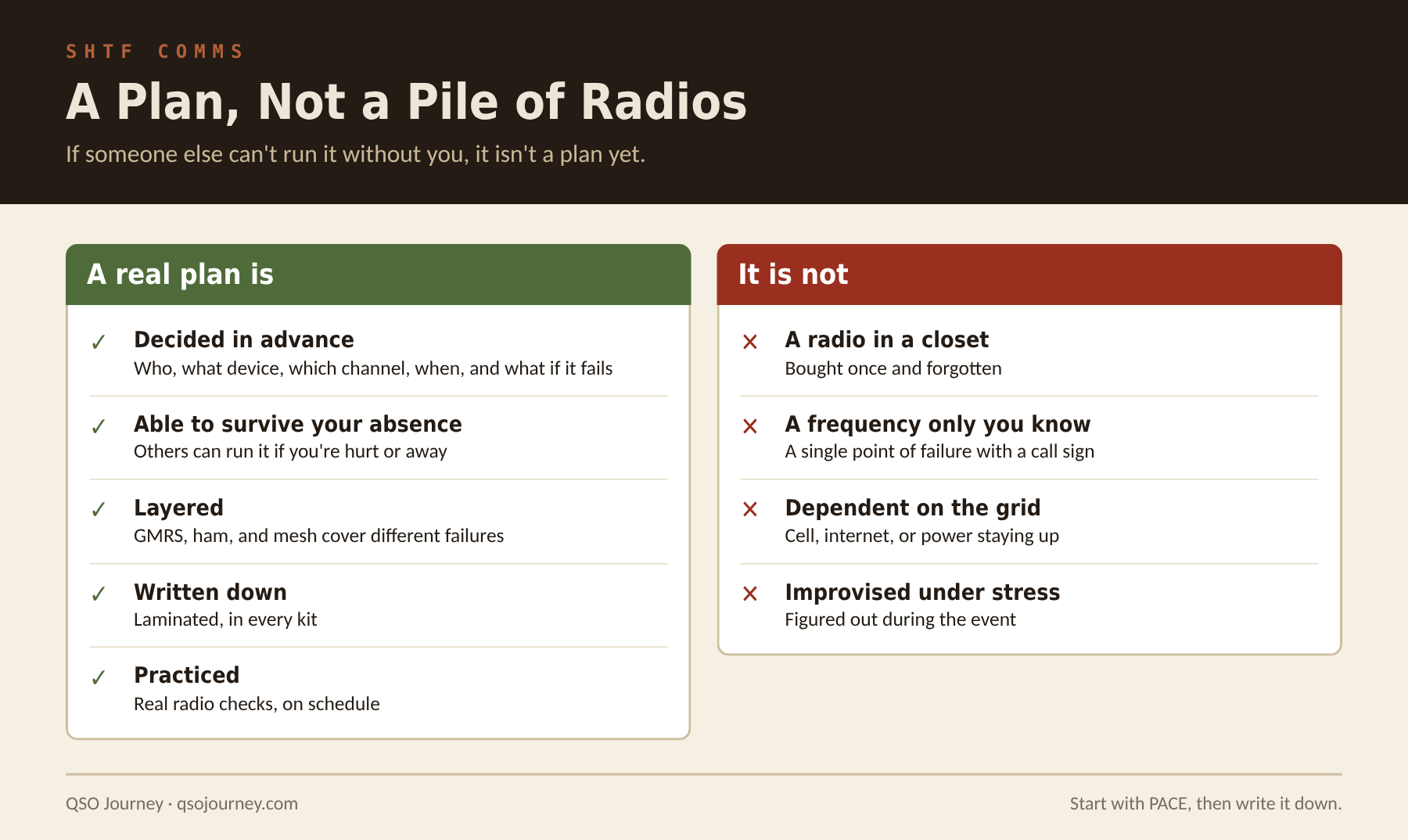
- It’s decisions made in advance. Who talks to whom, on what device, on what channel, at what times, and what happens if that fails, all decided while you’re calm. If you’re working any of that out in the moment, you have improvisation, and improvisation under stress goes badly more often than people admit.
- It survives your absence. The biggest gap in most setups is that the licensed ham in the house knows the frequencies, the schedule and the gear, and nobody else does. That’s a single point of failure wearing a call sign.
- It’s layered. GMRS is easy but short-ranged. Ham radio has range and flexibility but needs operators who know what they’re doing. Mesh tools like Meshtastic move small messages cheaply but have real bandwidth limits. No single tool covers every failure.
- It’s written down. If it isn’t on paper, preferably laminated, it’s a memory, and memories fail exactly when you need them.
- It’s practiced. A plan nobody has run is a theory. Running it surfaces dead batteries, forgotten channels and the person who never learned to key up, while those problems are still cheap to fix.
It is not a single expensive radio forgotten in a closet, a mental note about “the emergency frequency” only you know, anything that depends on cell service, the internet or the grid, or something you’re figuring out for the first time during the event.
The key parts: PACE, rally points, roles, channels and messages
PACE: Primary, Alternate, Contingency, Emergency
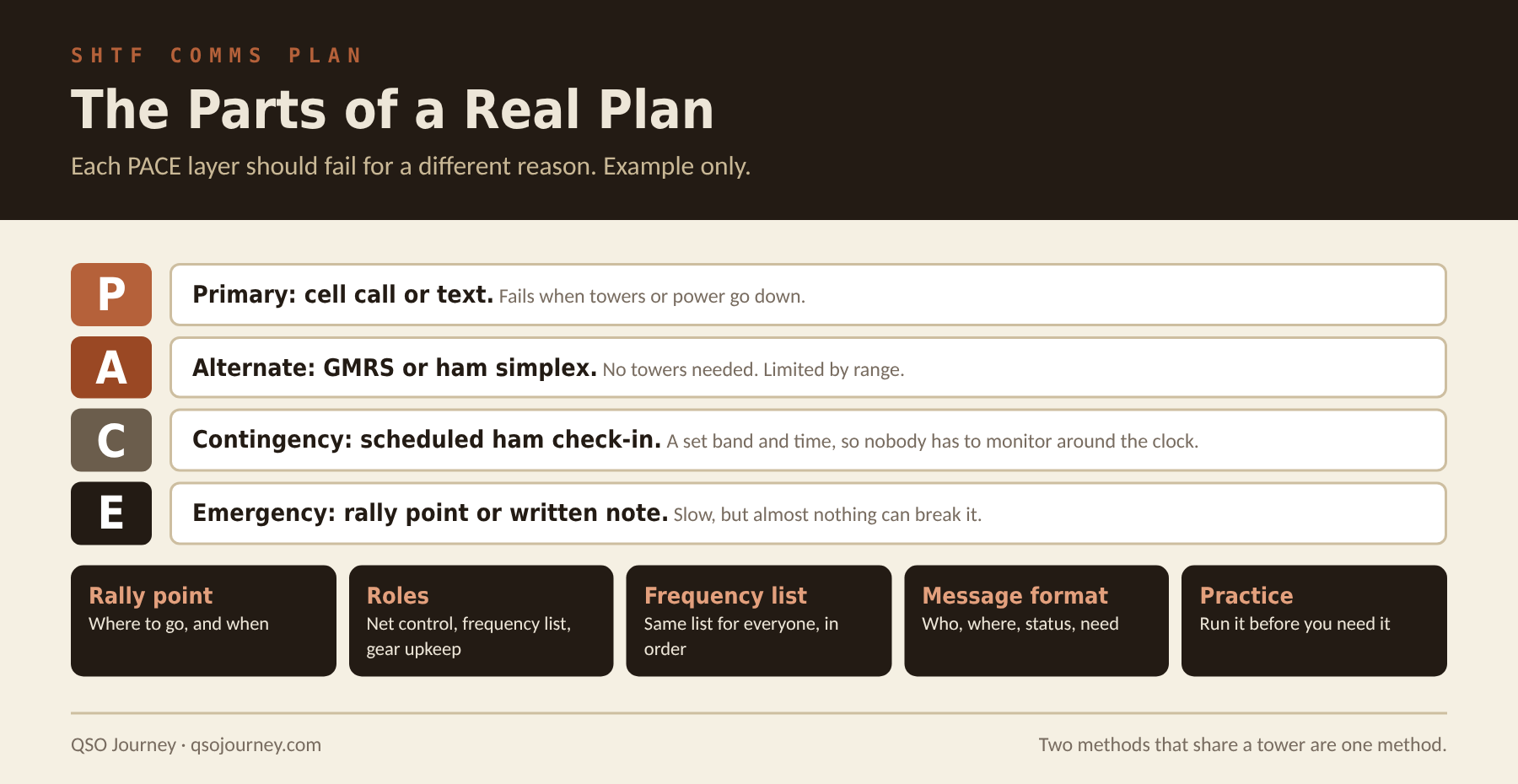
PACE is a military planning framework that has become standard in serious emcomm circles because it forces you to think through failure in advance. For each communications need you define four ranked options:
- Primary: the easiest method, like a call or a text.
- Alternate: something that doesn’t depend on the same infrastructure, like a GMRS or ham simplex channel.
- Contingency: a backup that assumes both have failed, such as a scheduled ham check-in on a specific band.
- Emergency: the last resort, slow but nearly infrastructure-proof, like a rally point or a note left at a known place.
The value isn’t the acronym. It’s redundancy across genuinely different failure modes. A call and a text die with the same cell tower. A GMRS radio and a ham radio don’t fail for the same reasons. The full framework is in Building a PACE Communications Plan.
Rally points
Every plan needs a physical fallback for when radio contact fails entirely: a place people know to go, and the time or condition for going there. Pick at least two, a close one you can walk to from home and a farther one outside the neighborhood in case the area has to be evacuated. Write the address on the plan, not a nickname only half the family knows.
Roles, a shared channel list and a message format
- Roles: someone runs net control for check-ins, someone owns the channel list, someone keeps the backup gear charged. In a served-agency setting this maps to ARES or RACES roles, but even a family plan benefits from simply assigning who does what.
- A common channel list: which GMRS channels, which ham simplex frequencies, which repeaters (knowing they may not survive an extended outage), and in what order to try them.
- A message format: status, location and requests for help go better with a consistent structure. You don’t need to run a formal net, but borrowing from ICS-213 and message formats helps.
The 3-3-3 radio plan
Of all the radio schedules floating around prepper circles, the 3-3-3 plan has stuck because it’s almost impossible to forget. It isn’t a licensing rule or an official protocol, just a sensible convention a lot of groups have converged on: every 3 hours, on the hour, turn your radio on and listen (and transmit if needed) for at least 3 minutes, on a pre-agreed channel, traditionally channel 3. In local time that gives eight windows a day: midnight, 3, 6 and 9 am, noon, and 3, 6 and 9 pm.
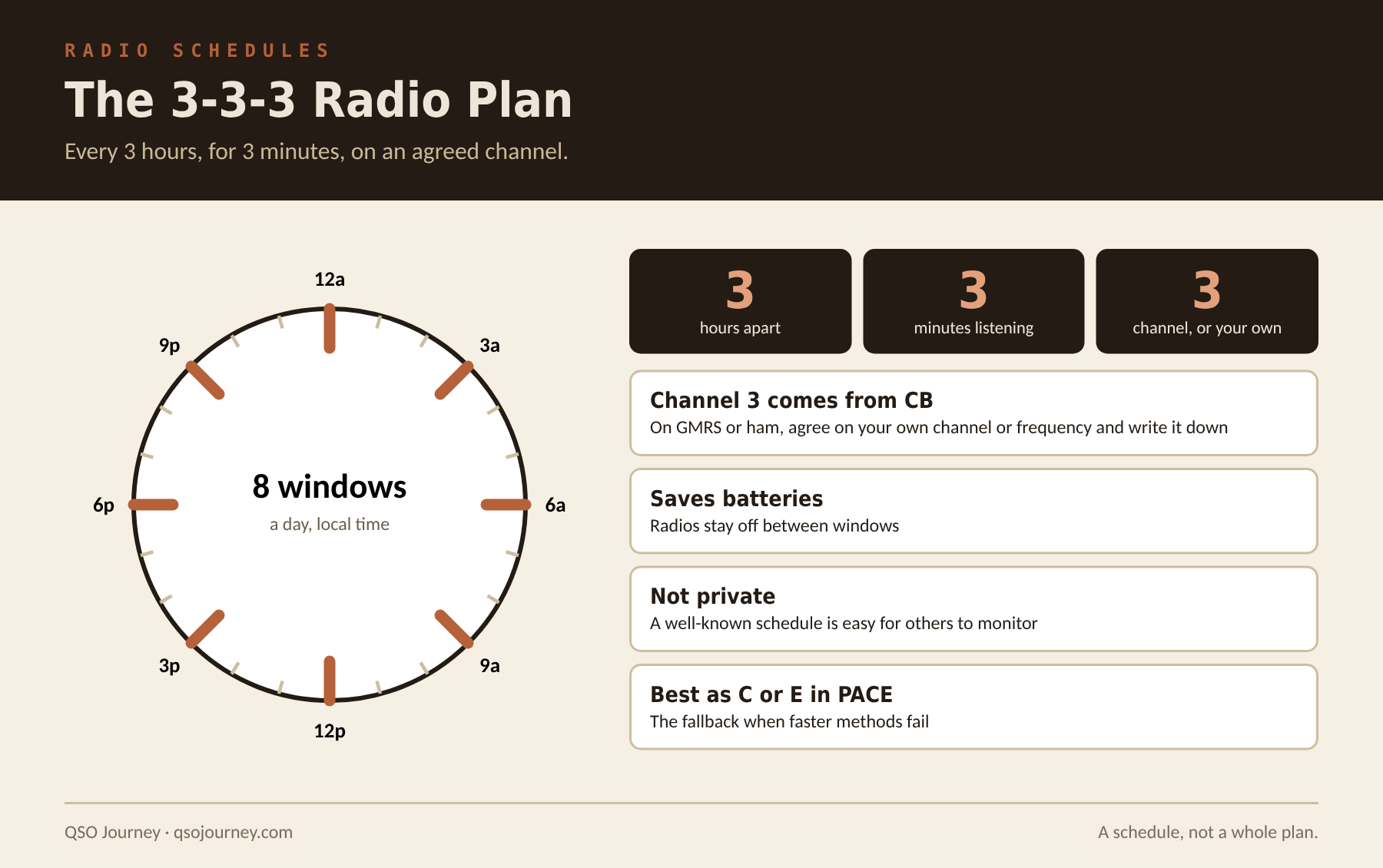
- Battery conservation: radios off between windows save power for when it matters, which is huge if you can’t recharge on demand.
- Predictability: everyone knows when to expect contact without coordinating in real time.
- Simplicity under stress: someone exhausted, scared or new to radio can still remember it.
- Rest: three hours between checks is enough time to rest, move or handle other tasks.
“Channel 3” comes from CB, which made it an easy universal default. For your group, the channel matters less than everyone agreeing on the same one. On GMRS, pick a designated simplex channel. On ham radio, many groups use a common 2 meter simplex frequency, since ham radios don’t use numbered channels. Write it on your plan.
3-3-3 is a scheduling convention, not a complete plan. It works best as the contingency or emergency tier of your PACE ladder. It doesn’t change range (no schedule changes physics), it doesn’t provide security (anyone with a scanner knows the convention too, so treat sensitive traffic accordingly), and it doesn’t replace practice.
The one-page reference everyone needs
The whole point of documenting the plan is that it works without you. Keep it to one page if you possibly can. A five-page plan gets skimmed once and never read again, while a laminated single page in a go-bag or glovebox actually gets used. Keep an expanded version for yourself if you need more detail. The one-pager should have:
- The channel and frequency list in PACE order
- The check-in schedule, in a format nobody has to do math to understand
- Call signs or agreed identifiers for everyone, so people know who they’re hearing
- The rally points and when to head there instead of trying the radio again
- Plain-language operating steps: turn it on, change channels, key up
- Contacts outside the group who might need to be reached or might relay information
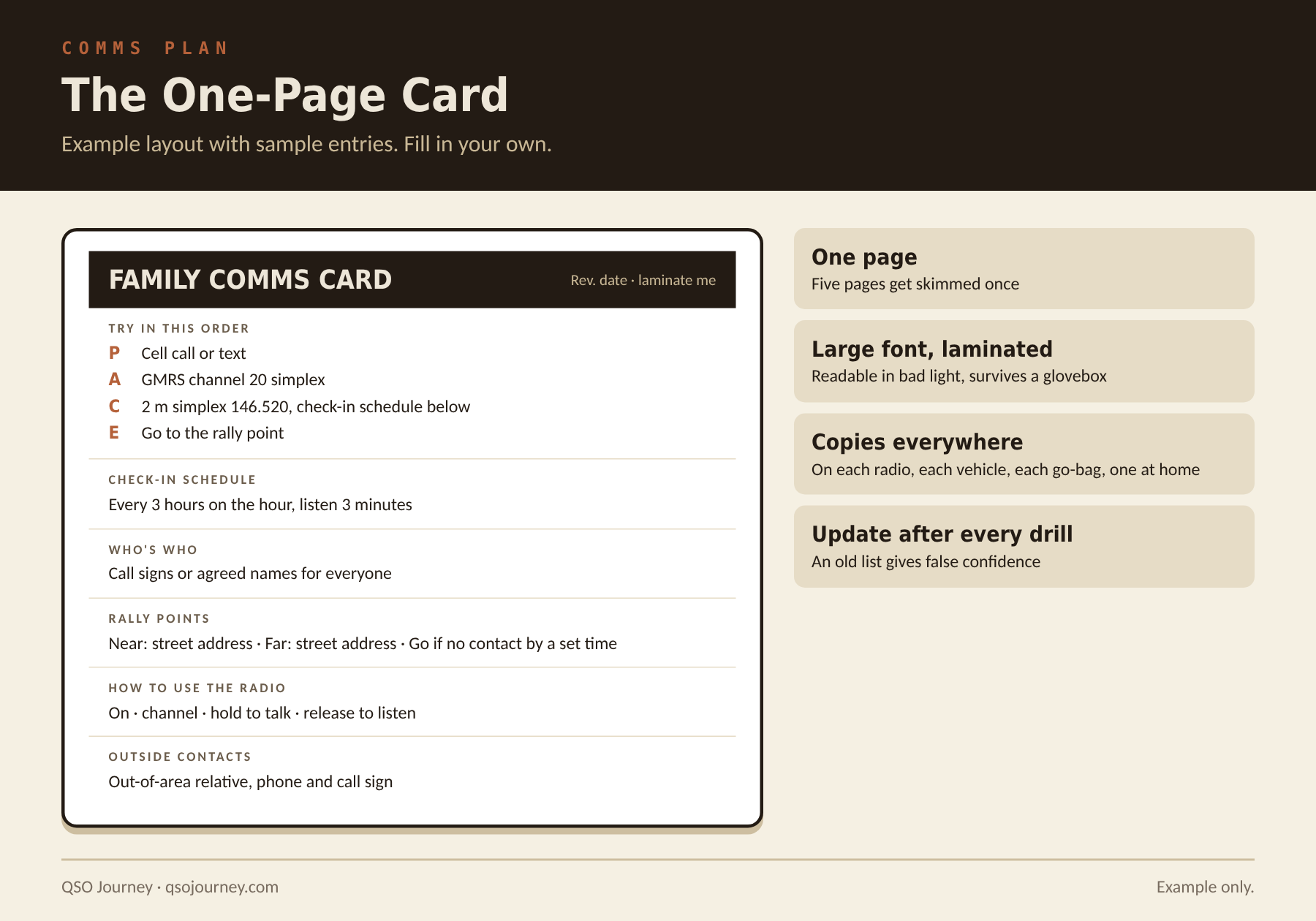
Laminate it, and use a large, legible font, because someone reading it under stress or in bad light shouldn’t squint at 8-point text. Keep a copy taped or zip-tied to each radio, one in each vehicle, one in each go-bag, and one somewhere central at home. Revisit it after every drill, because an outdated frequency list is worse than none: it creates false confidence. The free Family PACE Plan Builder fits a family plan on one printed page with wallet cards and radio labels, and EmComm Hub prints the same thing offline as wallet cards and a Family Binder.
Training your family or group
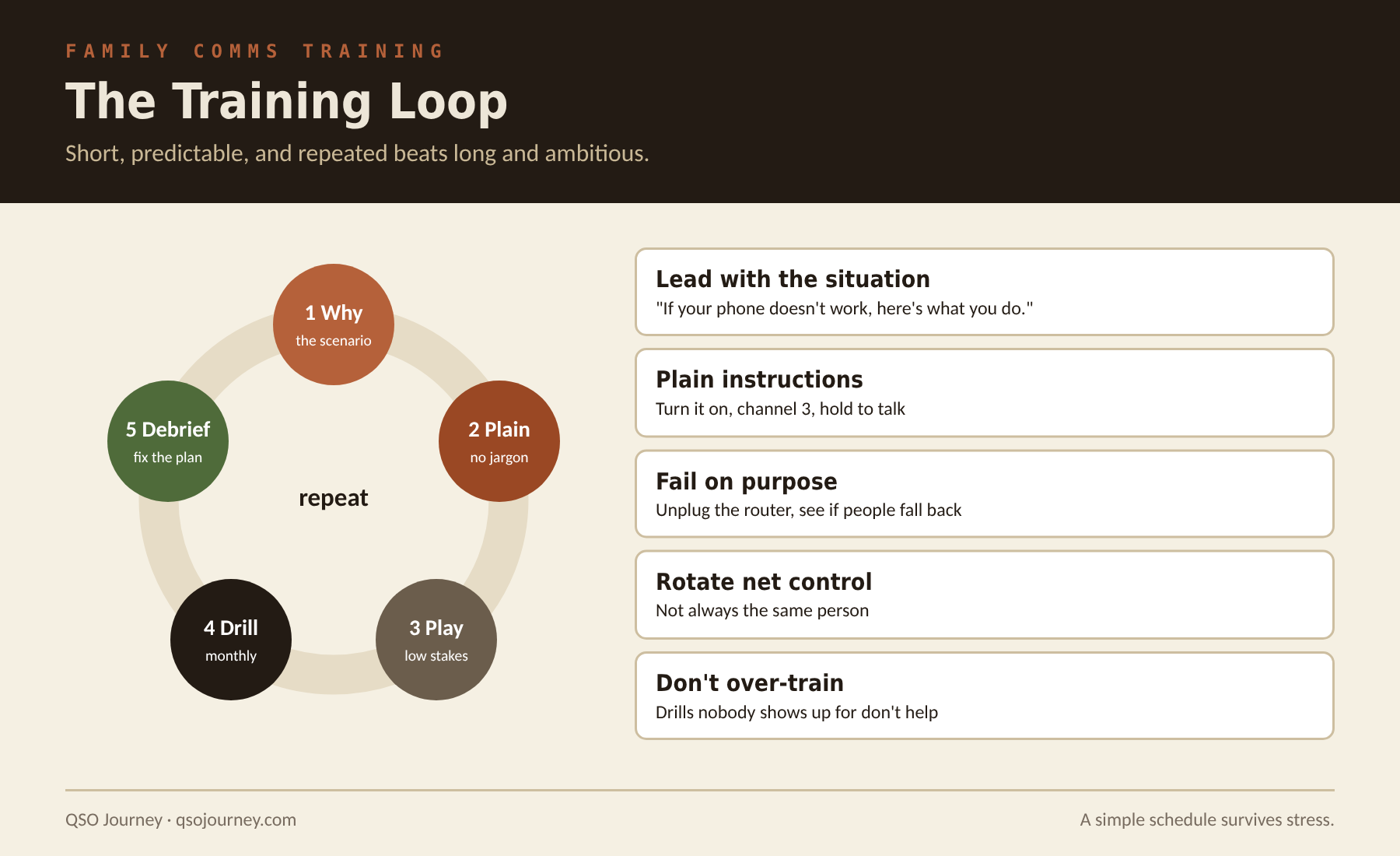
Writing the plan is the easy part. Getting people who aren’t radio hobbyists, and never will be, comfortable enough to execute it under stress is the part most plans skip.
- Start with why, not gear. “If your phone doesn’t work and you need to reach me, here’s what you do” sticks. A technical explanation doesn’t.
- Keep the jargon out. Simplex, offset and CTCSS are useful to you and noise to them. “Turn it on, make sure it’s on channel 3, hold this button to talk.”
- Play before you drill. Practice turning radios on, finding the channel and making a call on a normal weekend with no pressure. That’s where you find the person who never learned to change channels, or the radio with a six-month-old dead battery.
- Keep the schedule simple. Simple schedules like 3-3-3 survive stress better than clever ones.
- Run real drills. Monthly is reasonable for most families. Rotate who coordinates, break the primary on purpose, and debrief afterward.
- Don’t over-train. Drills that are too frequent or too long become a chore people quietly skip. A plan practiced occasionally and reliably beats one practiced intensely and then abandoned.
At least once a year, break the primary on purpose. Agree on a window, put the phones in airplane mode or unplug the home internet, and see whether people fall back to the radio and the schedule without being reminded. The gaps that show up (a dead battery, a forgotten channel, a card nobody can find) are what the debrief is for. Fix them, update the card, and run it again. Practicing Your Family Comms Plan has more drill ideas.
Tactical team comms vs SHTF comms
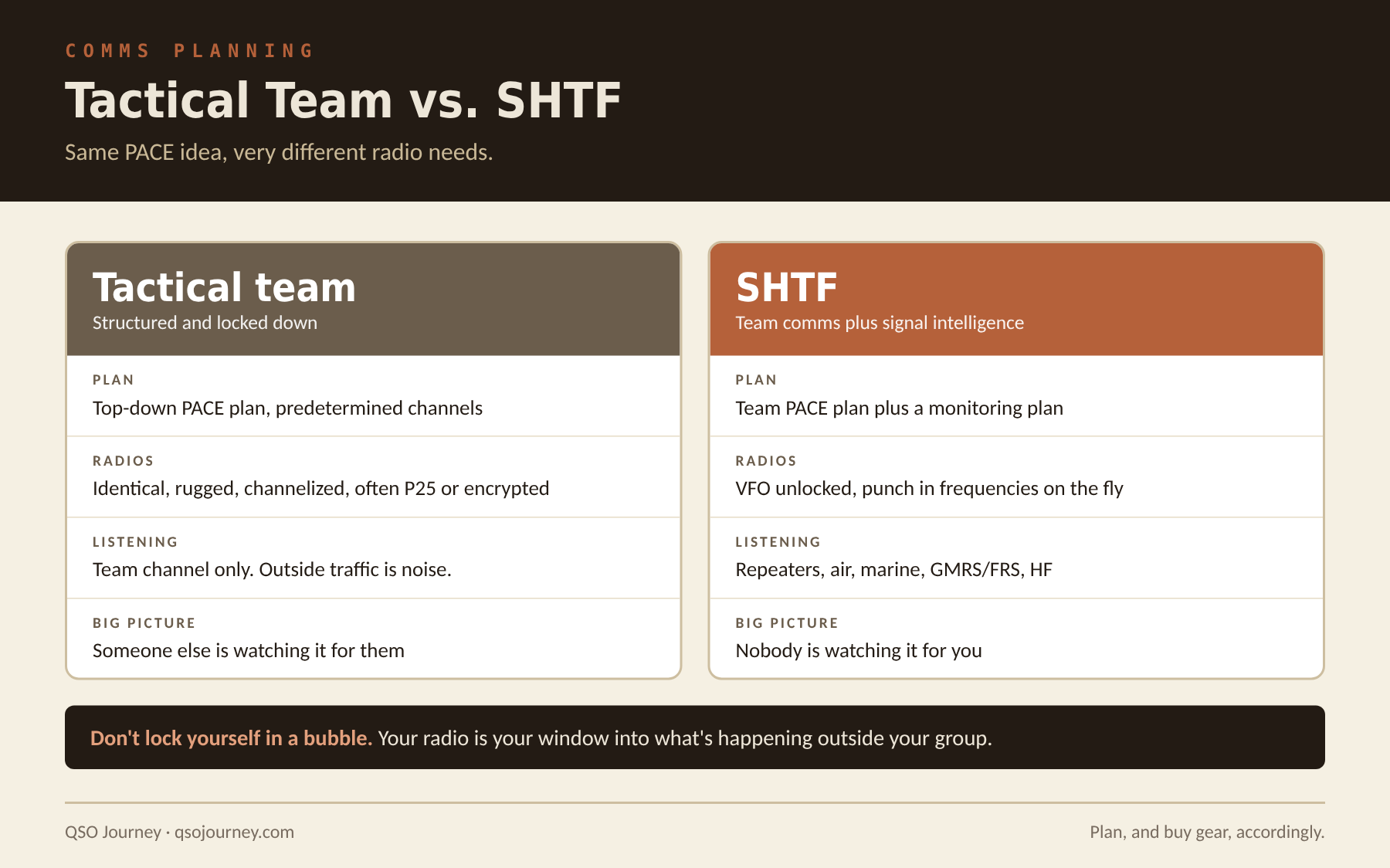
I see a lot of guys picking radios based entirely on what military, police or tactical teams use. A tactical team’s comms plan and a worst-case SHTF plan are two different animals, and copying one into the other will blind you.
- The tactical model is structured and locked down: a top-down PACE plan, predetermined frequencies, strict channelized memory, everyone on the same rugged radios, often locked to specific UHF/VHF or encrypted P25 channels. The goal is internal coordination, and outside traffic is just noise. You turn to channel 2 and stick to the plan.
- The SHTF model still needs that internal plan, but it’s only half the job. You’re also hunting for information: what emergency services are doing, what other groups are doing, where traffic is moving. Your radio needs VFO mode unlocked so you can punch in frequencies on the fly, and you need to monitor repeaters, airband, marine, GMRS/FRS and possibly HF to see the big picture.
A tactical team can go quiet and narrow because someone else is watching the wider picture for them. In a grid-down world nobody is doing that for you. Your radio isn’t just a phone to your team, it’s your window into what’s happening outside your bubble. Plan, and buy gear, accordingly. If your group coordinates more than a couple of people in the field, ATAK is worth a look for shared situational awareness.
Related reading: Building a PACE Communications Plan · A Family Comms Plan for Every Household · Your Comms Plan for Every Disaster Scenario · Emergency Communications and Preparedness