

Part of our Emergency Communications and Preparedness guide.
A family plan covers your household, and formal EmComm like ARES and RACES assumes trained operators working for served agencies. There’s a real gap in between: the neighbors on your street, a small church or community group, and the people physically closest to you, who are exactly who you’ll be relying on and helping in a local emergency. This guide covers that middle ground.
Jump to: A neighborhood net · Neighbors with no radio · A neighborhood radio watch · Church and community groups · CERT and ham radio
Organizing a Neighborhood Net
A neighborhood of five to twenty households sits awkwardly between a family and a formal net. People know each other well enough to cooperate but aren’t going to sit through net control training. The plan has to be simple enough that a neighbor with a $30 FRS radio can take part.

- A coordinator and a backup, not a committee. One person runs check-ins, one more can step in. That’s the whole org chart. A formal hierarchy for a volunteer group usually collapses the first time it’s tested, because nobody signed up for a chain of command. They signed up to know their neighbors are okay.
- A fixed check-in time. Once or twice a day during an event works better than open-ended standby, the same logic as the 3-3-3 radio plan. Keep the format dead simple: name, status, anything urgent.
- Pick the channel around the least capable radio. FRS and GMRS share channels 1 through 22, so a shared simplex channel lets a blister-pack FRS radio check in alongside licensed GMRS households, and hams in the group can relay to wider ham nets. Write the channel and any tone setting into the plan so every radio is set the same way.
- Informal, but written down. Who has what radio, the channel, and who the coordinator and backup are, with a copy in every household. A plan in one person’s head disappears when that person is unavailable, which is exactly the situation it exists for.
For a neighborhood PACE plan that layers GMRS, VHF/UHF ham and HF, see The Pentagon Wants Bases to Last 90 Days Off-Grid. What’s Your Plan?
Coordinating With Neighbors Who Don’t Own a Radio
Realistically, most neighbors don’t own a radio and never will. Accept that instead of fighting it. Push too hard and you become the weird prepper neighbor rather than someone people want to coordinate with. Their proximity is still valuable.
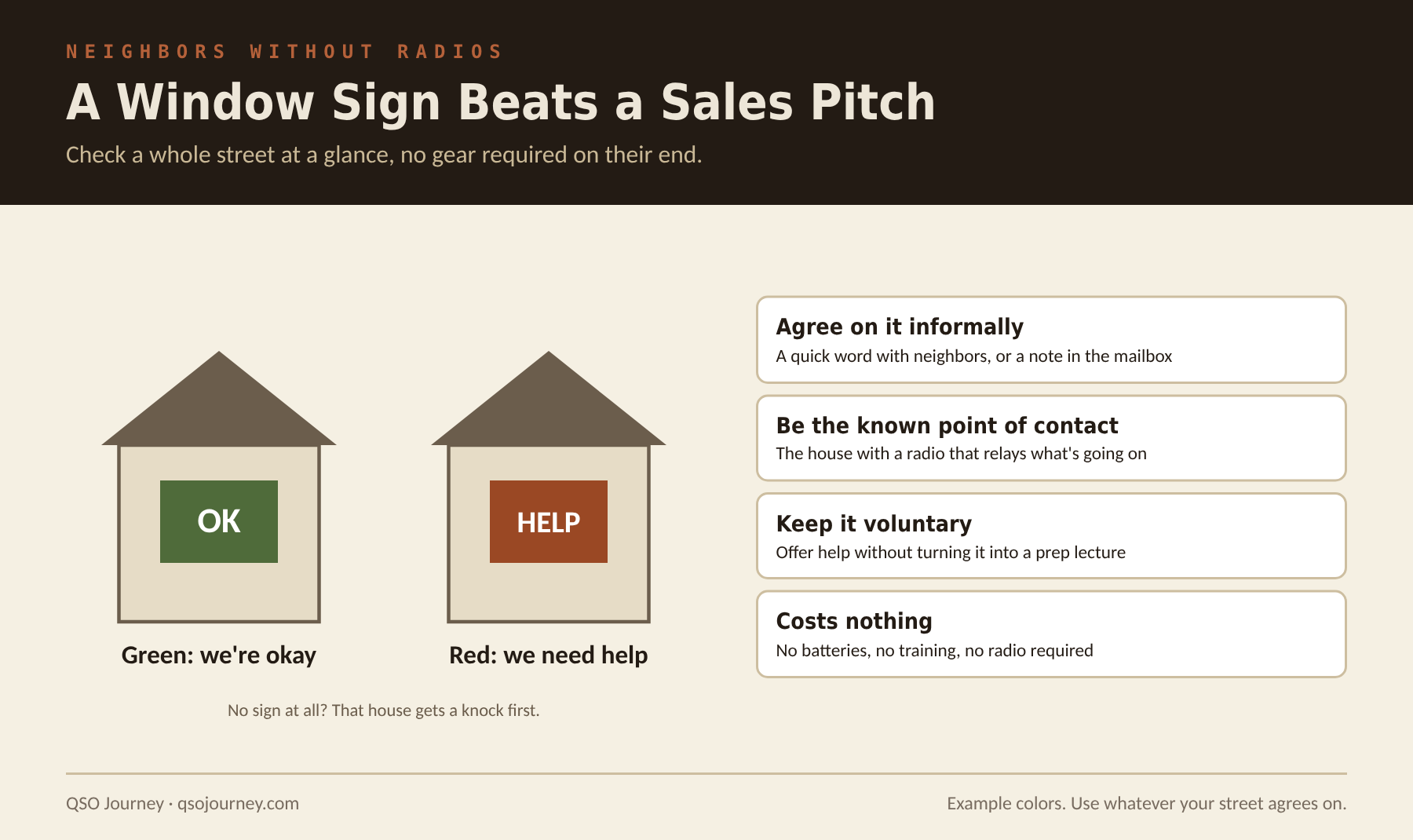
- A window sign system costs nothing. A colored cloth or sign in a front window, informally agreed as “I’m okay” or “I need help,” lets you check a whole street at a glance with no batteries and no conversations.
- Be the known point of contact. The person on the block with a radio, who knows what’s going on and will relay information, is valuable to neighbors even if they never buy gear.
- Keep it voluntary, not preachy. The neighbors most likely to take you up on a radio, a sign system or a warning are the ones you haven’t lectured beforehand.
Setting Up a Neighborhood Radio Watch
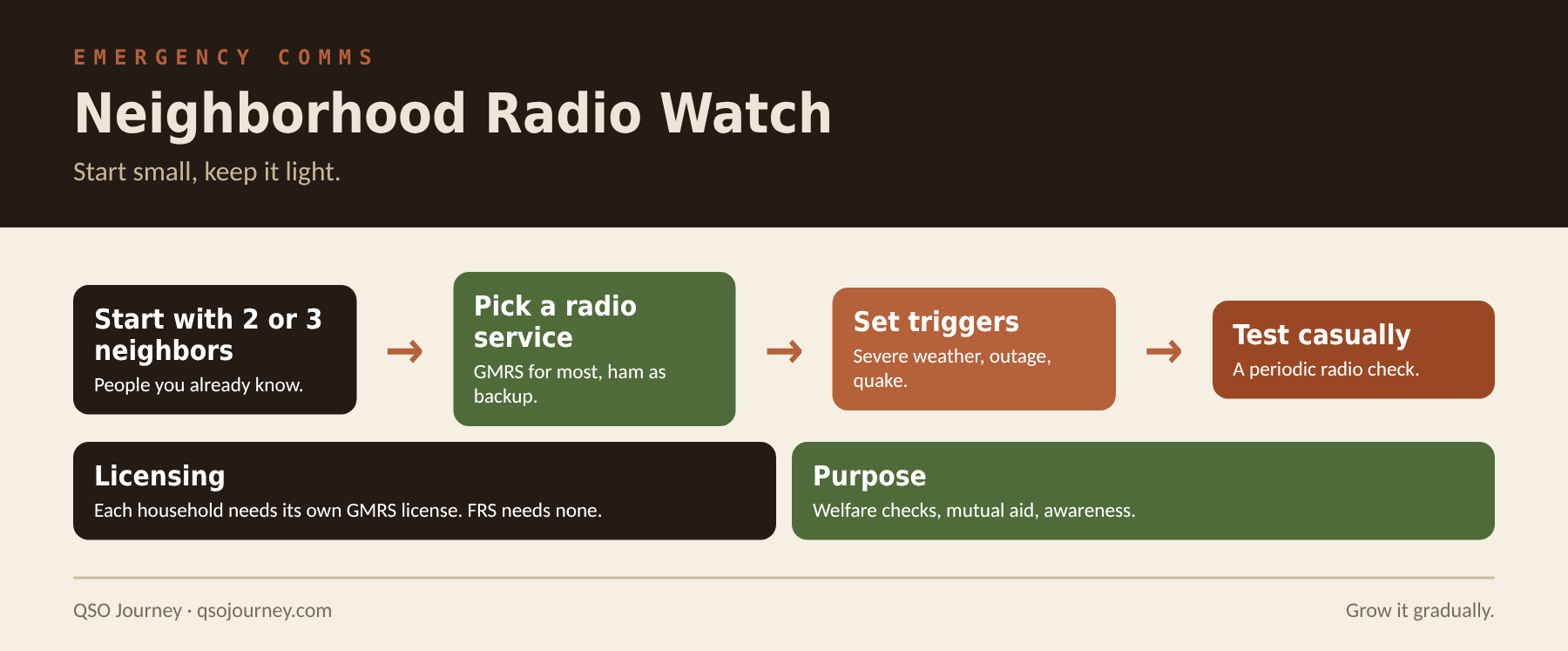
- Start with who you already know. Two or three neighbors you already have a relationship with. Five committed households beat fifty names on a list who never take part.
- GMRS is the practical foundation. No exam, and it covers short-range neighborhood coordination. Each household needs its own GMRS license, a simple online application with no test that covers that household’s family members. Neighbors who don’t want a license can use FRS on the shared channels at lower power. Licensed hams make a good backup layer for reaching further.
- Define a specific purpose: checking on each other after severe weather or a sudden local event, coordinating simple mutual aid during an extended outage like sharing generator power or checking on elderly neighbors, and general situational awareness.
- Keep the structure light. A shared channel, an agreed trigger for checking in (a severe weather warning, an extended outage), and a casual periodic test are enough. Over-formalizing kills participation before it starts.
- Grow it slowly. Once the core group’s habit sticks, invite neighbors gradually. A watch that grows from a useful, low-pressure habit lasts far longer than one launched with a big push.
A Plan for a Small Church or Community Group
A congregation isn’t a family, and it isn’t ARES either. Don’t import a formal EmComm structure onto a volunteer group. That assumes trained, committed operators, which is rarely what a church group has. The plan has to be simple enough that nobody feels they signed up for more than they meant to.

- One channel and one point of contact, usually whoever already holds a license or owns a radio, plus a named backup so the plan doesn’t depend on one person being home.
- Mind who the license covers. A GMRS license covers the licensee and immediate family, not the congregation, and a ham license covers only its holder. FRS needs no license and shares channels with GMRS, so an FRS channel is often the simplest common ground.
- Practice during existing gatherings. A quick radio check right before or after a regular meeting. Borrowed time is far more reliable than asking for a new commitment.
- Keep the ask small: know the channel, know who to contact, and know a radio exists as a fallback if phones go down. Print those three things on a wallet card or the back of the directory.
CERT and Amateur Radio: How the Programs Overlap

Community Emergency Response Team training is a FEMA-backed program that teaches civilians basic disaster response: light search and rescue, basic first aid, fire suppression basics and disaster psychology, so ordinary people can help neighbors in the early hours before professional responders reach everyone. It isn’t specific to ham radio, and anyone can take it.
CERT teams need communications as much as anyone, and many local programs recruit licensed hams or encourage members to get licensed to fill that role. ARES is different: it’s a ham radio volunteer organization that provides communications to served agencies. The two are complementary. CERT gives you hands-on response skills, ARES gives you communications training and served-agency relationships, and plenty of hams do both. Most CERT programs are free or low cost through local emergency management, and many CERT and ARES groups ask for the same free FEMA ICS courses, so knock those out early. For more on ARES, see ARES vs RACES.