
Part of our Where to Spend Your Money guide.
I get asked about these seven radios all the time, usually by someone weighing one of them against something I do own. I want to be straight up front: I don’t own any of them. This isn’t a set of hands-on reviews. It’s how I’d think about each one if I were shopping, based on the specs, how they compare to the radios I run every day (the FTX-1 Optima, IC-7300 Mark II, FT-891, TH-D75A and AnyTone 578s), and what I hear from hams who use them. Where the comparison is my own experience, I’ll say so.
Jump to: Portable HF: IC-705 and X6100 · IC-705 vs G90 vs FT-891 · Desktop HF: FT-710 · Flagship digital HTs: ID-52 and FT5D · Fusion mobiles: FTM-300DR and FTM-500D · Bottom line
Portable HF: Icom IC-705 and Xiegu X6100
Icom IC-705
The IC-705 was one of the first radios to put real SDR performance into a battery-powered, backpack-friendly package, and it’s still one of the most capable portable radios you can buy. It covers HF, 6 meters, 2 meters and 70 centimeters in one box, with a color touchscreen spectrum scope that feels closer to Icom’s base station radios than a field rig. It also does D-STAR, and it has GPS, Bluetooth, WiFi and microSD recording built in.
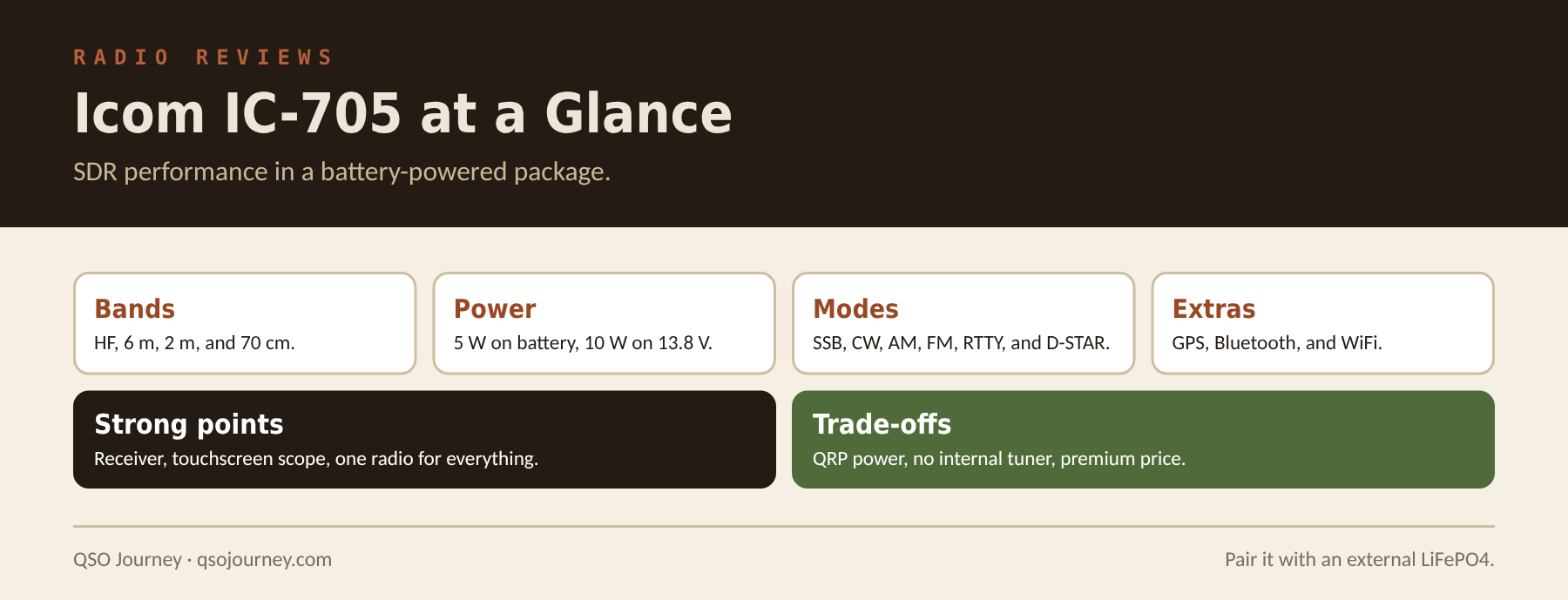
The tradeoff is power. It puts out 5 watts on the internal battery and 10 watts on 13.8 volts, which is real QRP, and pileups or marginal bands will test your patience more than a 100 watt radio. Internal battery runtime is modest for long SSB sessions, so most serious activators pair it with an external LiFePO4 pack. There’s no built-in tuner either, so plan on a resonant antenna or an external tuner. And it costs meaningfully more than a G90 or FT-891.
Who it’s for: someone who wants one radio for HF POTA and local VHF/UHF, values a great receiver, and is fine at QRP power. If you want more power for pileups, look at the FT-891 or a used IC-7300 instead.
Xiegu X6100
The X6100 is Xiegu’s more premium portable: a full touchscreen SDR with a usable spectrum scope, an internal battery, a built-in tuner, and coverage of HF plus 6 meters. It puts out up to 10 watts on external power and 5 watts on its battery. It runs Linux internally, which gives Xiegu room to improve it with firmware, and also means the occasional firmware quirk a more mature platform wouldn’t have.

This is the one comparison here where I have real experience on one side: I ran two Xiegu G90s before selling them. The X6100 trades the G90’s 20 watts and simpler physical interface for a touchscreen and an internal battery, at a higher price. Both have built-in tuners, so random wires work with either. If a modern touchscreen and battery convenience matter to you, the X6100 is worth a look. If you want the lowest price and the more proven radio, the G90 is still the safer choice. My full notes are in the Xiegu G90 Complete Guide.
IC-705 vs Xiegu G90 vs Yaesu FT-891
These three get cross-shopped constantly. I’ve owned two of them (the FT-891 is still in my Jeep, and I sold my G90s), so here are the real tradeoffs rather than a declared winner.
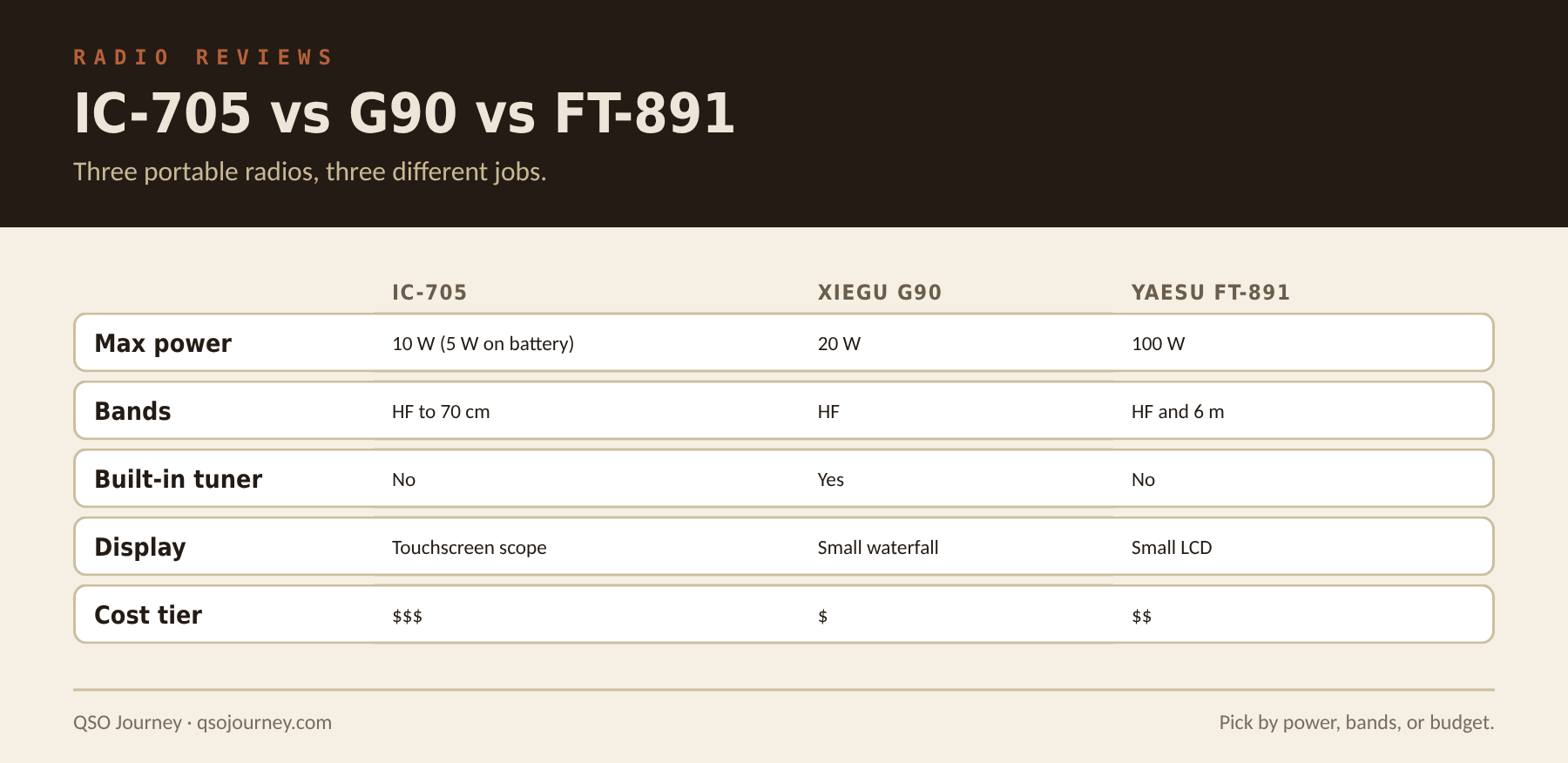
| IC-705 | Xiegu G90 | Yaesu FT-891 | |
|---|---|---|---|
| Max power | 10 W (5 W on battery) | 20 W | 100 W |
| Bands | HF, 6 m, 2 m, 70 cm | HF | HF and 6 m |
| Built-in tuner | No | Yes | No |
| Display | Touchscreen scope | Small waterfall | Small LCD |
| Internal battery | Yes | No | No |
- Power: the FT-891 wins decisively at 100 watts. If pileups or marginal conditions frustrate you, this matters more than any other difference.
- Bands: only the IC-705 adds VHF and UHF, which matters if you want one radio for HF activations and local repeaters.
- Receiver: the IC-705’s receiver and scope are excellent. The FT-891’s receiver is solid, but its display is tiny and text-only. The G90 sits between, with a usable waterfall and a receiver that shows its budget origins on crowded bands.
- Tuner: only the G90 has one built in. With the other two you need a resonant antenna or an external tuner. On my FT-891 that’s an MFJ-939.
- Price: the G90 is the clear budget option, the FT-891 lands in the middle, and the IC-705 sits in a different bracket.
Best value with a built-in tuner on a tight budget: the G90. Maximum HF power in a compact package: the FT-891. Best receiver, a touchscreen and VHF/UHF, and willing to pay for it: the IC-705. More detail is in the FT-891 Complete Guide and FT-891 vs FTX-1 Field vs G90.
Desktop HF: Yaesu FT-710 AESS
The FT-710 is Yaesu’s answer to the desktop SDR category the IC-7300 defined. It puts out 100 watts on HF and 6 meters, has a built-in automatic tuner and a color touchscreen with a spectrum scope, and comes in two versions. AESS stands for Acoustic Enhanced Speaker System: the AESS package ships with Yaesu’s SP-40 external speaker, which works with the internal speaker and DSP audio shaping for fuller receive audio. The Field version skips the speaker and includes a carrying belt instead.
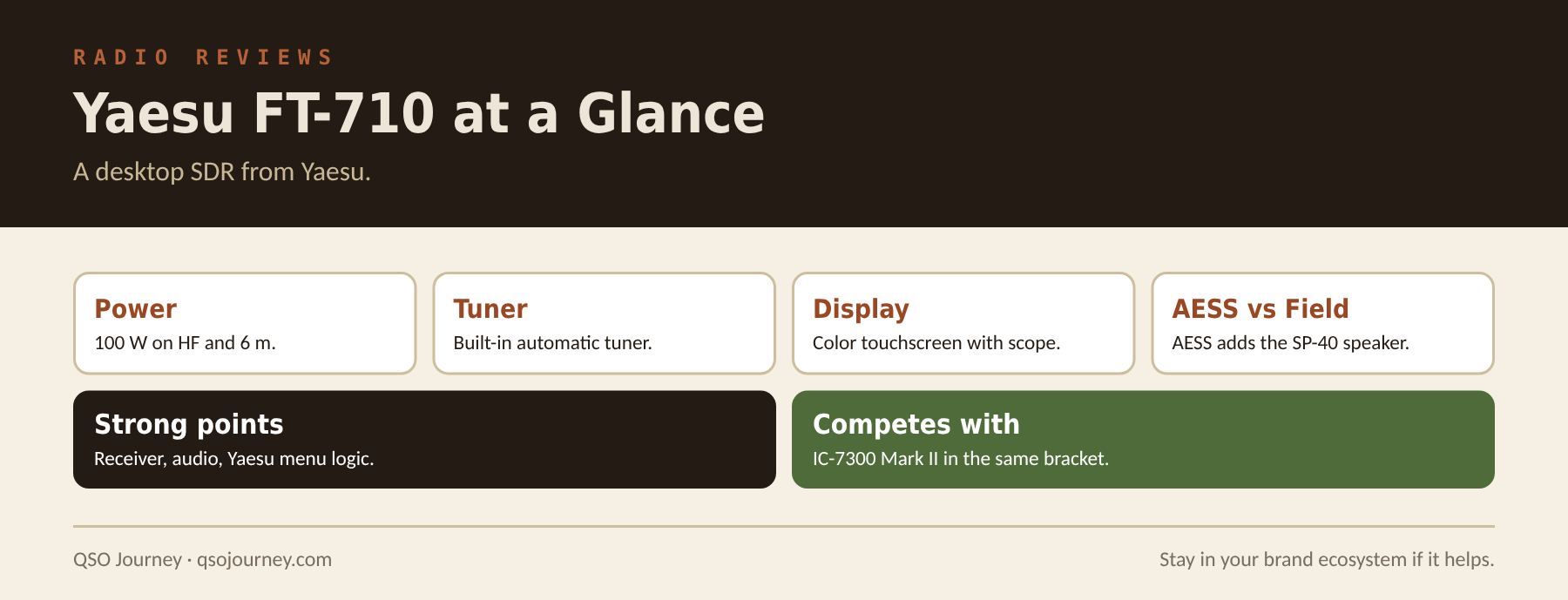
It’s a desk radio first. Unlike the FT-891 or FTX-1, it isn’t built for a backpack or a vehicle. Its real competition is the IC-7300 Mark II, which I do own and use as my backup and digital-mode radio. On receiver performance the two are close enough that either is a legitimate choice, and the decision usually comes down to brand ecosystem and menu logic. If you already run Yaesu gear and want the same CAT and menu conventions, the FT-710 is a sensible pick. If brand doesn’t matter, compare it with the Mark II on current pricing. My take on that radio is in the IC-7300 Mark II Complete Guide.
Flagship Digital Handhelds: Icom ID-52 and Yaesu FT5D
These two are the top of the line for D-STAR and System Fusion respectively. Both are 2 meter and 70 centimeter radios with genuine independent dual receive (not a simulated dual watch), built-in GPS, Bluetooth, microSD and a color display. The question with either one is whether you’re committed to its digital mode.
Icom ID-52
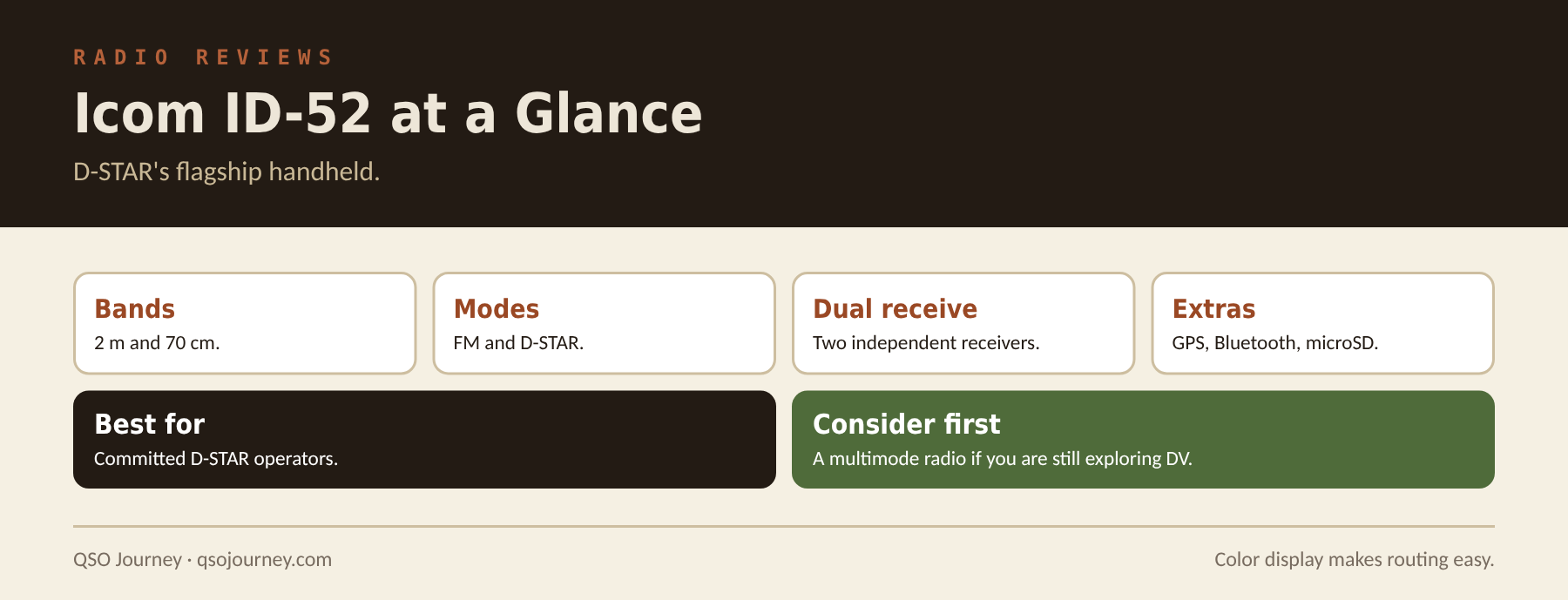
The ID-52 does FM and D-STAR, with D-STAR available on both receivers and wideband receive that includes airband. Its color screen makes D-STAR callsign routing, repeater lists and GPS data far easier to work with than the small monochrome screens on budget radios, and its GPS ties directly into D-STAR position reporting. Icom’s menu logic takes some getting used to coming from Yaesu or a Chinese radio, but it’s consistent with other Icom gear. If you’re committed to D-STAR, the price is justified. If you’re still exploring digital voice, a cheaper multi-mode radio makes more sense until you know where you’re staying.
Yaesu FT5D

The FT5D does FM and C4FM with two independent receivers, a color touchscreen, IPX7 submersion rating, and GPS feeding native APRS, so it sends and displays positions with no external tracker or phone app. The touchscreen makes Wires-X room browsing far easier than a button-driven menu. If you’re already in the Fusion and Wires-X world and actually use APRS, the extras earn their price. If Fusion is just one of several modes you want to try, start cheaper.
For comparison, my own APRS handheld is the Kenwood TH-D75A, which covers D-STAR and APRS with a built-in TNC. My setup is in Setting Up APRS on the Kenwood TH-D75A, and the mode comparison is in DMR vs D-STAR vs YSF.
Fusion Mobiles: Yaesu FTM-300DR and FTM-500D
These two are closer than they first look. Both are 50 watt dual-band mobiles (with 25 and 5 watt settings), both have C4FM on both receivers, both have GPS, Bluetooth and 1200/9600 APRS, and both have a detachable front panel so the body can go under a seat or in a console while the head goes on the dash.
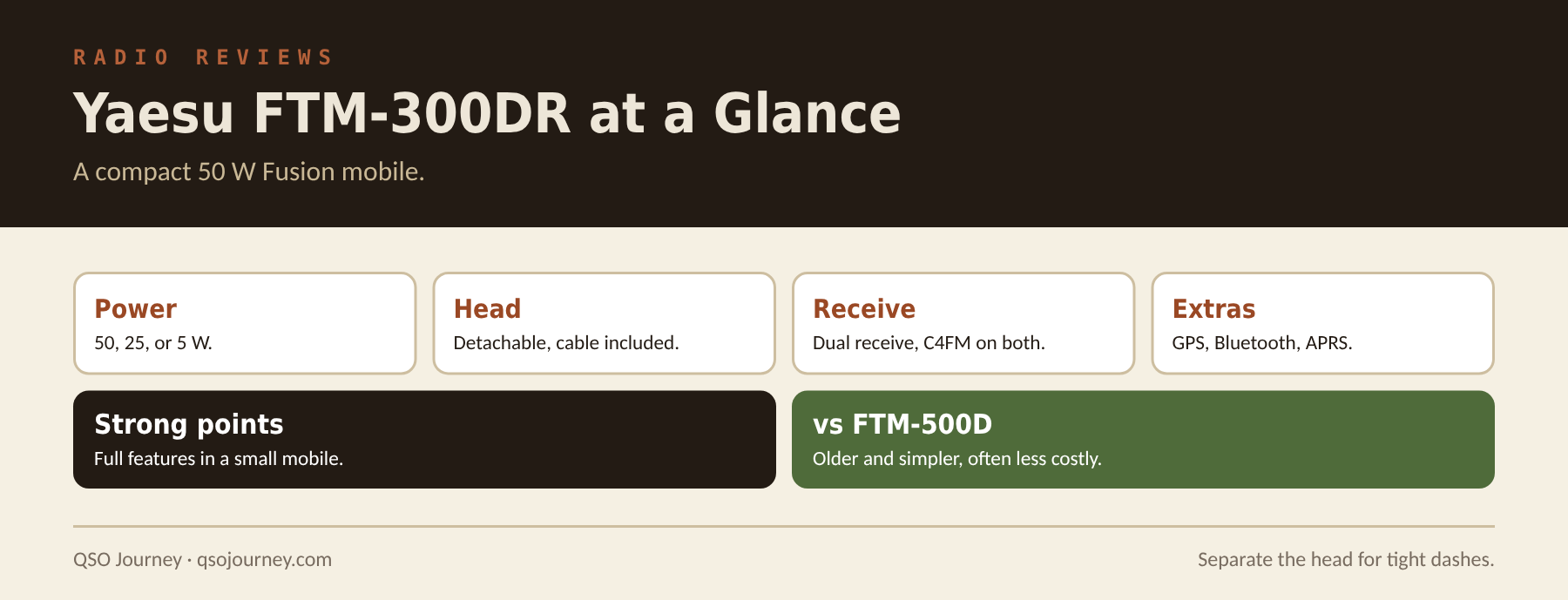
| FTM-300DR | FTM-500D | |
|---|---|---|
| Power | 50, 25 or 5 W | 50, 25 or 5 W |
| Head | Detachable, 10 ft control cable included | Detachable and tilting, with its own speaker |
| Receive | Two receivers, C4FM on both | Two receivers, C4FM on both |
| Extras | GPS, Bluetooth, 1200/9600 APRS, 2 inch color screen | GPS, Bluetooth, 1200/9600 APRS |
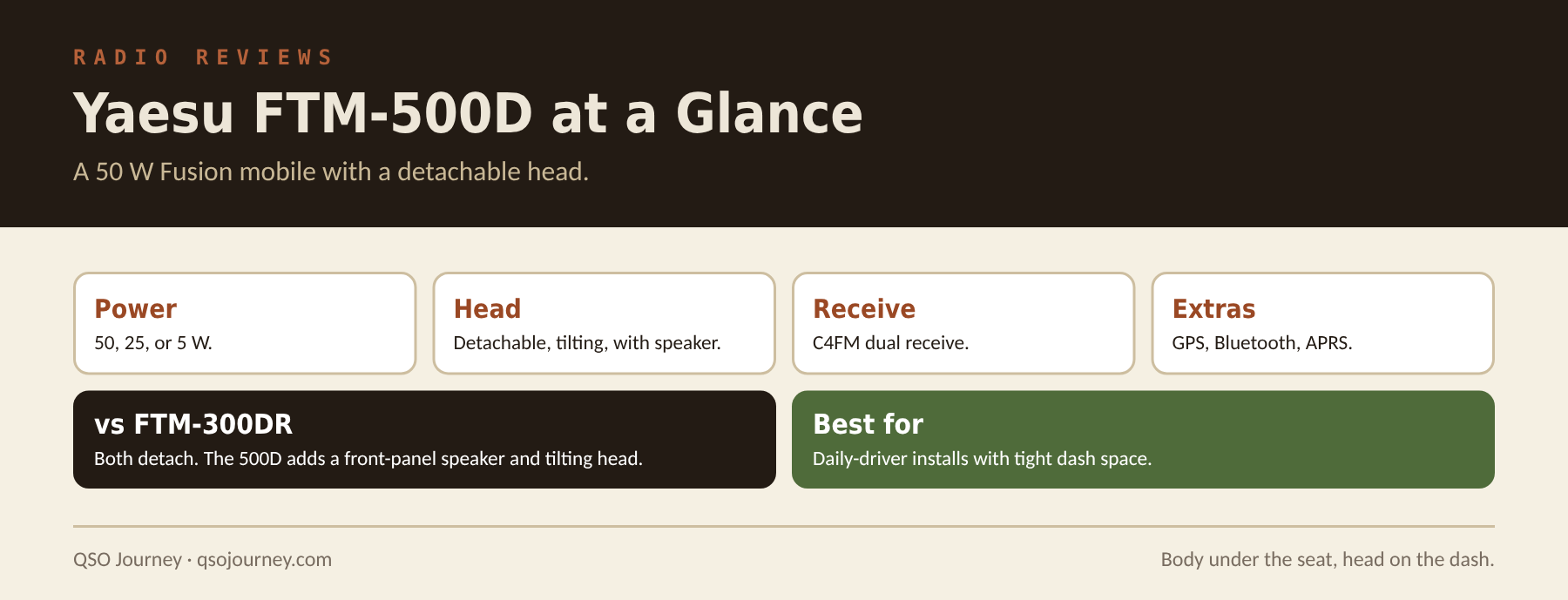
The FTM-500D is the newer design. It adds a speaker in the front panel for louder, clearer cab audio and a control head that tilts for better viewing. If you want the newest feature set and better audio, it makes more sense. If you want most of the same capability for less money, the FTM-300DR is still a strong, straightforward choice.
For context on why I went a different way in my own vehicles: I run AnyTone AT-D578UV III Plus radios in the Jeep and the shack, for DMR, matching radios in both places, and AES-256 encryption for emergency use. That’s covered in Installing a Ham Dual-Band Mobile Radio in Your Vehicle.
Bottom Line
- One radio for HF and VHF/UHF in the field: IC-705, if QRP power doesn’t bother you.
- Touchscreen portable on a smaller budget: X6100, or a G90 if price matters most.
- Desktop SDR in the Yaesu family: FT-710 AESS. Otherwise compare it head to head with the IC-7300 Mark II.
- Committed to D-STAR: ID-52. Committed to Fusion and APRS: FT5D.
- Fusion in the vehicle: FTM-500D for the best audio and newest design, FTM-300DR to save money.
For the bigger picture on where your radio money goes first, see Best HF Radios Under $1,000 and the Where to Spend Your Money guide.