
Part of our Getting Licensed guide.
Studying is the part everyone talks about. Finding a test session and knowing what happens once you’re there is the part that trips people up, usually because nobody explains it until you’re stressed out the week before you want to test. I run VE sessions regularly, and the biggest source of test-day anxiety I see isn’t the material. It’s not knowing what the process looks like. So here it is from start to finish, in person or online, from someone who sits on the other side of the table.
Jump to: What a VE session is · Finding a session · Get your FRN · What to bring · Test day, step by step · Testing online · After you pass · If you don’t pass
What a VE session actually is
The FCC doesn’t give amateur radio exams itself. It accredits Volunteer Examiner Coordinators (VECs) like the ARRL VEC, W5YI VEC and Laurel VEC, and they certify Volunteer Examiners (VEs), who run the actual sessions. Every session needs at least three accredited VEs in the room, or on the call if it’s remote. These are fellow hams, usually local club members, giving up a Saturday morning so you can get licensed. It’s a friendly environment, not an adversarial one.
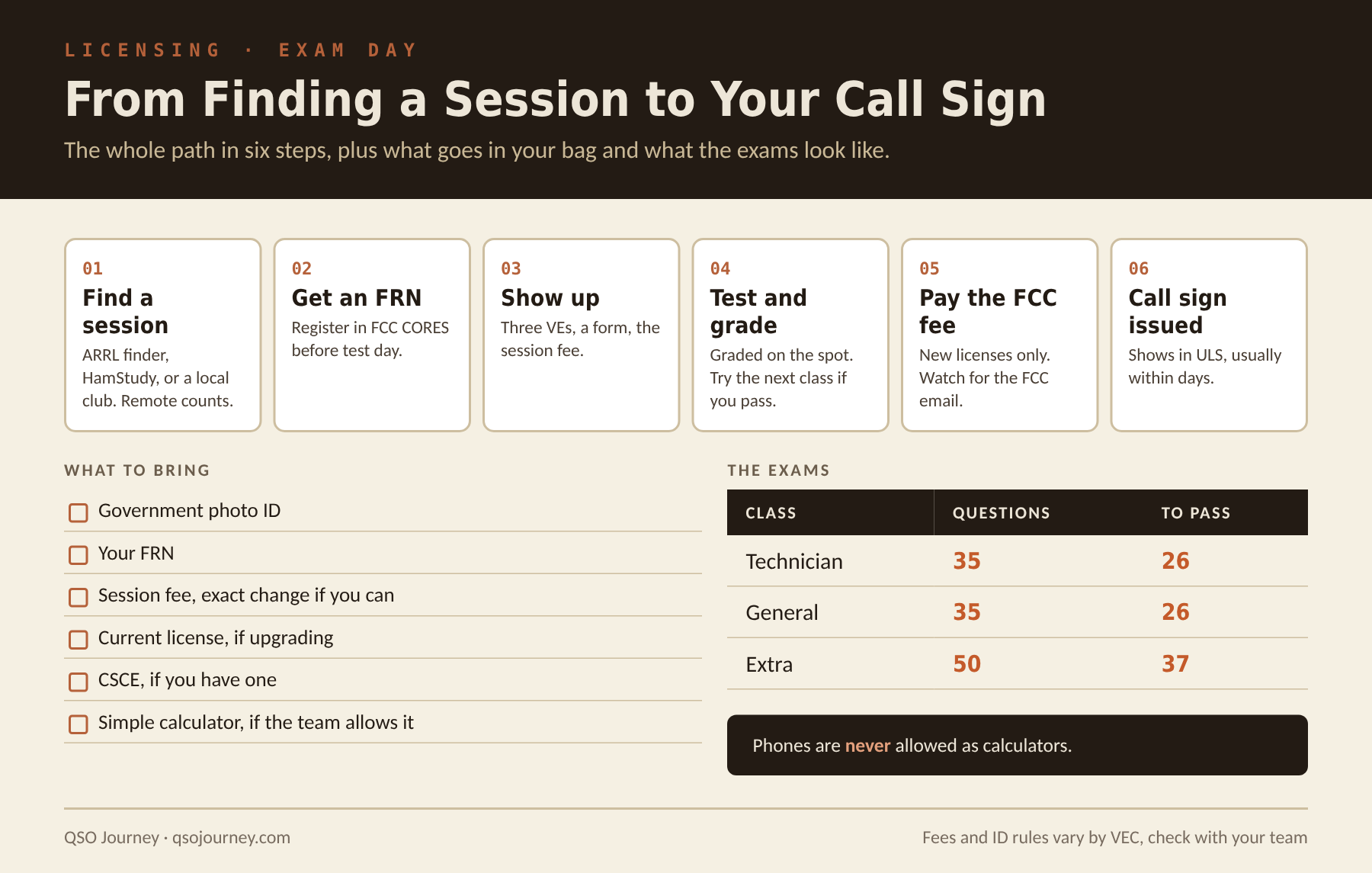
| Exam | Questions | Needed to pass |
|---|---|---|
| Technician (Element 2) | 35 | 26 |
| General (Element 3) | 35 | 26 |
| Extra (Element 4) | 50 | 37 |
Finding a session near you, or online
- The ARRL exam session finder is searchable by zip code and date, and it is the best starting point.
- HamStudy.org keeps its own calendar, including many remote sessions run over video call. If travel or scheduling is your obstacle, remote is usually the fastest path.
- Local clubs often run sessions monthly or quarterly. A search for clubs in your area, or the repeater listings on RepeaterBook, will usually turn one up.
- Email me. If you’d like to test online, send a note to kz7k@qsojourney.com with the license class you’re testing for and roughly when. I’ll get you connected with a session and walk you through anything you’re unsure about, including the FRN step below.
Get your FRN before test day
If this is your first FCC license of any kind, you need an FCC Registration Number. Many teams can register you on the spot, but showing up with one saves time. It takes a few minutes:
- Go to the FCC’s CORES system at apps.fcc.gov/coresWeb/publicHome.do and register for a new username.
- Create the account with your email address, then log in.
- Register for a new FRN with your legal name and a permanent mailing address.
- Your ten digit FRN appears right on the confirmation screen. Write it down. You’ll use it for every FCC filing you ever make, including renewals.
If you have ever held a ham or GMRS license, even one that expired years ago, you already have an FRN. Use it. A second FRN under your name creates a mess in the FCC database that’s annoying to untangle.
What to bring
- A government-issued photo ID. A driver’s license, state ID or passport. Some sessions accept a second form of ID if your primary has no photo.
- Your FRN.
- The exam fee. It’s set by the VEC. ARRL VEC sessions currently charge $15, and some teams test for free. Bring cash or a check unless your session confirms it takes other payment.
- Your current license, if you’re upgrading, either a copy or your FCC record on your phone.
- A CSCE, if you have one. If you recently passed an element but haven’t been granted the license yet, your Certificate of Successful Completion of Examination lets you go straight to the next element.
- A basic calculator, if allowed. Ask the VE team first. Phones are never allowed as calculators.
Test day, step by step
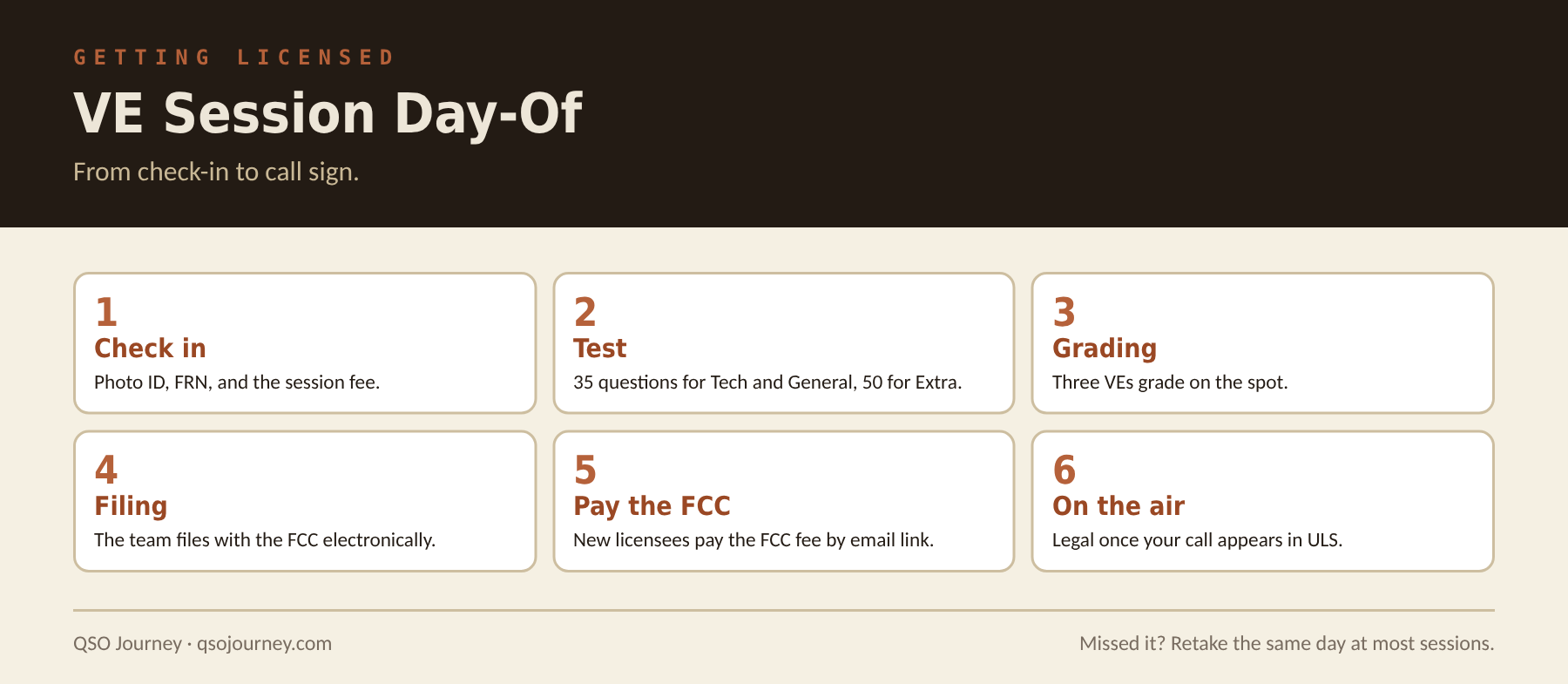
- Check-in. The lead VE verifies your ID and, if you’re upgrading, your current license. First-timers fill out a short form with their legal name and address for the FCC application. It’s all paperwork, no radio knowledge required.
- The exam. Most sessions now run on ExamTools or the HamStudy exam system, in person or online. You get a randomly generated set of questions from the current official pool. Most sessions have no strict time limit, so take your time on questions with diagrams or specific numbers.
- Grading. At least three VEs check your results right there, and you’ll know whether you passed within minutes.
- Keep going if you want. If you pass and want to try the next class the same day, just say so. Most sessions let you continue without a separate sitting fee, and there’s no penalty for trying a higher class and not passing.
- Filing. The VE team submits your application to the FCC electronically, usually the same day.
Testing online
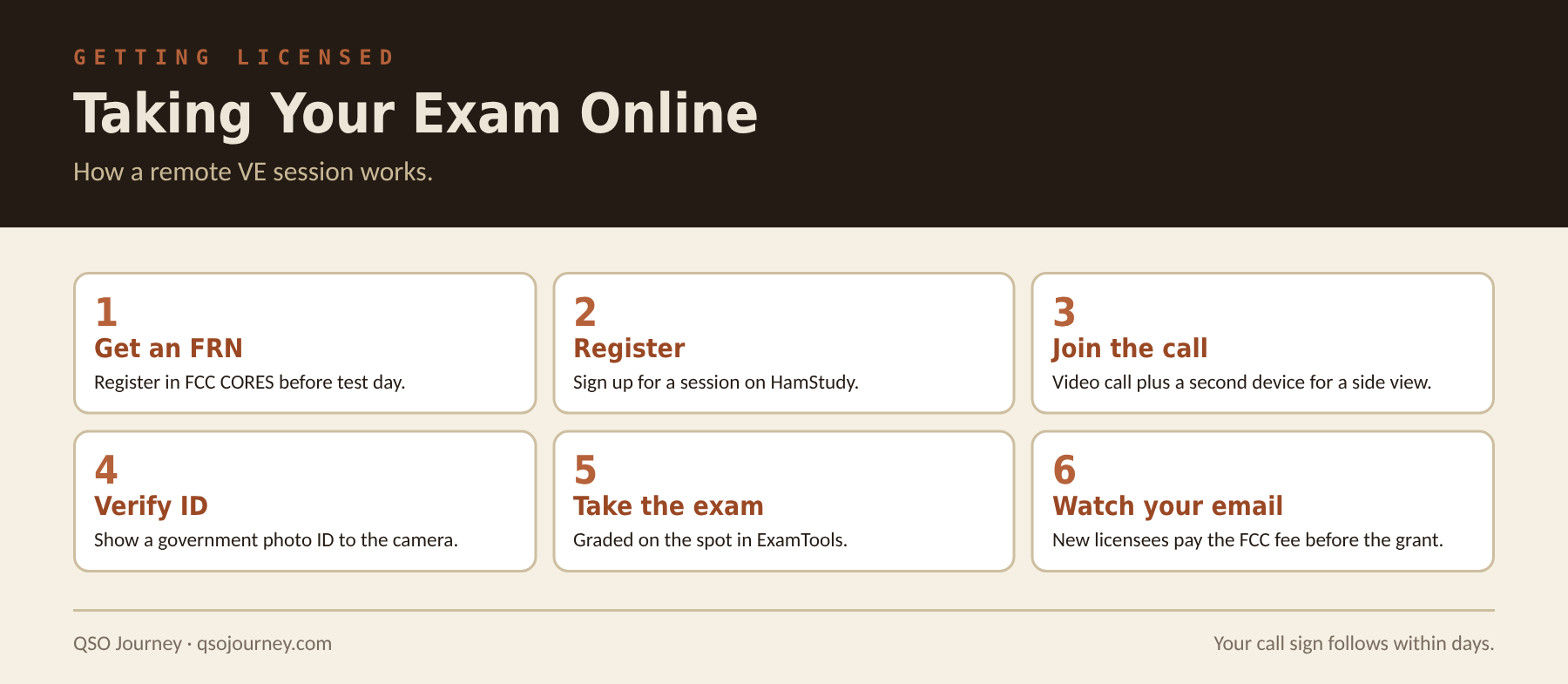
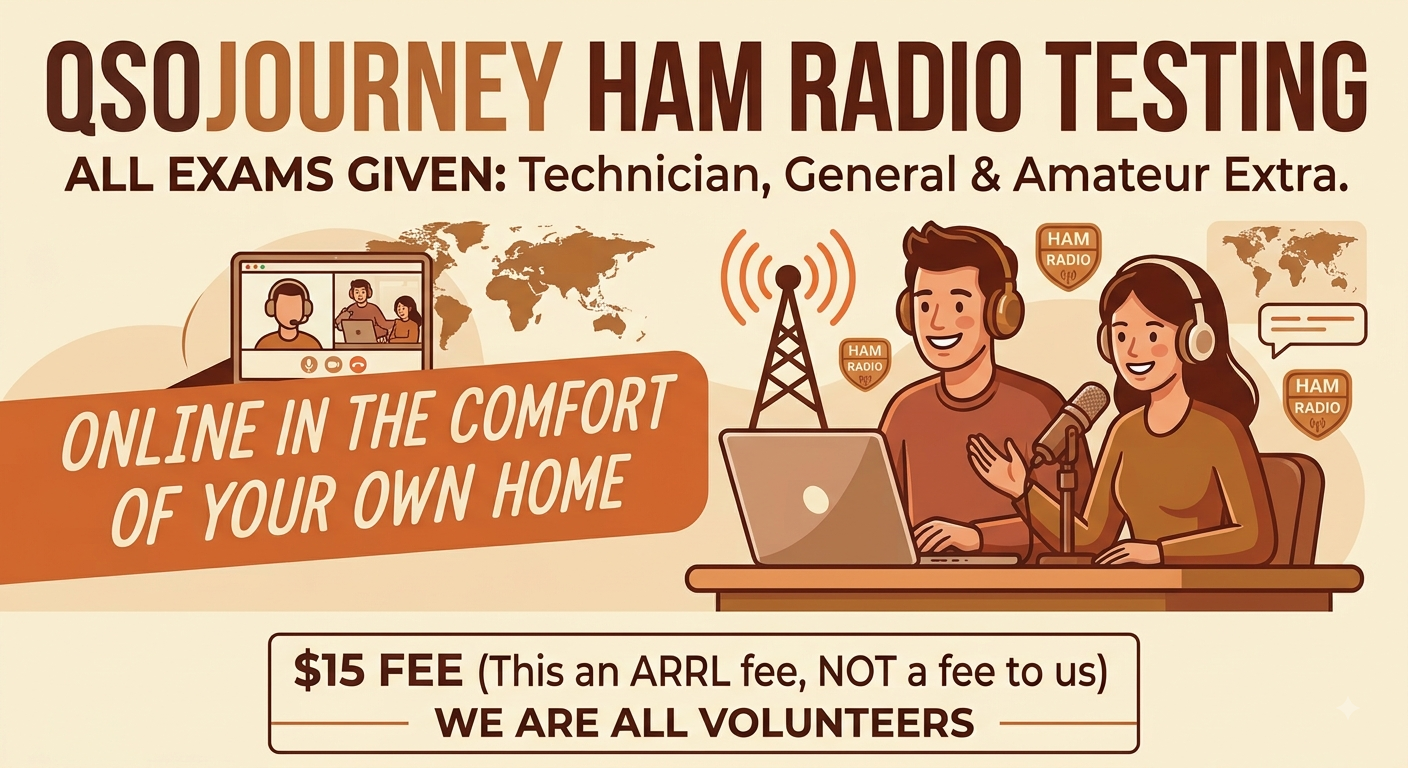
You don’t need a folding table at a community center anymore. Remote testing is a completely normal path into the hobby, and most of it runs on two connected tools. ExamTools is the software VEs use to run the session. On your side you’ll use HamStudy.org, where the team manages the session and gives you the four digit PIN that opens your exam. You’ll also join a video call, usually Zoom, so the team can verify your ID and watch you test. Answers are graded on the spot and the paperwork is signed digitally, so it’s every bit as legitimate as an in-person session.
For an online session you’ll need:
- Your FRN and your photo ID, which you’ll hold up to the camera.
- A laptop or tablet with a camera and a stable internet connection.
- A second device, like your phone, propped up for a side angle so the VEs can see your hands, keyboard and workspace. Charge it and have it ready to join the same call.
- A quiet, well-lit room with nobody else in it.
You’ll wait in a virtual waiting room until a VE team is free, go through ID verification, and then the exam opens on your screen. You’ll get your result before you log off.
Upgrading? Your registration has to match your current license exactly: same FRN, same name spelling, same call sign. If your address changed since you last renewed, the upgrade files the address change for you. And don’t register for an exam while another FCC application is pending, like a vanity call sign request, because the two filings can collide.
After you pass: getting your call sign
If this is your first license, the FCC emails you a link to pay its own $35 application fee through CORES, separate from the session fee. Your license isn’t granted until that’s paid, so watch your inbox and your spam folder. Upgrades don’t carry the fee. Once it clears, your call sign or new class usually appears in the FCC’s ULS database within a few business days to about a week. You don’t need to wait for anything in the mail: the database listing is your authorization to transmit. Checking ULS under your name is often faster than waiting for the email.
If you don’t pass
At most sessions you can retake the exam the same day, usually for another fee, with a fresh randomly generated question set. There’s no waiting period. Plenty of people pass on the second try that same afternoon, so treat a miss as useful information about what to study, nothing more.
Best advice I can give: make test day boring. The people who walk in relaxed have already passed the exam a few times at home. The free QSO Journey Exam Trainer builds practice exams the same way the real one is built, from the current pools, scores you the way the VE team will, and keeps your history so you can see when you’re passing comfortably. Here’s how it works.
More questions before test day? The Big Ham Radio FAQ covers exam costs, question pools, retakes, call signs and what happens after you pass, plus everything from first radios to repeaters.
Related reading: Getting Licensed: A Beginner’s Path Into Ham Radio · Upgrading to General and Extra · Renewing Your Ham Radio License · Becoming a Volunteer Examiner