

Part of our Getting Licensed guide.
Technician gets you on the air. General gets you onto HF in a real way, and Extra adds the last few slices of spectrum plus a couple of perks. I hold Extra, and I’ll tell you upfront that General is the upgrade that changes how you operate, while Extra is the smallest practical jump of the three. Here is what each one actually gives you, how the exams differ, and how to decide when to bother.
Jump to: General: what you gain · General HF privileges · The General exam · Where new Generals get overwhelmed · Extra: what it adds · The Extra exam · Is Extra worth it?
General: the upgrade that unlocks HF

For most people who caught the bug on 10 meters or borrowed a friend’s rig for a POTA activation, General is the license that unlocks the hobby they actually wanted. It opens phone on 160, 80, 60, 40, 20, 17, 15, 12 and 10 meters, plus CW and data on 30 meters, and raises you from the 200 watt Technician HF limit to 1,500 watts PEP on most bands.
That is the difference between working 10 meters during a good opening and having 40 and 20 meters available basically every day, which is where most reliable regional and continental HF contacts happen. It means real access to nets, DX, contesting and FT8 on bands that are open far more often than 10 meters. If you own an HF radio like the FTX-1, IC-7300 Mark II or FT-891 and you are still a Technician, your radio can do a lot more than your license allows.
General class HF privileges at a glance
Frequencies are in MHz, under the current FCC Part 97 rules. CW is allowed anywhere you hold privileges on a band. The middle column shows the CW and data segments, and the right column shows where phone and image modes are allowed.
| Band | CW and data | Phone and image |
|---|---|---|
| 160 m | 1.800 to 2.000 | 1.800 to 2.000 |
| 80 m | 3.525 to 3.600 | 3.800 to 4.000 |
| 60 m | 4 channels plus 5.3515 to 5.3665 | Same as CW and data (see note) |
| 40 m | 7.025 to 7.125 | 7.175 to 7.300 |
| 30 m | 10.100 to 10.150 | None (CW and data only, 200 W) |
| 20 m | 14.025 to 14.150 | 14.225 to 14.350 |
| 17 m | 18.068 to 18.110 | 18.110 to 18.168 |
| 15 m | 21.025 to 21.200 | 21.275 to 21.450 |
| 12 m | 24.890 to 24.930 | 24.930 to 24.990 |
| 10 m | 28.000 to 28.300 | 28.300 to 29.700 |
Two bands work differently. 60 meters is shared with other services, and since February 13, 2026 it combines four fixed channels (centered on 5.332, 5.348, 5.373 and 5.405 MHz) at up to 100 watts ERP with a new 5.3515 to 5.3665 MHz segment limited to 9.15 watts ERP, all at 2.8 kHz bandwidth or less. 30 meters is CW and data only, capped at 200 watts PEP. Near a band edge, remember your whole signal has to stay inside your privileges, not just the dial frequency. The Band Plan tool lets you flip between Technician, General and Extra to see exactly what each upgrade opens.
How the General exam differs from Technician
The General pool leans harder into propagation, more detailed electronics and circuits, and specific band plan knowledge. It is not dramatically harder than Technician, but it assumes you know the Technician material cold, since a fair number of questions build on band plan and safety concepts from that pool. If you are taking both on the same day, do Technician first and General second while it is fresh. I’d budget two to three weeks of steady study if you already hold a Technician and are comfortable with basic electronics, closer to a month if General is your first exam.
Where new Generals get overwhelmed
The most common thing I hear from newly upgraded Generals is that they don’t know where to transmit. You suddenly have a huge amount of spectrum and no feel for where the activity is. Start by finding one or two nets on 40 or 80 meters near you and checking in a few times before you call CQ cold. It is a low-pressure way to learn your radio’s HF behavior, your antenna’s real performance and basic net procedure before you try a pileup or a contest.
The second trap is antenna expectations. HF privileges do not mean you need a tower and a beam. A simple end-fed half-wave or a basic dipole will get you a shocking number of contacts, especially on 40 and 20 meters. Don’t let antenna anxiety delay your first HF contact.
Extra: what it actually adds
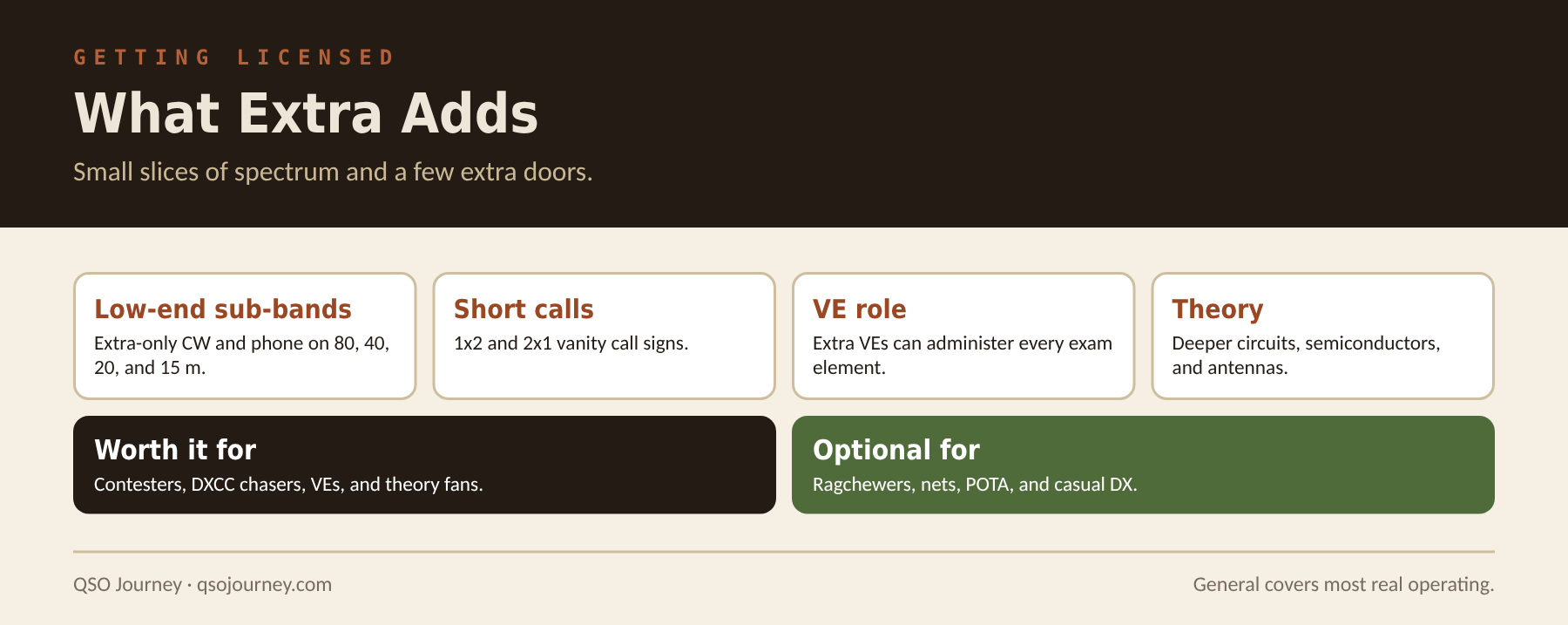
General already gives you well over 90 percent of the HF spectrum you will ever use. Extra opens the remaining slices of 80, 40, 20 and 15 meters, mostly narrow CW and phone sub-bands near the low end of each band. Those segments see a lot of DX and contest activity for their size, because that is where rare DXpeditions and top contesters camp out. Extra also makes you eligible for the shortest 1×2 and 2×1 vanity call signs, and it lets you serve as a VE for Extra-level exams.
How hard is the Extra exam, really?
Extra’s reputation as brutally difficult is a little overblown, but not entirely wrong. The pool goes deeper into real circuit analysis, semiconductor behavior, and more advanced propagation and antenna concepts than General touches, and there is more nuance per question. If General felt comfortable and you enjoy the technical side, Extra is a satisfying challenge rather than a wall. If General felt like a grind, budget a month or two of steady work rather than a couple of weeks.
Study for either here: the free QSO Journey Exam Trainer has the current General pool and the full 2024-2028 Extra pool (all 599 questions with the schematic figures), with practice exams built like the real test, topic quizzes and saved progress that shows which subelements still need work. Here’s how it works.
Is Extra worth chasing?
For most people the honest answer is no, or at least not yet. Extra matters if you are:
- A contester who wants the busiest sub-bands on major contest weekends
- A DXer working toward DXCC Honor Roll or chasing specific rare entities
- After a short, memorable vanity call sign
- Someone who enjoys the technical material for its own sake
- Planning to be an active VE, since Extra is required to administer Extra exams
I upgraded mostly because I wanted the technical material and knew I wanted to be a VE. My day-to-day operating barely changed the week I passed. For ragchewing, nets, POTA and casual DX you will rarely notice the difference between General and Extra. Get comfortable on General first, and study for Extra when the material itself sounds interesting, not because you feel you need the top license to be a real ham. Plenty of excellent operators never go past General, and that is a completely legitimate place to stop.
Related reading: Technician, General and Extra Explained · Technician’s Expanded HF Phone Privileges · Becoming a Volunteer Examiner