
Part of our Getting On The Air guide.
DXCC gets most of the attention, but it’s far from the only award worth chasing, and some of the others are a better fit for a newer HF operator or a different style of operating. This guide covers five: Worked All States, Worked All Continents, Islands on the Air, US county hunting, and the Ten-Ten International Net. I confirm my contacts through LoTW, QRZ and HRDLog, and the basics of confirming are in QSLing and Awards 101.
Jump to: Worked All States · Worked All Continents · IOTA · County hunting · Ten-Ten
Worked All States (WAS): How to Track and Claim It
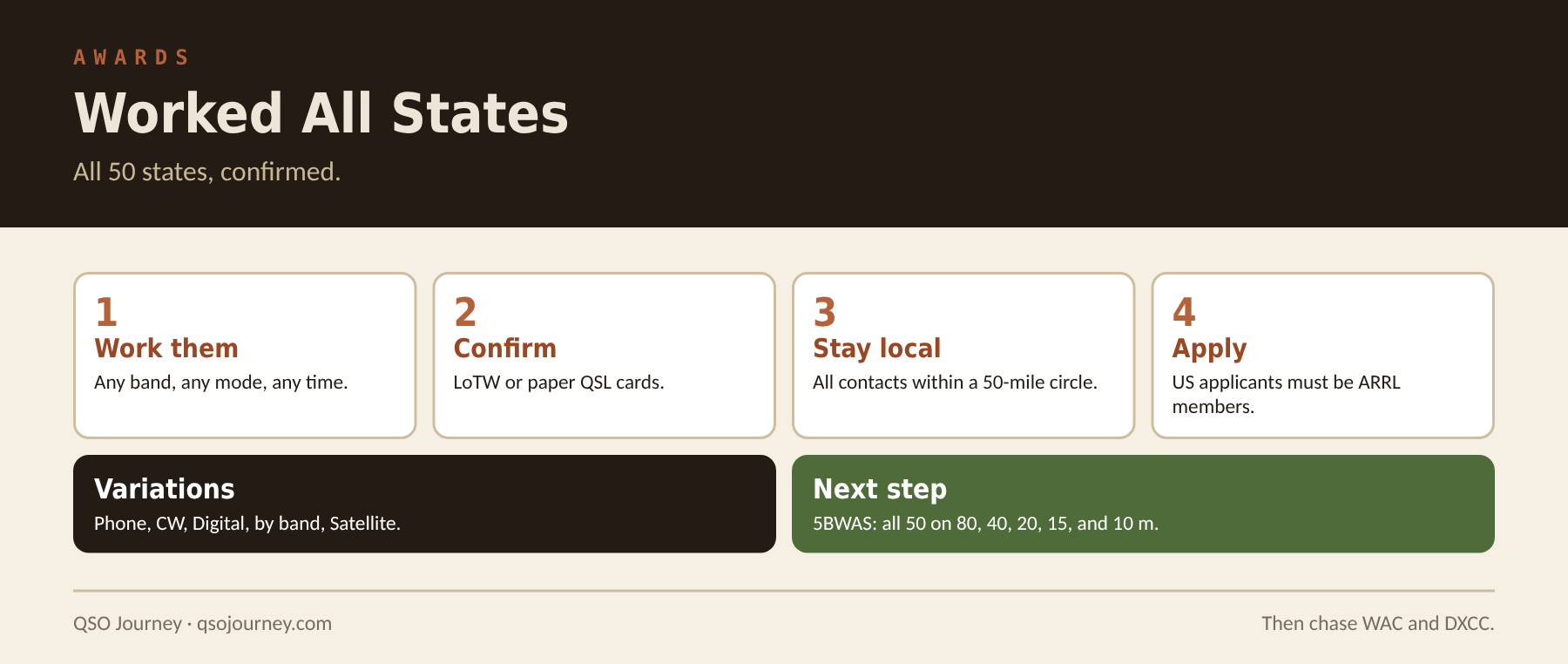
WAS is one of the most approachable awards in the hobby: confirmed two-way contacts with all 50 US states, on any band and mode, over any span of time. It’s a background goal you chip away at during normal operating, and most active HF operators can finish it within a year or two.
- Confirmations: ARRL’s Logbook of the World is the modern standard, matching your log against the other station’s with no paper cards. Paper QSLs still count.
- Tracking: most logging software, including Ham Radio Deluxe, Log4OM and Club Log, has a WAS tracker that shows which states you still need. Let it do the bookkeeping.
- Applying: through LoTW for electronic confirmations, or by mail with your cards. There’s a modest fee, US applicants must be ARRL members, and all contacts must be made from the same location or from locations no more than 50 miles apart.
- Variations: mode awards like Phone and Digital (endorsable by band), single-band awards such as 6 or 2 meters, and 5BWAS, all 50 states on each of 80, 40, 20, 15 and 10 meters.
Worked All Continents (WAC): The Next Step
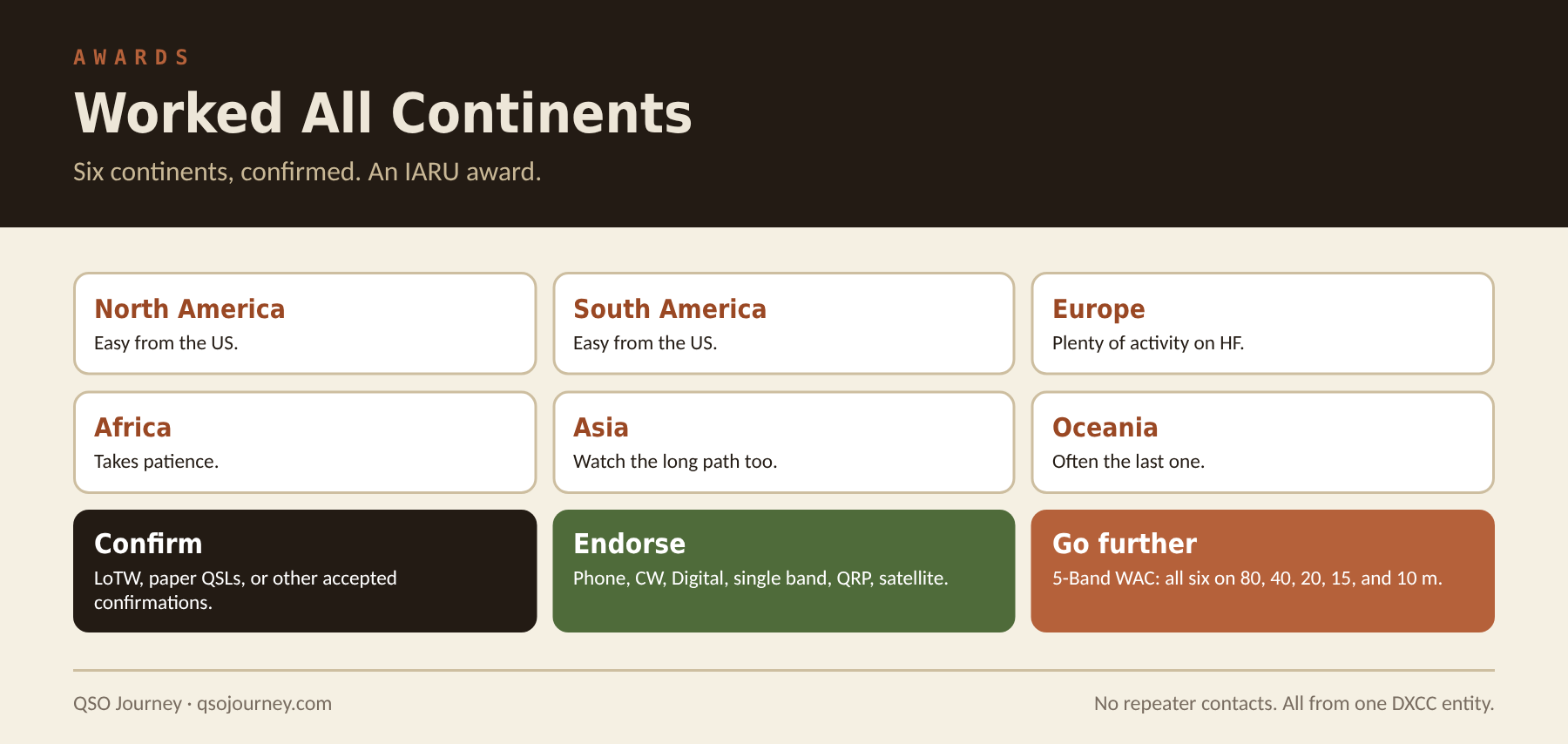
WAC sits between WAS and DXCC: harder than WAS because it needs real international contacts, far easier than DXCC because it needs six confirmations instead of over a hundred. It’s sponsored by the IARU, and for US hams the ARRL handles applications. You need confirmed contacts with North America, South America, Europe, Africa, Asia and Oceania. Antarctica isn’t one of the six, though it’s prized DX in its own right. All contacts must be from the same DXCC entity, and repeater contacts don’t count.
North and South America come easily from the US, and Europe is usually straightforward given the volume of European HF activity. Africa, Asia and Oceania take more patience, better conditions or a DXpedition, but none are rare. A good DX cluster, a DX-focused net and propagation predictions speed up the last few. LoTW confirmations count, and the ARRL WAC page lists current fees. Once you have the basic award, it can be endorsed by mode, band or QRP, and the separate 5-Band WAC asks for all six continents on each of 80, 40, 20, 15 and 10 meters.
IOTA: Chasing Islands, Not Just Countries
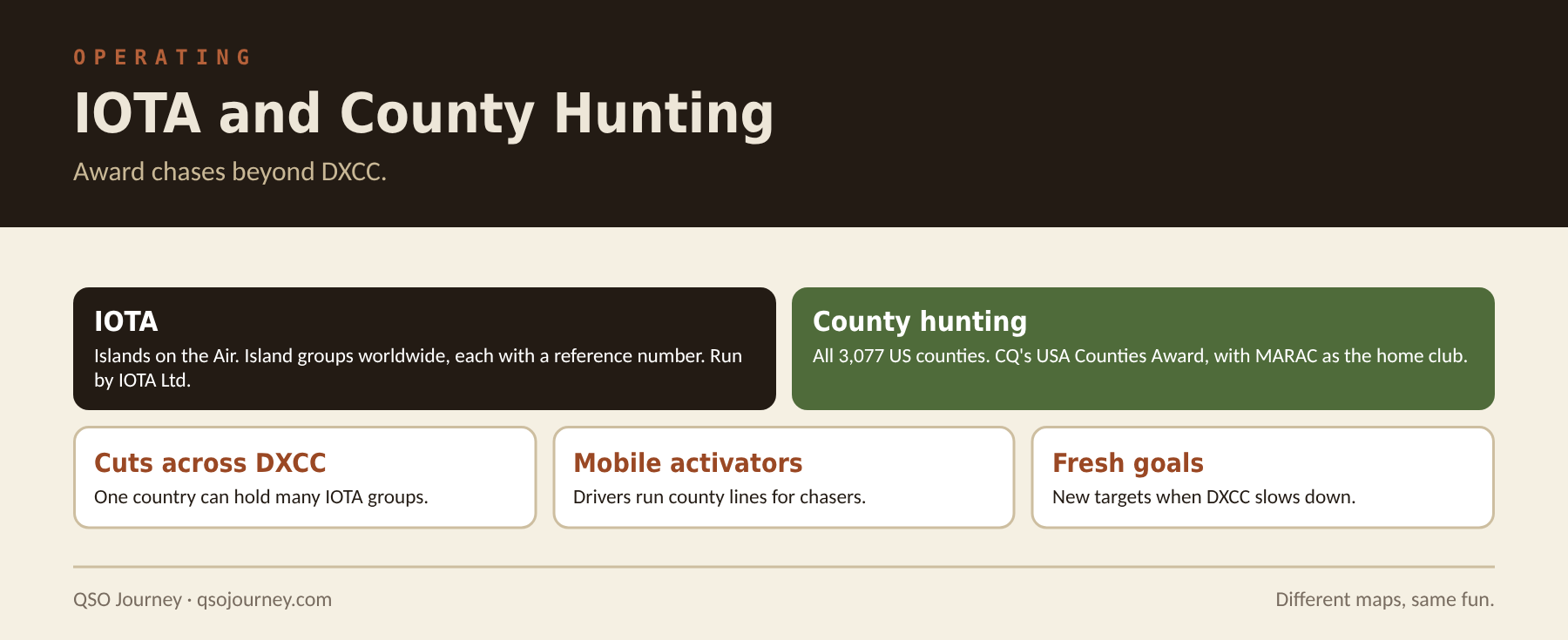
Islands on the Air, created by the RSGB and run by IOTA Ltd since 2016, tracks contacts with island groups around the world, each with its own reference number like NA-075. It cuts across DXCC in both directions: one DXCC country can contain dozens of IOTA groups, and some references span more than one entity. For DXers who’ve worked most of the accessible entities, it’s a fresh set of targets, since many island groups are difficult, expensive expeditions to activate. To get started, register on the IOTA website and link it to Club Log so your island contacts are matched automatically. Activations show up on the DX cluster with their reference.
County Hunting: DXCC for the Domestic Operator
USA county hunting chases all 3,077 US counties and county-equivalents through CQ’s USA Counties Award (USA-CA), with the Mobile Amateur Radio Awards Club (MARAC) as the home of the community. It’s DXCC turned inward, with its own activator culture: mobile operators drive county lines to activate rare counties for chasers at home. Start by logging the county with every US contact you make. The MARAC SSB net on 14.336 MHz is where mobile activators check in, and net control will help you find counties you still need. State QSO parties, covered in Contests Worth Your Weekend, are a great way to rack up counties fast.
The Ten-Ten International Net
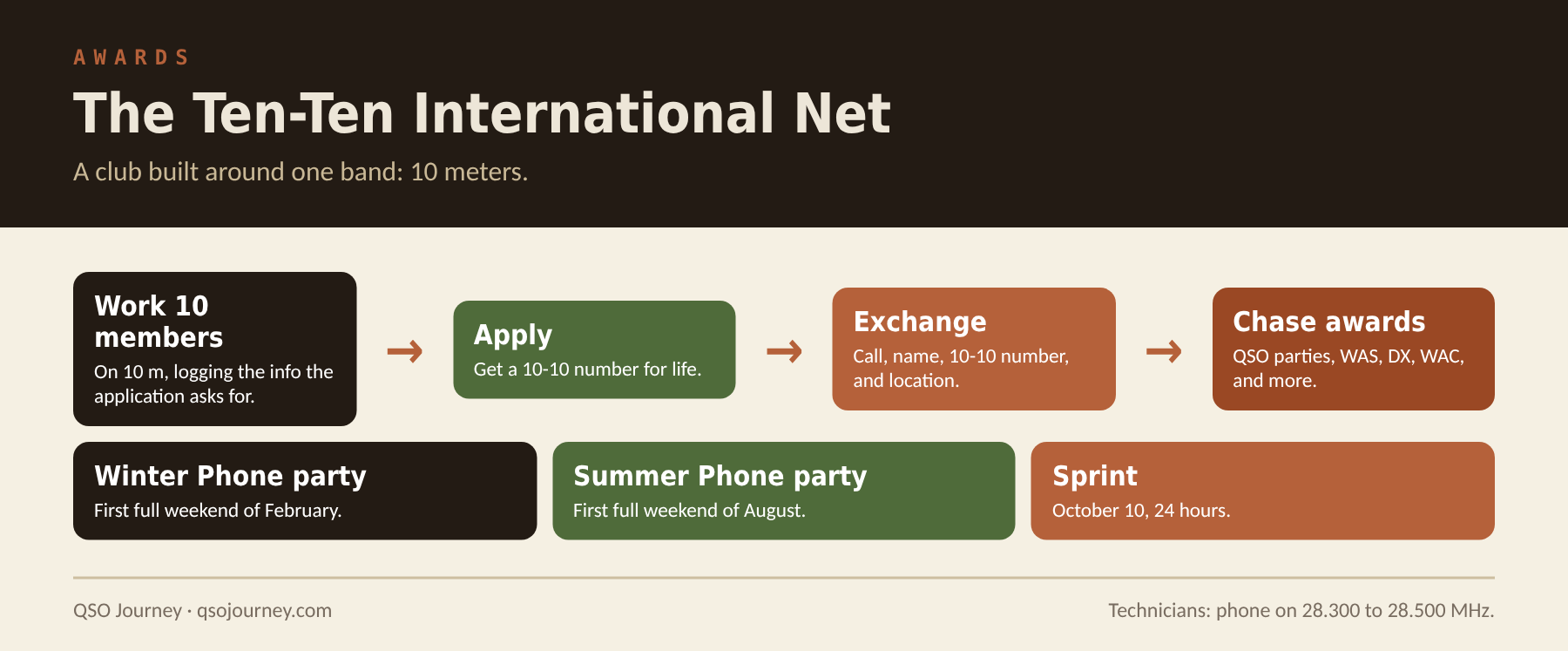
Ten-Ten is a club and awards program built entirely around 10 meters. To join, you work 10 current members on 10 meters and record the details the application asks for. You get a 10-10 number for life, even if your call sign changes, and members exchange numbers during contacts, building toward a series of certificates.
Ten meters is the only HF band where Technicians have phone privileges, on 28.300 to 28.500 MHz, and its swings between silence and wide-open propagation make it exciting to specialize in. Ten-Ten runs QSO parties on 10 meters: a Winter Phone party on the first full weekend of February, a Summer Phone party on the first full weekend of August, and a 24-hour Sprint on October 10. The exchange is your call, name, 10-10 number and location, and non-members send a zero, so anyone can join in. They’re welcoming to Technicians, and membership costs little. More on the band itself in 10 Meters: Amazing When It’s Open.
Which Award to Chase First
- New to HF: WAS. It teaches propagation and band selection without rare DX.
- Ready for real DX: WAC, then DXCC.
- Plateaued on DXCC: IOTA.
- Like domestic operating or mobile: county hunting.
- Technician, or hooked on 10 meters: Ten-Ten.