

Part of our Getting On The Air guide.
The contest calendar is packed year-round, and most of it isn’t worth planning a weekend around. A handful of contests are, both because they’re fun and because working them teaches you more about propagation and your own station than months of casual contacts. This guide covers which ones, how to work your first, and three low-pressure ways in: state QSO parties, QRP and VHF/UHF. For the basics of scoring and Cabrillo logs, see Contesting 101.
Jump to: The big HF contests · Your first contest · State QSO parties · QRP contesting · VHF/UHF and grid squares
The Big HF Contests Worth Knowing
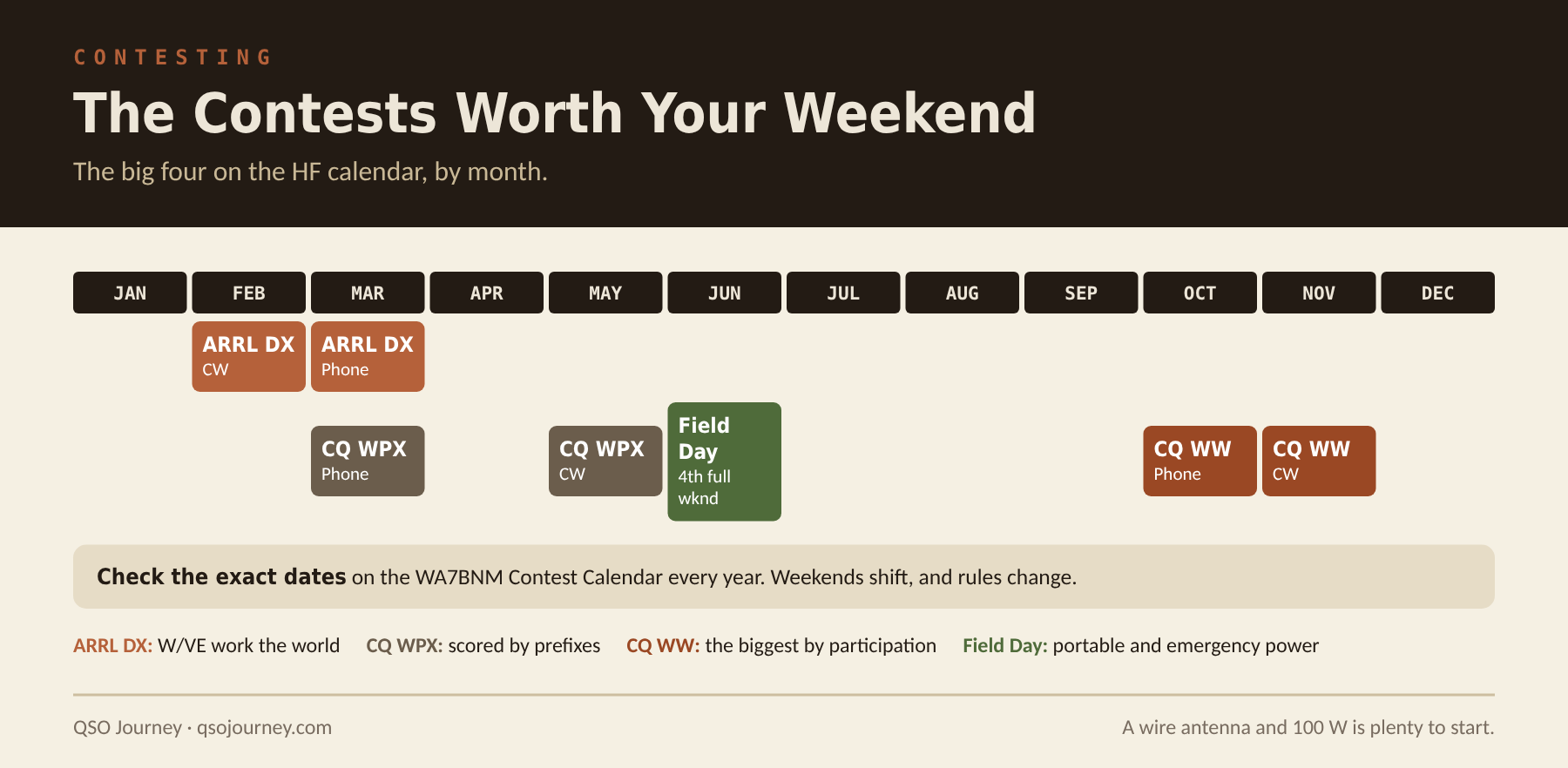
- ARRL DX Contest (phone weekend in early March): US and Canadian stations work the rest of the world. Great for chasing DX with a modest station.
- CQ WPX (phone in late March): scored by unique prefixes, which rewards working lots of different stations rather than just rare ones.
- ARRL Field Day (fourth full weekend of June): part contest, part public demonstration, mostly from portable and emergency power. See ARRL Field Day and Winter Field Day.
- CQ WW DX (phone in late October): the biggest contest on the calendar by participation. Bands are packed, which makes even a small antenna surprisingly productive.
Each of these also has a separate CW weekend. The WA7BNM Contest Calendar is the standard reference most contesters check weekly, with dates, modes and rules links for every sanctioned contest.
Working Your First Contest
You don’t need a tower and a beam. On a big contest weekend, usually quiet bands are wall to wall, so a wire antenna and 100 watts can rack up contacts fast. It’s one of the best real-world tests of your station.
For a first contest, don’t try to run a frequency and call CQ. Search and pounce: tune across the band, find a station calling CQ, give your call once, and copy the exchange they send back. Big stations are fast and patient with newcomers, because every contact counts for them too. Put in a couple of hours on a Saturday afternoon, submit your log even if it’s small, and use proper logging software rather than a paper pad. I use N3FJP for contest logging, and I compare it with N1MM+ in Contest Logging: N1MM+ vs N3FJP.
State QSO Parties: The Friendliest First Contest
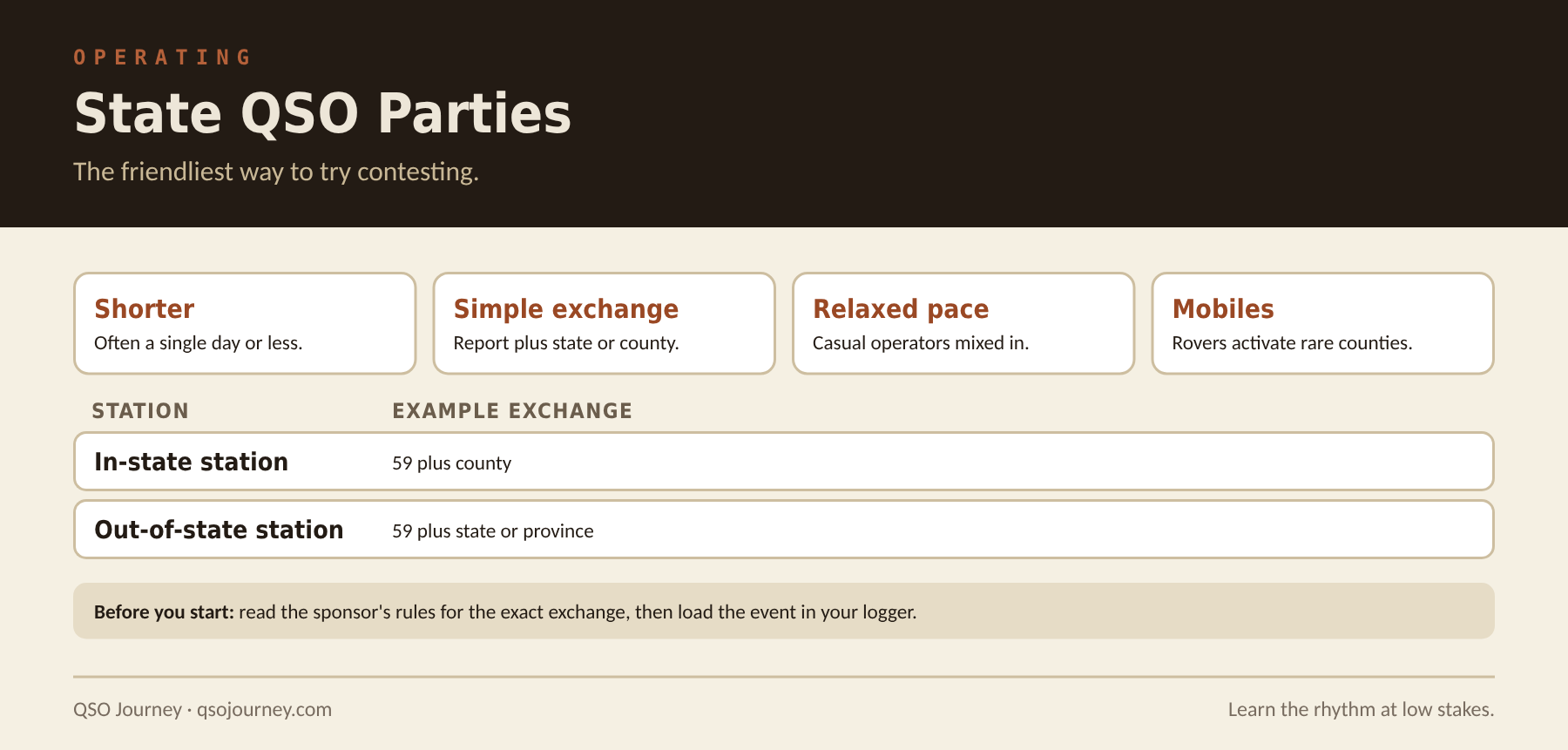
Big DX contests can be intimidating: fast exchanges, huge pileups, competitors who’ve been at it for decades. State QSO parties are gentler. Most run a single day, the exchange is simple (a signal report and your state or county), and plenty of casual operators mix in with the serious ones. Many have a mobile activation culture like county hunting, so even a modest home station can rack up a surprising number of contacts. There’s one most weekends from spring through fall, listed on the ARRL and WA7BNM calendars.
Here’s roughly how a contact sounds when you’re outside the state calling an in-state station:
- Them: “CQ Arizona QSO Party, K7ABC.”
- You: “KZ7K.”
- Them: “KZ7K, 59 Pinal.”
- You: “59 Texas, thanks.”
That’s it. Log it and move on. Most contest loggers have the major state QSO parties built in and track counties and multipliers for you.
QRP Contesting: Making the Most of Low Power
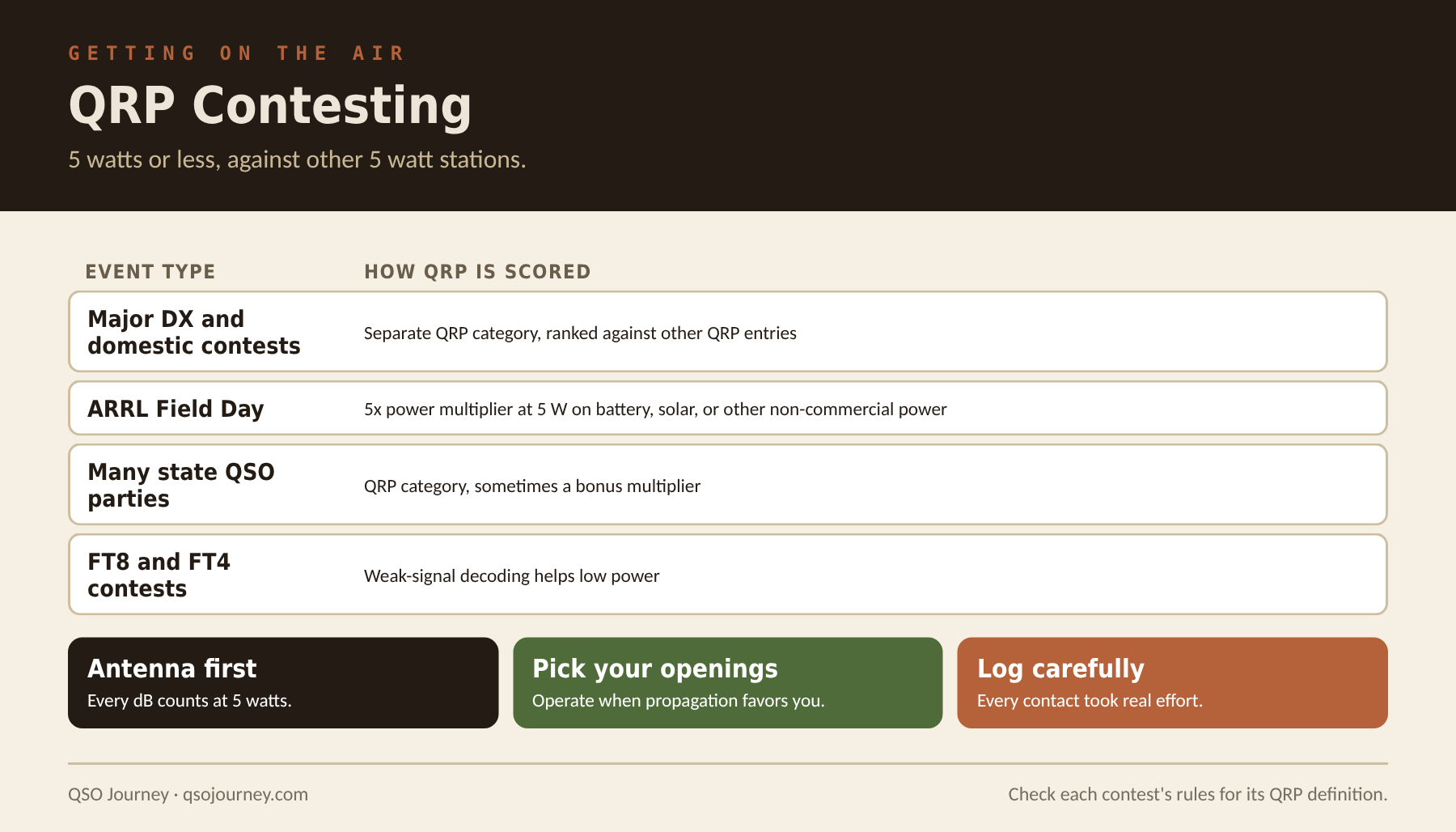
QRP sounds like a self-imposed handicap, but most major contests give QRP stations, typically 5 watts output or less, their own category, so you’re ranked against other QRP entries rather than kilowatt stations. Some events go further. ARRL Field Day multiplies your points by 5 when every contact is made at 5 watts or less on battery, solar or other non-commercial power, and some state QSO parties offer a QRP bonus. Read each contest’s rules, since limits and bonuses vary.
- Antenna matters more than ever. A resonant, well-matched antenna with real height can decide whether you break through at all.
- Call CQ during your best openings rather than constantly hunting weak stations with your own weak signal.
- Use digital modes. FT8’s weak-signal decoding gives low power a real fighting chance that voice can’t match. See FT8 Contesting.
- Time it to propagation, and log carefully, since a busted exchange costs more when every contact takes real effort.
VHF/UHF Contesting: Why Grid Squares Matter
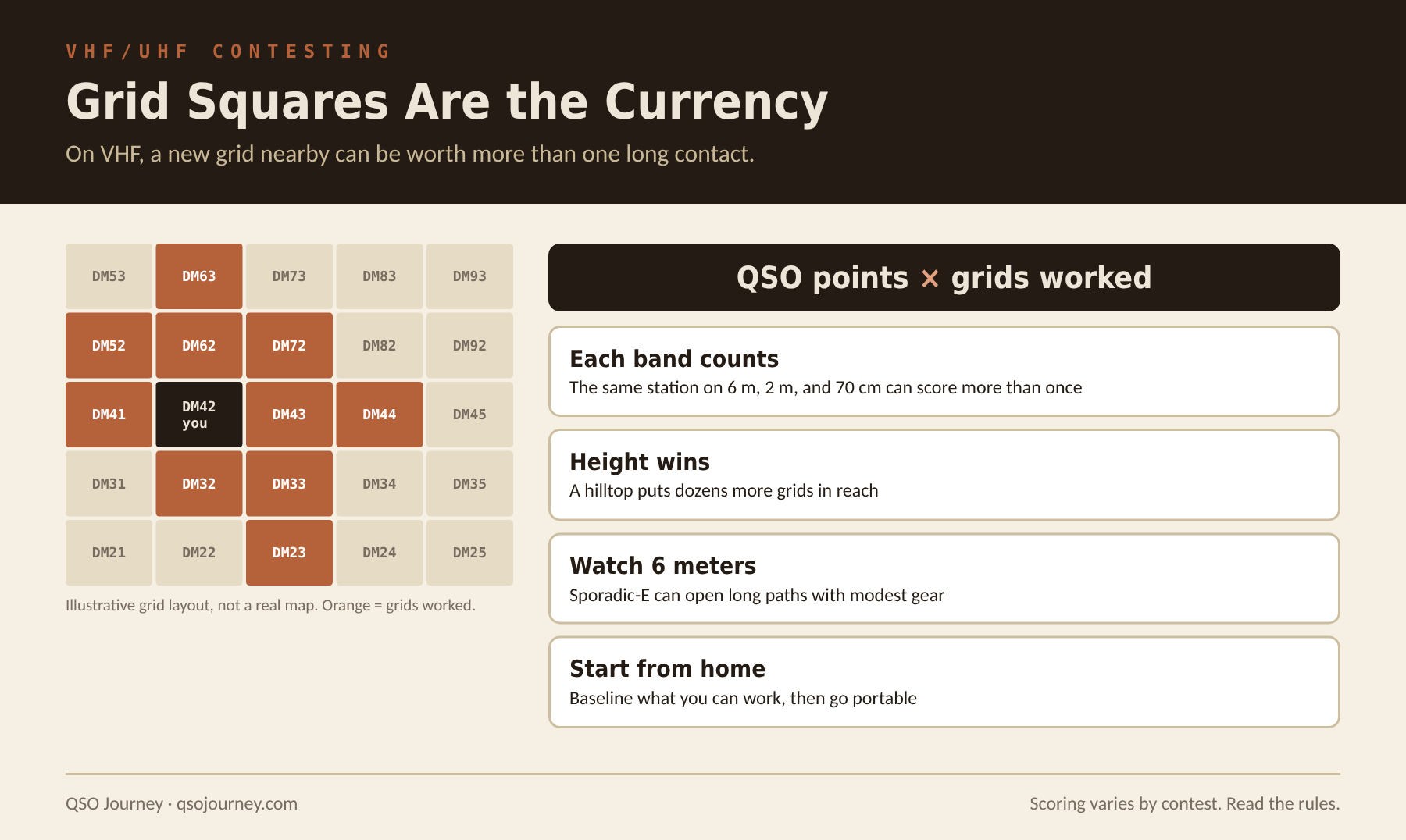
HF contests are mostly about countries and prefixes. VHF/UHF contests run on Maidenhead grid squares, because propagation is mostly line of sight or depends on tropospheric ducting, sporadic-E or meteor scatter. Grids are much smaller than countries, so ten nearby grids can be worth as much as one distant contact.
- Elevation wins. A hilltop can put dozens of grids within reach that are unreachable from a low home location, which is why contest stations set up on high ground.
- Multiple bands count. Serious VHF contesters run 6 meters, 2 meters, 70 cm and sometimes microwaves, since different bands open at different times and the same station on another band often scores again.
- Know the events: the ARRL VHF contests in January, June and September, and the CQ World Wide VHF contest in July on 6 and 2 meters.
- Look for rovers, stations that drive between grids during the contest. They’re why you can suddenly work a grid next to yours with no active hams in it, and they’re often happy to schedule a contact.
- Start from home. See what grids you can work normally, watch for 6 meter sporadic-E openings on contest weekends, and try a nearby high point if your home is obstructed.
For chasing awards alongside contests, see Ham Radio Awards Beyond DXCC.