

Part of our Emergency Communications and Preparedness guide.
If you’ve seen headlines about a Pentagon “doomsday plan” this week, here’s what’s actually going on. The Department of War has an initiative called FORTRESS (Federal Operations for Resilience, Troop Resources, Energy, Supply, and Survivability). Secretary Pete Hegseth announced it in his September 30 “State of the Force” speech at Quantico and signed the official memo establishing it the same day (Department of War release). On October 25, Fox News Digital reported on internal planning documents that call for every major military base in the continental U.S. to sustain essential operations on its own for at least 90 days. That means its own power, water, fuel, and communications if a major war knocks out the grid and supply chains.
A couple of things worth keeping straight. The 90-day number is a reported planning requirement, not something spelled out in the public memo, and Snopes notes the Pentagon hasn’t formally confirmed it. No cost or timeline has been released. Nobody in government has said a war is coming. This is the military deciding it can’t bet national defense on civilian infrastructure staying up.
Here’s the part that got my attention: if the people paid to plan for worst cases won’t trust the grid for their bases, why would you trust it for your family?
Comms Is the Pillar People Skip
Notice the four things on the Pentagon’s list: power, water, fuel, and communications. Most civilian prep stops at the first three. People stack water, buy a generator, rotate gas cans, and assume their cell phone will just work. It won’t. Cell towers run on battery backup measured in hours, maybe a day or two with generators, and they overload the moment everyone tries to call at once. I covered how that actually plays out in What “Grid Down” Actually Means: Realistic Timelines.
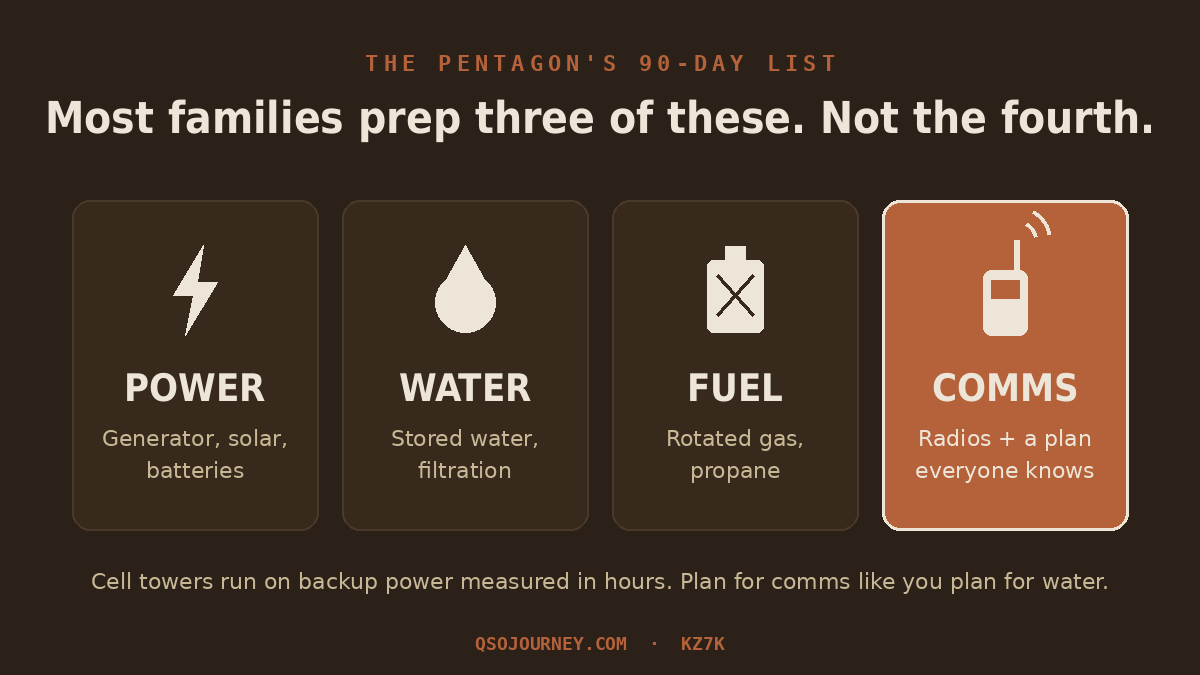
When the network goes down, the questions that matter are simple. Is my spouse okay across town? Did the kids make it home from school? Does the neighbor down the street need help? Without a way to talk, you’re guessing, and guessing gets people hurt.
Radios Without a Plan Are Just Expensive Paperweights
I’ve watched plenty of folks buy a stack of handhelds, toss them in a drawer, and call it done. When the day comes, nobody knows what channel to use, who’s supposed to check in, or what to do when the repeater is silent. A radio is a tool. The plan is what makes it work.
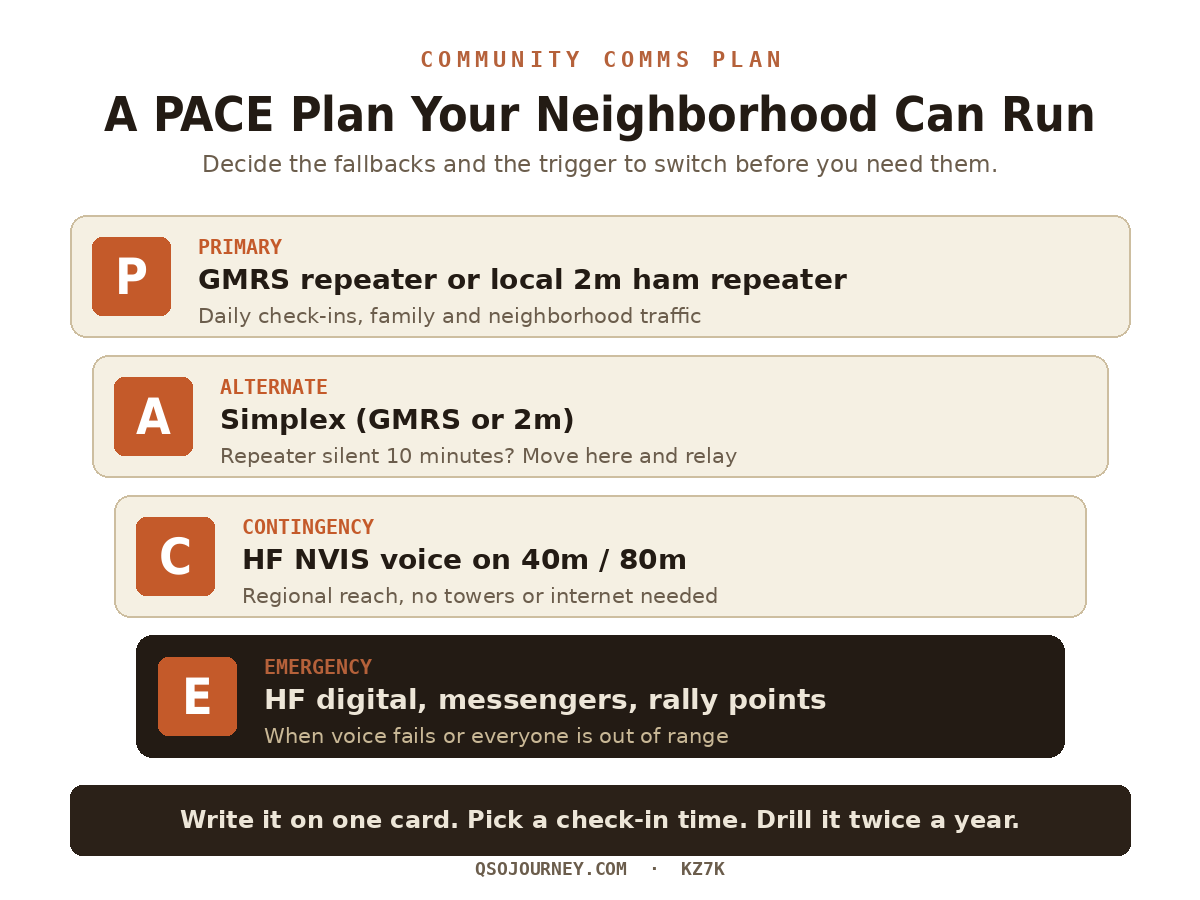
That’s where a PACE communications plan comes in: Primary, Alternate, Contingency, Emergency. You decide ahead of time which method you use first, what you fall back to, and when you switch. Here’s an example. My group runs a plan built around our local repeaters, and we’re working on expanding it to the clubs in the area. The primary is the Sacaton Peak repeater. If nobody answers there within 10 minutes, everyone moves to a 2 meter simplex frequency and relays for each other. HF stations on 40 meters cover the region if both of those fail, with digital modes as the last resort. The goal is for every member to know the steps before anything goes wrong, because a repeater by itself is not a plan.
Your neighborhood, church, or extended family can do the same thing. Pick your channels, pick a check-in time (top of the hour is easy to remember), and write it on a one-page card. If you’re building this for more than one household, start with organizing a neighborhood net or a comms plan for a church or community group, and don’t forget the folks who don’t own a radio at all.
GMRS: The Family Network
For most households, GMRS is the fastest way in. The license costs $35, lasts 10 years, requires no exam, and covers your immediate family. You get real UHF radios with up to 50 watts on the main channels, plus access to GMRS repeaters that can stretch your range across a town. Handhelds cover a neighborhood. A mobile or base radio with a decent antenna does a lot better. My shack GMRS radio is a Wouxun KG-1000+, and it’s the one I’d hand a family that wants a serious base station.
Be realistic about it, though. GMRS and FRS channels get crowded after a disaster, and GMRS alone won’t carry you through a long grid-down event. If you’re weighing the license-free options too, see MURS vs GMRS vs FRS. Everything else lives in the GMRS Complete Guide.
VHF and UHF Ham: The Community Backbone
A Technician license takes a weekend of studying and opens up the 2 meter and 70 centimeter bands. That puts you on the same repeaters and simplex frequencies as your local radio club, which is where most organized emergency traffic happens. Hams practice this every week on nets, and many of them already belong to ARES or RACES. If your neighborhood has even one licensed operator, you’ve got a bridge to the wider community. And a GMRS-licensed household with a ham in it can run both services side by side, as long as you keep the legal lines straight.
If you’re not sure which radio to start with, I answered that in What Handheld Radio Should I Get for Emergency Comms? For a ready-made family setup, here’s my 2m/70cm grab-and-go box.
HF: When Everything Local Is Down
Repeaters need power and mountaintops. When those fail, HF doesn’t care. NVIS on 40 and 80 meters bounces your signal off the ionosphere and covers a few hundred miles around you with no infrastructure at all, just a radio, a battery, and a wire antenna. That’s how you find out what’s happening in Phoenix or Tucson when the internet is gone. I went deep on this in Why HF Radio Matters Most When the Grid Goes Down and Your Repeater Is Not a Plan: Why HF NVIS Matters Just as Much, and you can see how a regular one works in What Is an HF NVIS Regional Net? Most HF phone privileges require a General license, which is one more exam past Technician and well worth it.
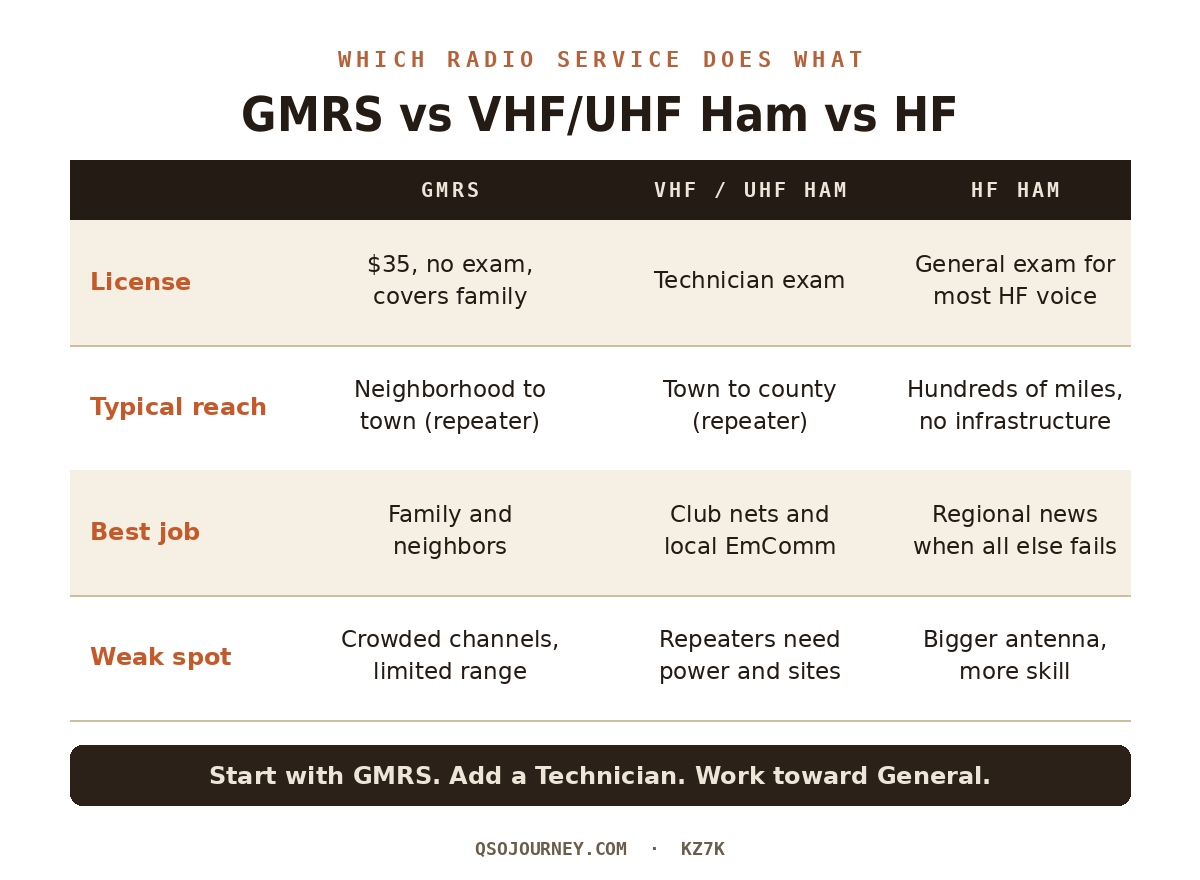
For the longer version of that comparison, see GMRS vs. Amateur Radio VHF/UHF vs. HF: Picking the Right Tool.
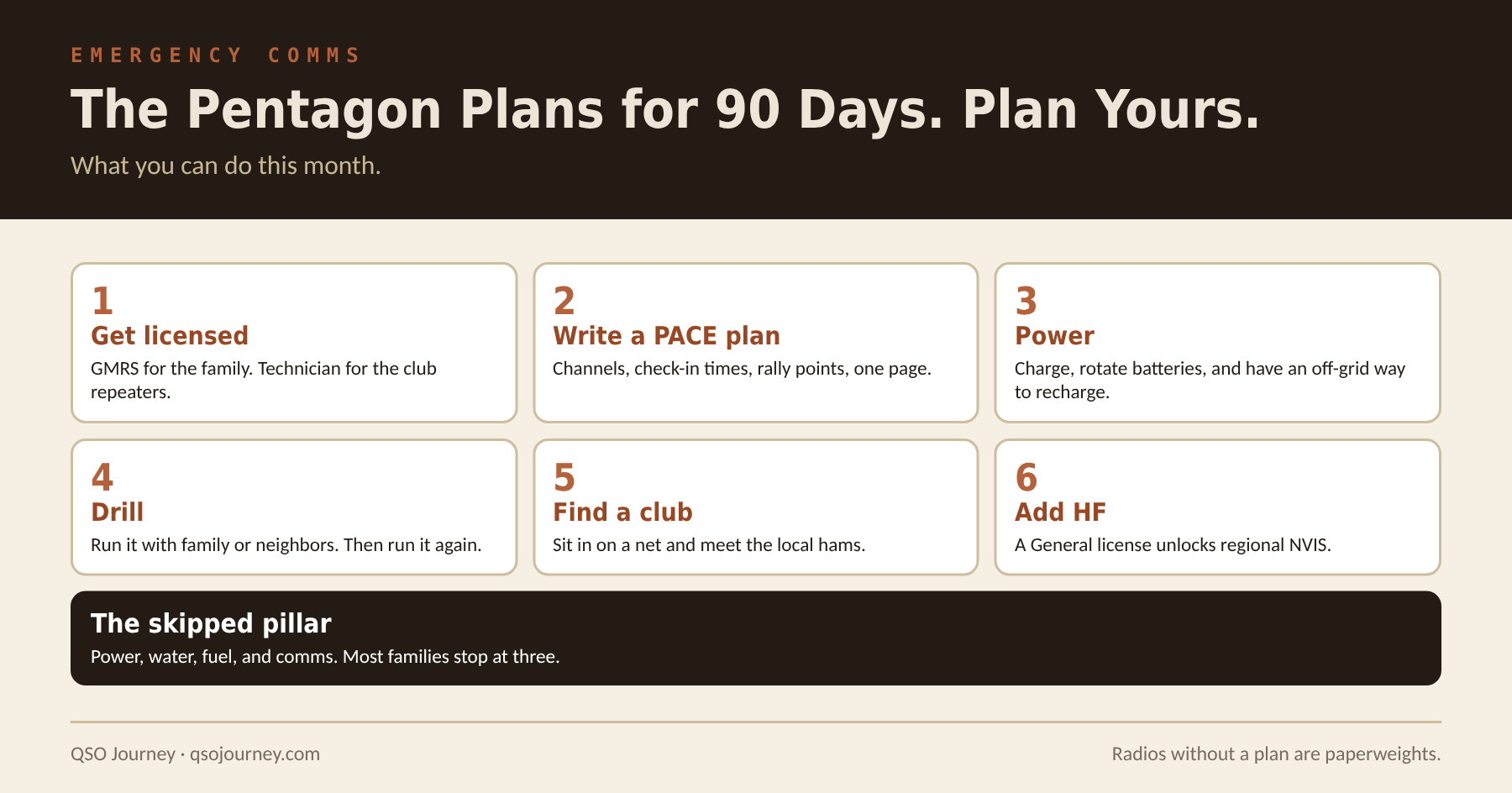
What You Can Do This Month
- Get your GMRS license and a few radios for the household.
- Write a one-page PACE plan with channels, check-in times, and meeting points. Make it simple enough for the non-hams in your family.
- Charge everything, rotate your batteries, and have a way to recharge off-grid (see Backup Power for the Shack and how long your kit will actually run).
- Run a drill with your family or neighbors. Then run it again.
- Find a local club in the Arizona ham and GMRS club guide (or anywhere else), sit in on a net, and start studying for your Technician license.
You don’t need a 90-day nuclear microgrid. You need a plan, some radios, and people who know how to use them. The Pentagon is building its version. Build yours.
Keep Reading
- What a Real SHTF Communications Plan Actually Looks Like
- The Key Parts of a SHTF Communications Plan: PACE, Rally Points, and Roles
- What EmComm Actually Is, and Why It Needs Both VHF/UHF and HF
- When the Repeater Goes Silent: Your Backup Plan for Grid-Down Comms
- Setting Up a Neighborhood Radio Watch Program
- CERT and Amateur Radio: How the Programs Overlap
- The Frequencies Every Ham Radio Should Have Programmed for SHTF
- Why Ham Radio Matters: A Hobby, a Lifeline, and a Century of Proof
- Emergency Communications and Preparedness (the full hub)
Sources
- Department of War memo: Establishment of FORTRESS America (Sept. 30, 2026, PDF)
- Department of War release: Secretary Hegseth Announces Six Major Initiatives at Quantico Speech
- DefenseScoop: Pentagon memo outlines plan to operationalize the FORTRESS America program office
- Fox News: Inside the Pentagon’s doomsday plan to keep America fighting if global war erupts
- Snopes: What we know about the Pentagon’s FORTRESS initiative