
Part of our Getting On The Air: Modes, Operations, and Making Contacts guide.
Ham Radio Deluxe, usually shortened to HRD, is one of the best-known software suites in amateur radio. Instead of stringing together several separate programs, HRD bundles rig control, logging, digital modes, and more into a single integrated package. It is the software I use to run my own station, and here is an overview of what it is and what it does.
What Ham Radio Deluxe is
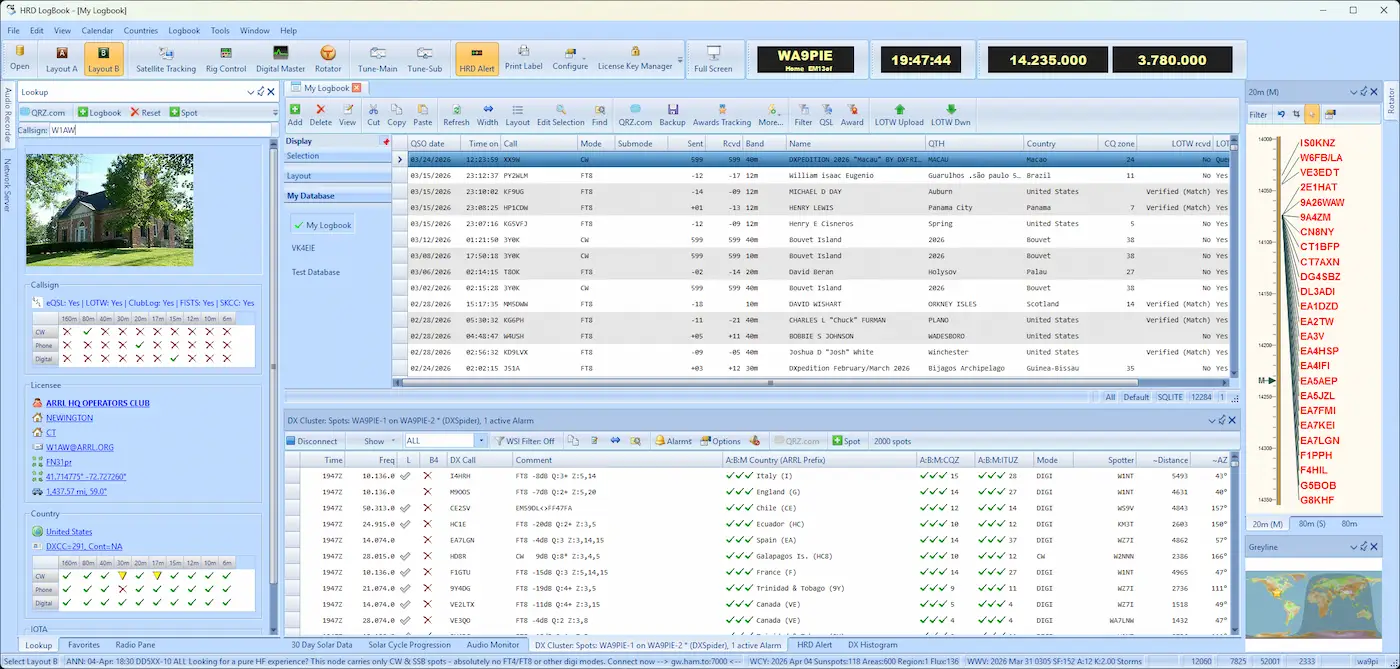
HRD is a commercial Windows software suite (it is paid software, with a support and update subscription) that aims to be a one-stop shop for running your station from your computer. Rather than being a single tool, it is a collection of integrated modules that share information with each other. You can use as much or as little of it as you like.
The main modules
- Rig Control. HRD provides CAT control for a very wide range of radios, giving you an on-screen interface to change frequency, mode, and settings, and to operate the radio from your computer.
- Logbook. A full-featured logging program that records your contacts and integrates with online services and awards tracking.
- Digital Master (DM780). A digital-modes module for running modes like PSK31, RTTY, and others, similar in spirit to Fldigi.
- Rotator Control. If you have an antenna rotator, HRD can point your beam.
- Satellite Tracking. Tools for working amateur satellites, including tracking and Doppler correction.
Why an integrated suite is appealing
The big draw of HRD is that everything is under one roof and talks to itself. Your rig control feeds your logbook, so contacts are stamped with the right frequency and mode automatically. Your logbook connects out to the online services. Your digital-mode contacts flow into the same log. For people who would rather configure one polished package than assemble a pile of separate free programs, that integration is worth a lot.
It also has a long history and a large user base, so there is plenty of help and documentation available, and it supports a huge list of radios.
A note on cost and alternatives
Unlike most of the free tools in the digital-mode world, HRD is paid software. Whether that is worth it depends on how much you value having everything integrated versus assembling free tools yourself. Free logging programs (like N3FJP’s software or Log4OM) and free digital-mode tools (like Fldigi and WSJT-X) can cover much of the same ground if you are willing to connect them together.
There is also a free, open-source option now aiming at the same all-in-one idea from the other direction, building the decoder, logger, and rig control together instead of bundling separate modules. I reviewed Nexus if you want to see how that compares to HRD’s approach.
For me, the convenience of the all-in-one approach won out. HRD handles the CAT control for my radios and ties my logging together, which I will talk more about in a separate post on logging software. If you want one cohesive package to run your whole station and do not mind paying for it, Ham Radio Deluxe is a strong option worth a look.
If you want to see that all-in-one approach in practice, our guide to setting up WSJT-X, GridTracker, HRD, and TQSL covers exactly how HRD shares CAT control with WSJT-X and backs up every QSO alongside GridTracker’s automatic uploads to LoTW, QRZ, and PSK Reporter.