
Part of our Building Your First Ham Radio Station guide.
If you do any portable operating (POTA, SOTA, or field deployment), you know the struggle: hauling three different antenna setups to cover different sites, trees, and ground types.
The Hydra from Coffee and Ham Radios (CaHR) fixes that. True to its name, it gives you one feed point with multiple heads, so you can shape the antenna to whatever the site throws at you. I already wrote about taking the Hydra from backyard tests to a mountain overnight. This post is the deeper look: what it is, how the 4:1 backpack works, the configurations you can build, and what I have learned owning two of them.
What It Does
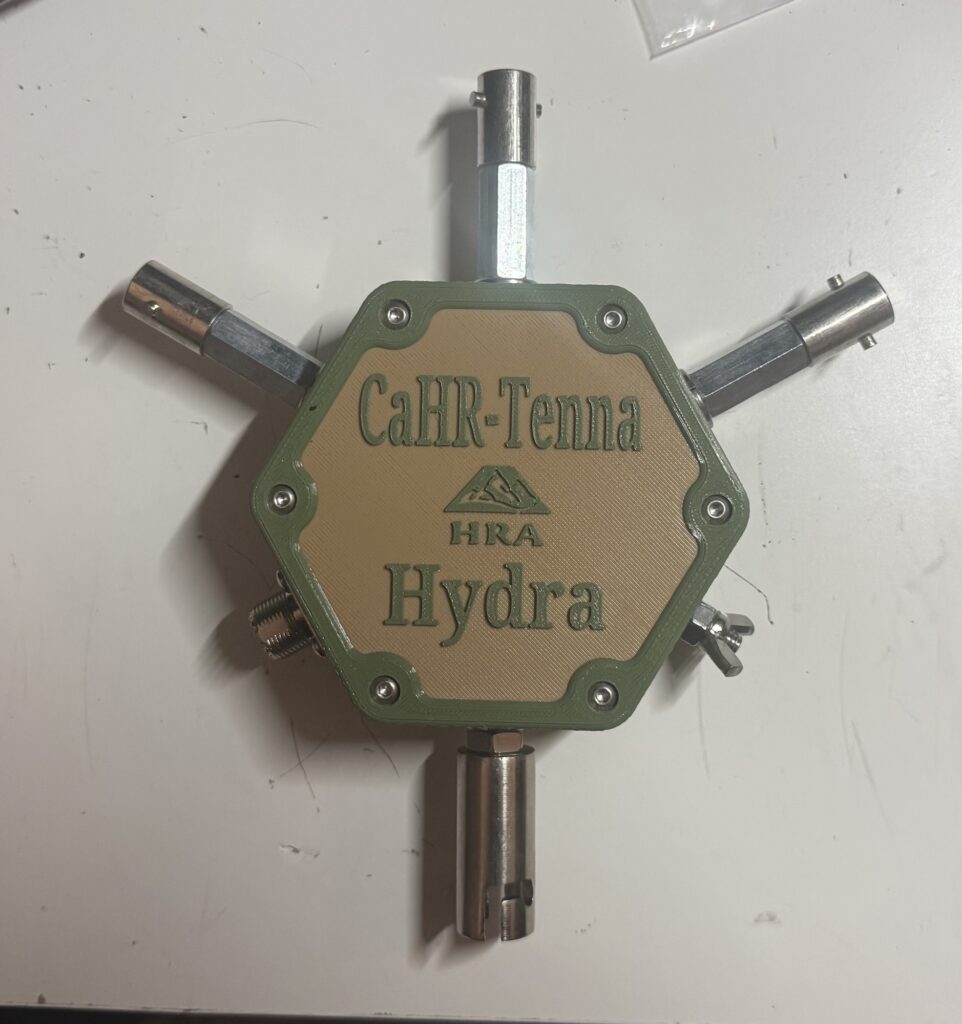
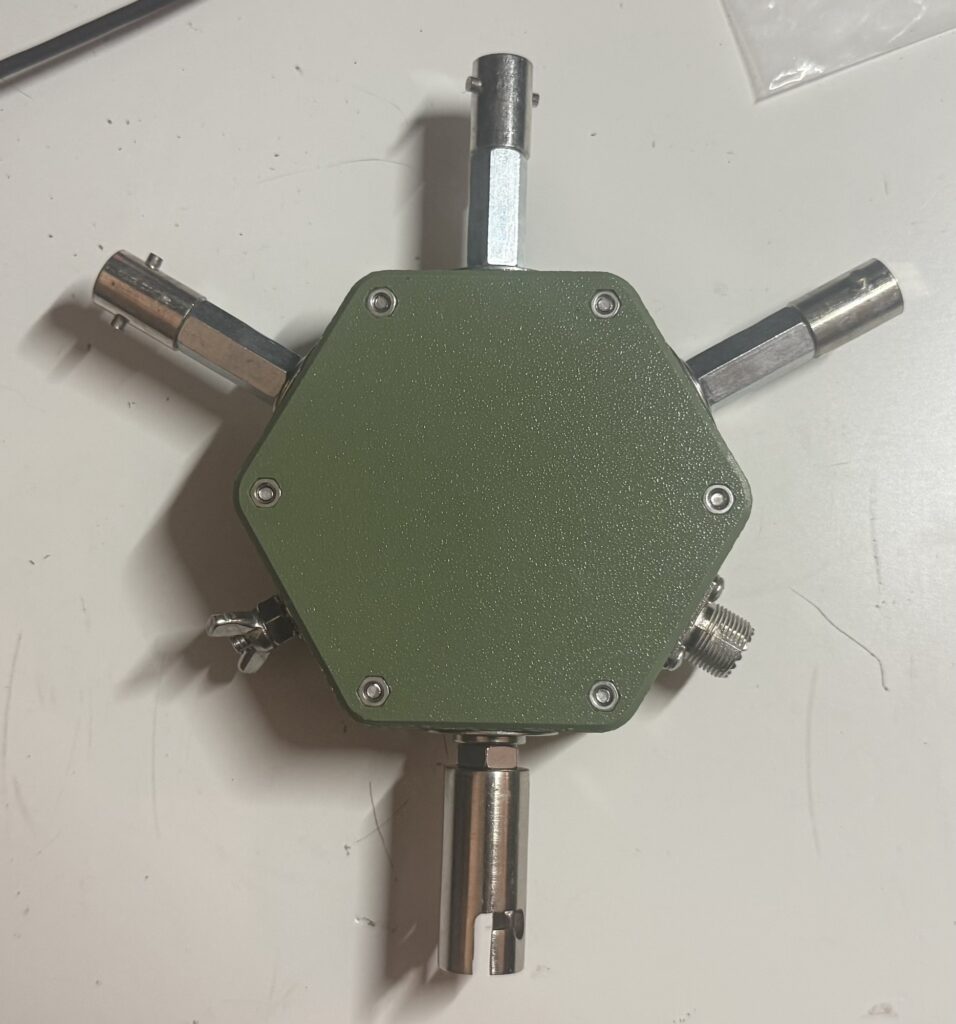
The Hydra is a modular, multi-configuration feed point built around standard 3/8-24 threaded components: 17 ft telescopic whips, counterpoise and radial wires, and dipole arms. It acts as a central hub that turns a couple of whips and some wire into almost any portable HF antenna shape you need.
Instead of carrying separate mounts for a vertical, a dipole, and a V, the Hydra is the single base for all of them.
How It Works
- Mechanical hub: Three 3/8-24 whip positions are placed around a central body, so you can thread in whips vertical, horizontal, or angled.
- Electrical feed: Coax connects through a standard SO-239 and feeds your radiating element(s) and counterpoise.
- Modularity: Add the 4:1 backpack (more on that below) when you want to run a non-resonant element instead of a resonant whip pair.
Why It’s Great
- A Swiss Army knife for POTA and SOTA: Tree, picnic table, or bare rock? It doesn’t matter. You shape the antenna to fit the space you have.
- Fast deployment: No wrestling tangled wire out of a tree. Thread in the whips, extend them, plug in the coax, and you’re on the air.
- Small footprint: The hub itself is compact enough to ride in a go-bag or a backpack side pocket. The whips and mast are the bulky part.
- Built for field abuse: Reinforced everywhere, with quality hardware, and still light enough for hike-in activations.
How the 4:1 Backpack Works
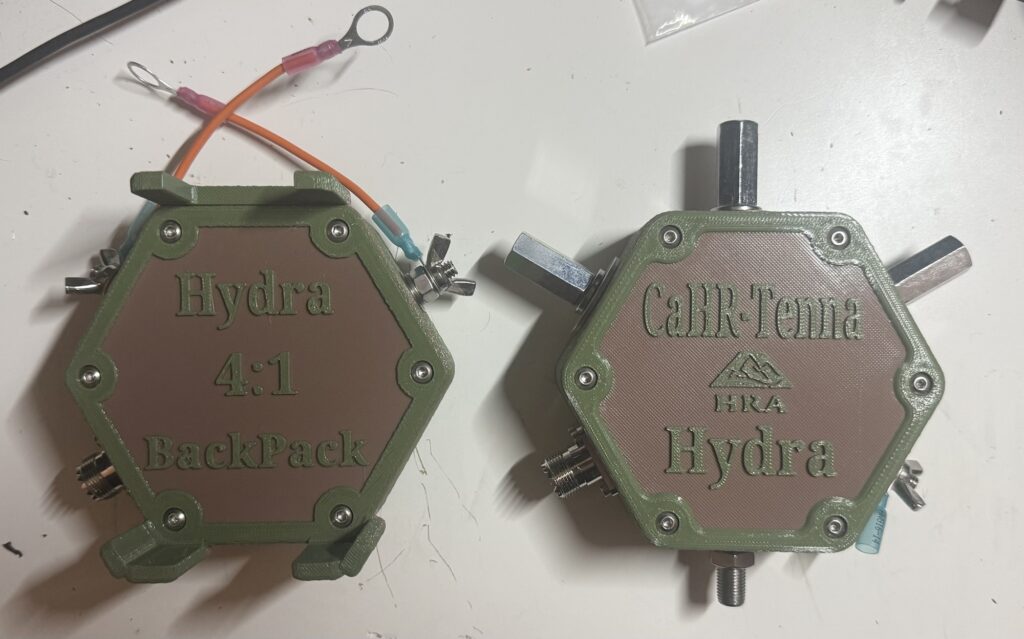
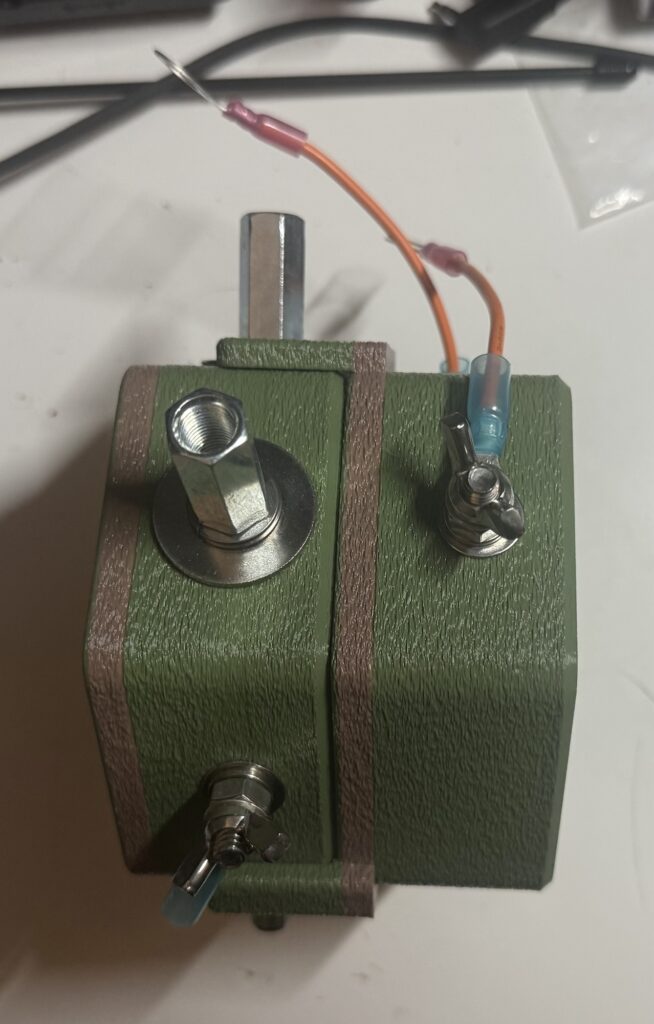
The add-on I like most is the 4:1 backpack, a piggyback transformer that mounts right onto the Hydra.
- Impedance matching: Some antennas present a feed point impedance around 200 ohms instead of the 50 ohms your radio wants. A 4:1 transformer brings 200 ohms down to 50. That’s the same idea behind a Rybakov-style non-resonant vertical, and it’s why 4:1 baluns show up on off-center-fed dipoles.
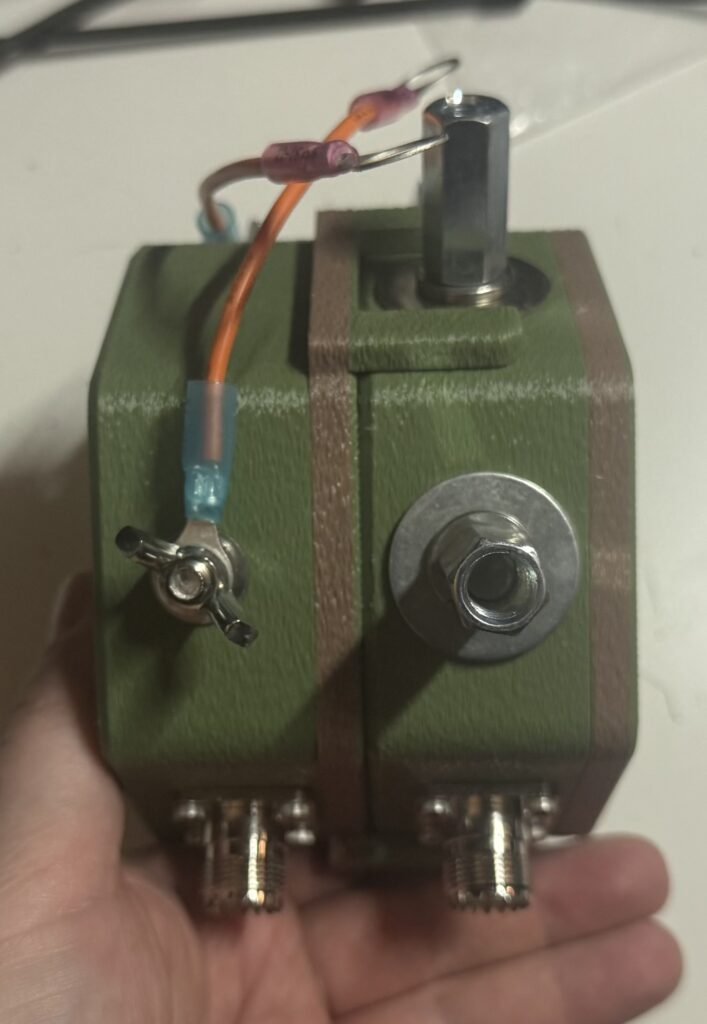
- The backpack form factor: Instead of a separate box dangling off the feed point, the transformer locks onto the back of the Hydra and becomes part of the hub.
- Easier tuning, not no tuning: With a non-resonant element, the 4:1 puts the impedance where a tuner can handle it easily across several bands. You still want an ATU in the line. Don’t expect a flat SWR everywhere without one.
- It opens up loops: With the backpack on, you can run an inverted delta loop off the Hydra: the feed point at the bottom corner, wires up to two supports, and a top wire closing the triangle. Details are in the table below.
Configuration Options
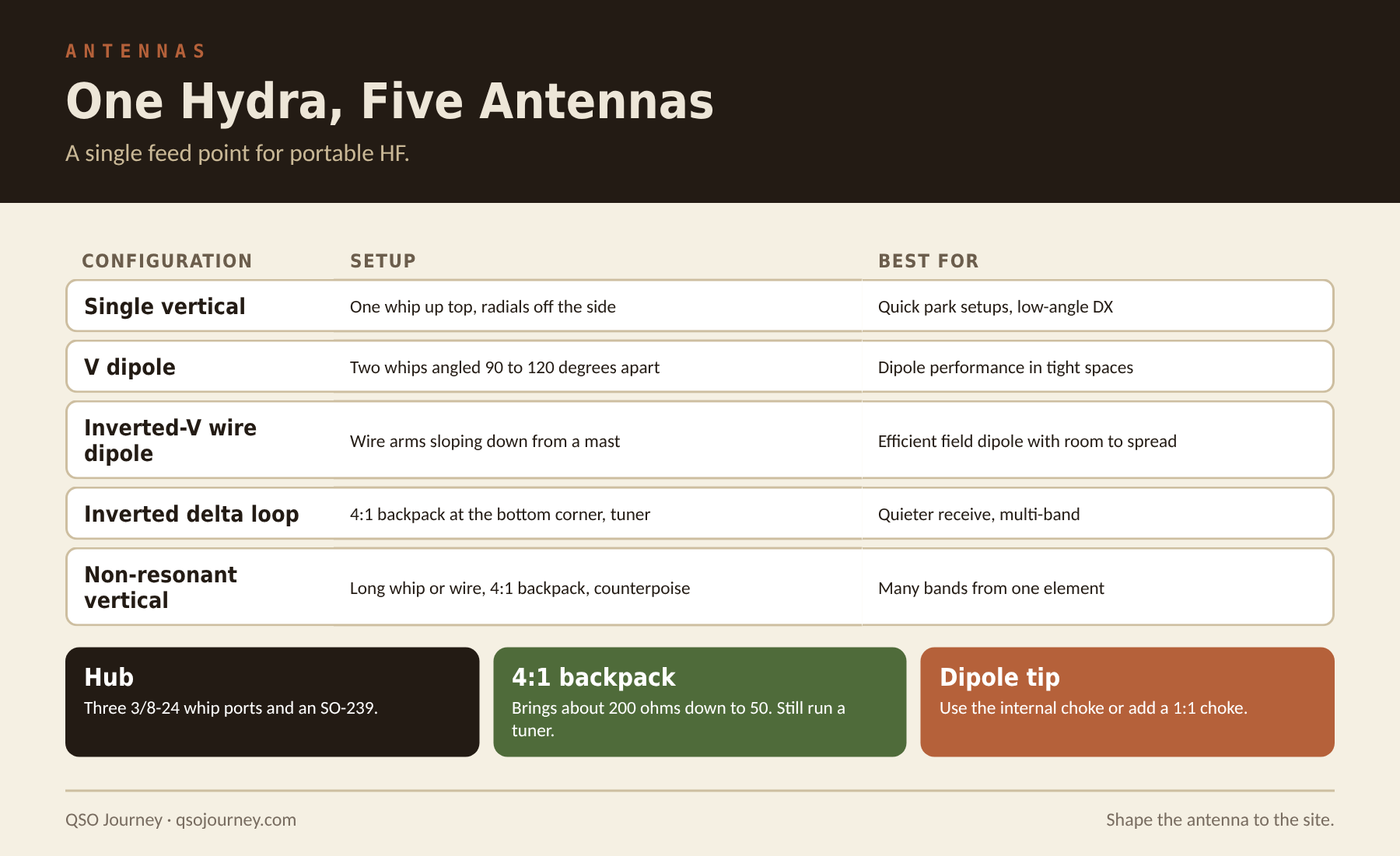
Because of the multi-port layout, you can build several antennas from one Hydra:
| Configuration | Setup | Best For |
|---|---|---|
| Single vertical whip | One telescopic whip in the top port, with radial wires off the side or bottom. | Quick park setups, low-angle DX, sites with no trees. |
| V dipole | Two whips angled up into a V, roughly 90 to 120 degrees apart. | Dipole-style performance when you don’t have room to go fully flat. |
| Inverted-V wire dipole | Wire elements sloping down from the hub on a mast, using 3/8-24 wire adapters. | A classic, efficient field dipole when you have a mast and room to spread out. |
| Inverted delta loop | The 4:1 backpack on the Hydra at the bottom point of the loop, a wire from each side running up to two supports, and a top wire closing the triangle between them. Run a tuner. | A closed loop that’s often quieter on receive than a dipole, with multi-band coverage through the tuner. |
| Non-resonant vertical | A long whip or wire with the 4:1 backpack, plus a counterpoise and a tuner. | Multi-band coverage from one element without changing lengths. |
Need help getting a whip on frequency? Start with how to tune a vertical whip antenna for HF. If you would rather build a wire version from scratch, see how to build a wire dipole on a budget.
How I’ve Actually Run Mine
The table is what the Hydra can do. Here’s what I’ve actually done with it:
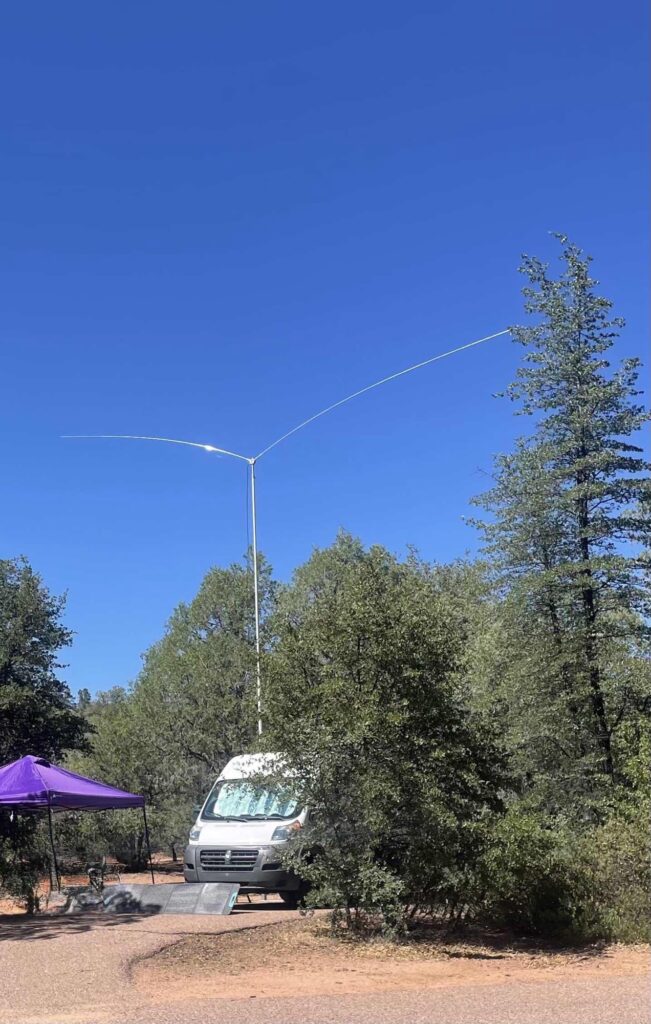
- V dipole with dual 17 ft whips. This is the setup in the photos at the top, up on the 25 ft Porta Mast.
- V dipole with 40 meter wires. The feed point sits on a stake right at ground level, and the two 40 meter wires run up to a pair of masts.
- Vertical. I’ve run it with a single 17 ft whip, and again with a 25 ft whip.
- NVIS wire dipole. A wire dipole about 6 ft off the ground, for close-in regional coverage. If NVIS is new to you, see NVIS vs. vertical DX antennas.
I’ve tried a few other configurations beyond those, too. Honestly, half the fun is just bringing it out and seeing what you can build with it, because there are so many options.
Notes From Owning Two Hydras
I have two Hydras. One has the internal choke and one doesn’t. If you’re running the Hydra as a dipole off coax, that choke matters, because it keeps common-mode current off the outside of your feed line. If you end up with the unchoked version, a 1:1 common-mode choke at the feed point does the same job.
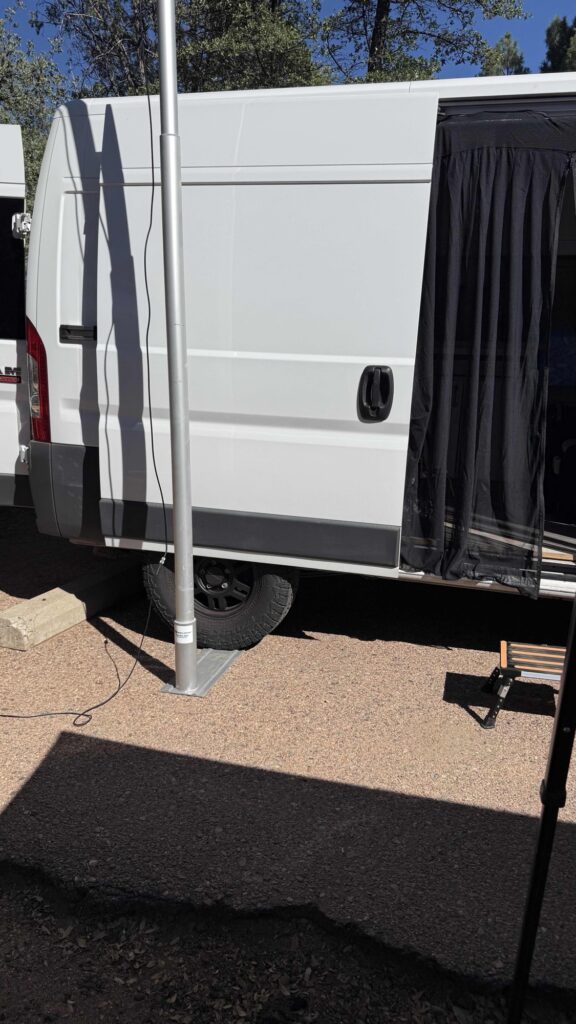
On one of them I added Chameleon quick disconnects, both for attaching the feed point to my mast and on the three whip positions. Those are the extra pieces you see in the front and back photos above. They make a big difference when the mast is tall even fully collapsed and you’re working at height. The Hydra next to the backpack has none of that, so you can see exactly how it looks when it shows up from CaHR.
As for build quality, it’s excellent. The 3D printing is top notch, and the attention to detail in the design is a cut above the similar products I have seen from other vendors. Every section is reinforced, the hardware is high quality, and everything fits together perfectly.
Where to Get One
The CaHR antennas, the Hydra included, are made by the crew behind the Coffee and Ham Radios channel. If you’re looking for one, hit up these links:
- Coffee and Ham Radios on YouTube
- TheSmokinApe on YouTube
- KK6USY Ham Radio Adventures on YouTube
Bottom Line
Whether you’re packing light for a summit or building a rapid-deployment emergency kit, the Hydra turns a couple of whips and some wire into a full antenna farm on one feed point. It’s also the backbone of the kit I recommend in What I’d Buy Instead of the Chameleon MPAS 2.0. For what to put it on, see every HF mast I’ve owned, and if you’re still deciding what goes in the bag, read which portable HF antenna you should actually bring.
Have you run a Hydra in the field yet? Tell me your favorite configuration in the comments.