
Part of our Building a PACE Communications Plan for Grid-Down Scenarios guide.
Here’s an example plan built around our local repeater, with a simple rule: if nobody answers on the Sacaton Peak repeater (447.725, minus 5 MHz offset, 100.0 Hz tone) within 10 minutes, everyone goes to simplex on 145.275, no tone, with 446.275 as the UHF simplex. My group runs a plan like this, and we’re working on expanding it to the clubs in the area. A rule like that only works if everyone knows what happens next. Without the repeater, a handheld in one neighborhood can’t hear a handheld across town. The fix is to let people do the repeater’s job.
A human relay network is exactly what it sounds like. Stations that can hear both sides of a gap copy a message from one side and pass it to the other. It’s slow, it’s manual, and it works with the radios you already own. It also falls apart fast if nobody has worked out the details ahead of time. Here’s how to set one up so it holds together on the day you actually need it.
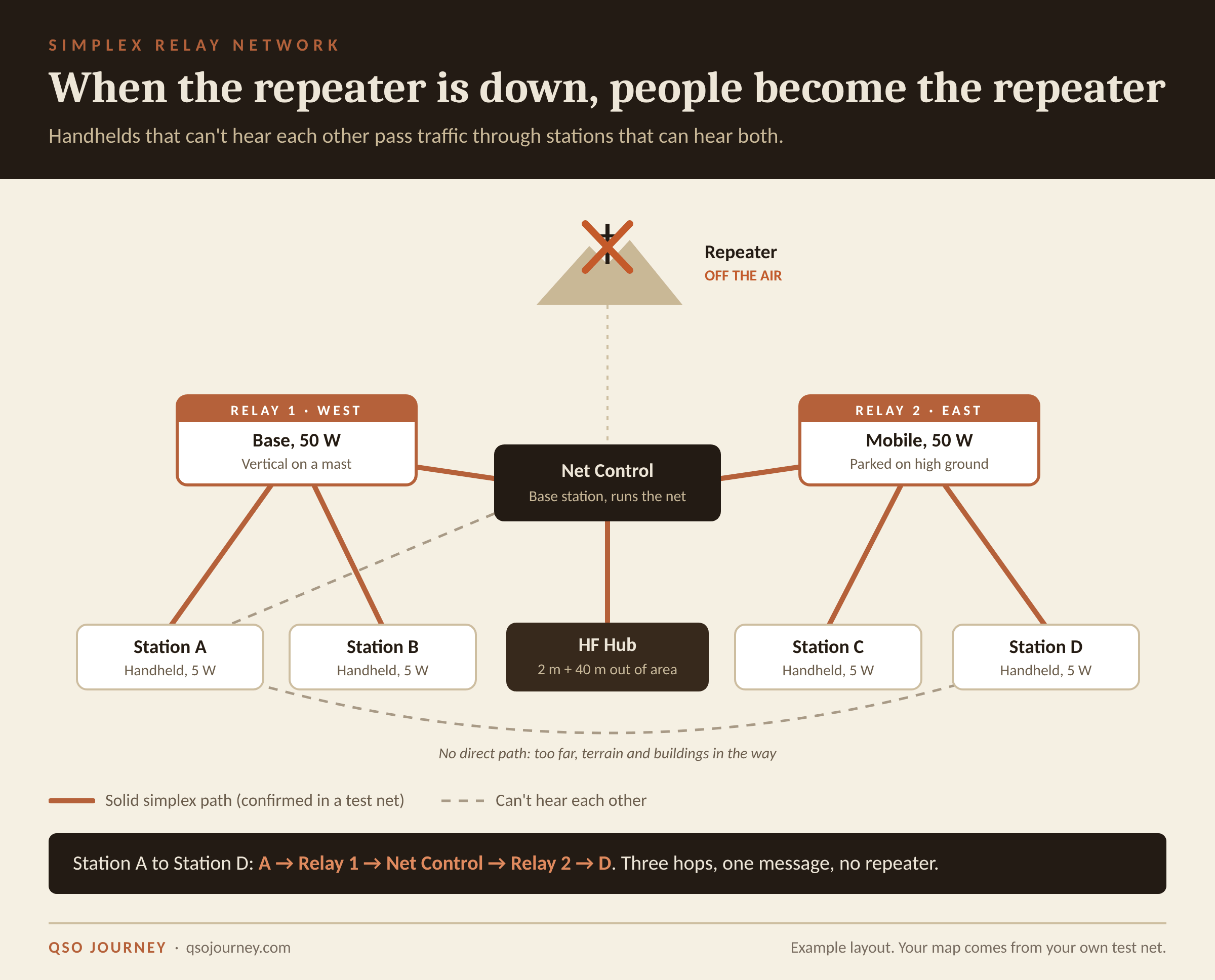
Why Simplex Needs Relays
A repeater works because it sits high and transmits with real power and a good antenna. Every handheld only has to reach the mountain, and the mountain reaches everyone else. Take the repeater away and every station has to reach every other station directly, from ground level. On 2 meters that’s mostly line of sight, so the distance you can cover depends far more on antenna height and terrain than on watts.
A handheld with a stock antenna, standing in a backyard surrounded by block walls and two-story houses, might reach a couple of miles. A 50 watt base radio with a vertical up on a mast might reach most of town. (I put real numbers on this in How Far Can Your VHF/UHF Radio Actually Talk?) Put those two facts together and you have the whole idea: the well-equipped stations become the backbone, and everyone else talks to the backbone instead of to each other.
Step 1: Map Who Hears Whom
You can’t design a relay network from a map. Terrain, buildings, and antennas decide who reaches who, and the only way to find out is to test. Run one net on simplex and have every station report which callsigns they can hear. Put it in a simple grid. A pattern shows up fast: a few stations hear almost everyone, and a few hear almost no one.
A few things make the test worth trusting:
- Test from where people will really be. A member who checks in from his truck at work isn’t telling you anything about his house.
- Use the radio they’d really grab. If the plan is a handheld on battery, test with a handheld on battery, not the base rig in the shack.
- Separate solid copy from weak copy. “I can kind of hear him” doesn’t count. A relay has to copy every word the first time.
- Have every station transmit. A short roll call where each station gives its callsign and location is enough. Everyone else writes down who they copied.
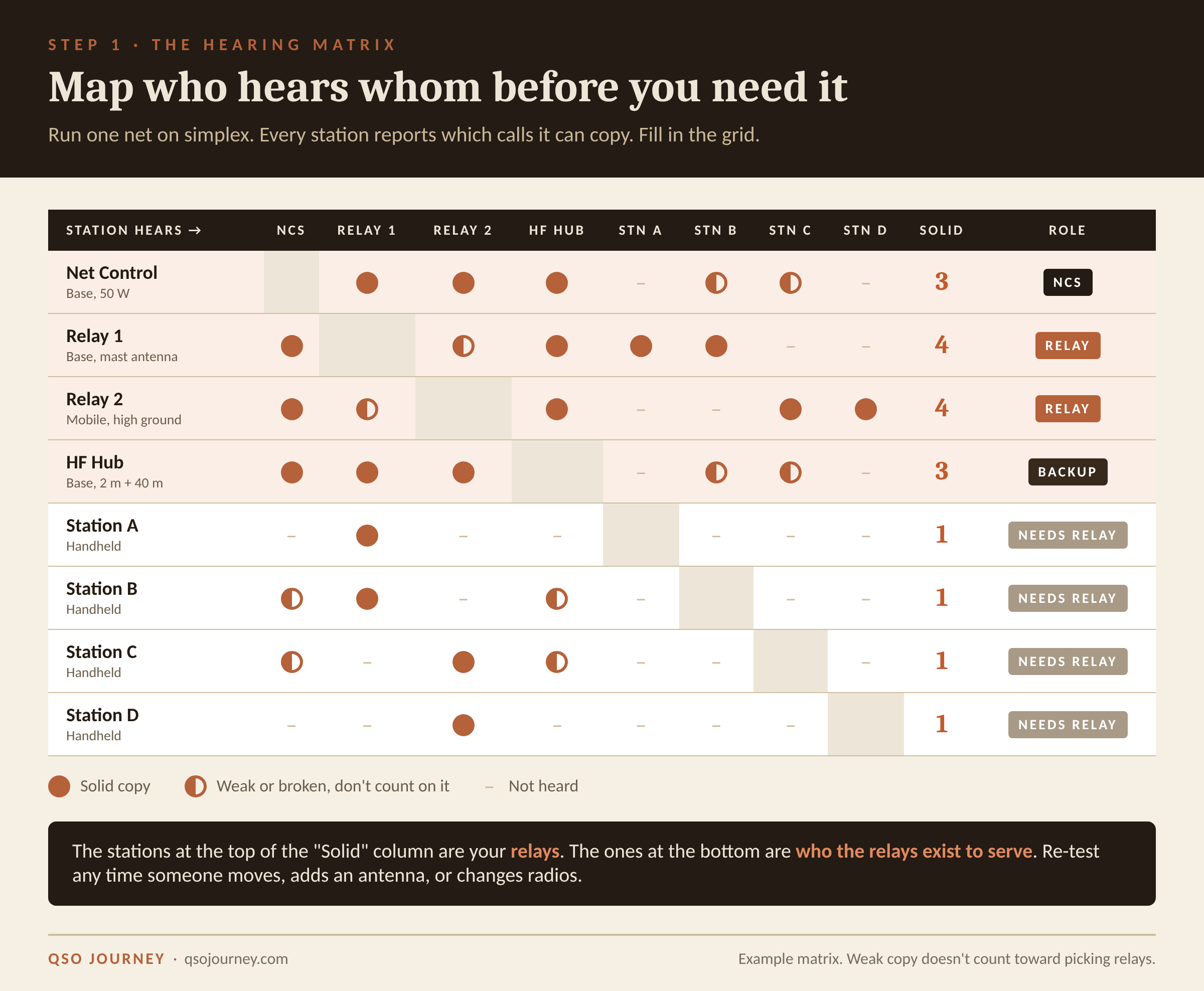
Once the grid is filled in, count the solid copies in each row. The stations at the top of that count are your relay candidates. The stations at the bottom are the people the relays exist to serve. Keep the grid, and re-test whenever someone moves, puts up a new antenna, or changes radios. It goes stale faster than you’d think.
Step 2: Pick Your Relay Stations
The stations that hear the most people are your relays. Usually that’s someone with a mobile or base radio at 50 watts and an antenna on a mast, not a handheld. Name two or three, and give each a backup in case they’re not home. Write their callsigns into the plan so nobody has to figure it out on the day.
Hearing a lot of stations is the first requirement, not the only one. A good relay station also has:
- Power that doesn’t depend on the grid. A battery box or generator that will run the radio for a full evening. A relay that drops off the air at hour two takes half of town with it.
- An operator who will actually be there. The best antenna in town doesn’t help if its owner works nights or travels every other week. That’s why every relay gets a named backup.
- Someone who can copy and write fast. Relaying is clerical work. Calm, steady operators who write neatly beat fast talkers every time.
- Coverage of a specific area. Two relays that both hear the same neighborhood are redundant. Spread them out so each one covers a part of town the others can’t.
If someone can park a vehicle on high ground, a dual-band mobile set to cross-band repeat can stretch coverage even further. I describe that setup in When the Repeater Goes Silent. Just remember that a cross-band repeater is a machine with nobody listening. It extends range, but it doesn’t copy, log, or confirm anything. You still need humans in the loop for traffic that matters.
Step 3: Let Net Control Run It
On a repeater, a loose net mostly works because everyone hears everyone. On simplex they don’t, so people step on each other without knowing it. One station has to run the frequency. Net control decides who transmits, assigns which relay handles which message, and keeps a running list of traffic that hasn’t been delivered yet.
Opening the net can be as simple as this:
"This is [call], net control for the simplex net on 145.275.
The repeater is off the air. This is a directed net.
Relay stations, check in now."

(Relays check in.)

"Stations needing a relay, call your nearest relay station,
not net control. Relays, collect check-ins and traffic
and report to net control when called."
That last line is the part people miss. If every station tries to call net control directly, half of them won’t be heard and they’ll keep calling. Pointing them at their relay turns one crowded channel into an orderly set of short exchanges. Any station with emergency traffic still breaks in first, and everyone else stands by until it’s handled.
Step 4: Pass Messages Cleanly
Every relay is a chance for words to change. The old party game where a sentence gets whispered around the room proves the point. A message that goes through three people can come out the other end meaning something different, and on simplex you might not catch it. The cure is a readback on every single hop.
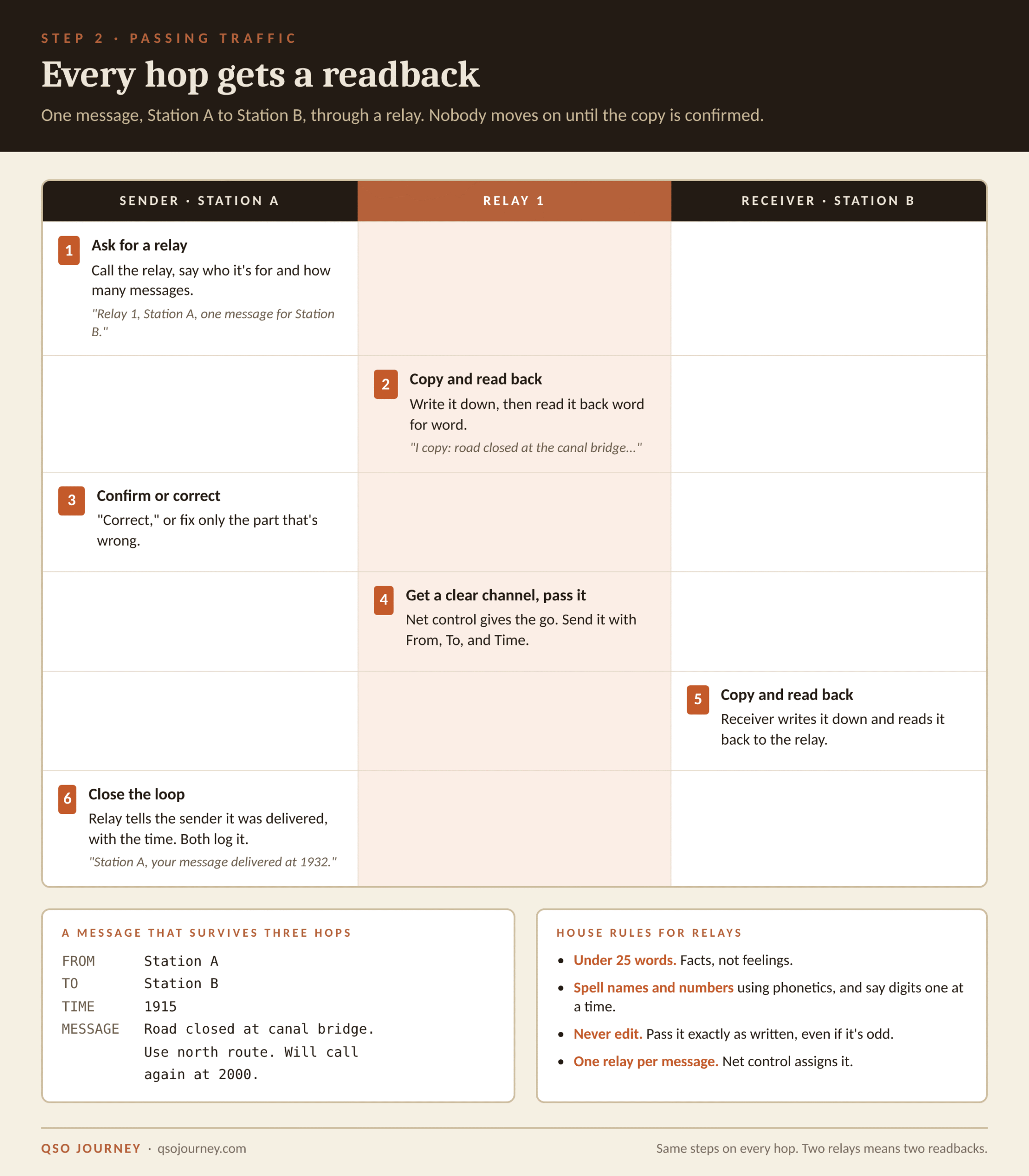
- Keep it short. Aim for under 25 words. Facts, not feelings. “Road closed at canal bridge, use north route” survives three hops. A paragraph doesn’t.
- Include who, to whom, and when. Every message carries a From, a To, and the time it was written. Without them, a relayed message is just a rumor.
- Read it back. The relay repeats the message to the sender before passing it on, and the receiver reads it back to the relay. Nobody moves on until they hear “correct.”
- Spell names, say digits one at a time. Use phonetics for names and street names. “One five, two zero” is clearer than “fifteen twenty,” and “fifteen” versus “fifty” is a classic simplex mistake.
- Never edit. The relay passes exactly what was written, even if it reads oddly. If something seems wrong, ask the sender. Don’t fix it on the way through.
- Close the loop. When the message is delivered, the relay tells the sender, with the time. Undelivered traffic stays on net control’s list until it’s done.
Step 5: Write It Down
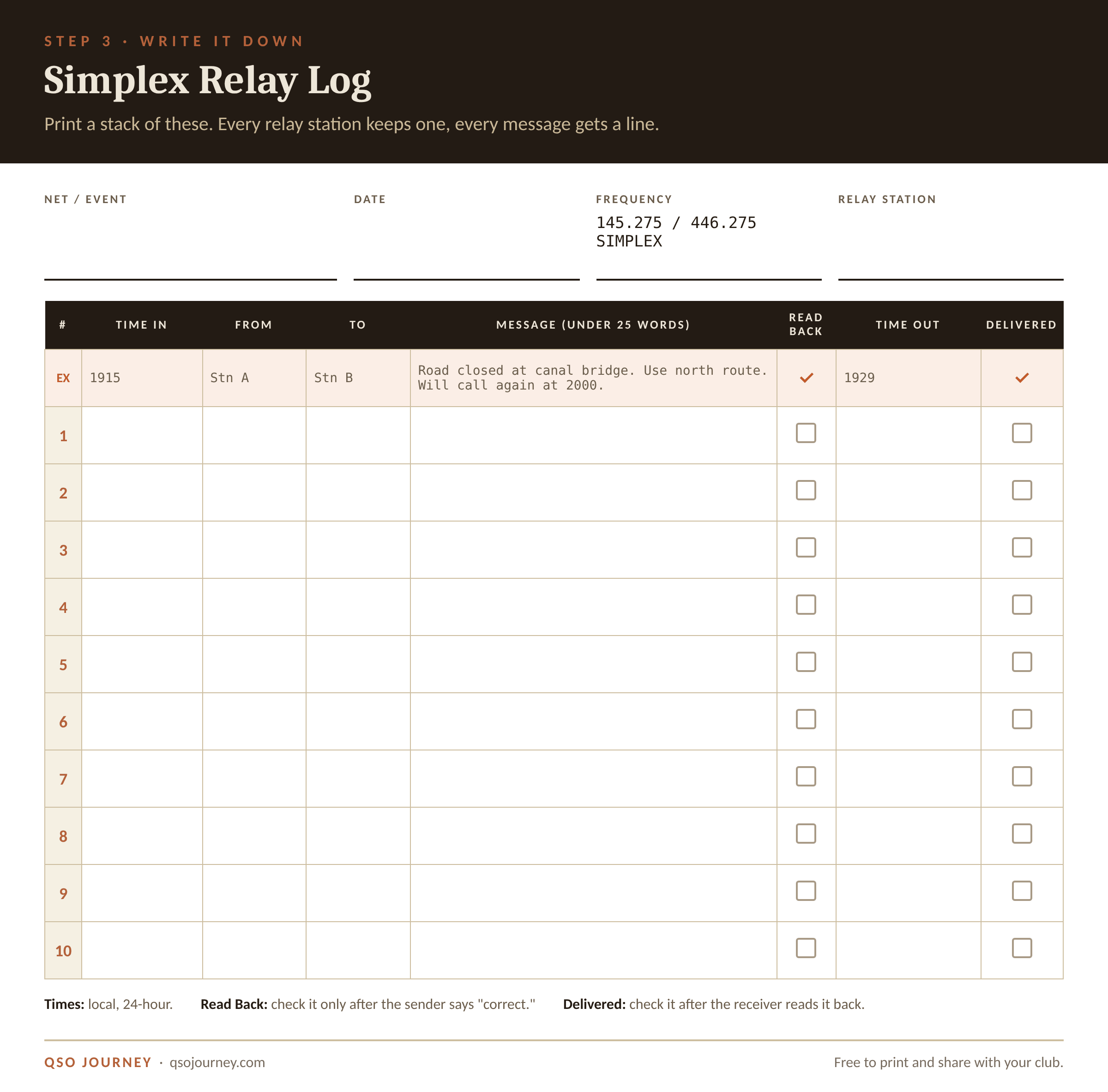
Relays log every message with a time, sender, and receiver. Memory fails after the third or fourth message, especially when you’re tired and the frequency is busy. A paper log also lets net control ask “what traffic do you still have?” and get a real answer instead of a guess.
Here’s a simple relay log you can print. Keep a stack of them with your radio and a couple of pens that work. If your group already uses ICS-213 general message forms for formal traffic, keep using them (I cover those in ICS-213 and Message Formats). This log is for tracking what came in, where it went, and whether it got there.
Where Relay Networks Break
Most relay failures aren’t radio problems. They’re people problems, and they’re predictable:
- Two relays grab the same message. Both pass it, the receiver gets it twice with slightly different wording, and nobody knows which one is right. Net control assigns one relay per message.
- Relays talk over each other. Relay 1 can’t hear Relay 2, so both key up at once and net control hears a mess. Relays only transmit when net control calls them.
- The relay goes quiet. Dead battery, dinner, kids. Every relay has a named backup, and net control checks on silent relays at a set interval.
- Someone assumes the message got through. No delivery confirmation means it didn’t get delivered. Treat it that way until you hear otherwise.
When Simplex Isn’t Enough
Some members will be out of reach no matter how good the relays are. That’s what the next levels of the plan are for. HF stations act as hubs on 40 meters and keep a second radio on 145.275 so they can relay for members without HF. A member on the far edge of town who can’t reach any 2 meter relay might still be heard by an HF hub running NVIS on 7.275 LSB, and that hub can pass the traffic back onto simplex. I explain how that kind of net works in What Is an HF NVIS Regional Net?, and the layers are covered in Your Repeater Is Not a Plan.
Practice It
Run your weekly net on simplex once a month. It will be slower and messier than the repeater net, and that’s the point. The first time you try a relay network shouldn’t be the day the repeater goes dark.
To make the drill worth the time:
- Rotate the jobs. Let backups run as relays and let a different member run net control. The day you need them, your best operators might not be home.
- Send a test message end to end. Have a station on one edge of town send a message with a name, a street, and a few numbers to a station on the other edge.
- Compare the copies. At the end of the net, the sender reads the original and the receiver reads what they got. Every difference is a lesson.
- Time it. Note when the message was handed off and when it was delivered. If it takes 20 minutes to move one sentence across town, you’ll want to know that now.
- Update the grid. Note any new stations, lost paths, or relays that couldn’t hear someone they used to.
None of this takes special equipment. It takes a grid, a few named relays, a net control who keeps order, and a habit of reading everything back. Build it while the repeater still works, and you’ll have something real to fall back on when it doesn’t.