
Part of our Emergency Communications and Preparedness guide.
Most people never start prepping because the list looks endless. So shrink it. Here are ten things you can knock out in the next seven days. Comms come first, because a radio you haven’t programmed or tested is a paperweight when the cell network goes down.
Comms
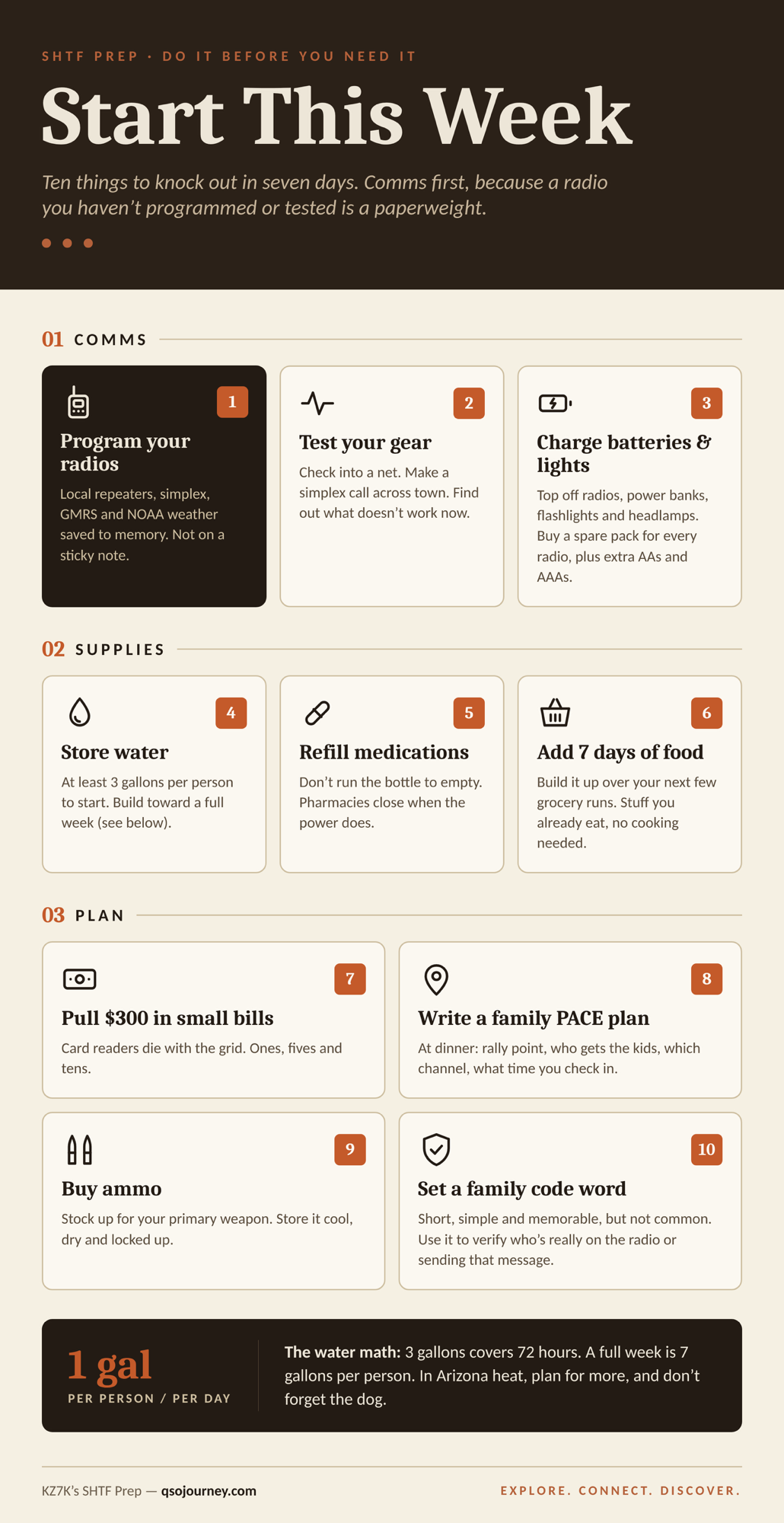
1. Program your radios. Put your local repeaters, simplex frequencies, GMRS channels and NOAA weather into memory. Not on a sticky note, not in your head. If you have to dig out a manual during an emergency, you’ve already lost. If you need a starting list, here are the frequencies every ham radio should have programmed for SHTF.
2. Test your gear. Check into a net. Make a simplex call across town. Find out now which radio has a bad antenna or a dead mic, while you still have time and a working internet to fix it. And practice the simplex part, because the repeater won’t always be there.
3. Charge batteries and lights. Top off every radio, power bank, flashlight and headlamp. Then buy a spare battery pack for each radio, plus extra AAs and AAAs. Put it all somewhere you can find it in the dark, and rotate your batteries so they actually work when you need them.
Supplies
4. Store water. The standard is one gallon per person per day. Three gallons per person covers 72 hours, and a full week is seven. Here in Arizona, plan for more than that, and don’t forget the dog.
Got a Pool? Use It, but Know Its Limits
A backyard pool holds thousands of gallons, which is real peace of mind here in Arizona. But the CDC is clear that pool and spa water is for hygiene and cleaning, not drinking. Pool chemicals like cyanuric acid (the stabilizer), algaecides and dissolved metals don’t boil off, and a camping filter won’t pull them out. So plan on using your pool two ways.
- Use it first for everything except drinking. Flush toilets by pouring a bucket into the bowl, wash hands, bathe, and do dishes and laundry with it. That stretches your stored drinking water a long way.
- For drinking, distill it, and only as a last resort. Distillation is the one method that leaves salt, cyanuric acid, metals and most other chemicals behind in the pot. A countertop distiller works if you have power. Off-grid, use a solar still, or a pot with the lid flipped upside down so condensate drips into a cup in the middle. It’s slow, so think of it as a top-off, not your main supply.
- Saltwater pools: same answer. A typical salt pool runs around 3,000 ppm, roughly a tenth as salty as seawater. No gravity filter, carbon filter or boiling removes salt. Your only options are distillation or a reverse osmosis desalinator, and pool water is hard on RO membranes.
- Chlorine is the easy part. Let the water sit uncovered in shallow containers in the sun (a stabilized pool can take days), or run it through an activated carbon filter. But pulling out the chlorine alone doesn’t make pool water safe to drink, because the stabilizer and everything else are still in it.
- Don’t rely on boiling. Boiling kills germs, but it concentrates salt and chemicals instead of removing them.
One more tip: if a storm is coming, skip the copper algaecide and keep the pool covered. Once the pump stops, the chlorine fades and the pool turns into a pond, so treat anything you pull late in an outage like lake water: pre-filter through cloth, then distill.
5. Refill your medications. Don’t run the bottle to empty. When the power goes out, so does the pharmacy.
6. Add seven days of food. Build it up over your next few grocery runs. Buy things your family already eats and that don’t need cooking.
Plan
7. Pull $300 in small bills. Card readers die with the grid. Ones, fives and tens are what you’ll actually use.
8. Write a family PACE plan. Do it at dinner. Where do you meet? Who picks up the kids? Which channel do you use, and what time do you check in? If you’ve never built one, a PACE communications plan (Primary, Alternate, Contingency, Emergency) is the easiest way to lay it out, and here’s how to build one your non-ham family members can actually use.
9. Buy ammo. Stock up for your primary weapon. Store it cool, dry and locked up.
10. Set a family code word. Pick a word or short phrase everyone can use to prove who they are on the radio or in a text. Keep it short, simple and memorable, but not common. Skip pet names, birthdays and anything posted on social media. Then run it in a drill so nobody forgets it; here’s how I approach training your family on the comms plan.
Don’t Wait for the Perfect Plan
None of this is expensive, and none of it takes more than an evening. Do one or two a night and you’ll be done by next weekend. That puts you ahead of most of your neighbors, and it gives you a working base to build on. Print the infographic, stick it on the fridge, and start checking boxes.