
Part of our Getting On The Air guide.
Diversity receive is a technique borrowed from serious contest and DX stations, using a second antenna and receiver simultaneously to fight noise and interference in a way a single antenna simply cannot.
The Core Idea
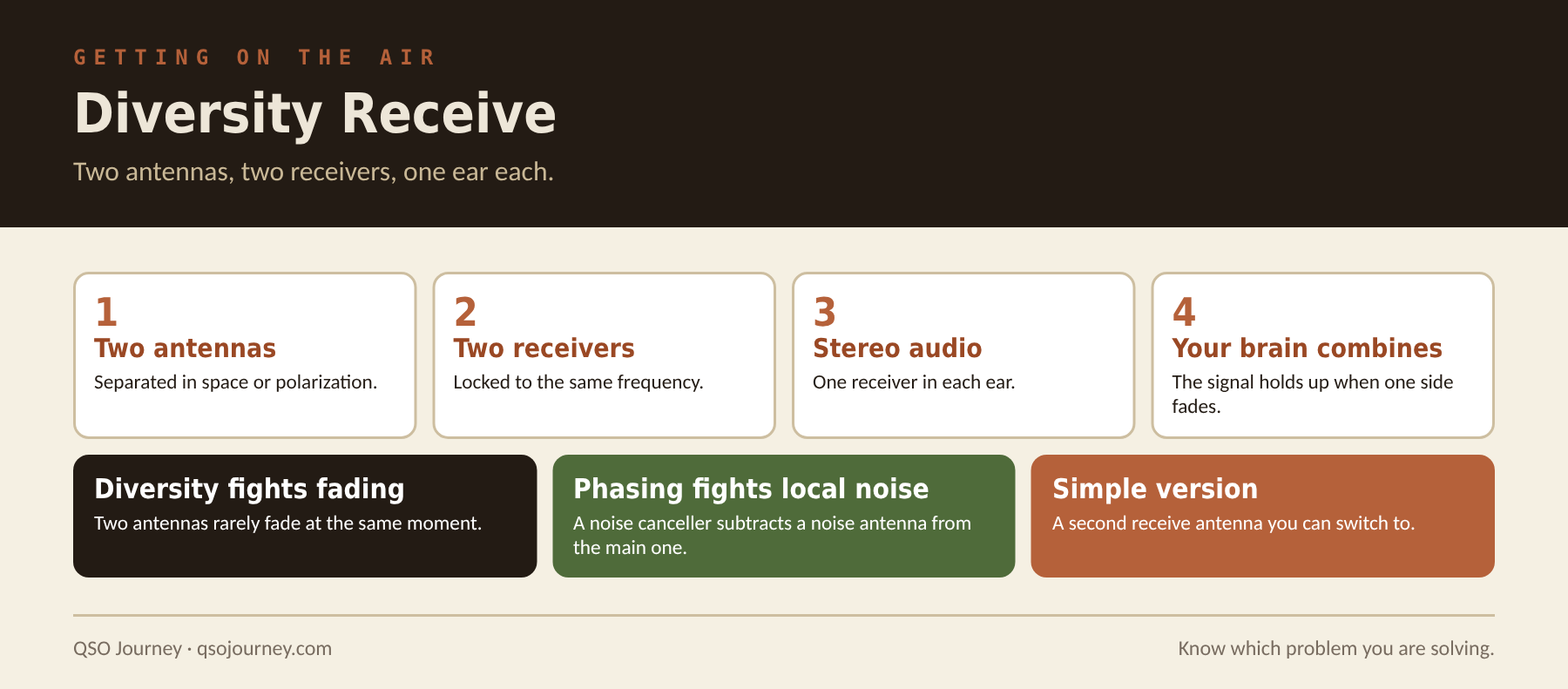
Signals arriving by ionospheric propagation fade constantly, and two antennas separated by a few wavelengths, or set up with different polarizations, rarely fade at the same moment. A diversity setup feeds each antenna to its own receiver, both locked to the same frequency, and sends one receiver to each ear through stereo headphones. Your brain combines the two, so when the signal drops out in one ear it is often still readable in the other. Diversity mostly fights fading. Local noise is a different problem, and the usual tool for it is a phasing noise canceller, which takes a dedicated noise antenna and subtracts what it hears from your main antenna.
What It Actually Takes
A genuine diversity receive setup needs two separate antennas, ideally with some real physical or polarization separation between them, feeding two receivers that stay locked to the same frequency, such as the two identical receivers in an Icom IC-7610, which has a dedicated diversity mode, plus stereo headphones to hear both at once. This is meaningfully more setup than most casual stations run, which is why diversity receive remains mostly a serious DXer and contester technique rather than something typical home stations bother with.
Simpler Approximations
You do not need a full dual-receiver diversity rig to get some benefit from this concept. Simply having a second, differently oriented or positioned receive antenna that you can quickly switch to when a signal is buried in noise gives you a manual, lower-tech version of the same benefit: comparing what two different antennas hear and picking whichever copy is cleaner.
Is It Worth Building
If you are chasing weak DX regularly and your noise floor is a limiting factor, even a simple secondary receive antenna, like a low-noise loop or a Beverage-style wire, that you can switch to for comparison purposes, delivers real practical benefit without the complexity of a full simultaneous diversity setup. It is a technique worth knowing about even if you never build the full version.