
Part of our New Ham? This Is Where You Should Spend Your Money guide.
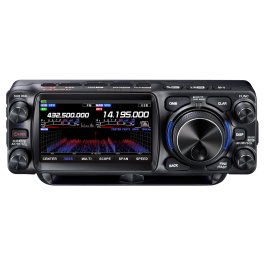
Hams had been asking Yaesu for a modern successor to the FT-817/818 for years, and the FTX-1 series, released in 2025, is the answer, though it arrived as something more ambitious than a simple update. Instead of one radio, Yaesu built a modular system: a compact “Field Head” that works alone as a QRP portable radio, and an “Optima” configuration that docks a 100W amplifier onto that same head to create a full base station. Same radio, two very different roles depending on what’s attached to the back.
The shared core
- Full coverage from 160m through 70cm, HF, 6m, 2m, and 70cm in one radio
- All mode: SSB, CW, AM, FM, plus Yaesu’s C4FM digital voice
- True dual independent receive, you can monitor two things at once, including two C4FM signals simultaneously
- 4.3″ full-color touchscreen with 3D Spectrum Stream (3DSS) for real-time band visualization
- Field Head dimensions: 8.4 x 3.5 x 2.2 in.
Field configuration
On its own, the Field Head runs on a 6400mAh Li-ion battery, putting out 6W (5W QRP mode), about 9 hours of SSB operation or 8 hours of FM on a charge, based on Yaesu’s typical duty-cycle numbers. Plug into external 13.8V DC instead and you can push it to 10W. For a SOTA or POTA activation, this is a genuinely modern package: touchscreen spectrum display to find activity fast, dual RX for working split or monitoring a second band, and USB-C charging support. It’s noticeably more capable than the old FT-817/818 it replaces, at the cost of being a larger, pricier unit.
Optima configuration
Attach the SPA-1 100W power amplifier to the back of the Field Head (no tools required) and the same radio becomes a full-power station transceiver, with a built-in automatic antenna tuner riding along in the amplifier module. This is the part that makes the FTX-1 concept interesting: you’re not buying a separate portable radio and a separate base radio. You’re buying one radio and deciding, day to day, whether to run it light or run it at full power.
In the shack
Set up as an Optima on the desk, it functions as a legitimate 100W base station: automatic tuner included, full mode coverage, and the same touchscreen spectrum display you’d get on a dedicated base radio. It won’t out-muscle a purpose-built flagship base transceiver in receiver dynamic range, but for someone who wants a single radio that goes from the shack to a summit without swapping equipment, it’s a compelling pitch.
Worth knowing before you buy
- Pricing is a real commitment: Field alone runs around $1,500 (street price closer to $1,340), the Optima bundle around $1,900, and the SPA-1 amp sold separately is about $650 if you start with Field and upgrade later
- The amp docks directly onto the head. There’s no remote-mounting the amplifier separately from the control head, which matters if you were hoping to install it mobile with the head on the dash and the amp elsewhere
- The modularity is genuinely useful if you’re not sure yet whether you want a QRP field radio or a full base station. You can start with Field and add the SPA-1 later without buying a second radio
Bottom line
The FTX-1 is built for operators who genuinely move between the field and the shack and don’t want to own or learn two different radios to do it. It’s not cheap, and the fixed head-to-amp docking limits some mobile installation options, but as a single system that scales from a 6W summit activation to a 100W desk station, it’s one of the more interesting radio designs to come out in a while.