
The whole point of documenting a communications plan is that it has to work without you. If you’re the only person who can explain the frequency list, the schedule, and the fallback plan, you’re a single point of failure, not a planner. Here’s what an actual usable document contains.
Keep it to one page if you possibly can
A comms plan that’s five pages long will get skimmed once and never looked at again. A single page, laminated, that fits in a bug-out bag or a glovebox gets actually used. If you need more detail for your own reference, keep an expanded version for yourself and distribute the condensed one-pager to everyone else.
What belongs on it
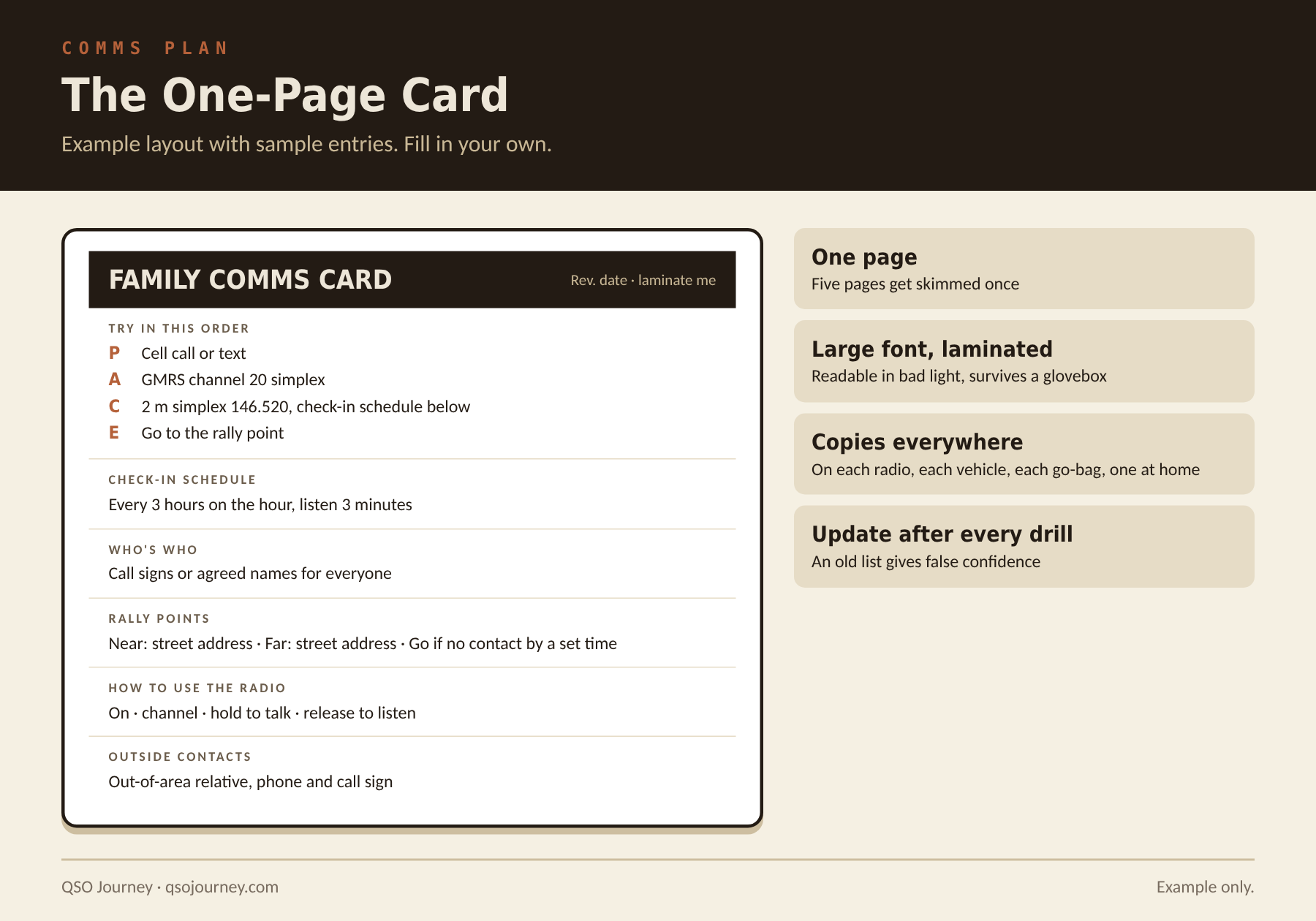
- The channel and frequency list, in priority order. Which GMRS channel to try first, which ham simplex frequency second, and so on, matching your PACE structure
- The check-in schedule. Exact times, exact duration, in a format nobody has to do math to understand, like the 3-3-3 Radio Plan’s “every 3 hours, for 3 minutes” structure
- Call signs or agreed identifiers for everyone in the group, so people know who they’re hearing on the air
- The rally point and the condition under which people should head there instead of continuing to try radio contact
- Basic operating instructions in plain language for anyone who isn’t a radio hobbyist: how to turn the radio on, how to change channels, how to key up
- Emergency contact info for anyone outside the immediate group who might need to be reached or who might relay information
Here is one example of how that can fit on a single page. The entries are placeholders, so swap in your own channels, frequencies, names, and rally points.
Format matters more than people expect
Laminate it. Paper degrades, gets wet, and gets lost. A laminated card survives being in a glovebox, a go-bag, or a jacket pocket for years. Use a large, legible font, someone reading this under stress or in poor light shouldn’t have to squint at 8-point text to find the right frequency.
Where to keep copies
- One with each radio itself, taped or zip-tied to the case so it’s never separated from the device it applies to
- One in each vehicle
- One in each bug-out bag or go-bag
- One posted somewhere central at home, like inside a cabinet door near the shack
Keep it current
An outdated frequency list is arguably worse than no list, because it creates false confidence. Revisit the document every time you run a drill, covered in Training Your Family or Group on the Communications Plan, and update it immediately if anything changes: a new radio, a changed rally point, a group member who’s no longer part of the plan.
For the structural pieces that go into this document, see The Key Parts of a SHTF Communications Plan. For the bigger picture, see my Emergency Communications and Preparedness pillar page.