
Part of our Handheld Radios (HTs) guide.
GMRS radios range from twenty dollar blister-pack pairs to mobile rigs that push 50 watts into a roof-mounted antenna. Most people don’t need the top of that range, and a lot of people buy the wrong end of it. Here’s how to think about it based on what you’re actually doing.
Handheld GMRS for families and hikes
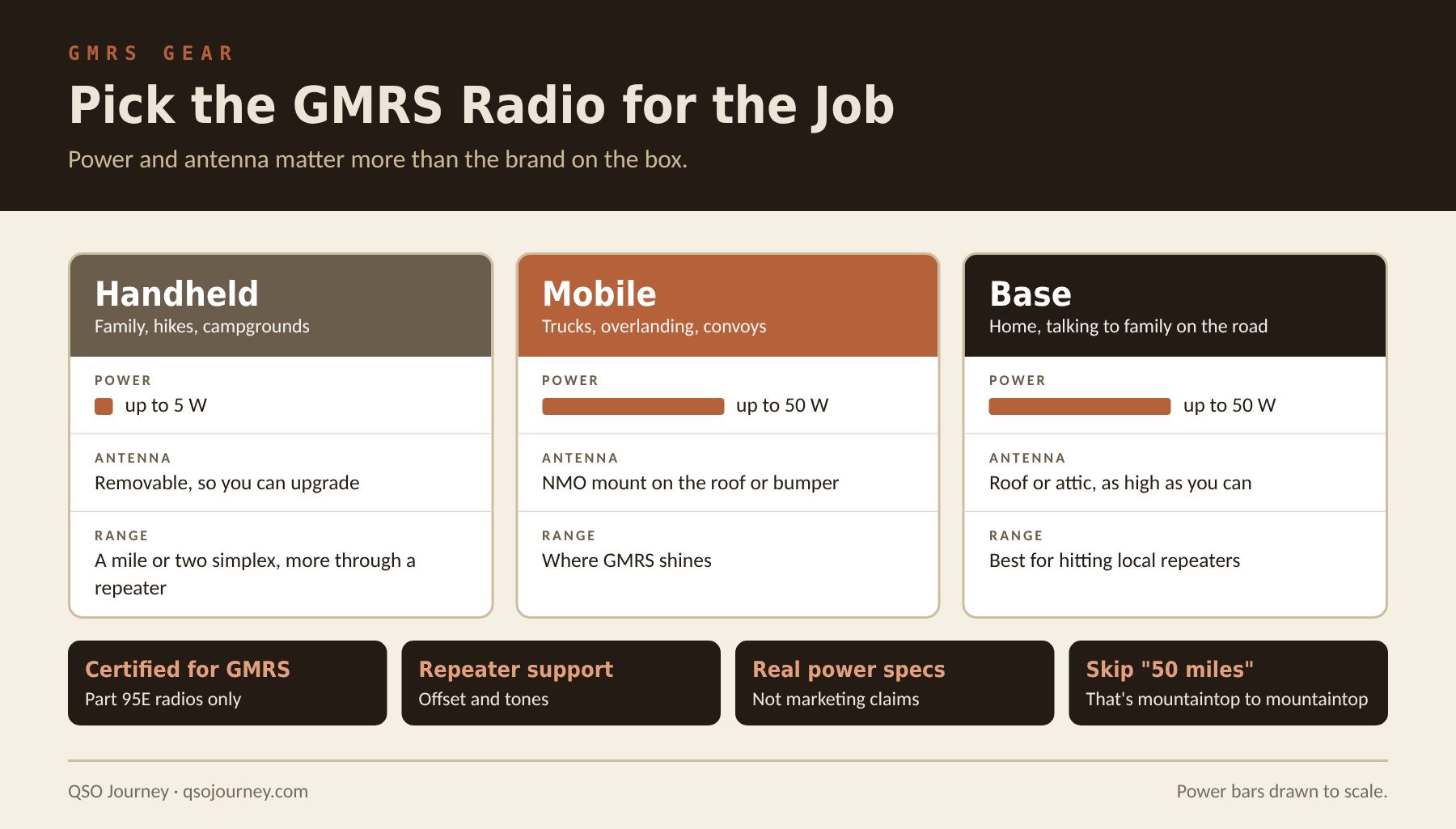
For general family use, campgrounds, and keeping track of kids, you want a handheld that’s simple to operate, has decent battery life, and doesn’t require a manual to change channels. Look for models with a real display, repeater channel support, and a removable antenna so you can upgrade it later. Skip anything that only comes with a fixed rubber duck antenna if you care about range at all.
Mobile GMRS for overlanding and trucks
This is where GMRS actually shines. A mobile radio mounted in a vehicle, running real power (25 to 50 watts) into a roof-mounted or bumper-mounted antenna, will vastly outperform any handheld. For overlanding groups and off-road caravans, a mobile unit is the difference between reliable convoy comms and constantly repeating yourself over static. Pair it with a simple NMO-mount antenna and you’ll cover far more ground than a handheld ever will.
Base station GMRS at home
If you want to talk to family members out running errands or coordinate from a home base, a mobile radio with a power supply and a roof or attic-mounted antenna works as a fixed base station. This is worth doing if you’re regularly using local GMRS repeaters, since a proper base antenna will outperform any handheld trying to hit the same repeater from inside a house.
What actually matters when you’re shopping
- Repeater capability with offset and tone support, not just simplex channels
- A removable antenna connector on handhelds (SMA is common) so you can upgrade later
- Real transmit power specs, not marketing numbers. Many cheap handhelds claim 5 watts and deliver a fraction of that
- Battery life and charging options if you’re using it away from power for a full day
One more thing to check before you buy: the radio has to be certified for GMRS under Part 95, Subpart E. A dual-band ham handheld that happens to tune 462 MHz is not legal to transmit on GMRS, even with a GMRS license, because it is not type-accepted for the service. Dedicated GMRS radios list the certification on the box or in the FCC ID database, and many of them are locked to the GMRS channels so there is nothing to get wrong. If you also have a ham license, plan on two radios, or a ham radio for the ham bands and a certified GMRS radio for the family channel.
What to skip
Skip bundles that advertise absurd ranges like “up to 50 miles.” That number assumes perfect line of sight between mountaintops, not real-world use. Skip radios with no repeater support if you’ll ever want the extended range a local repeater provides, which I cover in Finding and Programming GMRS Repeaters in Your Area.
Still figuring out your first radio purchase in general? My New Ham? This Is Where You Should Spend Your Money pillar page covers the bigger picture across every service, not just GMRS.
For antenna upgrades, see GMRS Antennas: What Actually Improves Your Range, and for repeater use once you’re set up, Finding and Programming GMRS Repeaters.