
Part of our Building Your First Ham Radio Station guide.
Every antenna, radio, and accessory in this hobby eventually needs a connector, and the four you will run into constantly, SO-239/PL-259, BNC, SMA, and N-type, each have their own strengths, weaknesses, and typical use cases. Picking the right one for the job matters just as much as picking good coax in the first place.
SO-239 and PL-259: the HF standard
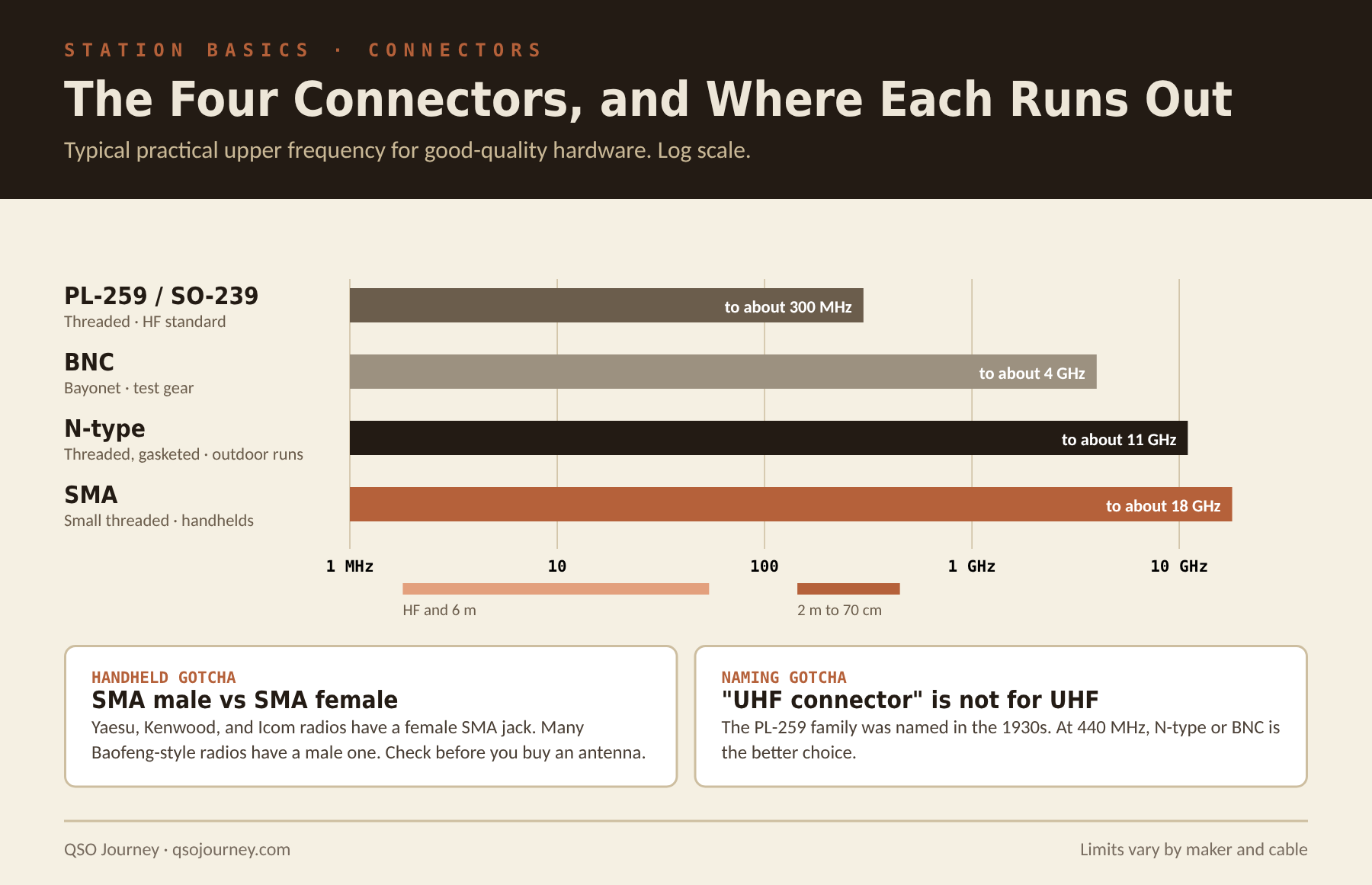
The SO-239 (the panel-mount jack) and PL-259 (the cable-mount plug) pairing is the de facto standard on most HF and many VHF radios, tuners, and antenna switches. It is a threaded, non-constant-impedance connector, meaning its actual impedance varies slightly along its length rather than holding a precise 50 ohms throughout, which matters very little at HF frequencies but becomes a real limitation well up into VHF and beyond. It is large, mechanically rugged, and easy to solder or crimp even with basic tools, which is exactly why it has stuck around for decades despite better-performing alternatives existing at higher frequencies. Confusingly, this family is often sold as the “UHF connector,” a name that dates to the 1930s when anything above about 30 MHz counted as ultra high frequency. It is not a good choice for today’s 70 centimeter band.
BNC: quick-connect for test gear and handhelds
BNC uses a quarter-turn bayonet locking mechanism instead of threads, letting you connect or disconnect with a quick twist rather than screwing anything down. This makes it popular on test equipment, some handheld radios, and antenna analyzers, anywhere fast, frequent connect-and-disconnect cycles matter more than the absolute most robust weatherproof seal. It performs well up through VHF and UHF and is a genuine constant-impedance design at 50 ohms, though the connector itself is more delicate than an SO-239 and less tolerant of repeated rough handling in the field.
SMA: small, common on handhelds, easy to damage
SMA is the tiny threaded connector found on the vast majority of modern handheld radios, and it performs well into the microwave range, well beyond what most hams will ever need. Its small size is both its main advantage, letting it fit on compact handhelds, and its main weakness, since the connector’s fine threads and small center pin are genuinely easy to damage through cross-threading or repeated rough antenna swaps. The confusion that trips up more new hams than any other is gender. Yaesu, Kenwood, and Icom handhelds have a female SMA jack on the radio, so their antennas are SMA-male, while many Baofeng-style radios have a male SMA jack and take SMA-female antennas. An antenna listed simply as “SMA” may not fit your radio at all, so match the gender, not just the name. Reverse-polarity SMA, with the center pin arrangement swapped, also exists, but you will mostly see it on Wi-Fi and other unlicensed consumer gear rather than ham radios.
N-type: the serious weatherproof choice
N-type connectors are threaded, genuinely constant-impedance at 50 ohms, and built for excellent performance well into the microwave range, with a weatherproof design that holds up far better outdoors than an SO-239 does over the long term. This makes them the preferred choice for permanent outdoor installations, especially anything running VHF, UHF, or higher, where connector loss and weather resistance both matter more than they do at HF. They are bulkier and more expensive than SO-239 hardware, which is largely why HF gear has stuck with the older standard despite N-type’s better technical performance.
Picking the right one, and adapting between them
- HF base and mobile gear: SO-239/PL-259 remains the practical default, matching what nearly every HF radio and tuner already uses.
- Handhelds: SMA-male or SMA-female, matching whatever your specific radio actually uses, check before ordering a new antenna.
- Test equipment and quick-swap setups: BNC, for the fast connect cycle.
- Permanent outdoor VHF/UHF runs: N-type, for the weatherproofing and lower loss at higher frequencies.
Adapters exist between every one of these, and keeping a small assortment on hand, SO-239 to BNC, SMA to N-type, and so on, saves a frustrating trip mid-project when two pieces of gear simply do not speak the same connector language.
Installing connectors that last
Most connector problems are installation problems. Use a connector made for your exact cable, since an RG-8X plug will not seat properly on LMR-400, and either crimp it with the matching die or solder the shield through the plug’s holes with enough heat to flow the solder without melting the dielectric. Check every new cable with a meter for a short between center and shield before it goes into service. Outdoors, seal the joint with self-fusing tape topped with a layer of good electrical tape, and avoid stacking several adapters on a radio jack, since each one adds a little loss and a lot of leverage on a connector that was never meant to carry that weight.