

Part of our Building Your First Ham Radio Station guide.
An HOA restriction feels like a dead end the first time you read it, no visible antennas, no towers, nothing above the fence line. In practice, plenty of hams operate perfectly functional HF stations from exactly these neighborhoods, because the restriction is usually about visibility and appearance, not about whether radio waves are physically allowed to leave your property. The trick is picking antennas that either hide in plain sight or do not trigger the restriction at all. If you want to understand what legal protections actually exist here, see my article on PRB-1 and local antenna ordinances.
Attic antennas
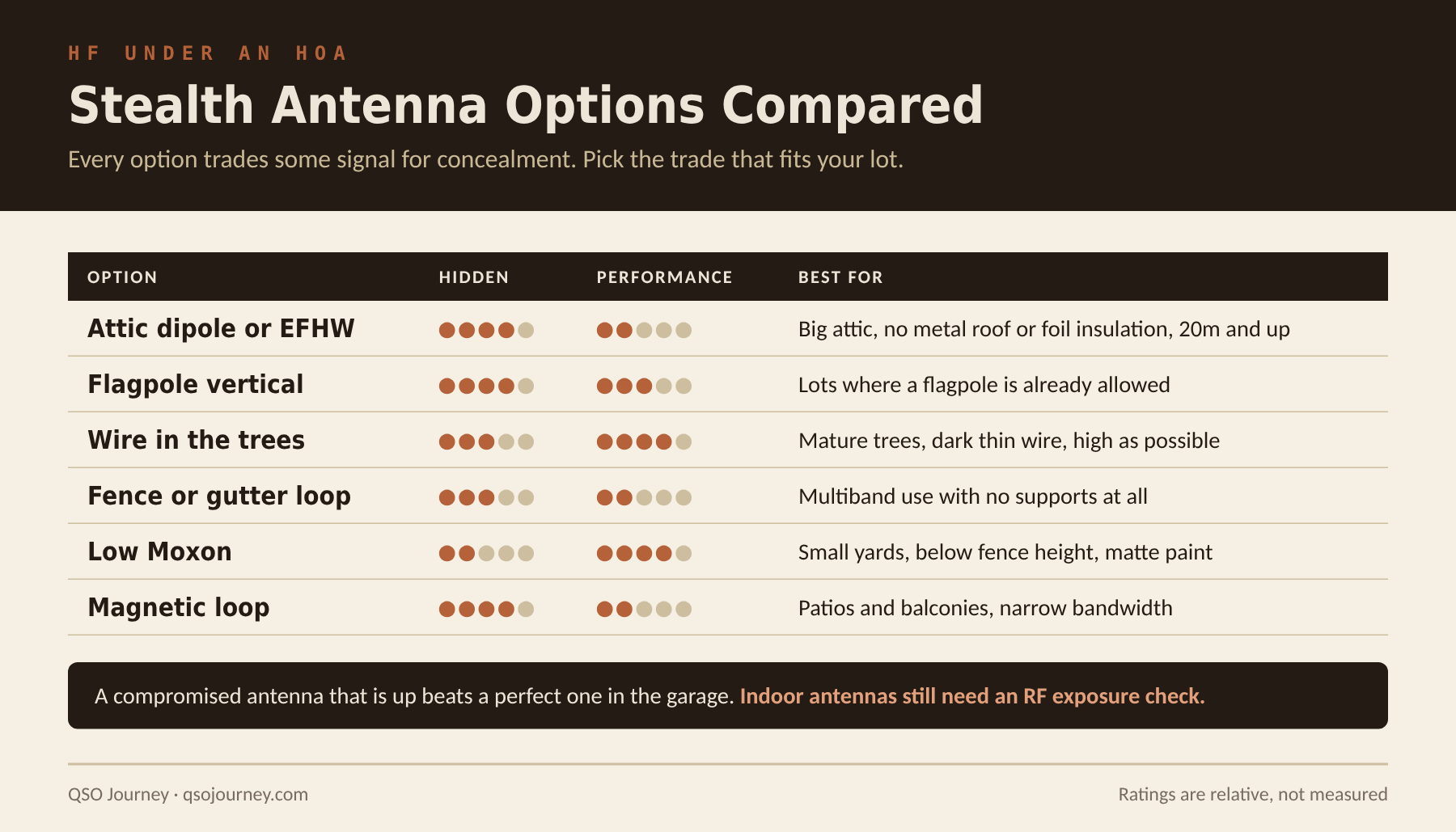
If your attic is large enough, running a wire dipole or an EFHW up in the rafters is one of the most complete stealth solutions available, since nothing at all is visible from outside the house. The tradeoffs are real: a roof, especially one with metal flashing, foil-backed insulation, or a metal roof itself, will absorb and detune your signal to some degree, and the available physical space in most attics limits you to higher bands like 20 meters and up rather than a full-size 80 meter antenna. Even a compromised attic antenna, though, will usually outperform no antenna at all, and many hams run one successfully for years without a neighbor ever knowing it exists.
Flagpole and other disguised verticals
A vertical antenna built inside a fiberglass flagpole shell looks exactly like a flagpole, and a genuine American flag flying from it only helps the disguise. Commercial products exist specifically for this purpose, and DIY versions built around a fiberglass tube are common in the stealth-antenna community. This approach works especially well because flagpoles are frequently exempted or treated more favorably than communications equipment in HOA rules written before amateur radio was ever considered.
Moxon antennas and other compact directional options
A Moxon antenna packs real directional gain into a surprisingly small footprint, roughly 70 percent the size of an equivalent two-element Yagi for the same band, which makes it a genuinely practical option for a small yard or a compact rotatable mount that stays below fence height. Painting the elements a flat, matte color that blends with the sky, rather than shiny aluminum, does a lot to reduce how noticeable it is even when technically visible above a fence line.
Wire in the trees
A thin wire antenna strung between trees, or from a tree to the house at a low angle, is remarkably difficult for anyone to notice unless they are specifically looking for it. Using dark colored wire, keeping it as high as your trees allow, and routing it to avoid crossing directly over a neighbor’s obvious sightline all help. This is essentially the same approach a lot of portable operators already use for EFHW deployments at a park, just made semi-permanent in a backyard setting.
Loop antennas along a fence or gutter line
A full-wave horizontal loop, run at low height along the top of a fence or tucked just inside a gutter line, is another option that hides well while still providing a genuinely usable multi-band antenna. It will not be as efficient as the same loop mounted high in the clear, but a compromised loop that is actually up and usable beats a perfect antenna sitting in a box in the garage because you never installed it.
Small magnetic loops on a patio or balcony
When there is no attic, no trees, and no fence line to work with, a small transmitting magnetic loop is often the last real option. A loop a few feet across can sit on a patio table and be brought out only while you operate, which sidesteps most rules about permanent structures entirely. The tradeoffs are a very narrow bandwidth that needs retuning every time you move more than a few kilohertz, modest power limits, and high voltage across the tuning capacitor, but a well-built loop performs far better than its size suggests.
Do not skip the RF exposure check
Stealth antennas tend to end up close to people, inside an attic directly above a bedroom, on a balcony a few feet from a sliding door, or along a fence beside the neighbor’s patio. That makes the RF exposure evaluation every station needs more important here, not less. Running modest power, remembering that full duty cycle modes like FT8 put out far more average power than SSB or CW at the same setting, and keeping the radiating part of the antenna as far from living spaces as you can are all simple ways to stay comfortably inside the limits.
A realistic mindset going in
Every option here trades some performance for concealment, and that is simply the cost of operating under real restrictions. The goal is not matching a full-size tower and beam, it is getting a genuinely workable signal on the air within the constraints you actually have, and every one of these approaches has put plenty of hams on the air from neighborhoods that looked, on paper, completely impossible to operate from.