
Part of our Emergency Communications and Preparedness guide.
If you’ve ever asked about joining ARES, volunteering with CERT, or helping at an emergency operations center, someone probably handed you a list of FEMA course numbers. IS-100, IS-200, IS-700, IS-800. It looks like bureaucratic alphabet soup, and plenty of hams skip it. I think that’s a mistake. These courses are free, you can do them from your couch, and they’re the price of admission if you want a served agency to actually use you.
This guide is written for the brand-new ham (or the not-yet-licensed prepper) who has never touched FEMA training. I’ll explain what ICS is, what each course covers, which ones you need, and link you straight to every course and exam.
First, What Is ICS?
The Incident Command System (ICS) is a standard way to organize people at an emergency. It was born out of California wildfires in the 1970s, when fire crews from different departments showed up to the same fire and couldn’t work together. Different radio terms, different titles, nobody sure who was in charge. ICS fixed that by giving everyone the same structure and the same vocabulary.
If you’ve ever checked into a directed net, you already understand the idea. Net control runs the frequency, stations check in, traffic goes through one person, and nobody talks over each other. ICS is that same discipline applied to an entire incident. A few core ideas show up over and over:
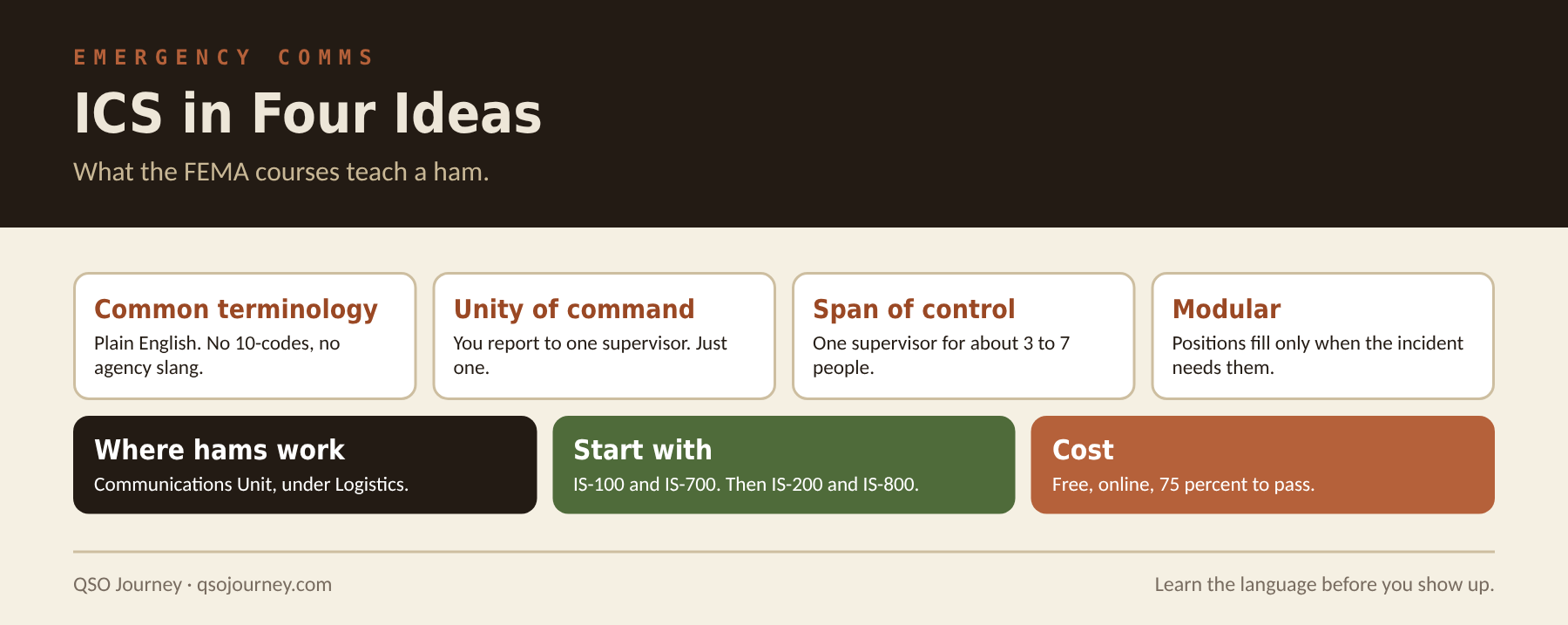
- Common terminology. Plain English, no 10-codes, no agency slang. Every agency uses the same names for the same jobs.
- Unity of command. You report to one supervisor. Just one.
- Span of control. One supervisor manages roughly 3 to 7 people. When it grows past that, the organization splits.
- Modular and scalable. A fender bender might be one Incident Commander and nothing else. A hurricane fills out the whole chart. Positions only get filled when they’re needed.
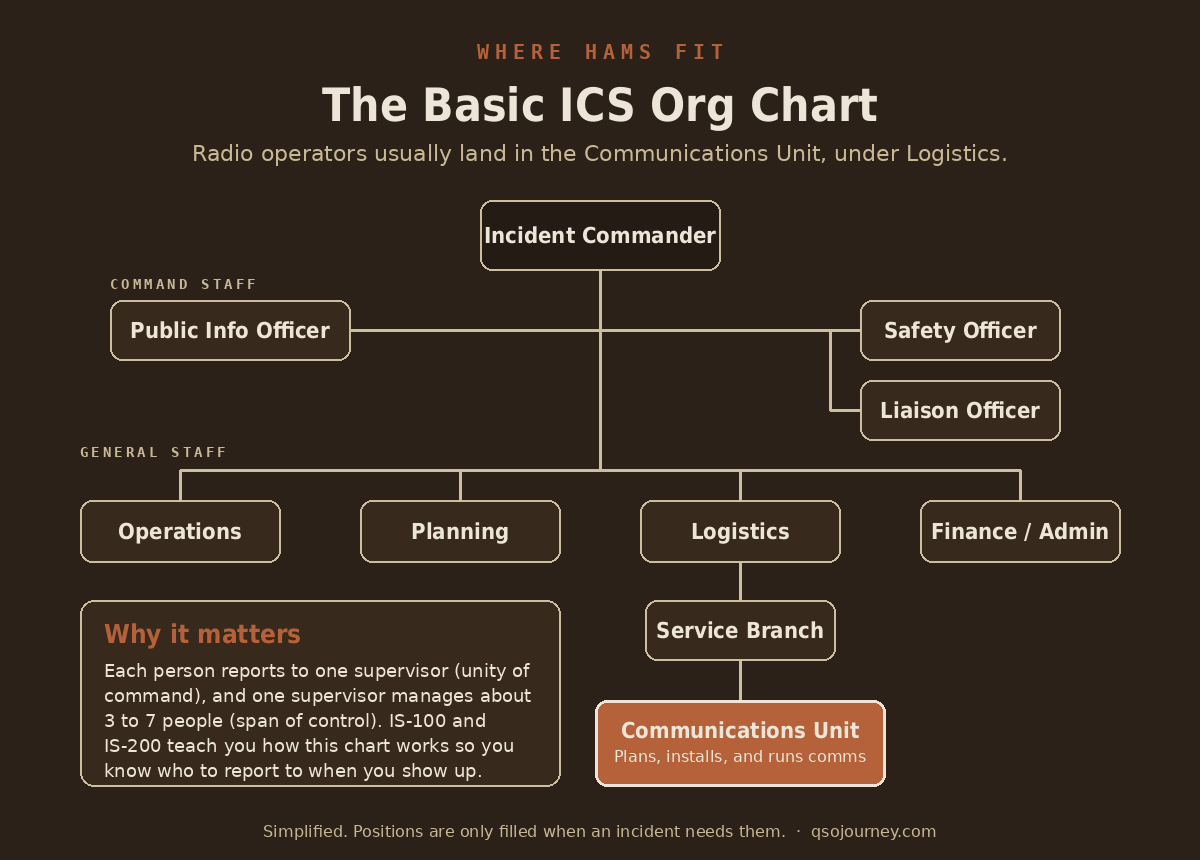
For hams, the box that matters most is the Communications Unit. It lives in the Logistics Section, and it’s responsible for planning, installing, and running the radios and networks for the incident. When an ARES or RACES operator gets deployed, that’s usually who they work for. The courses below teach you how that chart works so you know where you fit when you walk in the door.
Why Served Agencies Ask for Them
Every government agency that responds to emergencies in the US is supposed to use the same system, ICS, under the National Incident Management System (NIMS). Agencies that take federal preparedness money have to stay NIMS compliant, and that flows down to the volunteers they bring inside the tape.
The practical reason is simpler. When you show up at a command post, the people running it speak ICS. They’ll tell you who your supervisor is, ask for your resource status, and hand you an ICS-213. If you don’t know the language, you’re a liability, no matter how good your station is. Some groups simply won’t deploy an operator who hasn’t finished the courses.
The Four Courses at a Glance
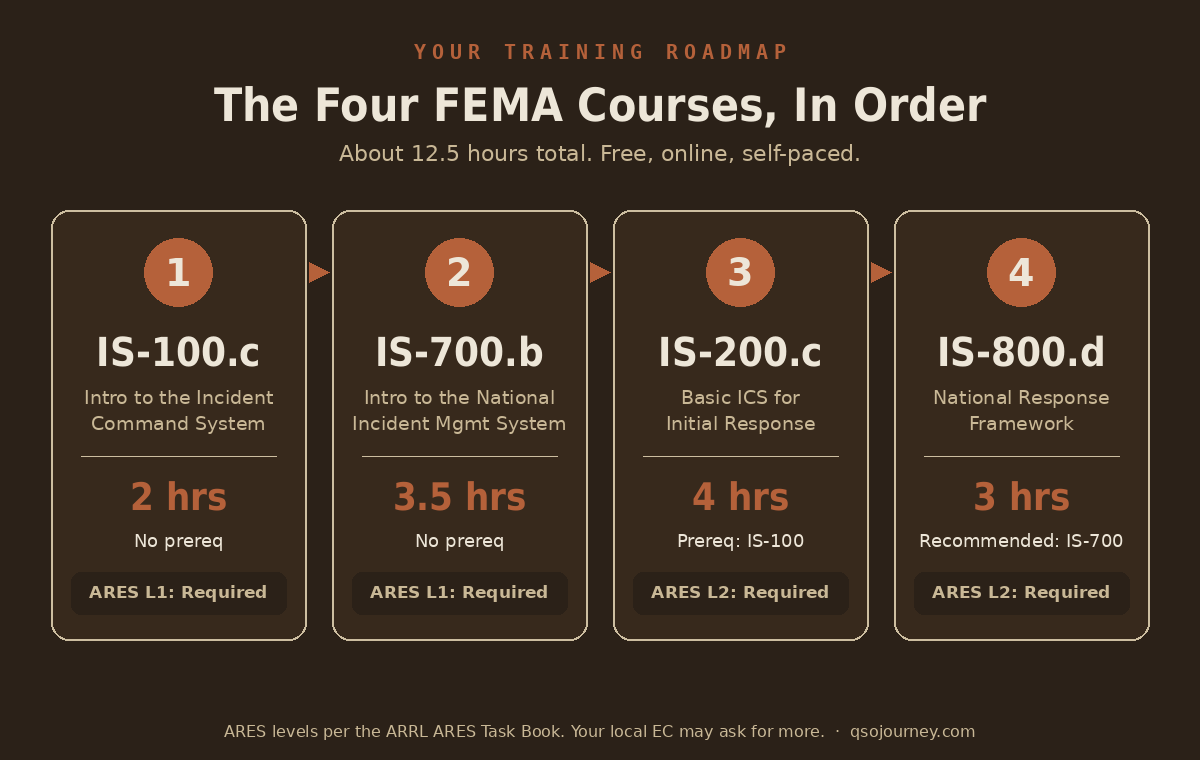
Every course has two parts: the course itself (an interactive web lesson, free and open to anyone) and the final exam (which needs a FEMA SID, more on that below). Here are the direct links to both.
| Course | Length | Prereq | Course page | Final exam |
|---|---|---|---|---|
| IS-100.c Intro to ICS | 2 hrs | None | Course page | Take the exam |
| IS-700.b Intro to NIMS | 3.5 hrs | None | Course page | Take the exam |
| IS-200.c Basic ICS for Initial Response | 4 hrs | IS-100 | Course page | Take the exam |
| IS-800.d National Response Framework | 3 hrs | IS-700 recommended | Course page | Take the exam |
The Four Courses, in Plain English
IS-100.c: Introduction to the Incident Command System
This is the one everyone needs, and the one to start with. It covers the history of ICS, the basic org chart, what the Incident Commander and command staff do, and the management principles (like unity of command and span of control) that hold it all together. No prerequisites, about two hours.
Why it matters to a ham: it teaches you the vocabulary. After IS-100, “report to the Comms Unit Leader in Logistics” actually means something.
Start the IS-100.c web course · Course page · Final exam
IS-700.b: An Introduction to the National Incident Management System
NIMS is the bigger framework that ICS lives inside. This course explains how governments, nonprofits, and private companies coordinate during an incident, how resources get requested and tracked, how emergency operations centers (EOCs) work, and how incident information gets shared. It even has a section on communications and information systems. No prerequisites, about three and a half hours.
Why it matters to a ham: a lot of ham deployments are at an EOC, not a field command post. IS-700 is where you learn what an EOC is and how it connects to everything else.
Start the IS-700.b web course · Course page · Final exam
IS-200.c: Basic ICS for Initial Response
This picks up where IS-100 leaves off and is aimed at people who’ll work inside an incident, possibly as a supervisor. It covers delegation of authority, management by objectives, the different types of briefings, how the org chart flexes as an incident grows, and how command gets handed off from one person to another. IS-100 is a prerequisite, and it runs about four hours, the longest of the four.
Why it matters to a ham: if you ever lead a small team of operators or run a shelter station, you’re a supervisor in ICS terms. This is the course that prepares you for it.
Start the IS-200.c web course · Course page · Final exam
IS-800.d: National Response Framework, An Introduction
This one zooms all the way out to how the whole country responds to a major disaster: who does what at the local, state, tribal, and federal level, the core capabilities, and the Emergency Support Functions (ESFs). Communications is ESF #2, which is where hams fit in the national picture. IS-700 is recommended first, and it runs about three hours.
Heads up: when I checked in November 2026, FEMA had a notice saying the IS-800.d online course is temporarily unavailable. Their workaround is to read the National Response Framework document and then take the online exam. The exam link still works. Check the course page for the current status.
FEMA updates these courses periodically and adds a version letter to the course number (the “.c” in IS-100.c), so always take the current version. If you already finished an older version, check with your EC before retaking it. FEMA says IS-200.c is equivalent to the older versions for credentialing purposes.
Which Ones Actually Matter
The ARRL’s ARES Task Book is a good guide. At Level 1, IS-100 and IS-700 are required, with IS-200 and IS-800 encouraged. At Level 2, all four are required, and IS-802 (ESF #2, Communications) is encouraged. Level 3 adds a long list of leadership and planning courses, with ICS-300, ICS-400, and AUXCOMM encouraged.
My advice: do IS-100 and IS-700 now, even if you never plan to join ARES. They make you a better net control operator and a better member of any group comms plan. If you want to deploy with a served agency, finish IS-200 and IS-800 too. Check with your local emergency coordinator, because some counties ask for more.
How to Take Them, Step by Step
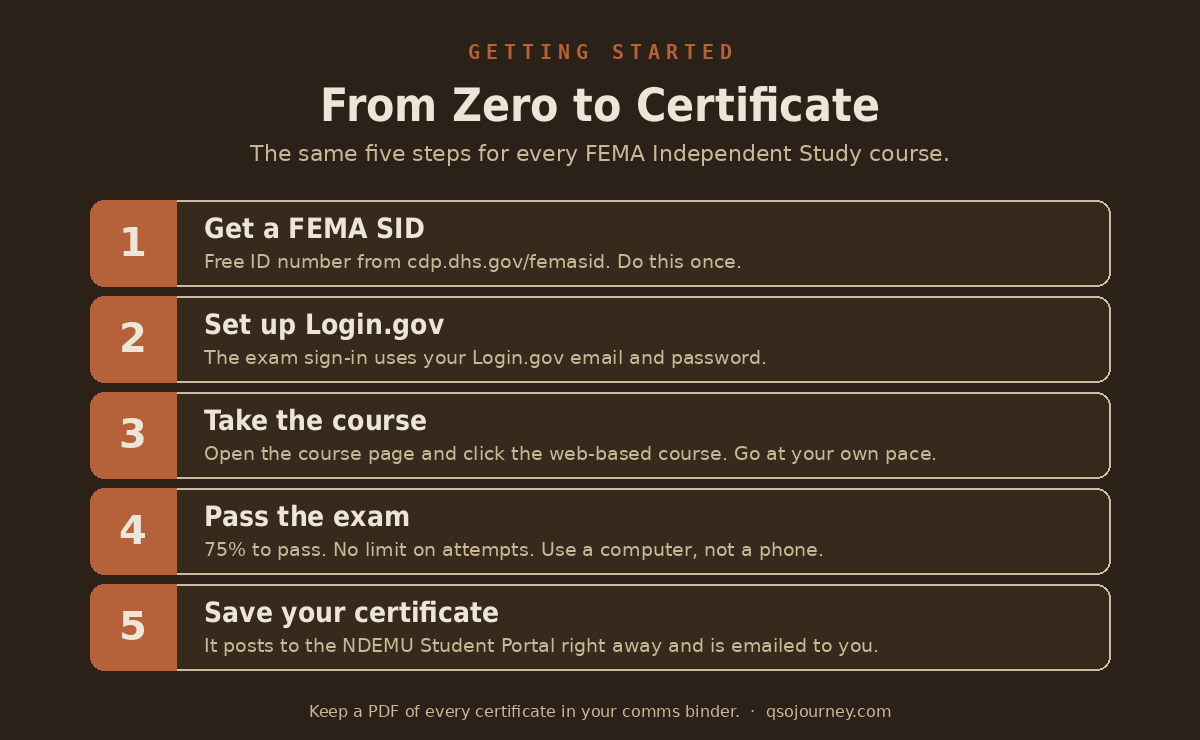
- Get a FEMA Student Identification (SID) number. It’s free and you only do it once. Register for your FEMA SID here. Every exam asks for it, so write it down.
- Have a Login.gov account ready. The exams sign you in with the email and password from your Login.gov account. If you’ve used other federal sites, you may already have one.
- Take the course. Open the course page from the table above and click the interactive web-based course. You don’t need to sign in for this part, and you can stop and come back.
- Take the final exam. Click “Take Final Exam Online” on the course page (or use the exam links above). You need 75% to pass, and FEMA doesn’t limit how many times you can try. Questions are scrambled, and FEMA won’t show you your score or which questions you missed, so read each one carefully. Use a desktop or laptop. FEMA doesn’t recommend mobile devices.
- Grab your certificate. Once you pass, your record updates in the NDEMU Student Portal right away, and FEMA emails it to you too. You can also download an unofficial transcript showing all your completions in one PDF.
Tips for First-Timers
- One course per evening. Two to four hours each is very doable after work. Knock out all four in a week, or spread them over a month.
- Take notes on the terms. The exams lean heavily on vocabulary: titles, section names, and the management characteristics. A one-page cheat sheet you build yourself goes a long way.
- Skip the answer-key websites. They’re out there, and they defeat the whole point. FEMA treats cheating seriously, and a certificate you didn’t earn won’t help you at a real command post.
- Save everything. Download each certificate as a PDF, print a copy for your comms binder, and keep the transcript handy. Your EC will ask for them, and it beats digging through email later.
What Comes After the Big Four
Once you have the four basics, the natural next step for a ham is IS-802, which covers ESF #2 (Communications) in more depth. You can find it in FEMA’s Independent Study course list. Beyond that, ICS-300 and ICS-400 aren’t part of the Independent Study program. They’re instructor-led classes run by states and local agencies, and FEMA points people to their State Training Office to find one. Those, plus AUXCOMM training, are where you go if you want a leadership role in emergency communications.
Worth a Weekend
None of this makes you a better radio operator. It makes you a useful one. The agencies you want to help already have a system, and these courses teach you how to plug into it instead of standing around waiting to be told what to do. For more on how the volunteer side is organized, see ARES vs RACES and CERT and Amateur Radio.