
Part of our Getting On The Air guide.
You don’t need a license to start playing with software-defined radio, and you don’t need to spend much either. A $30 RTL-SDR dongle plugged into a laptop will pull in FM broadcast, airband, public safety, ADS-B aircraft tracking, and a chunk of the HF spectrum with the right upconverter. I get more questions about this than almost any other entry point into the hobby, so here’s what actually matters.
What RTL-SDR Actually Is
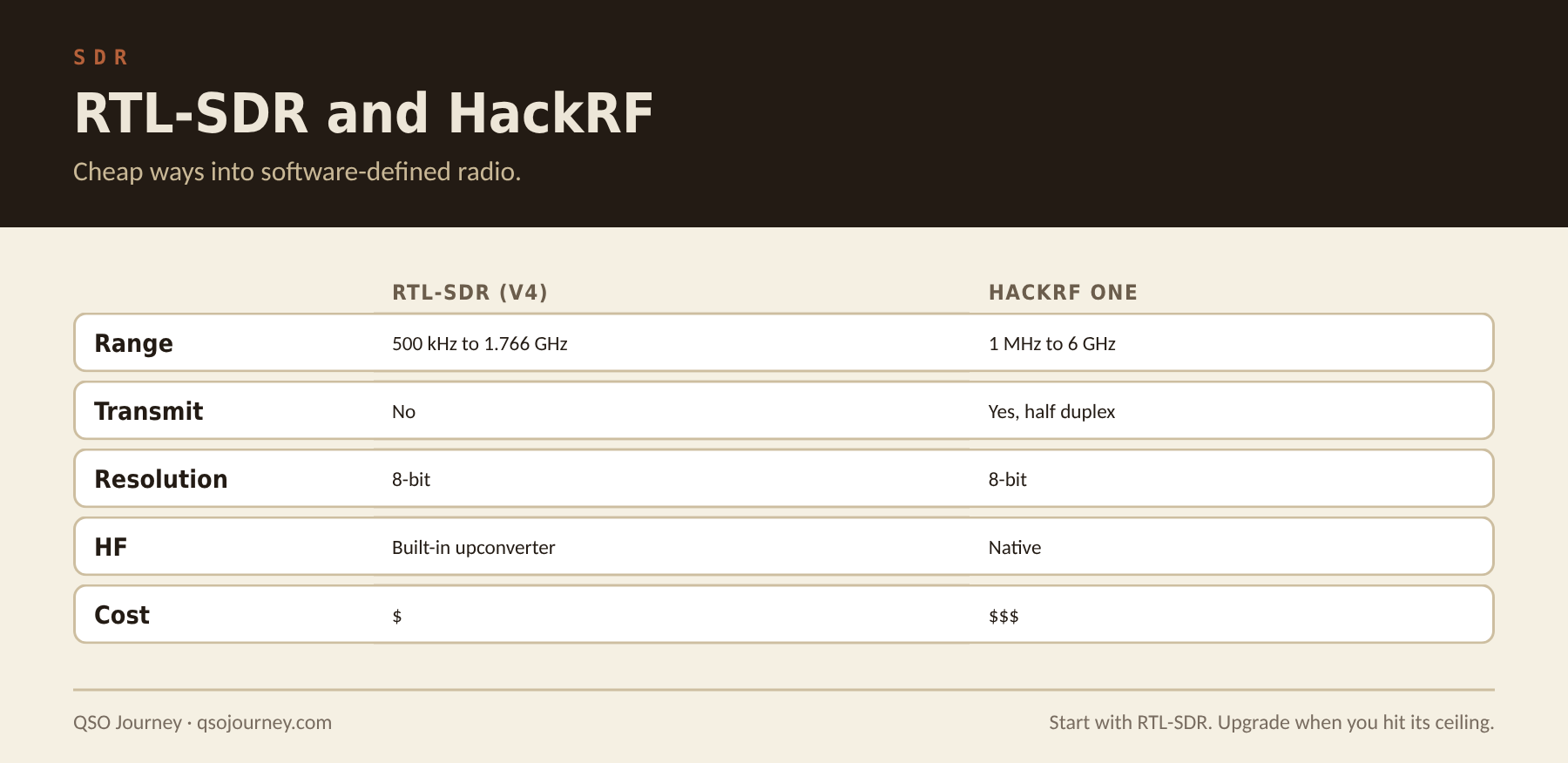
RTL-SDR started as a hack. People discovered that cheap USB TV tuner dongles built around the Realtek RTL2832U chip could be repurposed as wideband receivers by pulling raw I/Q samples off the chip instead of using it for TV. That accident turned into an entire ecosystem. Modern RTL-SDR dongles (buy from rtl-sdr.com or a reputable seller, not a random no-name tuner) cover roughly 500 kHz to 1.7 GHz depending on the model, with 8-bit resolution that’s fine for casual listening but limited for weak-signal work.
Where HackRF Fits In
HackRF One is a different class of tool. It’s a half-duplex transceiver covering 1 MHz to 6 GHz, and critically, it can transmit as well as receive. That makes it useful for protocol analysis, signal generation for testing, and exploring things RTL-SDR can’t touch. It costs roughly ten times as much as an RTL-SDR dongle, and for most new hams it’s overkill until you know exactly what you want to do with it. Start with RTL-SDR, and only move to HackRF once you’ve hit its ceiling. One caution: transmitting with a HackRF requires the right license for the frequency, and its raw output needs filtering before it is clean enough to put on the air, even on amateur bands.
Software That Actually Matters
SDR# (SDRSharp) is the standard starting point on Windows. SDR++ is cross-platform and actively developed, and it’s what I’d point a Mac or Linux user toward first. Both give you a waterfall display, mode selection (AM, FM, SSB, CW), and basic recording. For ADS-B aircraft tracking specifically, dump1090 or the Virtual Radar Server ecosystem is purpose-built and worth running alongside your general-coverage software.
What to Actually Expect
Set your expectations correctly. The stock antenna that ships with most RTL-SDR kits is mediocre, and a $15 upgrade to a proper telescoping whip or discone will do more for your results than any software tweak. Most RTL-SDR dongles use a tuner that starts around 24 MHz, so HF needs help: the RTL-SDR Blog V3 reaches HF through a direct sampling mode, the V4 adds a built-in upconverter, and generic dongles need an external upconverter. Even then, don’t expect DX-quality HF performance from an 8-bit receiver next to noisy USB electronics. Treat it as a wideband monitoring and learning tool, not a replacement for a real HF receiver.
Related reading: Fox Hunting in Ham Radio: How It Works, and How to Be Harder to Find · Ham Radio Apps and Software Worth Having, Phone and PC