

Part of our New Ham? This Is Where You Should Spend Your Money guide.
The Xiegu G90 has become one of the most common radios you’ll see at a POTA or SOTA activation, and after spending time with one, it’s not hard to understand why. It sits in a power niche most manufacturers ignore (more than a 5W QRP rig, less than a full 100W base radio) and backs that up with features that used to only show up on much pricier gear.
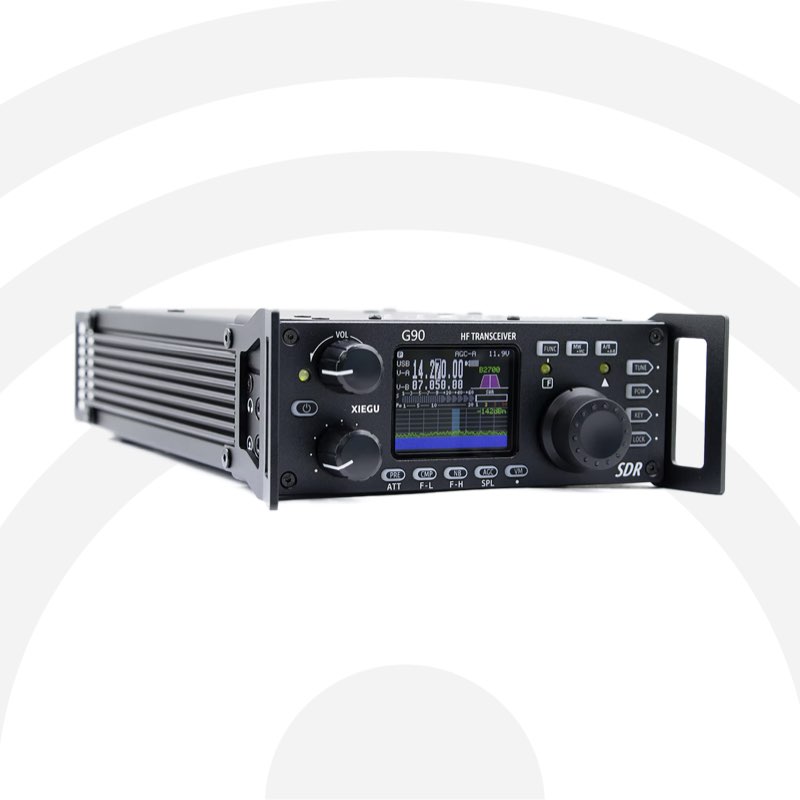
The basics
- 20W max output, general coverage RX and HF TX from 0.5-30 MHz
- SDR architecture with a 24-bit codec, color spectrum/waterfall display
- Built-in automatic antenna tuner, genuinely useful in the field
- Detachable front panel
- Compact: about 120 x 45 x 210mm
- No internal battery, runs from external 12V (battery pack or supply)
- Street price roughly $450-500
Why it works so well portable
Two things do most of the heavy lifting here. First, the built-in ATU means a random wire or an EFHW that’s slightly off resonance still loads up in seconds, no separate tuner to pack, no extra cable. Second, 20 watts is a genuinely good compromise: enough to punch through when 5W QRP would struggle, without the current draw that makes a 100W radio brutal on a small battery pack in the field. The waterfall display is also more useful than it sounds for portable ops. When you’ve got fifteen minutes on a summit before conditions change, being able to see activity across the band instead of tuning blind saves real time.
How it compares to the FT-891
These two get compared constantly, and the honest answer is that they’re built for slightly different priorities:
- Power: FT-891 wins outright, 100W vs 20W. That matters if you need to push through marginal conditions or want headroom for a future amplifier.
- Antenna tuner: G90 wins for convenience, it’s built in. The FT-891 needs an external unit, which is one more thing to pack and one more cable to run.
- Display: G90’s color waterfall is a real advantage for finding activity quickly; the FT-891’s display is more basic.
- Price: G90 is noticeably cheaper, roughly $450-500 vs about $650 for the FT-891.
- Receiver performance: The FT-891 generally has the edge in close-in dynamic range and handling strong adjacent signals, which shows up more in crowded contest conditions than casual POTA activating.
- Weight and current draw: G90 is lighter on battery consumption at full power, which adds up over a long activation.
Which one should you get?
If portable operating (POTA, SOTA, backpack trips) is your main use case and you want to travel as light as possible, the G90’s built-in tuner and lower power draw make it the more convenient choice, and it’s cheaper to boot. If you want one radio that also does double duty as a mobile or base rig with real headroom, or you plan to run it into an external amp someday, the FT-891’s extra power and slightly stronger receiver make it worth the added weight and the external tuner it needs. Plenty of operators end up owning both for exactly these reasons.