
Part of our Getting Licensed guide.
Those slash-marked additions to a callsign, /W, /VE, /4, and similar, look cryptic to a new ham but follow a consistent, logical system once you understand what each type is communicating.
Domestic Portable Designators: Operating From a Different Call Area
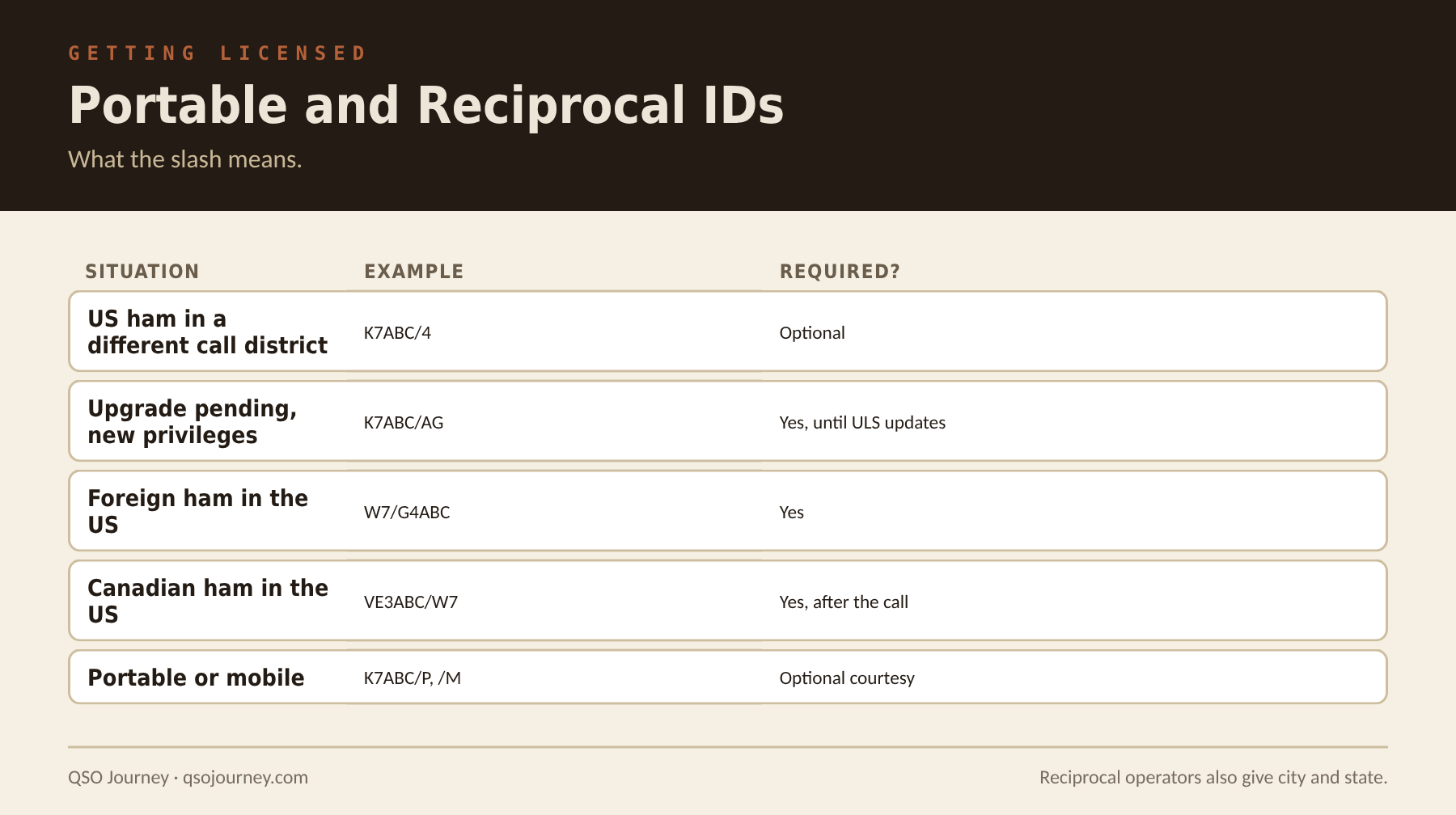
US callsigns include a call district number, but that number does not have to match where you are physically transmitting from, and a US ham operating from another call district is not required to sign anything extra. Many operators still choose to append /[district number], like /4 when operating from the 4th call district, as a courtesy that tells other stations where they actually are.
Reciprocal Operating Designators: /W, /VE, and Similar
When a foreign ham operates in the US under a reciprocal arrangement, Part 97 requires an indicator showing where the station is. For most countries it goes in front of the home call, so a British ham operating from Arizona signs W7/G4ABC. Canadian licensees put it after the call instead, so a Canadian ham in Arizona signs VE3ABC/W7. Reciprocal operators must also give their location by city and state at least once during each contact. US hams operating abroad follow the host country’s rules, which in Canada means signing your call followed by the Canadian prefix for the province, such as K7ABC/VE7.
Portable and Mobile Designators
Some operators append /P for portable operation or /M for mobile operation, communicating their operating style rather than their location specifically. These are more of a courtesy convention than a strict legal requirement in most cases, letting other stations know you are operating away from your normal fixed station.
When You Are Actually Required to Use One
Two situations actually require an indicator in the US. Reciprocal operators must use the location indicator described above. And when you upgrade and start using your new privileges before the FCC database shows your new class, you must add a temporary indicator after your call, /AG for a new General or /AE for a new Extra, until the upgrade appears in ULS. Domestic call district indicators and /P or /M remain optional.
Why This System Works Well
A consistent, widely understood designator system lets any ham anywhere in the world instantly understand something meaningful about where and under what authority you are operating, just from how you identify, without needing to explain the details verbally every single contact.
Related reading: Choosing a Vanity Call Sign: Rules, Costs, and How I Picked Mine · Callsign vs DMR ID vs APRS SSID: Untangling Your Identifiers