

Part of our Where to Spend Your Money guide.
A laptop that works fine on your shack desk can be genuinely frustrating in the field, where sunlight, dust, and limited power access expose weaknesses a desk setup never reveals.
Battery Life Matters More Than Raw Power
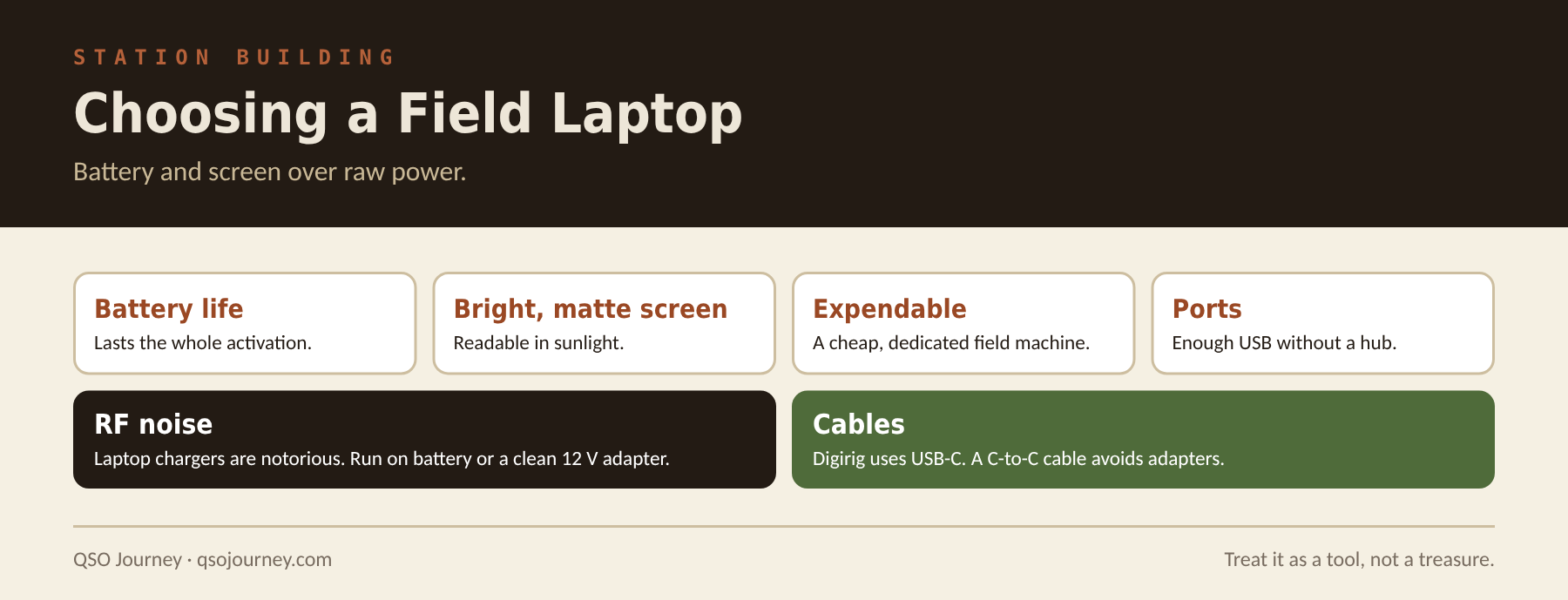
For digital modes, logging, or CAT control in the field, you rarely need serious processing power, but you do need the laptop to last through your entire activation without a charger. Prioritize genuine battery life over CPU benchmarks, since a powerful laptop that dies after two hours is far less useful in the field than a modest one that lasts all day.
Screen Visibility Outdoors
Standard laptop screens, optimized for indoor use, often become nearly unreadable in direct sunlight, which is a real problem when you are trying to read a WSJT-X waterfall or logging software outdoors. A higher brightness display, or a matte anti-glare screen finish, makes a genuine difference for outdoor visibility that specs alone do not always convey.
Ruggedness and Environmental Tolerance
You do not necessarily need a full military-spec rugged laptop, but consider dust and moisture exposure realistically for how you actually operate. A cheap secondary or older laptop dedicated specifically to field use, rather than your primary daily machine, removes the anxiety of exposing your main computer to dirt, occasional rain, or a rough bounce in a backpack.
Ports and Connectivity
- Many interfaces, GPS pucks, and radio cables still ship with USB-A plugs, so check whether you need an adapter if your laptop is USB-C only. The Digirig Mobile itself has a USB-C port, so a USB-C to USB-C cable avoids adapters entirely.
- A physical port count sufficient for your interface, GPS puck, and any other accessories, without needing a hub that adds another point of failure in the field.
Power and RF Noise
Many laptop power bricks are noisy RF sources that show up as hash on the waterfall. In the field, running the laptop on its own battery is often the quietest option. If you need to keep it charged, a quality 12 volt car-style adapter or USB-C charger fed from your station battery is usually quieter than an inverter feeding the stock charger. Clip-on ferrites on the charger and USB cables help too.
A Reasonable Approach
A dedicated, inexpensive field laptop, chosen for battery life and outdoor screen visibility over raw performance, and treated as expendable rather than precious, tends to serve most portable operators better than pressing a high-end daily-use machine into rough field service. For what to actually run on it, see Ham Radio Apps and Software Worth Having, Phone and PC.