
Part of our Emergency Communications and Preparedness guide.
Every ham who gets serious about emergency comms eventually has the same uncomfortable thought: if I can hear you, can somebody figure out where you are? The answer is yes, and our hobby has a name for doing it on purpose. It’s called fox hunting.
I’ll be upfront: I haven’t run a fox hunt myself yet. I’ve watched hunts, picked the brains of hams who have been doing this for years, and read everything I can get my hands on. It has become one of the most fascinating corners of the hobby to me, and this post is me sharing what I’ve learned so far as a newcomer. If you’re a seasoned hunter and I’ve gotten something wrong, tell me in the comments. That’s half the reason I’m writing this.
I’m going to cover what fox hunting is, what it isn’t, how hunters actually find a transmitter, and then flip it around and look at what makes a station harder to find. I’ll spend real time on HF NVIS, because that’s where my own operating experience meets what I’ve been learning about direction finding, and it’s the part that surprised me most.
What Fox Hunting Is
Fox hunting is radio direction finding (RDF) turned into a game. Someone hides a transmitter, called the fox, and everyone else, the hounds, uses receivers and directional antennas to track it down. You’ll also hear it called a T-hunt (transmitter hunt) or bunny hunt depending on where you live.
There are a few common flavors:
- Mobile hunts. The most common club format. Teams drive around taking bearings from the road, then finish on foot. The fox might be in a park, a parking garage, or a box under a bush.
- On-foot hunts. Smaller area, usually a park or open space, and often recommended as a good first hunt for new hams and kids.
- ARDF (Amateur Radio Direction Finding). The formal international sport. Competitors run a timed course through woods or open country with a map, a compass, and a handheld receiver, finding several foxes that take turns transmitting. ARDF runs on 2 meters and on 80 meters, and the 80 meter side is a good preview of the HF discussion later in this post.
Every experienced hunter I’ve talked to says the same thing: whatever the format, fox hunting is one of the best skill builders in the hobby. It teaches you how signals really behave, how they bounce off buildings, bend around hills, and flat out lie to you when you get close.
What Fox Hunting Isn’t
- It isn’t jamming. Hunters listen. Nobody is transmitting on top of anyone.
- It isn’t magic. One bearing gives you a direction, not a location. Finding a fox takes multiple bearings from multiple places and a lot of driving or walking.
- It isn’t instant. A fox that transmits once for five seconds and goes quiet is extremely hard to find. Hunters need the fox to keep talking.
- It isn’t just a game. The same techniques are how hams and the FCC track down stuck microphones, malicious interference, and unlicensed operators. They’re also how militaries locate enemy radios. The hobby version is just the friendly one.
- It isn’t only a VHF thing. Most club hunts are on 2 meters, but HF signals can be located too. It takes very different tools, and the results are much less precise.
The Gear Hunters Use
From what the veteran hunters I’ve talked with tell me, you don’t need much to start, but serious hunters build up a kit over time. Here’s how the tools stack up based on what I’ve seen and read:
| Tool | What it does | Best for |
|---|---|---|
| Handheld radio with S-meter | Shows relative signal strength | Everything, it’s the foundation |
| 3-element Yagi (often a tape measure Yagi) | Directional antenna that peaks when pointed at the fox | VHF/UHF bearings on foot |
| Offset or step attenuator | Knocks down a strong signal so the antenna can still show direction | The close-in phase |
| Sniffer receiver | Wideband, low-sensitivity receiver for the last few yards | Finding the actual box |
| Doppler DF unit | Roof-mounted antenna array that shows a continuous bearing while driving | Mobile hunts |
| KrakenSDR or similar | Multi-channel coherent SDR that calculates bearings and plots them on a map | Mobile and fixed DF, automated |
| Loop or ferrite rod antenna | Small directional antenna that works at HF | 80 meter ARDF, close-range HF |
| KiwiSDR TDoA network | Compares arrival time of a signal at several internet-connected receivers | Rough geolocation of HF signals |
If you’re new like me, the advice I keep hearing is to start with a handheld and a tape measure Yagi, and let the experienced folks at your club show you the rest.
How a Fox Hunt Actually Works
Here’s the process as it was explained to me, and as I’ve watched it play out.
Step 1: Take a Bearing
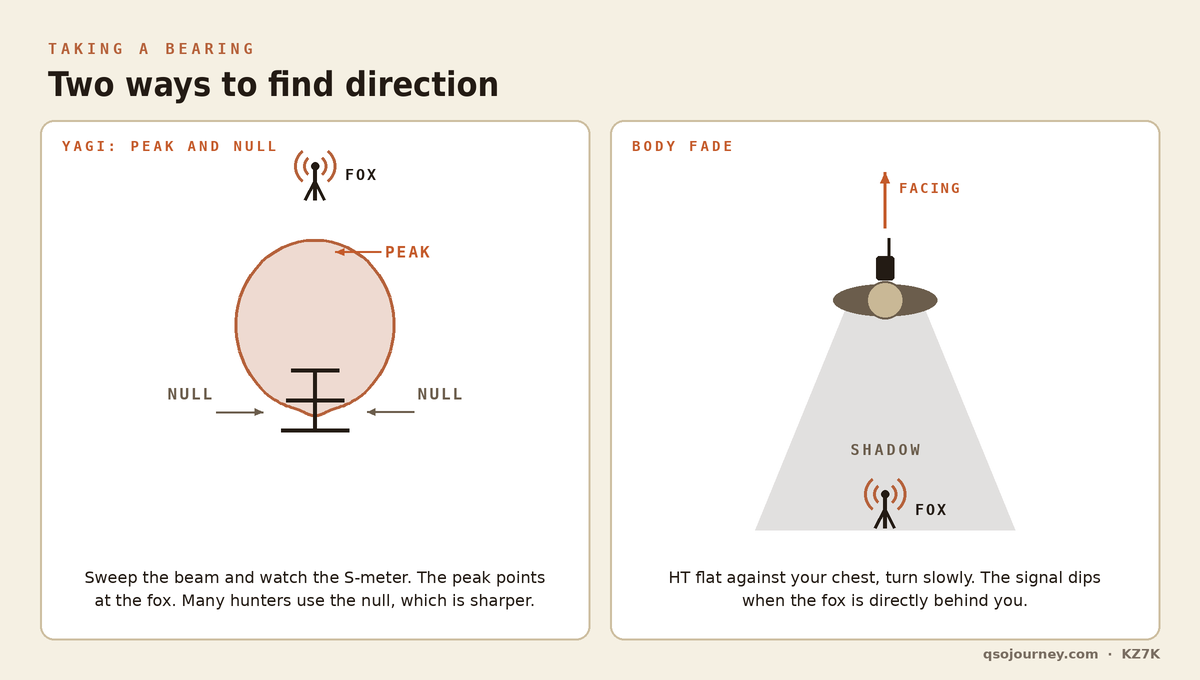
With a Yagi, you sweep the antenna slowly through a full circle and watch the S-meter. The strongest reading is your bearing. Several of the experienced hunters I’ve talked to actually prefer to find the null, the direction where the signal drops out, because a null is sharper than a peak. Either way, you read the direction off a compass and write it down.
No Yagi? The body fade trick is the one veteran hunters seem to love showing newcomers. Hold the handheld flat against your chest and turn slowly. Your body blocks the signal, so when the fox is directly behind you the signal dips. Turn around and you’re facing it.
Step 2: Triangulate
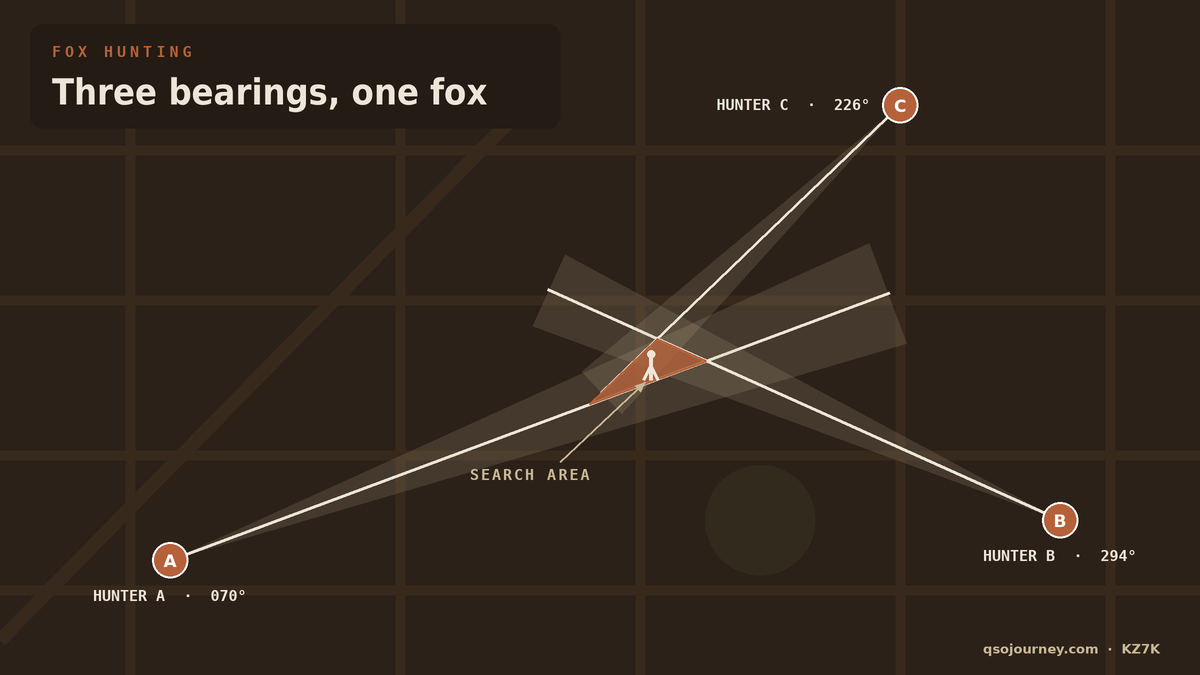
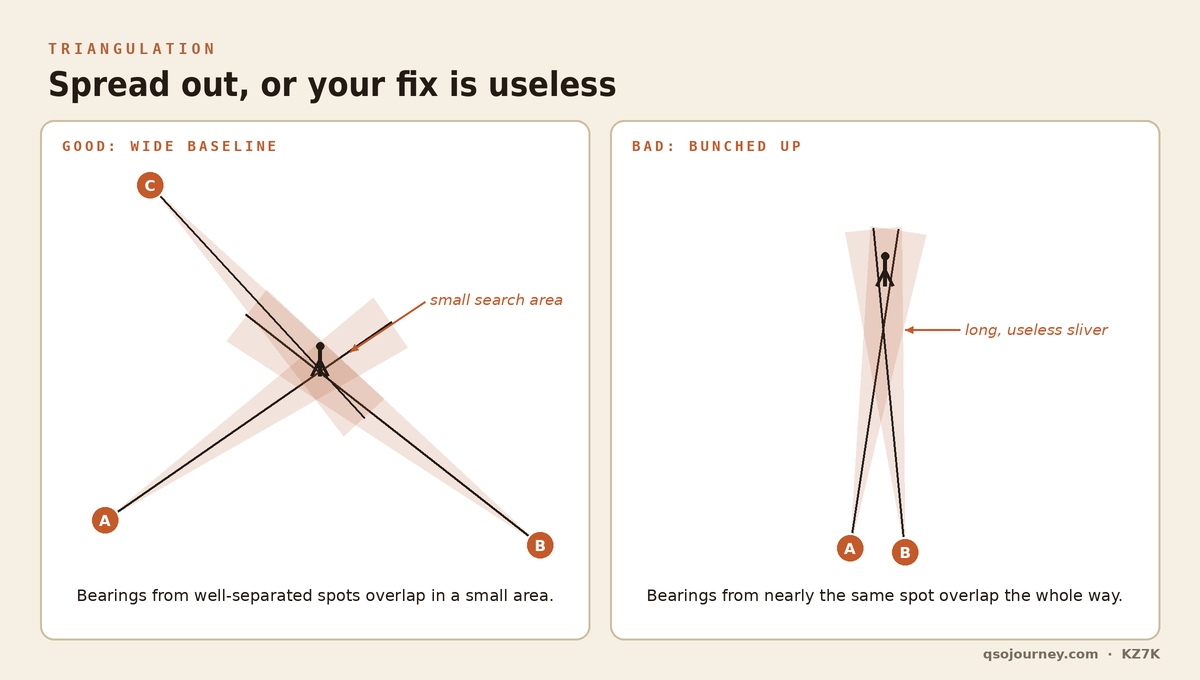
Draw your bearing on a map. Then move a good distance, ideally off to the side rather than straight toward the fox, and take another. Where the two lines cross is your first search area. A third bearing from another angle usually forms a small triangle, and the fox is somewhere inside it. The wider apart your bearing spots are, the smaller that triangle gets.
Step 3: Watch for Bad Bearings
VHF and UHF signals reflect off buildings, metal fences, cliffs, and hills. A strong reflection can give you a confident bearing that points the wrong way. The hunters I’ve talked with take bearings from open ground when they can, get up high, and throw out any bearing that doesn’t agree with the others. More than one of them told me reflections are the number one reason city hunts drag on.
Step 4: Close In
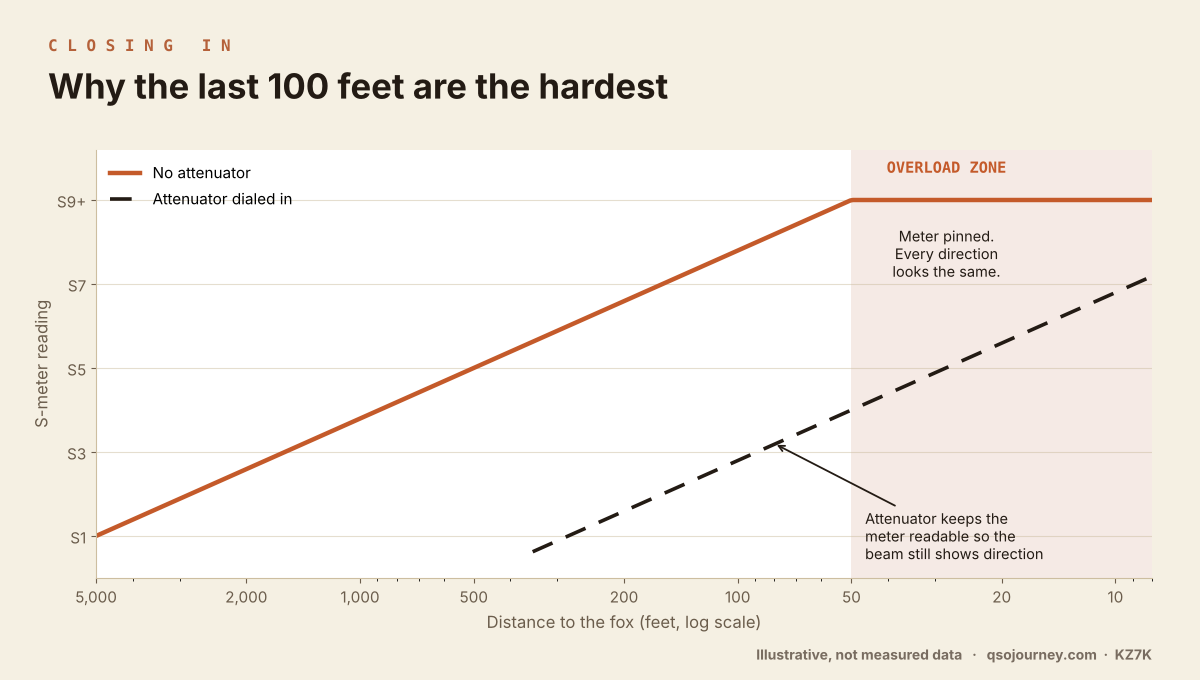
Ask any experienced hunter and they’ll tell you this is where hunts get won or lost. As you get close, the signal gets so strong that it overloads the receiver. The S-meter pins in every direction and the Yagi stops telling you anything. This is what the attenuator is for. An offset attenuator lets you dial the signal way down so the antenna can show direction again. In the final stretch, hunters switch to a sniffer and start looking at the actual bushes, rocks, and trash cans.
Step 5: Bring Better Tools
Mobile hunters with Doppler units or a KrakenSDR can take bearings continuously while driving and plot them automatically, which can cut a hunt down dramatically. For HF, the public KiwiSDR network has a TDoA (time difference of arrival) tool that compares when the same signal reaches several receivers spread across a region and produces a map of where the transmitter probably is.
The big takeaway for me: on VHF and UHF, a determined team with decent gear will find a transmitter that keeps talking, and watching them work, it happens faster than I expected.
Who Might Be Listening
Not every listener is equally capable. As I’ve been learning, I’ve started thinking about how findable a station is in tiers:
| Listener | Typical tools | What they can realistically do |
|---|---|---|
| Casual scanner listener | Scanner or HT, omni antenna | Hear you, guess your general area from signal strength, nothing more |
| Experienced fox hunter or club team | Yagi, attenuator, Doppler or KrakenSDR, vehicles | Find a VHF/UHF station that keeps transmitting, down to the building |
| Online HF network user | KiwiSDR TDoA | Rough regional fix on an HF signal, often miles to tens of miles wide |
| Government or military | Fixed DF arrays, aircraft, coordinated receivers | Locate almost anything that transmits long enough |
Most of what follows is about the middle two tiers. Nothing a ham does reliably defeats the last one, and I’d rather be honest about that than sell anybody a false sense of security.
How HF NVIS Changes the Game
This is the part that really hooked me, because NVIS is something I actually use. NVIS stands for Near Vertical Incidence Skywave. You put up a low horizontal antenna (roughly 0.1 to 0.25 wavelength above ground, so around 10 to 20 feet for 40 meters) and run a frequency below the ionosphere’s critical frequency, usually 40 meters during the day and 80 or 60 meters at night. The signal goes almost straight up, the ionosphere reflects it back down, and it fills in a circle roughly 0 to 300 miles across with no skip zone. It’s the backbone of regional emergency nets.
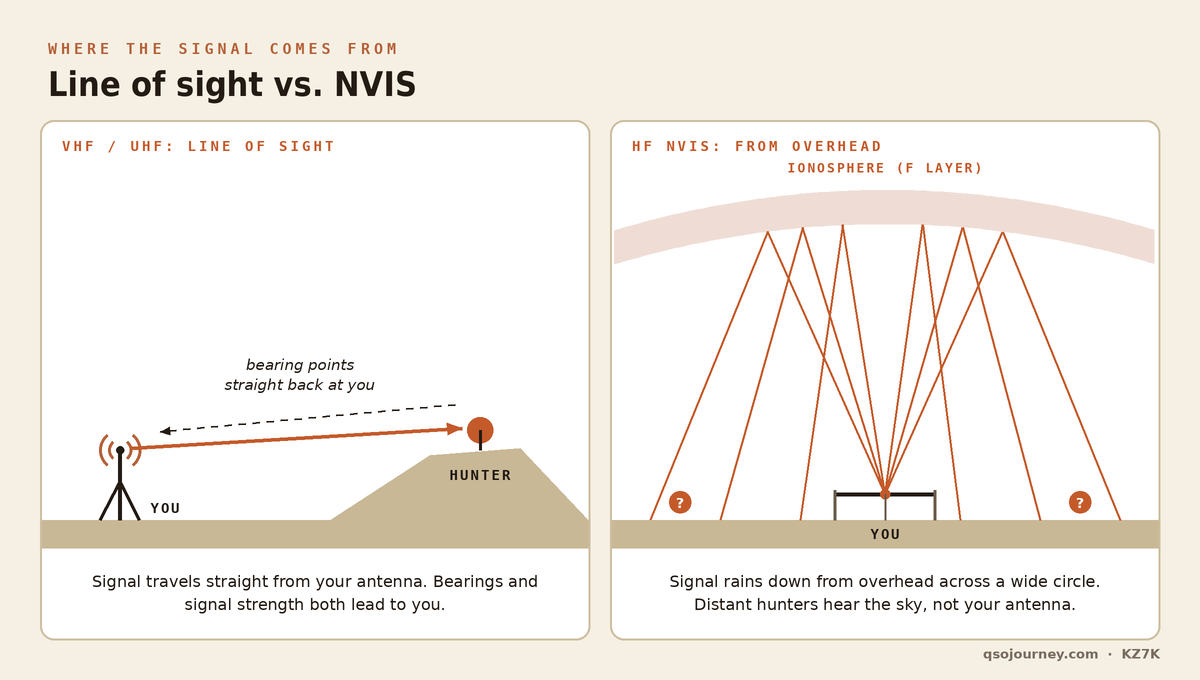
Once I started asking fox hunters about NVIS, the answers made it clear that its geometry is a real headache for direction finding. Here’s why, as best I understand it.
The Signal Comes From Overhead, Not From You
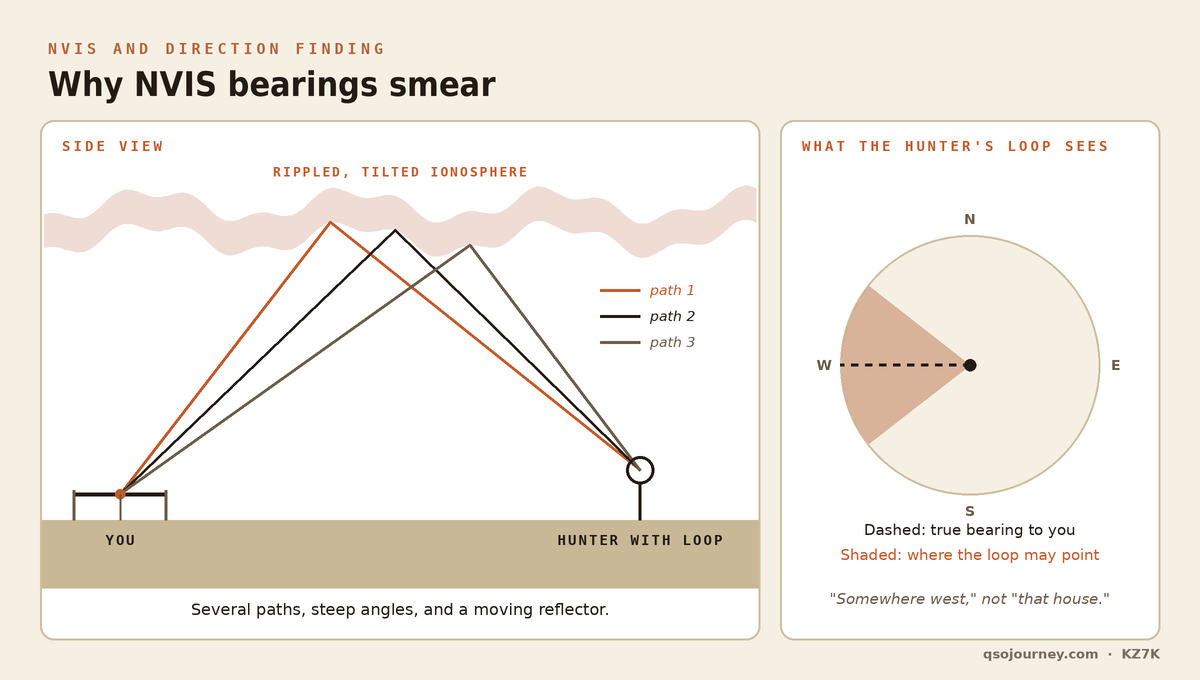
A station 80 miles away isn’t hearing your antenna directly. It’s hearing a patch of ionosphere somewhere above the path between you. At those steep arrival angles, small tilts and ripples in the ionosphere can swing the apparent bearing a long way. The signal also frequently arrives over more than one path at once, which blurs the bearing even more.
Skywave Confuses Ground-Based DF Antennas
Loop and Adcock style direction finders have a long-documented problem with skywave. Historically it was called “night effect” because DF bearings on lower frequencies got wildly unreliable after dark when skywave took over. The cause is the signal arriving at a high angle with mixed polarization. High-angle NVIS is close to a worst case for that kind of equipment.
The Wavelengths Are Huge
A 2 meter Yagi fits in your hand. A 40 meter signal is about 40 meters long, and an 80 meter signal is about 80 meters long. Nobody is walking around with a directional beam for that. Portable HF DF is limited to small loops and ferrite rods, which work at close range but don’t give clean bearings from across the county.
Signal Strength Stops Being a Breadcrumb
On VHF, the signal gets louder as hunters drive toward you, and that alone can lead them in. With NVIS, a station 20 miles away and one 150 miles away often hear you at similar levels, because both are hearing the same ionospheric reflection. I see this on our regional nets all the time. Driving around looking for the loudest spot doesn’t work well.
The Catch: Ground Wave
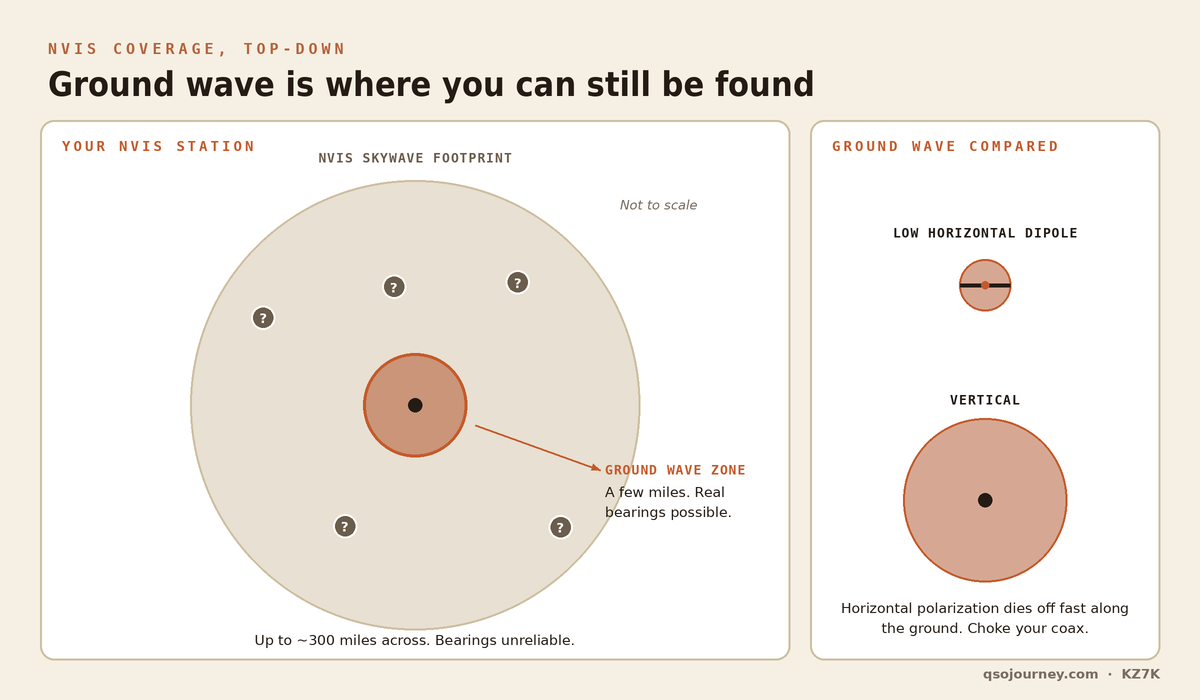
Here’s what keeps NVIS from being a cloak, and it’s something the hunters I talked to were quick to point out. Every HF antenna also radiates a ground wave that travels outward along the surface of the earth. Inside that ground wave zone, a hunter with a loop gets a real, honest bearing straight to you. That’s exactly how 80 meter ARDF works. Ground wave carries farther on 80 meters than on 40, and farther over wet or conductive ground than over dry rocky ground like a lot of the Arizona desert.
A low horizontal antenna helps here. Horizontally polarized ground wave dies off very quickly, so a properly built NVIS dipole puts much less into the ground wave than a vertical would. The thing that ruins it is common-mode current on the coax. If your feedline is radiating, it acts like a vertical antenna hanging under your dipole and pumps out exactly the ground wave you were trying to avoid. A good common-mode choke at the feedpoint matters.
VHF vs HF NVIS at a Glance
| VHF/UHF line of sight | HF NVIS | |
|---|---|---|
| Where the signal comes from | Straight from your antenna | From the ionosphere overhead (except ground wave) |
| Portable DF antenna | Small Yagi, easy | Loop or ferrite rod, limited |
| Bearing quality at a distance | Good, aside from reflections | Poor, smeared by the ionosphere |
| Does signal strength lead to you? | Yes | Mostly no |
| Where you’re most exposed | Anywhere with line of sight | Inside the ground wave zone, a few miles |
| Realistic result for a skilled hunter | The exact building | A region, unless they’re already close |
The KiwiSDR TDoA network and serious government HF DF systems can still produce a regional fix. NVIS turns “we found the house” into “somewhere in this part of the state,” which is a huge improvement. It is not invisibility.
How to Make Your Station Harder to Find
First, the ground rules. None of this is about breaking rules. Licensed amateur operation still means identifying with your call sign and not encrypting your traffic. What follows is EMCON, short for emissions control: habits that keep your electronic footprint small. I pieced this list together from conversations with experienced hunters and from what I’ve read, and these are habits I’m working on building myself. They matter if you ever find yourself in a situation where being located is a genuine risk, and frankly they also just make you a more efficient operator.
1. Transmit Less
When I asked hunters what makes a fox hardest to find, this was the first answer every time. Every bearing a hunter takes requires you to be transmitting while they’re pointed at you. Write your message before you key up. Use brevity. Agree on short check-in formats ahead of time. Then get off the air. A five second transmission gives a mobile hunter one bearing at best. A five minute ragchew gives them a dozen.
2. Use the Least Power That Works
Low power shrinks the area where you can be heard, and the area where you can be heard is the area where you can be hunted. If 5 watts reaches your partner, 50 watts just tells more people you exist.
3. Pick Modes That Keep Transmissions Short
A JS8Call message that sends and stops beats a long voice check-in. Digital modes also let you work at much lower power for the same reliability. Be careful with FT8, though. A station calling CQ every 15 seconds for half an hour is basically a fox beacon, and it even announces its grid square.
4. Use NVIS for Regional Traffic
If the person you need to reach is 50 miles away, NVIS on HF is far harder to direction find than a VHF signal shouting across the valley. Build it right: low and horizontal, choke on the feedline, lowest frequency the band conditions will support. And remember that anyone within a few miles may still be able to get a ground wave bearing. I make the bigger case for NVIS in Your Repeater Is Not a Plan: Why HF NVIS Matters Just as Much.
5. Point Your VHF/UHF Signal Where It Needs to Go
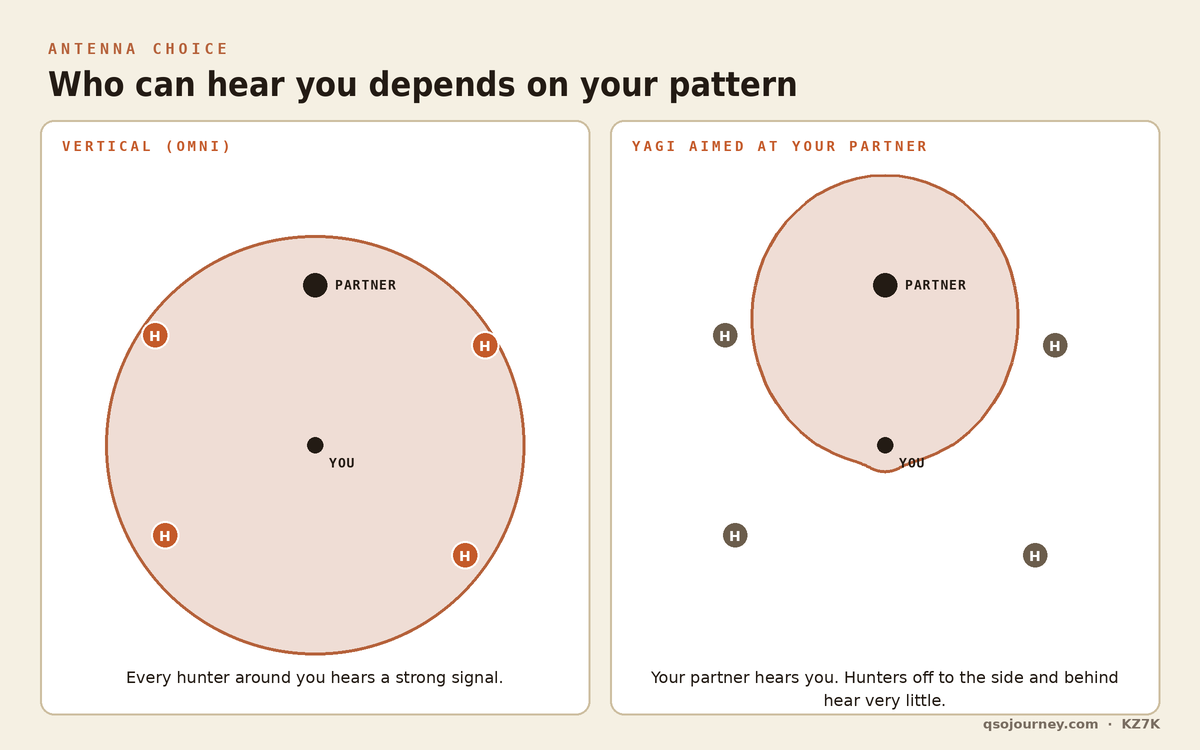
A vertical antenna radiates equally in every direction, which means everyone around you gets a strong signal to work with. A directional antenna aimed at your partner puts most of the energy one way. Hunters behind or to the side of you hear a small fraction of it, which can push them out of range entirely.
6. Use Terrain
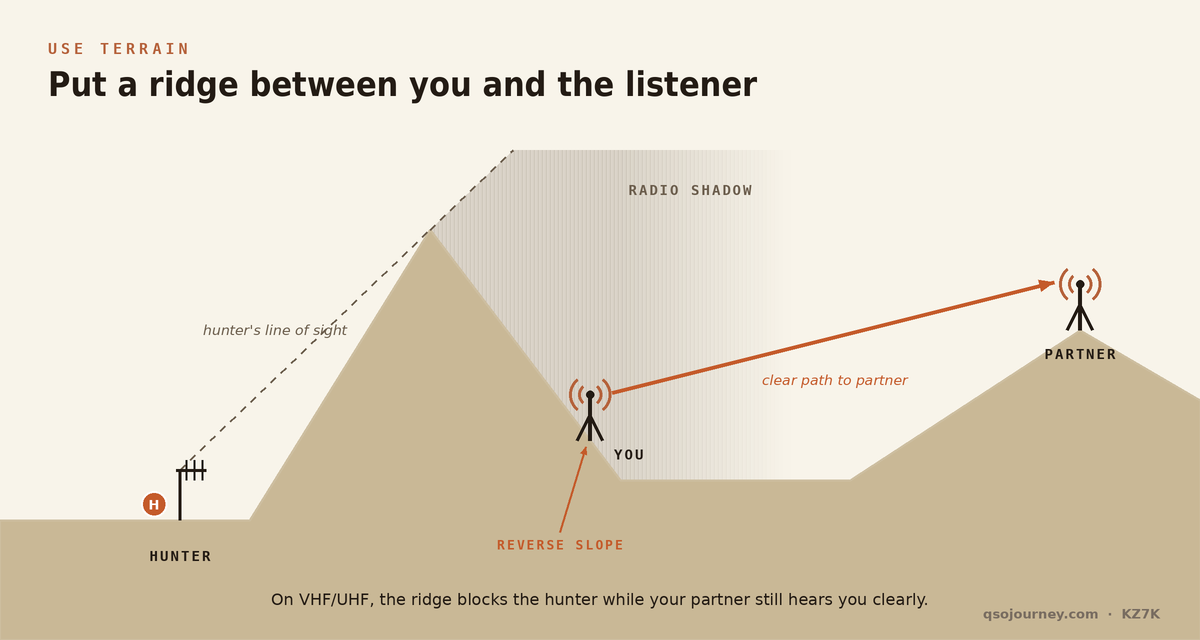
On VHF and UHF, a hill or ridge between you and the people you don’t want hearing you beats any gadget you can buy. Set up on the reverse slope, away from the direction you’re worried about, and let the terrain block your signal. Here in Arizona, with all our mountains and washes, terrain masking looks like the easiest win available.
7. Don’t Transmit From Where You Live
If someone does find your transmitter, the best outcome is that they find an empty spot. Separate where you transmit from where you stay. Transmit, then move. Avoid using the same site twice in a row.
8. Break Your Patterns
Same time, same frequency, same place every day is a gift to anyone listening. They don’t even have to hunt you live. They can set up multiple bearing stations ahead of time and wait for your next scheduled check-in. Vary your schedule within whatever your comms plan allows, and keep your PACE plan’s alternate and contingency channels in play.
9. Understand What a Relay Does and Doesn’t Do
A repeater or cross-band relay moves the loud signal away from you, and that loud signal is what most hunters will chase first. Your input signal is still on the air, though. A relay only helps if you’re also running low power and short transmissions into it, ideally with terrain between you and the people you’re worried about.
Quick EMCON Checklist
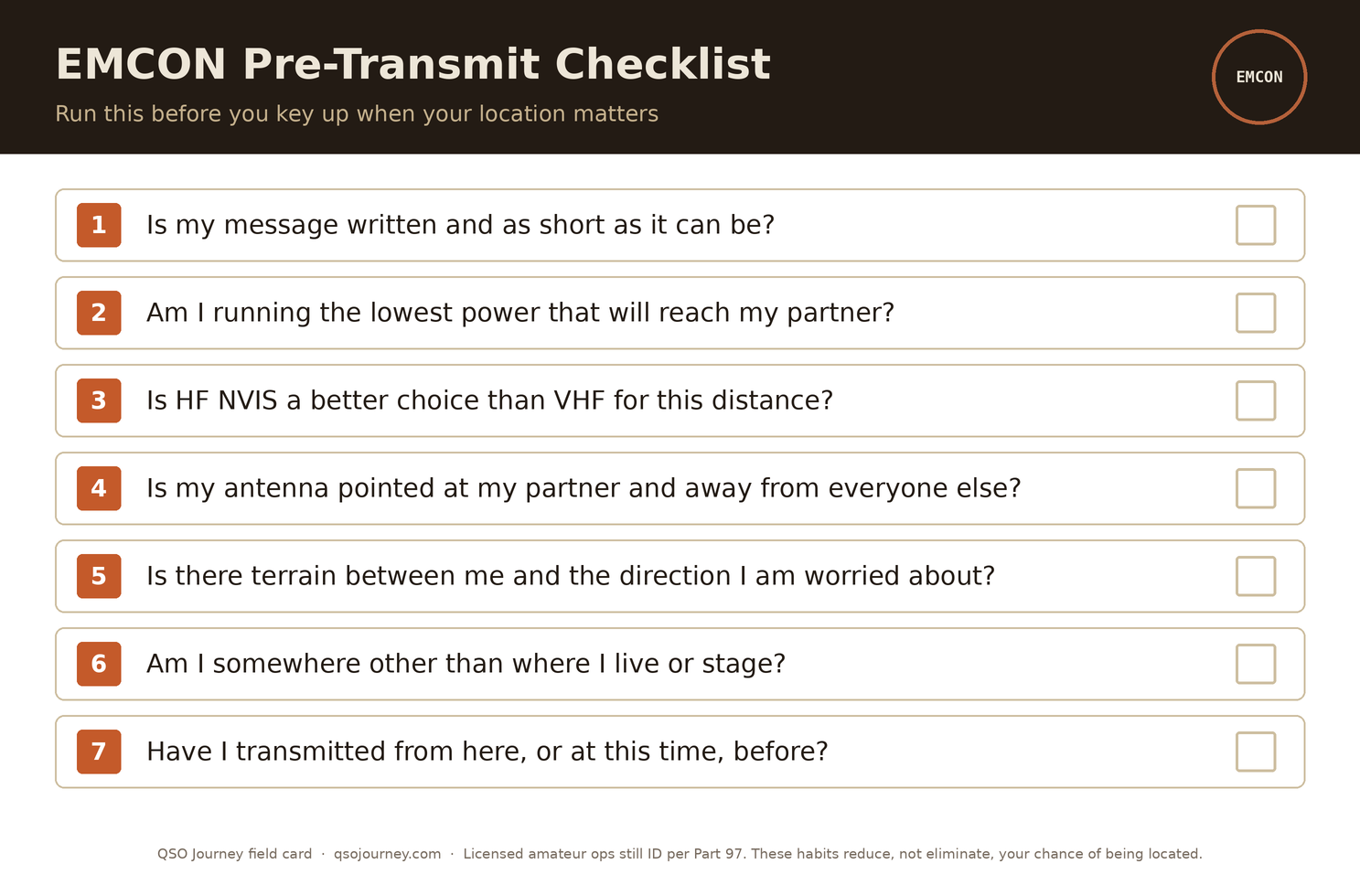
Before you key up in a situation where location matters, run through this:
- Is my message written and as short as it can be?
- Am I running the lowest power that will reach my partner?
- Is HF NVIS a better choice than VHF for this distance?
- Is my antenna pointed at my partner and away from everyone else?
- Is there terrain between me and the direction I’m worried about?
- Am I somewhere other than where I live or stage?
- Have I transmitted from here, or at this time, before?
Where I’m Going Next
Everything above is what I’ve picked up from watching and asking questions. The next step is actually doing it. I plan to join a local club hunt, learn to take a real bearing myself, and eventually volunteer to be the fox. Every experienced hunter I’ve talked to says you learn more in one afternoon watching the hounds close in on you than you will from any article, including this one.
There’s also one experiment I really want to try with my club. Run the same exercise twice: once with the fox on 2 meters, and once with the fox on 40 or 80 meter NVIS from a low horizontal dipole with a good choke. Then compare how long it takes and how close the hunters get. If the theory holds up, that contrast is the whole lesson of this post. I’ll write up how it goes, including anything I got wrong here.
If you’ve been fox hunting for years, I’d love to hear what you’d add or correct. Drop it in the comments.
Downloads From the Talk
If you scanned the QR code at the end of my talk, here is everything from it. Print the EMCON field card and keep it with your radio.