
Part of our New Ham? This Is Where You Should Spend Your Money guide.
Of all the gear on my desk, the Comet CAT-300 is the piece I reach for without thinking. It’s a manual tuner, which means no motors, no relays clicking away, no menu to navigate. Just two knobs, a band switch, and a meter that tells you exactly what’s going on. After using mine for a good while now, it’s earned a permanent spot in the shack.
The basics
- Covers 1.8-50 MHz, 160m through 6m in a single tuner
- Handles up to 300W PEP SSB, with selectable 30W/300W meter ranges
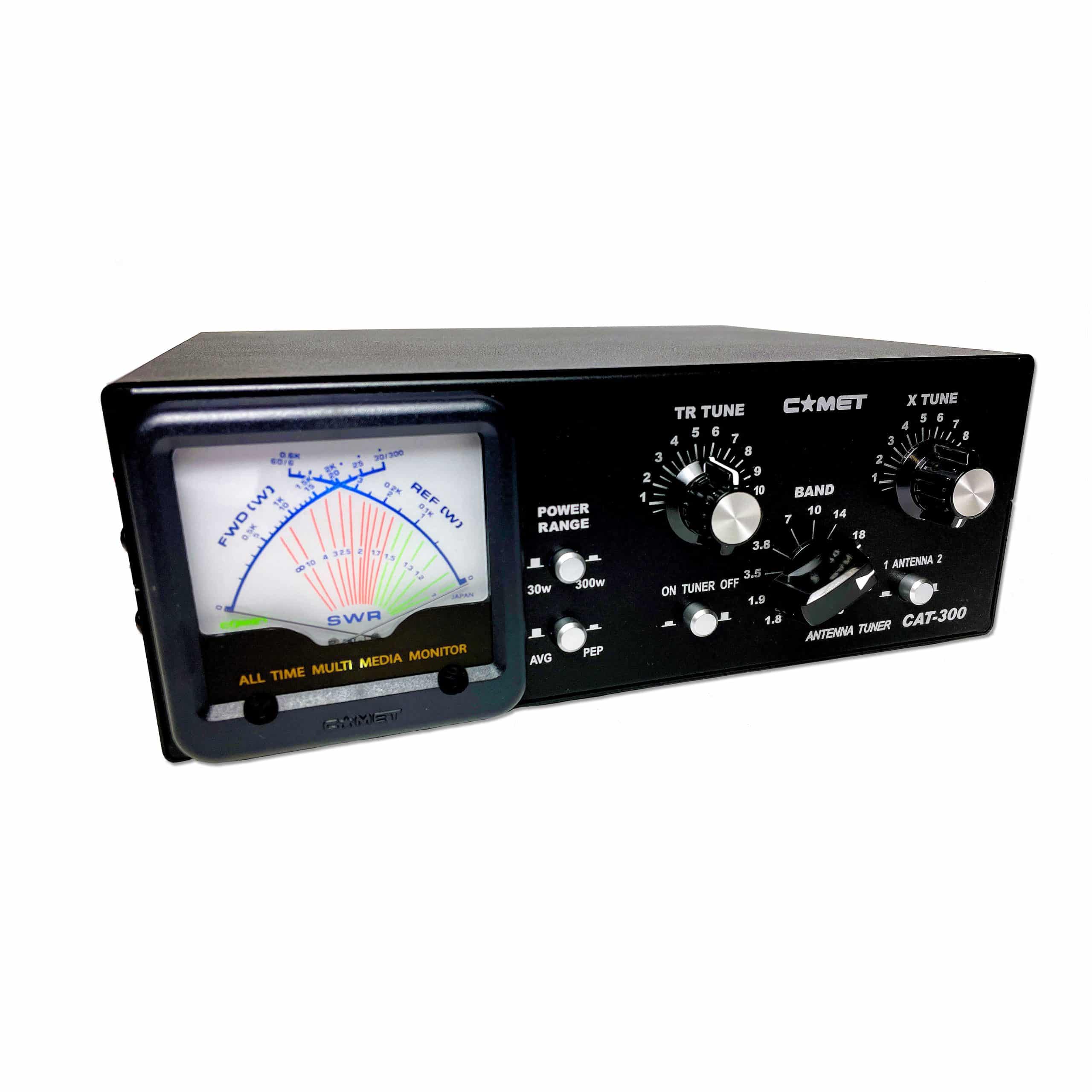
- Classic T-network design: two variable capacitors (“TR Tune” and “X Tune”) plus a rotary “Band” inductor selector
- Cross-needle meter shows forward power, reflected power, and SWR simultaneously
- Two SO-239 antenna ports (ANT 1 / ANT 2) plus a separate binding post for a long wire
- About 10 x 4 x 8 in. and 6 lbs, compact enough for base or field use
- Street price around $300
Setting it up
- Connect your transceiver’s coax to the INPUT SO-239 on the rear panel.
- Connect your antenna feedline to ANT 1 or ANT 2, handy if you swap between two antennas, since you don’t have to recable anything, just flip the selector switch. For a wire antenna, use the dedicated WIRE ANT terminal instead.
- Run a ground wire to the GND terminal. Don’t skip this one, it matters both for safety and for how well the tuner actually performs.
- If you want the meter backlight (genuinely useful for evening operating), connect a 13.8V DC supply to the power jack. The tuner itself works fine without it (the DC is only for the meter lamp), but I leave mine powered all the time since I do a lot of my operating after dark.
How to actually tune a frequency
- Set the Band switch to match the band you’re operating on.
- Drop your transceiver’s power down to around 10W. This is the manufacturer’s own recommendation, tune at low power first, then bring it up to full power once you’ve got a match. It’s easier on your finals and on the tuner’s capacitors.
- Key up on a steady carrier, CW or a continuous tone works better than SSB voice peaks for this, since you want a steady reading to tune against.
- Watch the cross-needle meter and adjust the TR Tune and X Tune capacitors, going back and forth between them. They interact with each other, so it’s rarely a one-and-done adjustment on either knob. Sweep one, then the other, narrowing in each pass.
- Keep adjusting until the SWR needle drops as low as it’ll go, ideally under 1.5:1. On most reasonable antennas, you’ll get close to 1:1.
- Once you’re happy with the match, bring your transceiver back up to your normal operating power.
Since it’s fully manual, there’s no memory. If you jump bands and come back later, you’ll re-tune from scratch. In practice this becomes muscle memory fast, and I’ve gotten to where I can find a match on a familiar band and antenna combo in well under a minute.
What I love about it
- The cross-needle meter is genuinely great. Forward power, reflected power, and SWR all visible at once, no cycling through a menu to check different readings.
- One box, six bands. 160m through 6m covered without swapping tuners or worrying about coverage gaps.
- Real power headroom. 300W PEP means it’ll comfortably handle a 100W radio with room to spare if I ever add an amp.
- Two antenna ports plus a wire terminal. I can leave a dipole on ANT 1 and a vertical on ANT 2 and flip between them without touching a cable.
- It’s simple. No firmware, no relays to wear out, nothing to update. It’ll work exactly the same way in twenty years.
The honest downsides
- It’s manual, on purpose. If you’re used to an auto-tuner finding a match in a second or two, retuning by hand every time you change bands takes some getting used to.
- The meter backlight isn’t very bright and there’s no way to adjust its intensity, fine in a dim room, less fine if there’s any ambient light nearby.
- You need external 13.8V DC just for the light. The tuner itself is fully passive, but if you want to see the meter in the dark, that’s one more cable to run to the desk.
- No presets or memory. Every band change means re-tuning, even if you were on that exact frequency an hour ago.
Bottom line
If you want speed, an auto-tuner will always win. But there’s something satisfying about manually walking a match in and watching that needle settle, and the CAT-300 makes it easy with a meter that actually tells you what’s happening instead of just a pass/fail light. For the price, the band coverage, and the fact that it’s basically bulletproof, it’s stayed my favorite piece of gear on the desk.