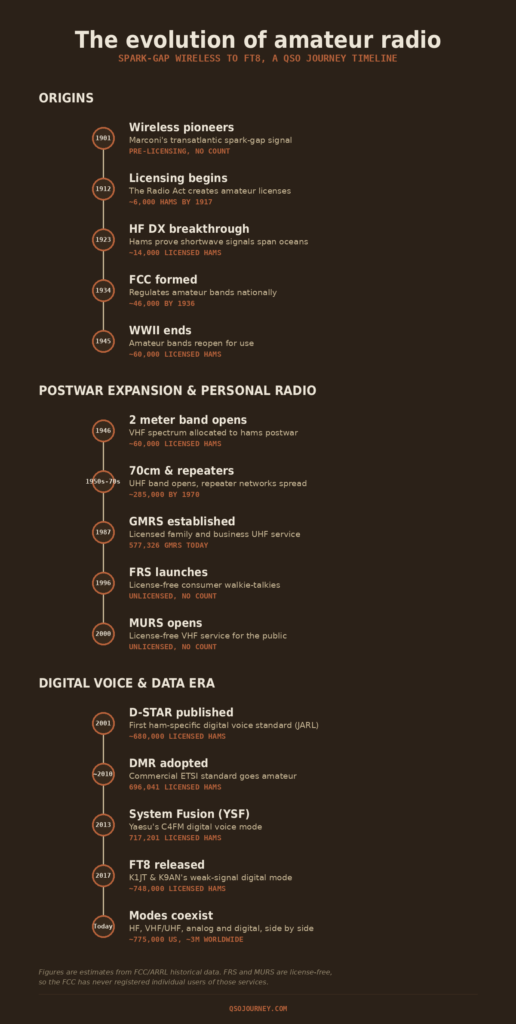
Ham radio didn’t arrive all at once. It grew in fits and starts over more than a century, from illegal spark-gap experiments to a regulated hobby, then split off entire sibling services like GMRS and FRS, and eventually went digital. I put together a timeline of the milestones that shaped the hobby we operate today, and I broke each one out into its own post so I could actually do the history justice instead of cramming it into a single wall of text.
Here’s the full picture first, then the deep dives below.
Origins (1901 to 1945)
This era covers the unregulated wireless experimenters, the first licenses under the Radio Act of 1912, the 1923 shortwave breakthrough that proved amateurs could talk across oceans, the formation of the FCC in 1934, and the reopening of the bands after World War II.
- 1901: Wireless pioneers
- 1912: Licensing begins
- 1923: HF DX breakthrough
- 1934: FCC formed
- 1945: WWII ends
Postwar expansion and personal radio (1946 to 2000)
Hams got new VHF and UHF spectrum after the war, and the FCC carved out separate license-free and lightly-licensed services for the general public nearby: GMRS, FRS, and MURS.
- 1946: 2 meter band opens
- 1950s to 70s: 70cm and repeaters
- 1987: GMRS established
- 1996: FRS launches
- 2000: MURS opens
Digital voice and data era (2001 to today)
This is where most of my own gear lives. D-STAR, DMR, and System Fusion brought digital voice to ham radio, and FT8 changed weak-signal HF work forever.
- 2001: D-STAR published
- Around 2010: DMR adopted
- 2013: System Fusion (YSF)
- 2017: FT8 released
- Today: modes coexist
Every link above goes to a full post on that milestone, with the major events from that period, not just the headline date.