
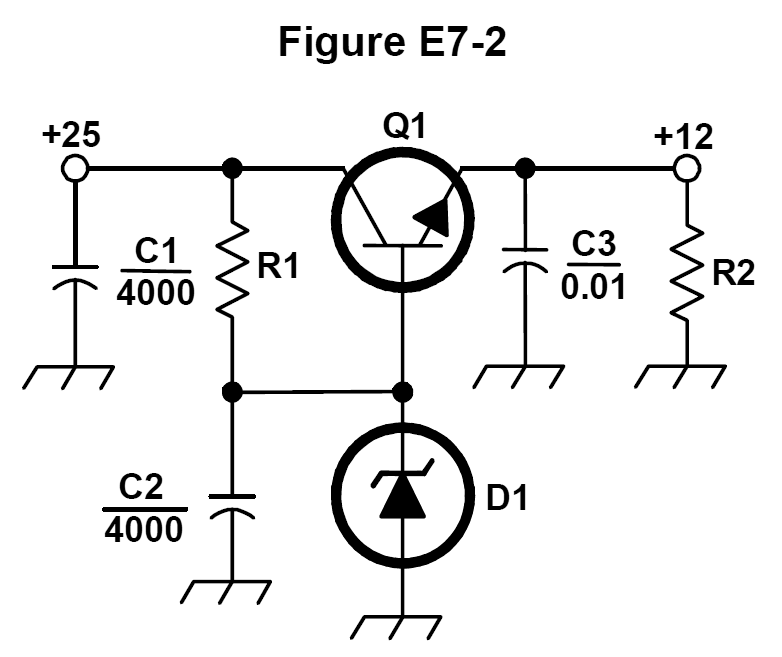
What is the purpose of Q1 in the circuit shown in Figure E7-2?
- AIt provides negative feedback to improve regulation
- BIt provides a constant load for the voltage source
- CIt controls the current to keep the output voltage constant correct answer
- DIt provides regulation by switching or "chopping" the input DC voltage
Answer: C. It controls the current to keep the output voltage constant
In figure E7-2, Q1 is the pass transistor: it controls current to keep the output voltage constant.
Learn more: Why filter width matters · Solid-state vs tube amplifiers
More from group E7D: Power supplies and voltage regulators; solar array charge controllers
- E7D01 How does a linear electronic voltage regulator work?
- E7D02 How does a switchmode voltage regulator work?
- E7D03 What device is used as a stable voltage reference?
- E7D04 Which of the following describes a three-terminal voltage regulator?
- E7D05 Which of the following types of linear voltage regulator operates by loading the unregulated voltage source?
- E7D07 What is the purpose of C2 in the circuit shown in Figure E7-2?
- E7D08 What type of circuit is shown in Figure E7-2?
- E7D09 How is battery operating time calculated?
- E7D10 Why is a switching type power supply less expensive and lighter than an equivalent linear power supply?
- E7D11 What is the purpose of an inverter connected to a solar panel output?
- E7D12 What is the dropout voltage of a linear voltage regulator?
- E7D13 Which of the following calculates power dissipated by a series linear voltage regulator?
- E7D14 What is the purpose of connecting equal-value resistors across power supply filter capacitors connected in se…
- E7D15 What is the purpose of a step-start circuit in a high-voltage power supply?
From the NCVEC public-domain Amateur Extra question pool, 2024-2028 (4th errata, Feb 4, 2026). Explanations by QSO Journey. Practise every question in the free Exam Trainer.
How to Study With the Exam Trainer
The Exam Trainer uses the current NCVEC question pools for all three US license classes: Technician, General and Amateur Extra. I’m a Volunteer Examiner, and the people who pass easily are the ones who drilled the pool, not the ones who crammed a textbook the night before.
- Practice exams are built like the real test: one question from every group in the pool, shuffled.
- Topic quizzes give instant feedback on one section at a time.
- Weak-spot drills keep putting the questions you miss in front of you.
- Study Answers shows only the correct answer, which is a fast way to learn the pool before you start testing yourself.
How many questions do I need to pass?
Technician and General are 35 questions each, and you need 26 right. Amateur Extra is 50 questions, and you need 37 right.
Do I need an account?
Sign in with a site account to keep your scores, pool progress and training history. If you’re already licensed, add your call sign and the classes you’ve passed are marked done, so the trainer opens on your next exam.
When am I ready to test?
When you’re scoring well above passing on several full practice exams in a row, book a session. Getting Licensed covers finding an exam session and what to expect, and the Band Plan shows what each license lets you do.